
Binarysoft is Authorised Tally Sales & Implementation Partner in India
+91 742 877 9101 or E-mail: tally@binarysoft.com 10:00 am – 6: 00 pm , Mon-Fri

Binarysoft is Authorised Tally Sales & Implementation Partner in India
+91 742 877 9101 or E-mail: tally@binarysoft.com 10:00 am – 6: 00 pm , Mon-Fri
Call CA Tally HelpDesk +91 9205471661, 7428779101
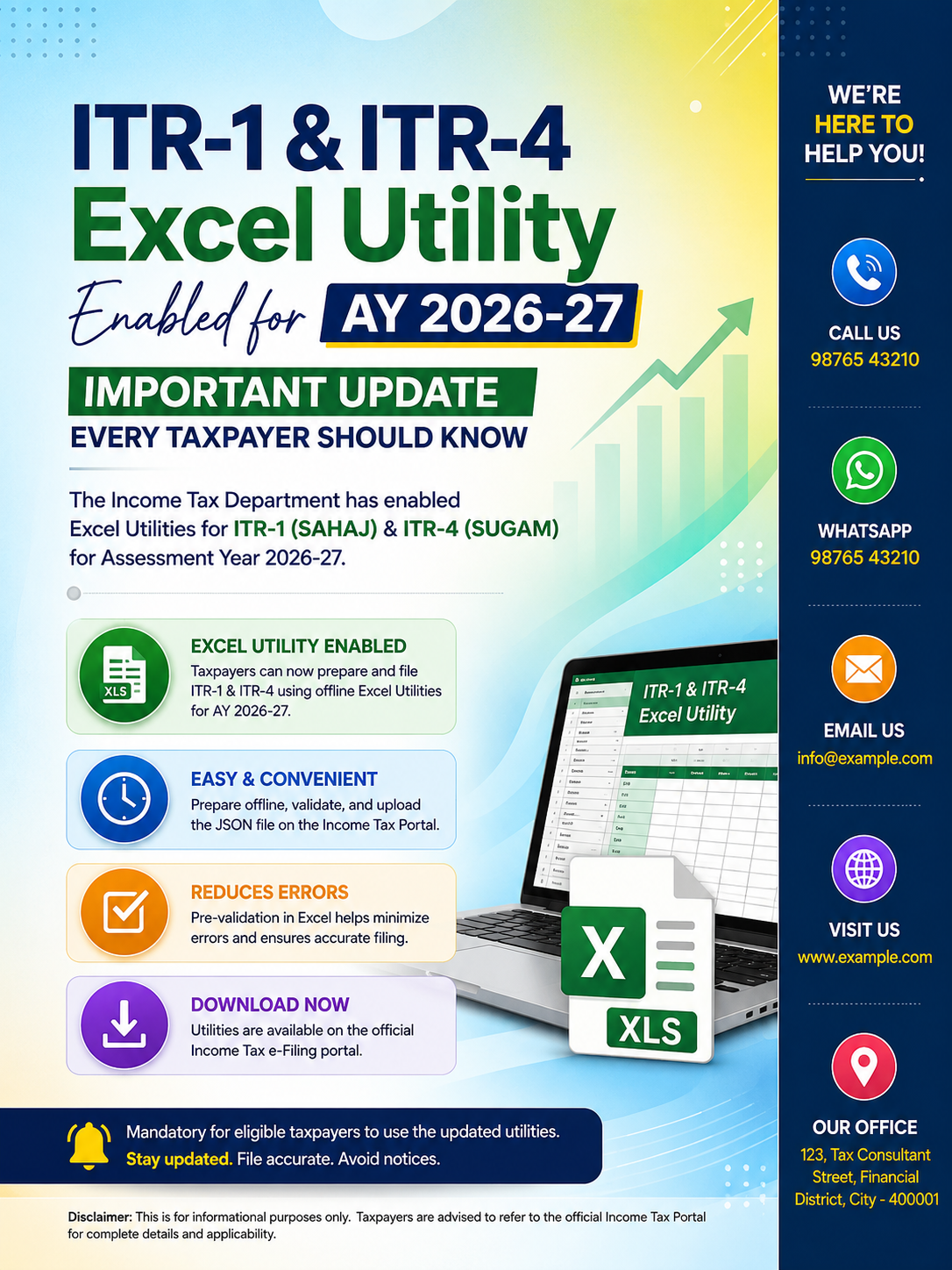
The Income Tax Return filing season for Assessment Year 2026-27 has officially started with the activation of the Excel utilities for ITR-1 and ITR-4 forms. In recent months, taxpayers across India have been waiting for smoother and faster return filing after multiple compliance updates, AIS mismatches, stricter verification systems, and growing digital checks by the Income Tax Department. Salaried employees, freelancers, pensioners, and small business owners are now under greater pressure to file accurate returns without errors because even a small mismatch can lead to notices, delayed refunds, or verification issues.
The newly enabled Excel utilities for ITR-1 and ITR-4 are expected to simplify the filing process for millions of taxpayers. These utilities allow users to prepare their returns offline, validate information, calculate taxes automatically, and upload the JSON file directly on the income tax portal. For taxpayers who want faster refunds, fewer mistakes, and better compliance in 2026, understanding how these utilities work has become extremely important.
A small business owner in Delhi recently shared how he received a notice last year because his bank interest income was not properly matched with AIS records. He believed his return was correct, but the mismatch delayed his refund for months. This year, after carefully checking the Excel utility and matching details with Form 26AS and AIS before filing, he successfully submitted his return without any errors. Stories like these show why taxpayers must become more careful and informed while filing returns in 2026.
The Income Tax Department provides offline Excel utilities that help taxpayers prepare and validate their Income Tax Returns before uploading them to the e-filing portal. These utilities are especially useful for taxpayers who prefer working offline or want better control over their tax calculations.
The utility automatically checks:
Once the form is completed and validated, the taxpayer can generate a JSON file and upload it on the Income Tax e-filing portal.
ITR-1, also known as Sahaj, is mainly meant for salaried individuals and pensioners having simple income sources.
ITR-4 is mainly designed for small businesses, professionals, freelancers, and taxpayers opting for presumptive taxation schemes under Sections 44AD, 44ADA, and 44AE.
One of the biggest advantages is that taxpayers can prepare their returns without depending on continuous internet connectivity. This is especially beneficial for professionals handling multiple client returns.
The utility automatically identifies:
This reduces chances of defective returns.
Correctly filed returns with accurate validation are usually processed faster by the department. Taxpayers expecting refunds can benefit significantly.
In 2026, the Income Tax Department is using advanced data analytics and reconciliation systems. Taxpayers must carefully match:
The Excel utility helps taxpayers verify these entries before submission.
Most notices are issued due to:
Using the utility properly can reduce such risks significantly.
The department has strengthened AI-based scrutiny systems. Information from:
is now cross-verified more aggressively.
Many taxpayers ignore AIS entries and later receive notices. In 2026, AIS reconciliation has become critical before final submission.
The utility now supports larger pre-filled datasets including:
Taxpayers should still verify every entry carefully.
Refund failures often happen due to:
The new filing environment strongly encourages bank validation before filing.
Visit the Income Tax e-filing portal and download:
based on your eligibility.
After opening the Excel file:
Without enabling macros, validations may not work properly.
Download the pre-filled JSON file from the portal and import it into the utility.
This automatically fills:
Cross-check:
Do not blindly trust pre-filled data.
Check deductions under:
Incorrect deduction claims may trigger verification.
Click on “Validate” in each sheet.
Resolve all highlighted errors before proceeding.
Once validation is complete:
Login to the Income Tax portal:
Many taxpayers only disclose salary income and forget:
Banks already report these transactions.
Choosing the wrong ITR form can lead to defective return notices.
Example:
Always compare:
before filing.
Fake or unsupported deductions can attract scrutiny.
An unverified return is treated as invalid.
Always complete:
Small businesses and freelancers are now under stronger digital monitoring because:
Taxpayers using presumptive taxation should maintain:
Even under presumptive schemes, incorrect reporting can trigger notices.
Many salaried taxpayers believe only businesses are monitored. However, the department now tracks:
If these transactions appear in AIS but not in the return, notices may be issued.
Early filers generally receive refunds sooner.
If errors are found, revised returns can be filed comfortably.
Near the deadline:
Early filing avoids these problems.
An acknowledged ITR helps in:
The following taxpayers should begin preparation early:
Keep these documents ready:
India’s tax system is rapidly becoming data-driven. Artificial Intelligence and analytics now help authorities identify:
This means taxpayers can no longer rely on incomplete disclosures.
The focus in 2026 is shifting toward:
Taxpayers who maintain accurate records and file correctly will benefit from quicker processing and reduced compliance stress.
The activation of ITR-1 and ITR-4 Excel utilities for AY 2026-27 marks the beginning of another important tax filing season in India. While the utilities make return preparation easier, taxpayers must understand that compliance standards have become stricter than ever before. Every income source, deduction, and financial transaction is now digitally traceable and cross-verified.
Salaried employees, pensioners, freelancers, consultants, and small businesses should use this opportunity to prepare their returns carefully, verify AIS and Form 26AS details, and avoid last-minute filing pressure. Filing accurately and early not only helps in faster refunds but also protects taxpayers from unnecessary notices and compliance complications.
In 2026, smart tax filing is no longer just about submitting a form — it is about maintaining financial accuracy, transparency, and long-term credibility.
 Continue Here >>
Continue Here >>
Continue Here >>
Continue Here >>
Continue Here >>