Call CA Tally HelpDesk
+91 9205471661,
7428779101
Introduction
Many businesses today do not operate on simple one-time billing. Finance companies, NBFCs, service providers, traders, and even wholesalers often deal with:
- Credit sales
- Installment payments
- Monthly EMIs
- Interest on outstanding balances
- Penalty or late payment charges
This leads to a common and very important question:
“Can billing software handle interest and EMI calculations?”
The short answer is YES—modern billing software is fully capable of managing interest, EMI schedules, and installment-based billing, provided it is configured correctly.
This article explains how billing software handles interest and EMI calculations, its benefits, use cases, limitations, and best practices.
What Are Interest and EMI Calculations in Billing?
Interest Calculation
Interest is charged on:
- Loans
- Credit balances
- Delayed payments
- Advances
It may be:
- Monthly
- Quarterly
- Yearly
- Flat or reducing balance
EMI (Equated Monthly Installment)
EMI is a fixed installment amount paid periodically, usually including:
- Principal portion
- Interest portion
Billing software must track:
- Total loan value
- Interest rate
- EMI tenure
- Outstanding balance
Can Billing Software Handle Interest and EMI Calculations?
✅ Yes, modern billing software can handle interest and EMI calculations efficiently.
Advanced billing software supports:
- Automatic interest calculation
- EMI scheduling
- Installment-wise billing
- Outstanding balance tracking
- Overdue interest and penalties
Solutions built on platforms from Tally Solutions are widely used for this purpose.
How Billing Software Handles Interest Calculations
Billing software manages interest using predefined rules:
1. Interest Rate Setup
- Fixed interest rate
- Period-based rate (monthly / yearly)
- Customer-wise interest rate
2. Interest Calculation Basis
- Outstanding balance
- Due amount
- Loan principal
3. Automatic Posting
- Interest automatically added to customer ledger
- Journal or debit note entries generated
- Accurate reflection in accounts
4. Overdue & Penal Interest
- Late payment charges
- Overdue interest calculation
- Automatic alerts and reporting
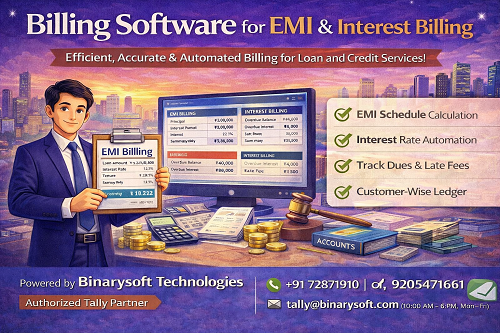
How Billing Software Manages EMI Calculations
1. EMI Schedule Creation
Billing software allows:
- Loan amount entry
- Interest rate definition
- Tenure selection
- EMI auto-calculation
2. Installment-Wise Billing
- Monthly or periodic EMI invoices
- Clear breakup of principal and interest
- Invoice number and due date tracking
3. Outstanding Balance Tracking
- Real-time outstanding EMI balance
- Paid vs unpaid installments
- Advance or partial payment adjustment
4. EMI Reports
- EMI due reports
- Customer-wise loan summary
- Interest earned reports
Businesses That Benefit Most from Interest & EMI Billing
Billing software with EMI and interest features is ideal for:
- Finance companies
- NBFCs
- Loan providers
- Credit-based traders
- Service providers offering installment plans
- Educational institutes
- Equipment and asset leasing businesses
Key Features Required for Interest & EMI Billing
When choosing billing software, ensure it includes:
- Interest calculation rules
- EMI scheduling
- Recurring invoice generation
- Customer-wise ledger management
- Outstanding and aging reports
- GST and tax support (if applicable)
- Audit trail and data security
GST & Compliance Considerations
Billing software can also:
- Apply GST on interest or service charges (where applicable)
- Separate taxable and non-taxable components
- Generate GST-ready reports
✔️ This helps avoid compliance errors and audit issues.
Common Problems Without EMI-Enabled Billing Software
Businesses that rely on manual or basic systems often face:
- Incorrect interest calculations
- EMI mismatch disputes
- Missed installment tracking
- Manual reconciliation errors
- Client dissatisfaction
Proper billing software eliminates these risks.
Best Practices for Using Interest & EMI Billing Software
- Define interest rules clearly at the beginning
- Keep EMI tenure and rates documented
- Reconcile outstanding balances regularly
- Generate periodic EMI statements
- Maintain proper backups
Limitations to Be Aware Of
While billing software is powerful, it:
- Requires correct configuration
- Needs disciplined data entry
- Depends on regular reconciliation
Professional setup ensures best results.
How Binarysoft Technologies Helps
For businesses looking to implement interest and EMI-enabled billing software:
Powered by Binarysoft Technologies – Authorized Tally Partner
�� Location:
1626/33, 1st Floor, Naiwalan, Karol Bagh, New Delhi – 110005, INDIA
�� Contact Us:
+91 7428779101
+91 9205471661
+91 8368262875
�� Email:
tally@binarysoft.com
�� Working Hours:
10:00 AM – 6:00 PM (Mon–Fri)
What Binarysoft Technologies Offers:
- Interest and EMI billing configuration
- Loan and installment setup
- Client-wise outstanding management
- GST-compliant billing support
- Custom reports and training
Conclusion
So, can billing software handle interest and EMI calculations?
�� Yes—efficiently, accurately, and securely.
With the right billing software and expert configuration, businesses can automate EMI schedules, calculate interest correctly, track outstanding balances, and maintain compliance without manual effort.
For professional implementation and long-term support, Binarysoft Technologies is your trusted partner.
Frequently Asked Questions
Can billing software calculate EMI automatically?
Yes. EMI amount can be auto-calculated based on principal, interest rate, and tenure.
Can interest be charged automatically on overdue payments?
Yes. Overdue interest and penalties can be configured.
Is GST applicable on interest billed?
GST applicability depends on the nature of service. Billing software supports correct tax handling.
Can I generate monthly EMI invoices?
Yes. Recurring and installment-based invoices are supported.
CA. Shivesh Khandelwaal is a practicing Chartered Accountant experienced in accounting automation, compliance management, and audit support. He has worked with trading and distribution businesses to improve inventory visibility and financial reporting. His articles focus on real-world applicability.