Call CA Tally HelpDesk
+91 9205471661,
7428779101
Businesses are under more pressure than ever to manage inventory accurately while maintaining error-free accounting records. Rising GST compliance requirements, faster delivery expectations, multi-channel selling, and increasing audit scrutiny have exposed a major problem for many companies: they are still using disconnected systems for stock and accounts. In recent months, manufacturers, wholesalers, retailers, and even CA firms have started shifting toward integrated business solutions because manual inventory tracking and delayed accounting entries are causing stock mismatches, payment confusion, and financial reporting errors. Companies now want real-time inventory visibility along with instant accounting updates to avoid losses, improve cash flow, and make faster business decisions. Whether you run a trading company, retail store, distribution business, or manufacturing unit, understanding the difference between an Inventory Management System and Accounting Software has become critical for business growth in 2026.
A few months ago, a Delhi-based electronics distributor faced a serious issue during year-end stock verification. The accounts department showed profitable sales figures, but the warehouse inventory did not match the accounting records. Multiple products had been sold online, but stock adjustments were updated manually after several days. Because of this delay, the company unknowingly accepted orders for items that were already out of stock. Customers became unhappy, GST reconciliation became difficult, and the management struggled to identify the actual profit margin. After implementing integrated inventory and accounting software, the company gained real-time stock tracking, automatic invoice accounting, and better financial visibility. Within three months, operational errors reduced significantly and decision-making became faster and more accurate.
Understanding Inventory Management System
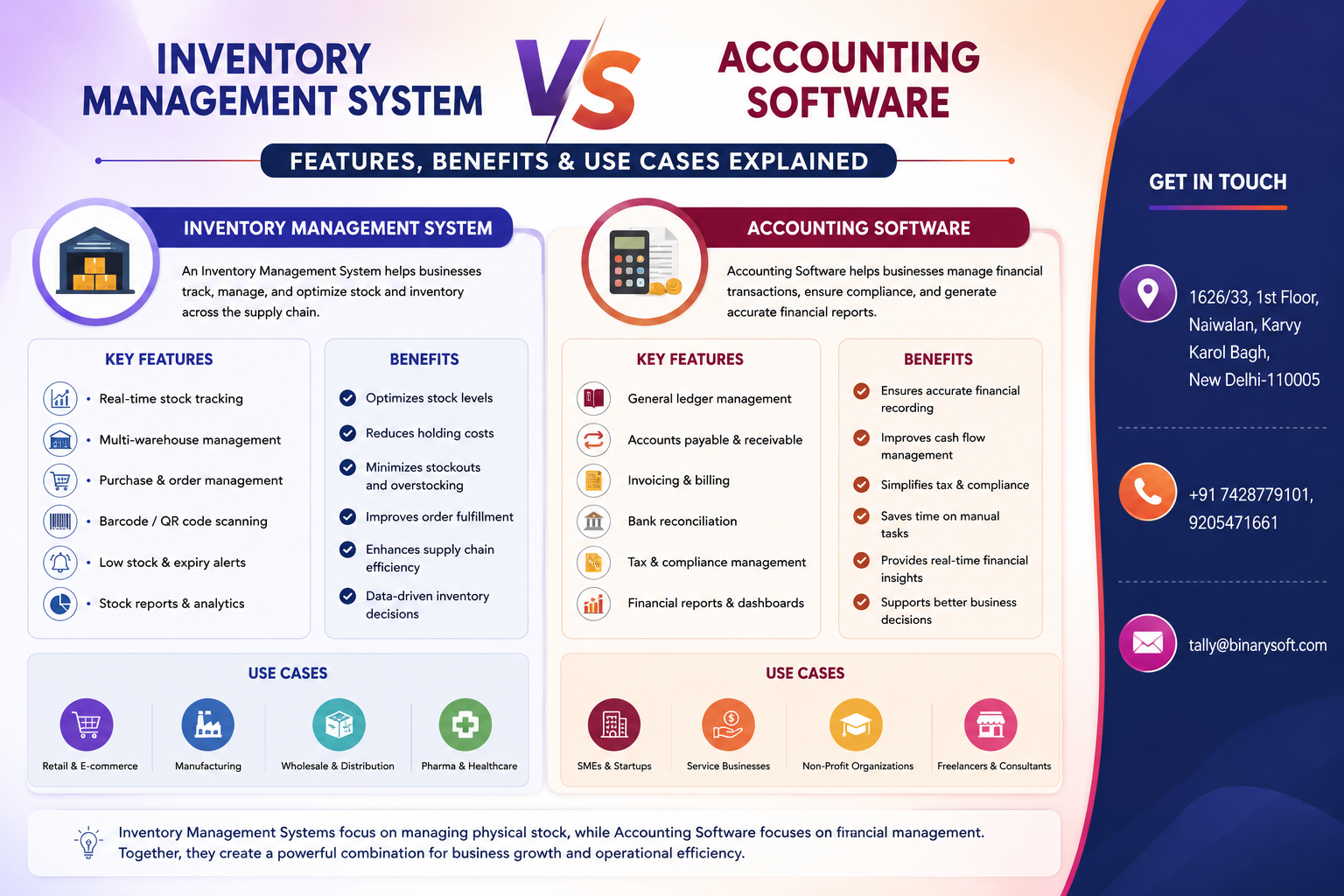
An Inventory Management System is software designed to manage and monitor stock movement, warehouse operations, purchase orders, sales orders, product availability, batch tracking, and inventory valuation in real time.
The primary focus of inventory software is stock control and operational efficiency. Businesses use inventory systems to ensure the right products are available at the right time while reducing overstocking and stock shortages.
Key Functions of Inventory Management Software
- Real-time stock tracking
- Barcode and QR code scanning
- Warehouse management
- Batch and expiry management
- Multi-location inventory control
- Purchase and sales order management
- Stock transfer between branches
- Inventory forecasting
- Low-stock alerts
- Production and manufacturing tracking
Inventory software is especially useful for:
- Retail businesses
- Wholesale distributors
- Manufacturers
- E-commerce companies
- Pharmaceutical businesses
- Garment and textile industries
- FMCG businesses
- Electronics distributors
Understanding Accounting Software
Accounting Software focuses on managing financial transactions and maintaining accurate business accounts. It records sales, purchases, receipts, payments, taxes, ledgers, bank transactions, and financial statements.
The main objective of accounting software is to provide clear financial visibility and ensure compliance with taxation and reporting standards.
Key Functions of Accounting Software
- Voucher entry management
- GST billing and return filing
- Ledger management
- Bank reconciliation
- Profit & Loss reporting
- Balance Sheet generation
- Cash flow tracking
- Payroll accounting
- Tax compliance management
- Financial reporting and analytics
Accounting software is commonly used by:
- Chartered Accountants
- Small businesses
- Trading companies
- Service providers
- Educational institutions
- Healthcare businesses
- Corporate offices
Major Difference Between Inventory Management System and Accounting Software
Although both systems are important for business operations, they serve different purposes.
| Feature | Inventory Management System | Accounting Software |
|---|
| Main Purpose |
Manage stock and inventory |
Manage financial transactions |
| Focus Area |
Inventory operations |
Financial accounting |
| Real-Time Stock Tracking |
Yes |
Limited or integrated |
| Financial Reporting |
Basic |
Advanced |
| GST & Tax Filing |
Limited |
Comprehensive |
| Warehouse Management |
Yes |
No |
| Barcode Support |
Yes |
Limited |
| Profit Analysis |
Basic |
Advanced |
| Bank Reconciliation |
No |
Yes |
| Payroll Management |
No |
Yes |
| Manufacturing Support |
Advanced |
Limited |
| Audit Compliance |
Limited |
Strong |
Why Businesses Need Both in 2026
In earlier years, many businesses operated inventory and accounting separately. However, in 2026, integrated operations are becoming essential due to:
- Real-time GST compliance requirements
- Faster audit verification
- Multi-channel sales management
- Online marketplace integration
- Instant inventory valuation
- Better decision-making through analytics
- Automation in business workflows
Businesses using separate manual systems often face:
- Duplicate data entry
- Inventory mismatches
- Delayed reporting
- Human errors
- Incorrect GST calculations
- Poor customer experience
Integrated systems eliminate these problems by synchronizing inventory and accounting automatically.
Features of Modern Integrated Business Software
Modern business management software combines inventory and accounting features into a single platform.
Advanced Features Available in 2026
Real-Time Inventory Updates
Every sales invoice instantly updates stock quantities.
Automatic Accounting Entries
Purchase and sales transactions automatically affect ledgers and financial reports.
GST Automation
GST calculations, e-invoicing, and return preparation happen automatically.
Cloud Access
Businesses can access reports and inventory from anywhere.
Multi-User Support
Different departments can work simultaneously.
Business Intelligence Reports
Advanced dashboards help management analyze performance instantly.
Mobile App Integration
Business owners can monitor operations remotely.
AI-Based Inventory Forecasting
Software predicts inventory demand based on previous trends.
Inventory Management System Benefits
Improved Stock Accuracy
Businesses can avoid stock shortages and overstock situations.
Faster Order Processing
Real-time stock visibility speeds up billing and dispatch operations.
Better Warehouse Efficiency
Warehouse staff can track products easily using barcode systems.
Reduced Inventory Costs
Proper inventory planning minimizes unnecessary stock investment.
Enhanced Customer Satisfaction
Customers receive products faster with fewer order errors.
Accounting Software Benefits
Better Financial Control
Businesses gain clear visibility into expenses, income, and profits.
GST Compliance
Automated GST reports reduce compliance risks.
Simplified Auditing
Accurate records make audits faster and easier.
Improved Cash Flow Monitoring
Businesses can track receivables and payables effectively.
Financial Decision Support
Management can analyze profitability using detailed reports.
Use Cases of Inventory Management Software
Retail Stores
Retailers use inventory software to track stock movement and billing.
Manufacturing Units
Manufacturers manage raw materials, production stages, and finished goods.
Pharmaceutical Companies
Batch-wise tracking helps monitor expiry-sensitive products.
E-commerce Businesses
Online sellers synchronize inventory across multiple marketplaces.
Textile & Garment Industry
Size, color, and design-wise stock management becomes easier.
Use Cases of Accounting Software
CA Firms
Chartered Accountants manage multiple client accounts and tax filings.
Service Businesses
Consultants and agencies track invoices and payments.
Educational Institutions
Schools and colleges manage fees and accounting records.
Healthcare Clinics
Hospitals manage billing, payroll, and financial reporting.
Trading Companies
Businesses monitor purchases, sales, and profitability.
Which Software is Better for Small Businesses?
The answer depends on business requirements.
Choose Inventory Management Software If:
- You manage physical products
- Stock tracking is your main challenge
- You have warehouses or multiple branches
- Inventory movement is high
Choose Accounting Software If:
- Financial management is your priority
- You need GST compliance
- You manage accounts and taxation
- Your business is service-oriented
Choose Integrated Software If:
- You want complete business automation
- You need both stock and accounting
- You want faster reporting
- You need real-time operational visibility
Why TallyPrime is Popular in 2026
Many Indian businesses prefer integrated solutions like TallyPrime because it combines accounting, inventory, GST, banking, payroll, and reporting in one platform.
Key Advantages of TallyPrime
- Easy-to-use interface
- Real-time inventory tracking
- Powerful accounting features
- GST and e-invoicing support
- Multi-user capability
- Remote access functionality
- Bank reconciliation automation
- Business reporting dashboards
For SMEs, distributors, retailers, and manufacturers, integrated software reduces operational complexity significantly.
Future Trends in Inventory & Accounting Software
AI Automation
AI-driven systems will automate inventory forecasting and accounting reconciliation.
Cloud-Based Operations
More businesses are shifting toward cloud software for remote accessibility.
Connected Banking
Direct bank integration is simplifying payment reconciliation.
Mobile-First Business Management
Business owners increasingly manage operations through smartphones.
Advanced Compliance Monitoring
Future systems will provide automatic compliance alerts and audit checks.
Common Mistakes Businesses Should Avoid
Using Manual Excel Sheets
Manual tracking increases errors and reporting delays.
Delayed Stock Updates
Late updates create inventory mismatches.
Separate Accounting and Inventory Systems
Disconnected systems reduce operational efficiency.
Ignoring Data Backup
Businesses risk losing critical financial and inventory data.
Choosing Cheap Software Without Support
Poor support can create operational disruptions.
How to Select the Right Business Software
Before selecting software, businesses should evaluate:
- Business size
- Number of users
- Industry requirements
- Inventory complexity
- GST compliance needs
- Cloud accessibility
- Integration requirements
- Budget and scalability
- Technical support availability
Choosing scalable software ensures long-term business growth.
Contact Details
Powered by Binarysoft Technologies – Authorized Tally Partner
1626/33, 1st Floor, Naiwalan, Karol Bagh,
New Delhi – 110005, INDIA
Contact Us:
+91 9205471661
+91 7428779101
Email:
tally@binarysoft.com
Working Hours:
10:00 AM – 6:00 PM (Mon–Fri)
Conclusion
In 2026, businesses can no longer afford disconnected operations between inventory and accounting. Inventory Management Systems help companies control stock efficiently, while Accounting Software ensures accurate financial management and compliance. However, the real advantage comes from integrated solutions that combine both functions into one platform.
Businesses that adopt integrated automation gain better visibility, faster operations, improved customer service, and stronger financial control. Whether you are a retailer, wholesaler, manufacturer, CA firm, or service provider, investing in the right software solution can transform your business operations and support long-term growth.
Frequently Asked Questions
What is the main difference between inventory software and accounting software?
Inventory software focuses on stock management, while accounting software focuses on financial transactions and reporting.
Can accounting software manage inventory?
Some accounting software includes inventory modules, but advanced inventory management may require specialized features.
Which businesses need inventory management software?
Retailers, wholesalers, manufacturers, e-commerce businesses, and distributors benefit the most.
Why is real-time inventory important?
Real-time inventory helps businesses avoid stock shortages, overstocking, and delayed order fulfillment.
CA. Rohin Mehtaal is a Chartered Accountant with experience in accounting systems, audit support, and GST compliance. He has assisted businesses in adopting structured financial processes and improving inventory accuracy. His writing emphasizes clarity, control, and data-driven decision making.