Call CA Tally HelpDesk
+91 9205471661,
7428779101
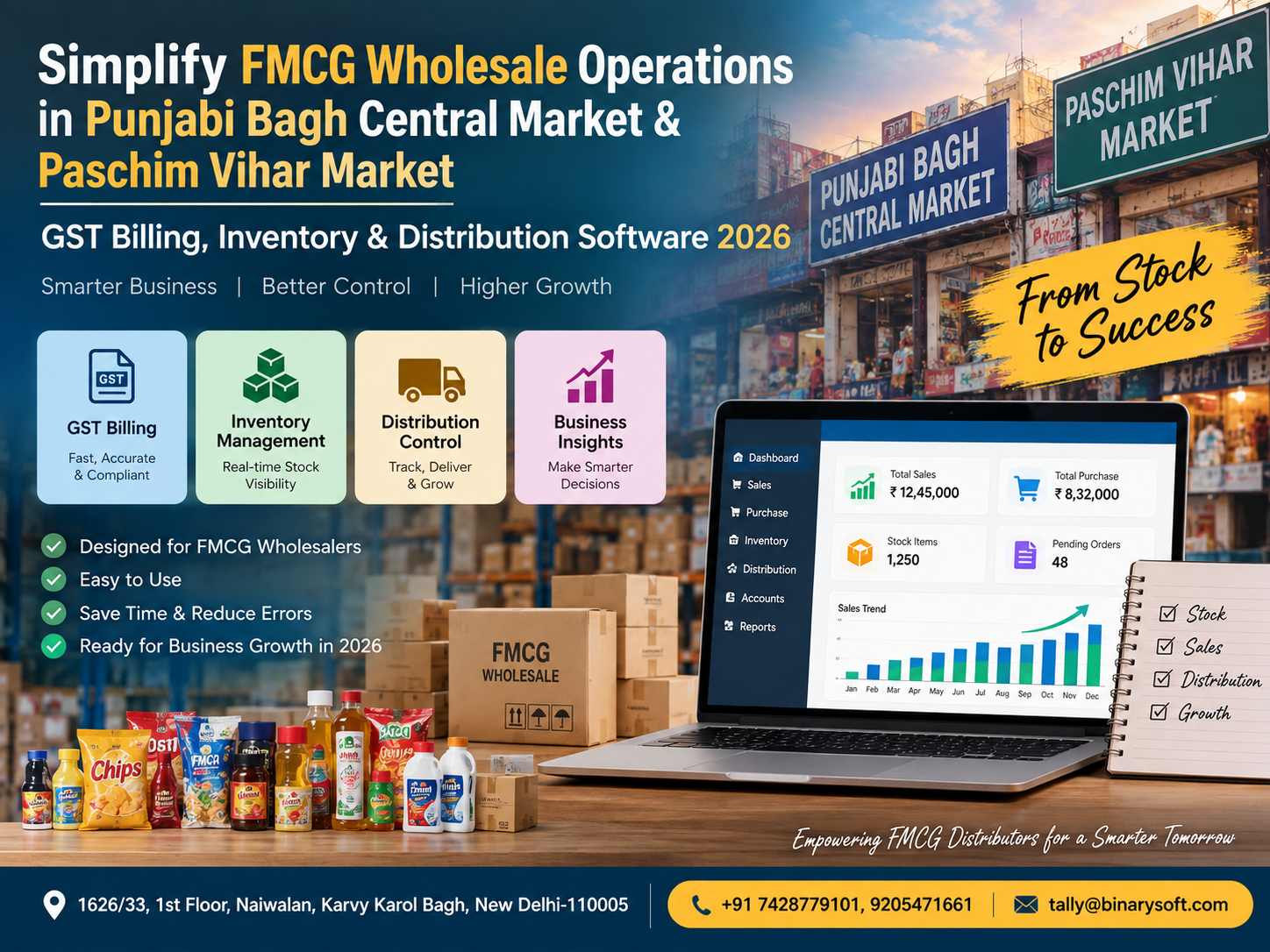
FMCG Wholesale Is Changing in 2026: Faster Operations Are Becoming Essential
In 2026, FMCG wholesalers operating in Punjabi Bagh Central Market and Paschim Vihar Market are facing a business environment where speed, stock accuracy and financial visibility matter more than ever. Retailers expect faster deliveries, businesses manage hundreds or thousands of SKUs, GST documentation must remain organised, and owners cannot afford to discover stock shortages only when an important order arrives. Recent months have also increased the pressure on distributors to know exactly what is selling, what is approaching expiry, which customers have outstanding balances and how much inventory is actually available. A modern GST billing, inventory and distribution software system can bring these activities into one connected workflow. Instead of depending on separate registers, spreadsheets and manual calculations, FMCG businesses can manage billing, purchases, stock, outstanding receivables, batch details and business reports from organised data—helping owners save time, reduce avoidable mistakes and make faster decisions.
Why FMCG Wholesale Businesses Need Better Management in 2026
FMCG is fundamentally different from many other wholesale businesses.
Products move quickly. Margins can be narrow. The number of transactions can be high. Multiple brands, pack sizes, schemes and batches may need to be managed simultaneously. Some products have short shelf lives, while others may remain in the warehouse for months.
A wholesaler serving retailers across Punjabi Bagh, Paschim Vihar and surrounding areas may deal with products such as:
Food and packaged grocery products
Personal care products
Household cleaning products
Beverages
Snacks and confectionery
Cosmetics
Daily-use consumer products
Stationery and general merchandise
Health and hygiene products
Packaged consumer goods
Managing this volume manually becomes increasingly difficult as the business grows.
The problem is not simply creating an invoice.
The real challenge is connecting sales, purchases, inventory, GST, outstanding payments, batches, expiry dates, customer accounts and profitability so that the owner receives a clear picture of the business.
That is where integrated FMCG wholesale management software becomes valuable.
FMCG Wholesale Management Software for Punjabi Bagh Central Market
Punjabi Bagh is surrounded by established residential and commercial areas, creating opportunities for wholesalers and distributors supplying neighbourhood retailers, supermarkets, general stores and other businesses.
As transaction volumes increase, wholesalers need a system capable of handling repetitive billing without making the back-office process complicated.
A suitable FMCG management solution can help centralise:
GST invoicing
Purchase management
Inventory tracking
Customer ledgers
Supplier ledgers
Outstanding receivables
Outstanding payables
Batch-wise inventory
Expiry information
Sales returns
Purchase returns
Distribution records
Financial accounting
MIS and management reports
The objective is simple: information entered during normal business operations should become useful business data instead of remaining scattered across registers and spreadsheets.
FMCG Distribution Software for Paschim Vihar Market
For distributors serving Paschim Vihar Market and surrounding areas, managing retailer orders and stock availability is particularly important.
Consider a distributor supplying dozens or hundreds of retailers.
Every day the business may receive multiple orders for different products and pack sizes. The sales team wants to know what is available. Warehouse staff need accurate quantities. Billing staff need correct rates and tax details. The accounts team needs customer outstanding information.
When every department maintains separate information, discrepancies become common.
With an integrated system, sales, inventory and accounting information can remain connected.
When an invoice is recorded, stock records can be updated accordingly and the transaction can flow into the customer's account. This reduces duplicate data entry and provides better visibility across the organisation.
GST Billing Software for FMCG Wholesalers
GST billing is a core requirement for registered FMCG businesses.
The billing system should make everyday invoicing quick while keeping the underlying transaction information properly organised.
Depending on the nature and configuration of the business, a GST-ready accounting solution can assist with information such as:
Customer GSTIN
Supplier GSTIN
HSN/SAC details
Taxable value
Applicable GST rates
CGST
SGST
IGST
Discounts
Invoice numbers
Credit notes
Debit notes
Sales returns
Purchase returns
This becomes particularly useful when hundreds of invoices are being processed every month.
A structured billing process also reduces dependence on manual tax calculations.
Fast Billing Matters in FMCG Distribution
In a high-volume wholesale business, a small delay on each invoice eventually becomes a large operational problem.
Imagine that billing an order takes two additional minutes because staff must repeatedly search for product rates, calculate discounts or verify stock manually.
For 100 invoices, that represents more than three additional working hours.
Efficient billing software can therefore have a direct operational impact.
Products can be selected quickly, rates retrieved from configured records, taxes calculated according to setup, and invoices generated in a consistent format.
Faster billing can mean shorter queues, faster dispatches and more time for staff to focus on customers and collections.
Inventory Management: Know What Is Actually in Your Warehouse
Inventory is one of the biggest investments for an FMCG wholesaler.
Too little stock can mean missed sales.
Too much stock can block working capital.
The problem becomes more serious when businesses cannot accurately identify which products are available and which are moving slowly.
Inventory management software can help owners monitor:
Opening stock
Purchases
Sales
Closing stock
Stock transfers
Sales returns
Purchase returns
Stock adjustments
Fast-moving products
Slow-moving products
Reorder requirements
Warehouse-wise quantities
Instead of waiting for physical stock checking to discover problems, owners can regularly review inventory information and take corrective action.
The Story of a Busy FMCG Distributor
Imagine an FMCG distributor operating near West Delhi.
For years, the business had grown through relationships. Retailers trusted the owner, salespeople knew customers personally and warehouse staff could remember the location of most popular products.
As the business expanded, that strength slowly became a weakness.
More retailers meant more invoices. More brands meant more stock. More staff meant information no longer stayed in one person's head.
One evening, a long-standing retailer called urgently for a large quantity of a popular product.
The sales register showed that stock should be available.
The warehouse team searched.
It wasn't.
Some cartons had already been dispatched against another order, but the information had not reached the person maintaining the stock sheet.
The retailer could not wait and purchased the goods elsewhere.
For the owner, losing one order was frustrating. What worried him more was the thought that the same thing might be happening quietly every week.
The business had grown, but its systems had not grown with it.
After moving toward integrated billing and inventory management, the most important change was not simply faster invoices. It was confidence.
When a customer asked, “Is this item available?”, the team could answer based on organised records rather than memory.
That confidence can make a significant difference in a competitive wholesale market.
Batch-Wise Inventory Management for FMCG Products
Batch management is particularly important for businesses dealing with packaged products.
The same product may arrive in multiple batches at different times. Those batches can have different purchase rates, manufacturing information or expiry dates.
Without batch-wise tracking, staff may know that 500 units of an item are available but not clearly know which batch should be dispatched first.
A properly configured inventory system can help businesses maintain batch-related records and improve stock rotation.
This becomes especially useful for food products, personal care products and other goods where shelf life matters.
Expiry Date Management
Expiry-related losses can quietly reduce FMCG profitability.
Suppose a wholesaler has ₹50,000 worth of a particular product in stock. If the product is not selling quickly and nobody notices its approaching expiry, the business may eventually need to discount, return or write off the stock.
Regular expiry monitoring can help management identify vulnerable inventory earlier.
The business may then have time to:
Prioritise the stock for sale
Discuss returns with the supplier where permitted
Run a retailer scheme
Adjust future purchase quantities
Move inventory between locations
Stop unnecessary reordering
Software cannot eliminate expiry risk, but better information can give the business more time to respond.
Reorder Management and Stock Planning
One of the most common questions in FMCG wholesale is:
“How much should we order?”
Ordering too little can result in stock-outs.
Ordering too much can block cash.
Inventory reports can help owners review sales movement and current quantities before placing purchase orders.
For example, if a product sells consistently while available inventory is falling, the purchasing team can plan replenishment earlier.
On the other hand, if several weeks of stock remain available for a slow-moving product, additional purchasing may be postponed.
This creates a more disciplined purchasing process.
Manage Multiple FMCG Brands and Product Categories
A distributor may handle several companies and hundreds or thousands of individual items.
Products can be organised using logical categories such as:
Brand
Product group
Category
Pack size
Unit
Supplier
Tax rate
Location
Batch
Well-structured masters make searching, billing and reporting easier.
Instead of remembering every product manually, employees can retrieve information through the software.
Sales Order to Invoice Management
Retailer orders often arrive through phone calls, WhatsApp messages, sales representatives and other channels.
Without a structured process, an order may be missed, billed incorrectly or dispatched twice.
A systematic workflow can help businesses manage the movement from customer requirement to billing and dispatch.
A typical process may include:
Customer order received
Order recorded
Stock checked
Goods prepared
Invoice generated
Goods dispatched
Customer account updated
Payment followed up
Creating a defined process becomes increasingly important as order volume grows.
Customer-Wise Pricing and Discount Management
FMCG wholesalers may not always sell every product to every retailer at the same effective rate.
Pricing can depend on:
Customer category
Order quantity
Brand
Product
Scheme
Season
Previous agreement
Distribution territory
Payment terms
Managing such variations manually can cause disputes.
A configured billing system can make pricing more consistent while maintaining the flexibility required by the business.
Scheme and Discount Management
FMCG distribution frequently involves schemes.
For example:
Buy 10, get 1 free
Quantity-based discounts
Percentage discounts
Seasonal offers
Retailer-specific schemes
Brand promotions
The commercial effect of these schemes should be understood clearly because an attractive sales figure does not necessarily mean a high profit.
Businesses should review the net impact of discounts and schemes when analysing margins.
Outstanding Receivables Management
Sales do not automatically create cash flow.
For many wholesalers, the bigger challenge begins after the invoice is generated.
A distributor might achieve excellent monthly sales while still facing a shortage of working capital because customers have not paid on time.
Customer outstanding reports can help identify:
Total amount receivable
Customer-wise balances
Overdue invoices
Invoice dates
Pending amounts
Collection priorities
Management can then focus collection efforts where they matter most.
Credit Control for Retail Customers
Giving credit can support sales, but uncontrolled credit can create serious financial pressure.
Suppose a retailer normally purchases ₹50,000 per month but gradually accumulates ₹2 lakh of unpaid invoices.
Without regular monitoring, additional orders may continue to be supplied.
A structured accounting system makes customer balances easier to review before extending additional credit.
Credit decisions remain a business judgment, but accurate information makes that judgment more informed.
Supplier Outstanding and Purchase Management
FMCG wholesalers must manage both sides of working capital.
Money has to be collected from customers while supplier payments must also be planned.
Purchase and payable reports can help management understand:
Supplier-wise balances
Purchase values
Pending bills
Payment schedules
Purchase returns
Supplier transactions
This allows businesses to plan cash requirements more effectively.
Sales Returns and Purchase Returns
Returns are common in distribution.
Retailers may return products because of:
Damage
Incorrect quantity
Wrong product
Scheme adjustment
Quality issue
Expiry-related arrangements
Other commercial reasons
Similarly, wholesalers may need to return goods to suppliers.
Proper recording is important because returns affect inventory, customer/supplier balances, tax records and profitability.
Multi-Godown Inventory Management
Some wholesalers maintain inventory at more than one location.
For example:
Main warehouse
Shop stock
Secondary godown
Dispatch location
When stock is spread across locations, employees need to know not only how much inventory exists but where it exists.
Godown-wise inventory tracking can provide this visibility.
This helps prevent unnecessary purchasing when the required stock is already available at another location.
Barcode-Based Product Management
Barcode functionality can be useful for businesses handling large numbers of packaged items.
Depending on the operational setup, barcode-supported workflows can assist with:
Product identification
Faster item selection
Billing
Stock handling
Reducing manual product-selection errors
The actual implementation should be designed according to the warehouse and billing workflow rather than adding barcode processes simply because the technology is available.
GST and Accounting in One System
Using one system for invoicing and another for accounting can create unnecessary duplication.
The billing team enters a transaction.
Then the accounts team enters the same transaction again.
This takes additional time and creates another opportunity for error.
An integrated accounting and billing environment can allow a sales transaction to simultaneously contribute to inventory records, customer accounts and financial reporting.
Know Your Real FMCG Profitability
High sales do not always mean high profit.
An FMCG business may generate substantial turnover while margins are affected by:
Purchase cost
Discounts
Schemes
Damaged stock
Expiry losses
Returns
Freight
Operating expenses
Credit losses
Price changes
Management reports can help owners evaluate performance beyond turnover.
The important question is not simply:
“How much did we sell?”
It is:
“What did we earn from those sales?”
Product-Wise Sales Analysis
Some products generate revenue.
Some generate margin.
Some move quickly but contribute little profit.
Some remain in inventory for months.
Product-wise reporting can help management understand these differences.
Businesses can identify:
Best-selling products
Low-selling products
High-value products
Slow-moving inventory
Frequently returned products
Important categories
These insights can support purchasing and sales planning.
Customer-Wise Sales Analysis
Not all customers contribute equally to the business.
One retailer may purchase frequently but in small quantities.
Another may place large orders but delay payments.
A third may provide consistent sales and timely payment.
Customer-wise analysis can help management understand both sales contribution and collection behaviour.
This is especially important when planning credit limits and sales priorities.
Salesperson-Wise Reporting
If a distributor employs multiple sales representatives, management may want visibility into performance.
Depending on the business setup, reports can be structured around:
Sales value
Customer coverage
Orders
Collections
Outstanding amounts
Product categories
Territories
This provides management with a more objective basis for reviewing sales activity.
Distribution Management for Growing FMCG Businesses
As the number of retailers increases, informal processes become harder to manage.
A business that supplies 20 retailers can often operate through personal memory.
A business serving 200 or 500 retailers needs stronger systems.
Distribution management software can provide a central source of information for customers, products, sales, inventory and accounts.
This allows the business to scale without creating the same increase in administrative confusion.
Reduce Dependency on Excel and Manual Registers
Excel remains useful for many business tasks.
The problem begins when spreadsheets become the primary transaction system for a growing FMCG operation.
Different employees may maintain different versions.
Formulas may be changed accidentally.
Stock sheets may not reflect the latest invoices.
Customer balances may require manual reconciliation.
A dedicated business management system provides structured transaction records and reporting that spreadsheets alone may struggle to maintain as transaction volumes increase.
Better Decision-Making for Business Owners
A business owner should be able to answer important questions without waiting several days for staff to compile information.
For example:
What are today's sales?
How much money is outstanding?
Which customers owe the most?
What is our current inventory value?
Which products are running low?
Which products are not moving?
What do we owe suppliers?
Which items are selling fastest?
Which customers purchased the most this month?
Which inventory requires attention?
The faster management can obtain reliable answers, the faster it can act.
Daily Reports FMCG Wholesalers Should Review
A disciplined business does not need hundreds of reports every day.
A focused management dashboard can include:
Daily sales
Daily purchases
Cash and bank position
Customer outstanding
Supplier outstanding
Stock summary
Low-stock products
Fast-moving items
Slow-moving inventory
Receivables requiring follow-up
Weekly and monthly reviews can then go deeper into profitability and trends.
How FMCG Software Helps Reduce Human Error
Manual mistakes are inevitable in repetitive work.
An employee may type an incorrect quantity.
A tax rate may be selected incorrectly.
A customer balance may not be updated.
A stock transaction may be missed.
Software cannot prevent every mistake, but structured workflows, predefined masters and integrated records can substantially reduce repeated manual work.
Preparing an FMCG Business for Future Growth
Technology investment should not only solve today's problem.
It should support tomorrow's business.
An FMCG wholesaler might currently operate from one location with three employees.
In a few years, the business could have:
Multiple warehouses
More salespeople
Hundreds of additional retailers
More brands
Higher transaction volumes
Additional billing users
A scalable software environment makes that transition easier than rebuilding operational processes after the business has already become complex.
Why TallyPrime Can Be Considered for FMCG Wholesale Management
TallyPrime is widely used by businesses for accounting, inventory and GST-related business processes.
For an FMCG wholesaler, an appropriately configured Tally environment can help bring accounting, invoicing and inventory records into a more integrated workflow.
Depending on business requirements and configuration, businesses may use it for areas such as:
GST billing
Sales and purchase transactions
Inventory records
Batch-related stock management
Godown management
Receivables and payables
Accounting
Financial statements
Business reports
The correct setup should always be based on the actual operational requirements of the business.
Why Software Configuration Matters
Purchasing software is only the first step.
The quality of implementation determines how useful it becomes.
A poorly structured system can simply convert manual confusion into digital confusion.
Before implementation, an FMCG business should consider:
Number of users
Number of locations
Product categories
Brands
Batch requirements
Expiry requirements
Billing workflow
Customer pricing
Discount structure
Sales returns
Purchase returns
Credit policy
Reporting needs
GST requirements
Backup procedures
Once these requirements are understood, the software can be configured around the actual business process.
Staff Training Is Equally Important
Even excellent software provides limited value if employees do not know how to use it properly.
Training should cover relevant day-to-day activities such as:
Creating invoices
Recording purchases
Managing returns
Checking stock
Reviewing customer balances
Correcting transactions
Generating reports
Following backup procedures
A well-trained team is more likely to maintain accurate data.
Data Backup and Business Continuity
Business data is an important operational asset.
Invoices, customer accounts, supplier balances, inventory records and financial information may represent years of business history.
Regular backup procedures should therefore form part of the implementation plan.
Businesses should define:
Who is responsible for backups?
How frequently are backups taken?
Where are backup copies stored?
Who can access them?
How will data be restored if required?
Business continuity planning is particularly important for companies that depend heavily on their accounting and inventory systems for daily operations.
Who Can Benefit from FMCG Wholesale Software?
The solution can be relevant for different types of businesses operating in and around Punjabi Bagh Central Market, Paschim Vihar Market and other areas of Delhi, including:
FMCG wholesalers
Distributors
Super stockists
General merchandise wholesalers
Packaged food distributors
Personal care distributors
Household product distributors
Retail suppliers
Multi-brand distributors
Consumer goods wholesalers
The exact software setup will depend on the size and complexity of each business.
Signs Your FMCG Business May Need an Upgrade
A business should consider reviewing its existing process when:
Stock figures frequently differ from physical stock.
Employees repeatedly ask whether an item is available.
Customer balances require manual calculation.
Sales and accounting are maintained separately.
Invoices take too long to prepare.
Expiry stock is discovered too late.
Reports require several spreadsheets.
The owner cannot see current outstanding amounts easily.
The same data is entered multiple times.
Sales are increasing but operational control is decreasing.
These problems often indicate that business growth has exceeded the capacity of existing processes.
From Billing Software to a Business Control System
The biggest misconception is that FMCG software is only an invoice-printing application.
Billing is only one component.
A well-designed system can connect:
Sales
Purchases
Inventory
Distribution
Receivables
Payables
GST
Accounting
Management reporting
That connection is where much of the business value comes from.
The owner moves from asking staff for information to reviewing organised records.
The billing team works faster.
The warehouse receives clearer stock information.
The accounts team gets structured transactions.
Management gains visibility.
Choosing FMCG Wholesale Software in 2026
Before selecting a solution, businesses should focus on their actual requirements rather than choosing software based only on a long feature list.
Ask questions such as:
Can it handle our transaction volume?
Can we manage our inventory structure?
Can it support batch-wise records where required?
Can we manage multiple godowns?
Can customer outstanding balances be tracked easily?
Can our team generate GST invoices efficiently?
Can management obtain useful reports?
Can the solution scale with the business?
Is implementation and support available?
Can our staff learn the workflow easily?
The best solution is not necessarily the one with the largest number of features.
It is the one that fits the business and is actually used consistently.
FMCG Software Support in Punjabi Bagh and Paschim Vihar
Binarysoft Technologies provides Tally-related solutions and support for businesses looking to improve their accounting, GST billing, inventory and related business processes.
For FMCG wholesalers and distributors, the first step should be understanding the current workflow.
This includes reviewing how products are purchased, stored, sold, returned and accounted for.
Once the operational gaps are understood, the software setup can be planned around the business.
Powered by Binarysoft Technologies
Binarysoft Technologies
Authorized Tally Partner
Location: 1626/33, 1st Floor, Naiwalan, Karol Bagh, New Delhi – 110005, INDIA
Contact us: +91 7428779101, 9205471661
Email us: tally@binarysoft.com
Business Hours: 10:00 AM – 6:00 PM, Mon–Fri
Businesses in Punjabi Bagh Central Market, Paschim Vihar Market and other parts of Delhi can contact Binarysoft Technologies to discuss Tally, GST billing, accounting, inventory management and business software requirements.
Conclusion
For FMCG wholesalers in Punjabi Bagh Central Market and Paschim Vihar Market, 2026 is a good time to evaluate whether existing billing and inventory processes can support future growth.
The challenge is no longer simply generating GST invoices. Growing distributors need visibility across sales, purchases, inventory, batches, outstanding receivables, supplier payments and profitability.
When these activities remain disconnected, employees spend valuable time checking spreadsheets, calling warehouse staff, reconciling balances and correcting duplicate information.
An integrated GST billing, inventory and distribution management system can create a more organised workflow.
The benefits can extend beyond faster billing. Better stock visibility can improve purchasing decisions. Outstanding reports can strengthen collection follow-ups. Batch and expiry information can reduce inventory risk. Customer and product reports can support better sales decisions.
Most importantly, management gets clearer information about what is happening inside the business.
For an FMCG wholesaler planning to grow in Punjabi Bagh, Paschim Vihar or across Delhi, the goal should therefore be more than digitisation.
The goal should be control, visibility and a business system capable of growing with the organisation.
Frequently Asked Questions
What is FMCG wholesale management software?
FMCG wholesale management software helps distributors and wholesalers organise business activities such as billing, purchases, inventory, customer accounts, supplier accounts, stock management and business reporting through a structured system.
Is FMCG software useful for wholesalers in Punjabi Bagh Central Market?
Yes. Wholesalers handling multiple products, retailers and daily transactions can use an integrated system to improve billing, inventory visibility and accounting processes.
CA. Shivesh Khandelwaal is a practicing Chartered Accountant experienced in accounting automation, compliance management, and audit support. He has worked with trading and distribution businesses to improve inventory visibility and financial reporting. His articles focus on real-world applicability.