Call CA Tally HelpDesk
+91 9205471661,
7428779101
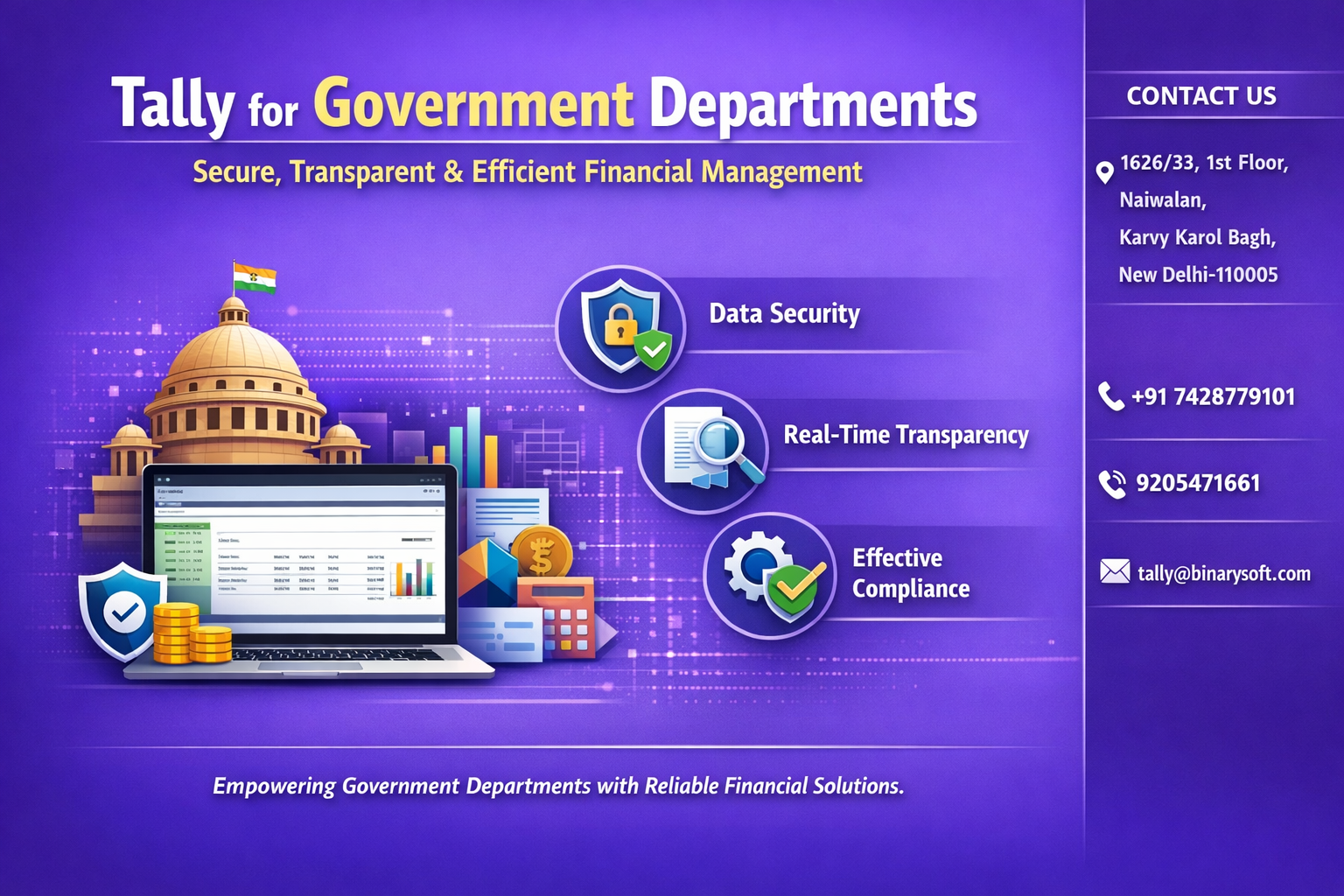
In 2026, financial governance across government departments is undergoing a quiet but powerful transformation. Recent months have brought stronger audit expectations, increased demand for real-time expenditure visibility, and tighter compliance frameworks. Authorities are prioritizing transparency more than ever, while citizens expect faster reporting and responsible fund utilization. Manual bookkeeping, fragmented spreadsheets, and delayed reconciliations are no longer sustainable in an environment where accountability is constantly scrutinized. Even minor financial inconsistencies can trigger audit observations, administrative delays, or reputational concerns. Departments that have adopted structured digital accounting systems are already experiencing measurable benefits—faster reporting cycles, clearer budget tracking, improved audit readiness, and stronger financial control. The shift is unmistakable: modern financial management is becoming essential for institutions that want to operate efficiently while maintaining public trust.
A few years ago, the finance division of a regional public works department faced a situation that many government offices quietly recognize. A major infrastructure project was nearing completion when auditors requested a detailed breakdown of fund utilization. The data existed—but it was scattered across registers, spreadsheets, and departmental files.
For weeks, officers worked late into the evening compiling reports manually. Stress levels rose, routine work slowed, and leadership worried about how the delay might be perceived.
It was not a question of whether funds were used properly. It was about proving it with clarity.
After transitioning to a structured accounting platform, the department’s workflow changed dramatically. Budget allocations, contractor payments, and project expenses became traceable in seconds. Reports that once took days were generated almost instantly.
But the most important change was emotional—confidence replaced anxiety.
Officials could focus on delivering public value rather than chasing paperwork.
This story reflects a broader reality: strong financial systems are not just administrative tools; they reinforce institutional credibility.
The Rising Importance of Financial Transparency in Government
Public sector organizations operate under constant observation. Every allocation represents taxpayer money, and every expenditure must withstand scrutiny.
Modern departments must manage:
-
Budget allocations across programs
-
Grant utilization
-
Vendor and contractor payments
-
Inter-departmental transfers
-
Compliance documentation
-
Audit trails
-
Asset tracking
-
Financial reporting
Without an integrated system, these responsibilities create operational friction and increase the likelihood of reporting delays.
Transparency is no longer optional—it is a governance priority.
Why Traditional Accounting Methods Are No Longer Enough
Many government offices still rely on legacy processes developed for a slower administrative era. While familiar, these methods often struggle to meet today’s expectations.
Common challenges include:
Delayed Financial Reporting
Manual consolidation consumes valuable administrative time.
Limited Visibility
Decision-makers may lack real-time insight into budget utilization.
Audit Pressure
Disorganized records increase preparation time and stress during reviews.
Higher Risk of Human Error
Multiple data sources create inconsistencies.
As governance becomes more data-driven, these inefficiencies become increasingly difficult to justify.
How Tally Strengthens Financial Management in Government Departments
Tally has evolved into a comprehensive financial management solution capable of supporting the structured needs of public institutions.
Secure Financial Recordkeeping
A centralized system ensures that every transaction is recorded systematically, reducing the risk of misplaced or duplicated data.
Real-Time Budget Monitoring
Departments gain immediate visibility into fund allocation and expenditure, helping administrators prevent overspending and maintain fiscal discipline.
Audit-Ready Documentation
Organized financial records simplify audit preparation and demonstrate procedural integrity.
Accurate Reporting
Automated report generation accelerates decision-making and supports leadership with reliable data.
Controlled User Access
Defined permission structures help maintain accountability while protecting sensitive financial information.
Efficiency That Extends Beyond Finance
When financial workflows become streamlined, the positive impact spreads throughout the department.
Administrative teams spend less time compiling data and more time focusing on policy execution. Leadership gains the clarity needed to prioritize initiatives effectively. Projects move forward with fewer procedural bottlenecks.
Efficiency, in this context, directly enhances public service delivery.
Compliance as a Pillar of Institutional Trust
Regulatory expectations are rising, and oversight mechanisms are becoming more sophisticated. Departments that maintain organized financial records benefit from smoother audits and stronger stakeholder confidence.
Well-managed financial systems help institutions:
-
Demonstrate responsible fund utilization
-
Respond quickly to audit queries
-
Improve internal controls
-
Strengthen governance standards
Trust is built when transparency is effortless rather than forced.
The Human Side of Financial Systems
Behind every ledger are professionals committed to public service. Yet outdated processes often place unnecessary pressure on them.
Unclear records create hesitation. Officers double-check numbers repeatedly. Leadership worries about unforeseen discrepancies.
When accounting becomes structured, a subtle transformation occurs.
Workplaces feel calmer. Decisions become quicker. Teams operate with assurance rather than uncertainty.
Technology may appear procedural, but its impact is deeply human—it allows public servants to focus on outcomes instead of administrative strain.
Warning Signs a Department Needs Digital Financial Management
Institutional growth and expanding responsibilities often expose operational gaps. Indicators include:
-
Difficulty generating timely financial reports
-
Lengthy audit preparation cycles
-
Limited visibility into real-time expenditures
-
Heavy dependence on manual registers
-
Frequent reconciliation delays
-
Challenges tracking project-wise spending
Addressing these early helps prevent systemic inefficiencies.
Preparing Government Institutions for the Future
Governance is steadily moving toward digital accountability. Departments that modernize their financial infrastructure today position themselves for long-term resilience.
Future-ready institutions prioritize:
Clarity – Every financial movement is traceable.
Control – Structured workflows support compliance.
Speed – Reliable data enables faster administrative action.
Modern financial management is not simply about technology adoption—it is about strengthening governance itself.
Conclusion
Government departments carry the responsibility of managing public funds with integrity, precision, and transparency. As expectations rise, financial systems must evolve to support this mandate.
Tally provides a structured approach to financial management—helping institutions maintain accurate records, monitor budgets in real time, prepare confidently for audits, and operate with greater efficiency.
When transparency becomes embedded in everyday processes, departments build stronger credibility with stakeholders and the communities they serve.
In an era defined by accountability, secure and efficient financial management is more than an operational upgrade—it is a commitment to better governance.
Powered by Binarysoft Technologies
Authorized Tally Partner
Location:
1626/33, 1st Floor, Naiwalan, Karol Bagh, New Delhi – 110005, INDIA
Contact Us:
+91 7428779101
+91 9205471661
+91 8368262875
Email:
tally@binarysoft.com
Business Hours:
10:00 AM – 6:00 PM (Mon–Fri)
Frequently Asked Questions
Is Tally suitable for government departments?
Yes, it supports structured financial workflows and helps institutions maintain organized, transparent records.
Can it improve audit readiness?
Well-maintained digital records simplify audit preparation and enable faster responses to queries.
Does it help track budget utilization?
Real-time visibility allows administrators to monitor allocations and expenditures effectively.
Why is digital financial management becoming essential in governance?
As oversight increases and public expectations rise, reliable financial systems are critical for maintaining accountability and institutional trust.
CA. Ankit Vardiya works closely with traders, wholesalers, and service businesses on accounting automation, GST reporting, and audit readiness. His professional exposure to day-to-day business operations allows him to translate complex accounting concepts into practical guidance for Indian business owners.