
Binarysoft is Authorised Tally Sales & Implementation Partner in India
+91 742 877 9101 or E-mail: tally@binarysoft.com 10:00 am – 6: 00 pm , Mon-Fri

Binarysoft is Authorised Tally Sales & Implementation Partner in India
+91 742 877 9101 or E-mail: tally@binarysoft.com 10:00 am – 6: 00 pm , Mon-Fri
Call CA Tally HelpDesk +91 9205471661, 7428779101
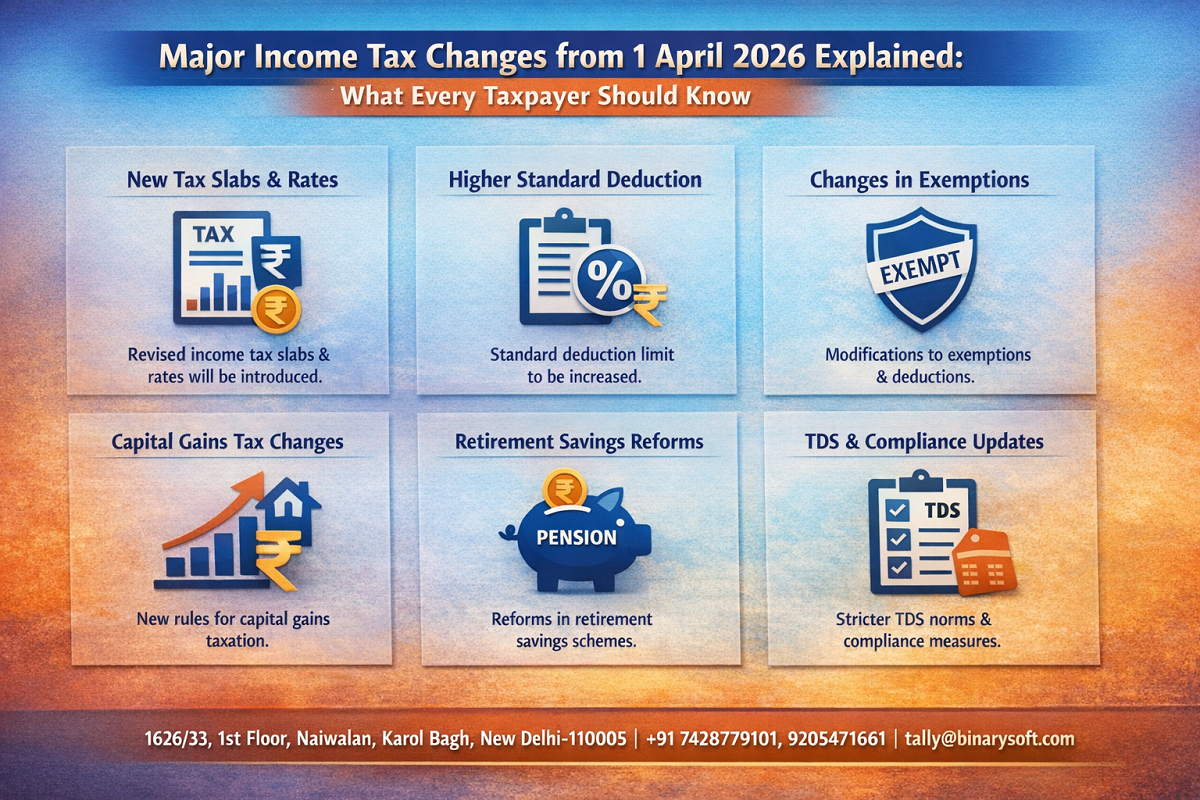
As the new financial year begins on 1 April 2026, several important income tax changes are coming into effect that will directly impact individual taxpayers, salaried employees, freelancers, and businesses across India. In recent months, the government has introduced multiple tax reforms aimed at improving compliance, simplifying taxation, and encouraging digital financial reporting. These updates include changes in tax slabs, revised compliance rules, stricter reporting requirements, and new deductions or benefits for certain taxpayers.
For many individuals, these changes could mean higher tax savings, different filing strategies, or new compliance responsibilities. At the same time, businesses must adapt their payroll systems, tax calculations, and reporting procedures to align with the latest rules.
Understanding these changes early can help taxpayers avoid penalties, plan their finances better, and maximize available tax benefits in the Financial Year 2026–27.
Income tax regulations in India evolve regularly as the government adjusts policies to support economic growth, encourage investment, and improve tax collection.
Each financial year, the government may introduce changes such as:
Adjustments in tax slabs
New deductions and exemptions
Changes in compliance rules
Updates to TDS and reporting requirements
Simplification of tax filing processes
These updates are usually announced in the Union Budgetand implemented at the start of the new financial year.
One of the most discussed changes in recent years has been the expansion of the new tax regime, which offers lower tax rates but fewer deductions.
From 1 April 2026, more taxpayers are expected to adopt the simplified tax structure because:
Tax rates remain competitive
Compliance becomes easier
Fewer deductions simplify tax filing
Many salaried individuals may find that the new regime reduces complexity while offering similar or lower tax liability.
The standard deduction has become an important relief for salaried taxpayers.
Recent updates continue to support employees by providing a fixed deduction from taxable income before calculating tax liability.
This helps reduce the taxable income of employees and pensioners without requiring them to claim multiple deductions.
The Income Tax Department is strengthening its monitoring systems by expanding digital transaction reporting.
Financial institutions and payment platforms are now required to report certain high-value transactions automatically.
This includes transactions related to:
Large bank deposits
High-value property purchases
Significant stock market investments
Major credit card spending
These measures aim to reduce tax evasion and improve transparency.
Tax Deducted at Source (TDS) continues to be a key compliance requirement for businesses.
From the new financial year, businesses are expected to maintain stricter compliance related to:
Vendor payments
Professional fees
Contract payments
Salary payments
Failure to deduct or deposit TDS correctly may lead to penalties and interest charges.
Companies must ensure their accounting systems are properly configured to handle these requirements.
The government is continuously improving the income tax return filing systemto make it easier for taxpayers.
Recent improvements include:
Pre-filled tax return forms
Faster verification processes
Improved online filing platforms
Simplified documentation requirements
These changes aim to reduce the time and effort required to file income tax returns.
The Income Tax Department has been using advanced technology and data analytics to identify discrepancies in tax filings.
By analyzing financial data from banks, stock exchanges, and digital platforms, authorities can detect inconsistencies between reported income and actual financial activity.
Taxpayers must therefore ensure that their income declarations match their financial transactions.
Another important change is the increasing focus on financial transparency.
Businesses and professionals must maintain proper documentation of income, expenses, and financial transactions.
Digital accounting systems and modern accounting software are becoming essential tools for maintaining compliance with evolving tax regulations.
Employees may benefit from simplified tax filing and standard deduction benefits. However, they must carefully choose between the old and new tax regimesbased on their deductions and financial situation.
Small businesses must maintain accurate accounting records and ensure proper TDS compliance. Using reliable accounting software can help simplify tax calculations and reporting.
Freelancers must carefully track income and expenses, as digital transaction monitoring makes it easier for authorities to detect undeclared income.
Investors in stock markets, mutual funds, and other financial assets must maintain proper records of their transactions to ensure accurate tax reporting.
Businesses can take several steps to stay compliant with evolving tax regulations.
Maintain accurate financial records
Use reliable accounting software
Track all business transactions
Ensure timely tax filing
Consult professional tax advisors when required
Using modern accounting platforms helps businesses generate accurate reports and simplify tax compliance processes.
Technology is playing a major role in transforming tax compliance in India.
Digital accounting software can help businesses:
Track financial transactions automatically
Generate tax-ready reports
Monitor GST and income tax obligations
Maintain audit-ready financial records
By adopting modern financial management tools, businesses can reduce compliance risks and improve efficiency.
Powered by Binarysoft Technologies – Authorized Tally Partner
1626/33, 1st Floor, Naiwalan, Karol Bagh,
New Delhi – 110005, INDIA
Contact Us:
+91 7428779101
+91 9205471661
Email:
tally@binarysoft.com
Working Hours:
10:00 AM – 6:00 PM (Mon–Fri)
The start of the Financial Year 2026–27brings several important income tax changes that taxpayers must understand. These updates focus on simplifying tax structures, improving compliance monitoring, and encouraging transparent financial reporting.
For individuals and businesses alike, staying informed about these changes is essential to avoid penalties and optimize tax planning strategies.
By maintaining accurate financial records and adopting modern accounting tools, taxpayers can easily adapt to evolving tax regulations while ensuring smooth compliance with government requirements.
 Continue Here >>
Continue Here >>
Continue Here >>
Continue Here >>
Continue Here >>