
Binarysoft is Authorised Tally Sales & Implementation Partner in India
+91 742 877 9101 or E-mail: tally@binarysoft.com 10:00 am – 6: 00 pm , Mon-Fri

Binarysoft is Authorised Tally Sales & Implementation Partner in India
+91 742 877 9101 or E-mail: tally@binarysoft.com 10:00 am – 6: 00 pm , Mon-Fri
Call CA Tally HelpDesk +91 9205471661, 7428779101
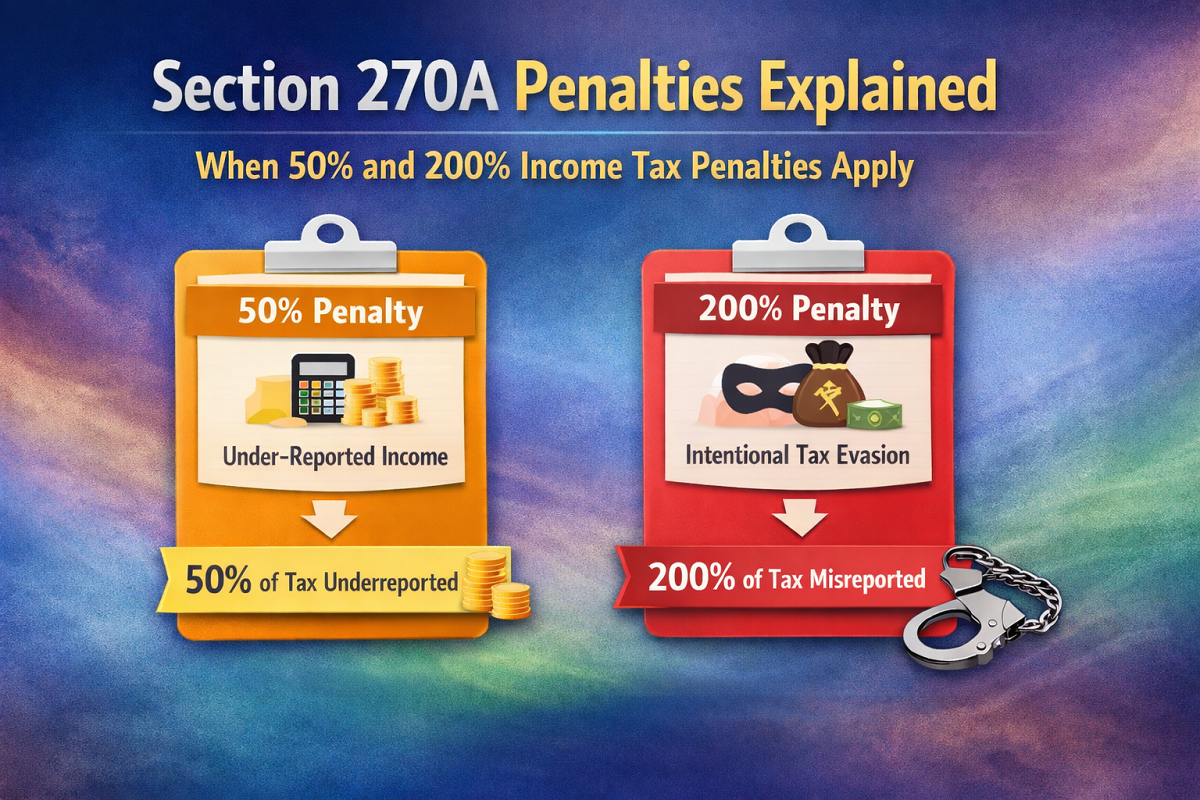
In 2026, income tax compliance is no longer just about filing returns—it’s about accuracy, transparency, and accountability. With advanced data matching, AIS (Annual Information Statement), and stricter scrutiny by the Income Tax Department, even small mismatches can trigger serious consequences. One of the most important provisions taxpayers must understand today is Section 270A, which deals with penalties for under-reporting and misreporting of income. The stakes are high: a mistake can cost you 50% of the tax, while intentional misreporting can lead to a 200% penalty. For businesses and professionals, this is not just a financial risk—it’s a compliance risk that can affect credibility. Understanding how Section 270A works is essential to avoid unnecessary penalties and stay on the right side of tax laws.
Section 270A of the Income Tax Act deals with penalty for under-reporting and misreporting of income. It replaced the earlier penalty provisions to bring more clarity and structure.
The section broadly classifies defaults into two categories:
The key difference lies in intent. If the error is unintentional, it falls under under-reporting. If it involves deliberate concealment or false reporting, it becomes misreporting.
Under-reporting happens when the income declared in the tax return is less than what should have been declared.
Misreporting is a more serious offence where there is intentional concealment or falsification of income.
| Basis | Under-Reporting | Misreporting |
|---|---|---|
| Nature | Unintentional | Intentional |
| Penalty | 50% of tax | 200% of tax |
| Severity | Moderate | Severe |
| Example | Missed income | Fake expense claim |
Understanding this difference is crucial because it directly impacts the penalty amount.
With digital transformation, tax authorities now use:
This means:
Even small discrepancies can lead to scrutiny under Section 270A.
The penalty applies to:
Anyone who files an income tax return and under-reports or misreports income can be penalized.
There are certain situations where penalty may not be imposed:
Proper compliance and transparency can help avoid penalties.
Match your income with AIS, bank statements, and Form 26AS.
Keep records of expenses, invoices, and financial transactions.
Do not claim deductions or expenses without proper proof.
Using tools like TallyPrime helps ensure accurate records, GST compliance, and error-free reporting.
Double-check all entries before submission to avoid mistakes.
Consult a CA or tax expert for complex transactions.
For businesses, penalties under Section 270A can have serious consequences:
In competitive markets, even a small penalty can affect cash flow and reputation.
The tax ecosystem is becoming more data-driven and automated. Authorities now rely on:
This means there is very little room for error or manipulation. Businesses and individuals must adopt better systems and processes to stay compliant.
Section 270A is a powerful provision that enforces discipline in tax reporting. The difference between a 50% penalty and a 200% penalty lies in intent—but both can be financially damaging.
In 2026, compliance is no longer optional. With increasing transparency and digital tracking, taxpayers must ensure that their income reporting is accurate, complete, and honest.
By maintaining proper records, using reliable software, and following best practices, you can avoid penalties and focus on growing your business with confidence.
 Continue Here >>
Continue Here >>
Continue Here >>
Continue Here >>
Continue Here >>