Call CA Tally HelpDesk
+91 9205471661,
7428779101
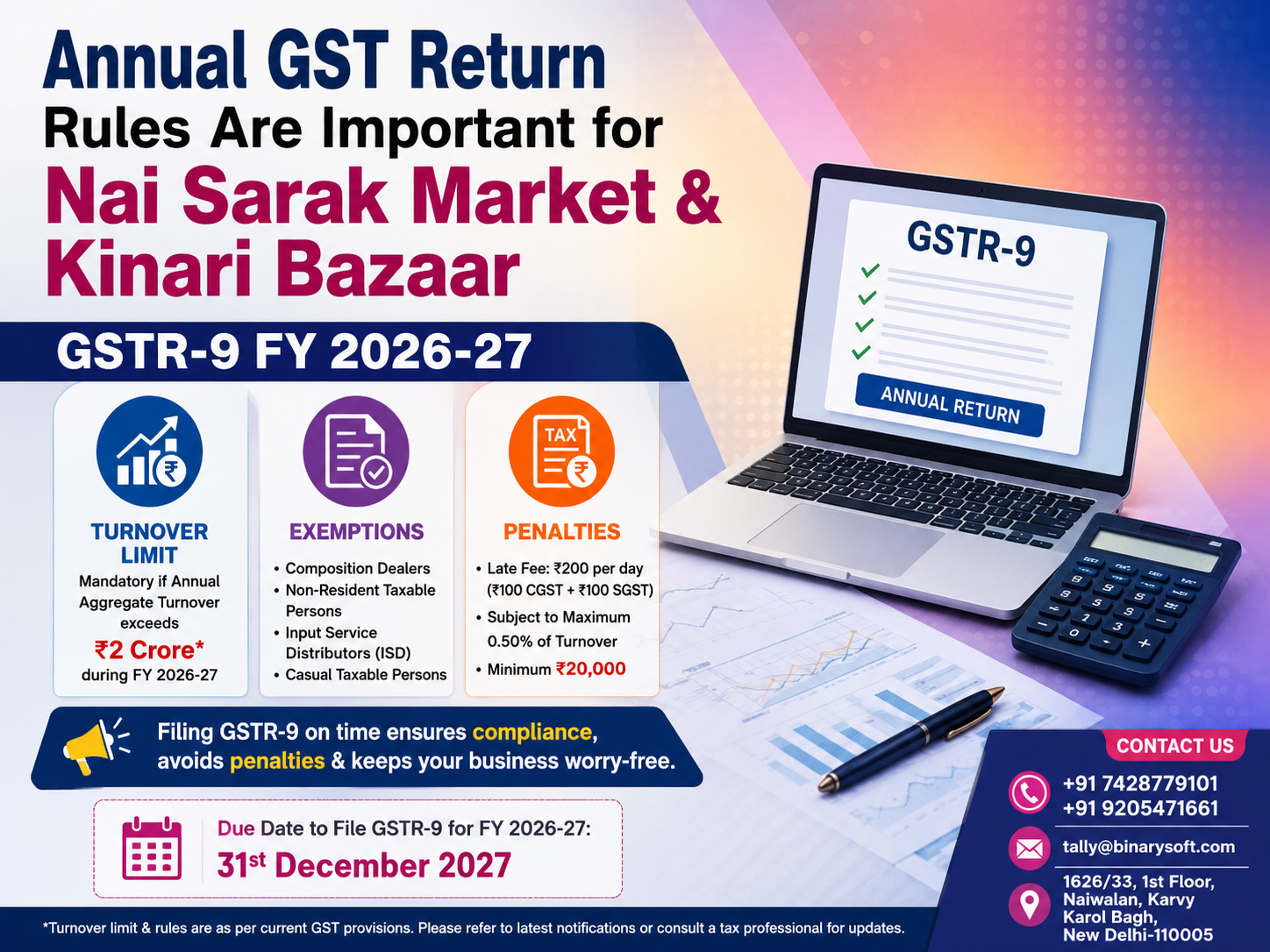
GSTR-9 FY 2026-27: Why Traders in Nai Sarak Market and Kinari Bazaar Should Start Preparing Now
In 2026, GST compliance is becoming increasingly data-driven, and businesses operating in busy wholesale markets such as Nai Sarak Market and Kinari Bazaar in Delhi cannot afford to treat the annual GST return as a year-end formality. GSTR-9 brings together an entire financial year's GST information, including outward supplies, purchases, Input Tax Credit (ITC), taxes paid, adjustments and other disclosures. The pressure comes when figures reported during the year do not reconcile with accounting books and GST records. The benefit of preparing early is significant: traders can identify mismatches, missing invoices, incorrect ITC claims and turnover differences before annual-return filing becomes urgent. For FY 2026-27, however, businesses should be careful about relying on old threshold assumptions. As of September 2026, the final annual-return position for FY 2026-27 may still depend on notifications or amendments issued for that financial year. A year-round reconciliation process is therefore the safer strategy.
Important update: This article is current as of 2 September 2026. Where FY 2026-27-specific exemptions, thresholds or procedural changes have not yet been formally notified, businesses should verify the latest CBIC/GST Portal notification before filing.
What Is GSTR-9?
GSTR-9 is the annual GST return for regular taxpayers. It consolidates information relating to supplies, purchases, Input Tax Credit, tax liability and other GST particulars for a financial year.
The GST Portal describes GSTR-9 as an annual return filed once for each financial year by applicable regular taxpayers, including SEZ units and SEZ developers. It covers information such as purchases, sales, ITC, refunds and demands.
For traders operating in markets such as Nai Sarak and Kinari Bazaar, the annual return effectively becomes a final GST summary of the year's business activity.
That makes accuracy particularly important.
FY 2026-27: Understand the Financial Year First
FY 2026-27 covers:
1 April 2026 to 31 March 2027
Under Section 44, the statutory framework provides for the annual return to be furnished by the 31st day of December following the end of the financial year, subject to applicable provisions, notifications, extensions and exemptions.
Accordingly, businesses should not wait until the end of 2027 to start checking their records.
The better approach is to reconcile accounts throughout FY 2026-27.
GSTR-9 Turnover Limit for FY 2026-27
This is one of the most important points for traders.
Historically, the government has issued financial-year-specific notifications exempting registered persons with aggregate turnover up to a specified threshold from furnishing the annual return. For example, CBIC's notification records show that taxpayers with aggregate annual turnover up to ₹2 crore were exempted from furnishing the annual return for FY 2020-21 and FY 2021-22 through specific notifications.
Therefore, businesses should not automatically assume that a previous year's ₹2 crore exemption applies unchanged to FY 2026-27.
As of September 2026, FY 2026-27 itself has not even ended. Any financial-year-specific exemption applicable to its annual return must be checked against the notification ultimately applicable to that year.
This distinction is extremely important for SEO articles, tax advice and actual compliance.
Practical approach for FY 2026-27
Businesses should calculate their aggregate turnover accurately and maintain GSTR-9-ready records regardless of whether they expect to fall below an exemption threshold.
If a notification subsequently grants exemption, the business can act accordingly.
If it does not, the records are already prepared.
Why GSTR-9 Matters for Nai Sarak Market Businesses
Nai Sarak is associated with a large trading ecosystem where businesses may handle substantial numbers of invoices, suppliers and customers.
A wholesaler can have hundreds or thousands of transactions during a financial year.
Consider a business dealing in books, stationery or related merchandise.
During FY 2026-27 it may have:
B2B sales,
B2C sales,
interstate transactions,
local purchases,
purchase returns,
sales returns,
credit notes,
debit notes,
Input Tax Credit,
reverse-charge transactions,
cancelled invoices,
discount adjustments,
and amendments to previously reported invoices.
Monthly GST filing may seem manageable individually.
But GSTR-9 asks the business to look at the entire financial year as one compliance period.
That is when differences become visible.
Why Kinari Bazaar Traders Need Extra Attention
Kinari Bazaar businesses can similarly have high transaction volumes, seasonal demand and extensive supplier networks.
Businesses dealing in decorative materials, wedding accessories, fabrics, embellishments and related wholesale goods may experience major sales peaks around festive and wedding seasons.
High-volume periods create a common accounting challenge.
The sales team focuses on dispatch.
The accounts team focuses on billing.
The purchase team focuses on stock.
GST compliance continues simultaneously.
One wrong GSTIN, forgotten credit note or incorrectly booked purchase can remain unnoticed for months.
That is why annual reconciliation should not begin only when the GSTR-9 deadline approaches.
A Trader's Story: The Invoice That Wasn't the Real Problem
Imagine a fictional wholesale trader named Rajesh, running a family business near Kinari Bazaar.
November was his busiest month.
Wedding-season orders were arriving continuously. His employees were working late, suppliers wanted payments, customers wanted urgent dispatches, and cartons were leaving the shop almost every hour.
Rajesh felt relieved when the season ended.
Sales were strong.
Payments were coming in.
Everything appeared fine.
Months later, while preparing annual GST records, his accountant found several differences between the books and GST data.
Rajesh initially thought:
"It must be one missing invoice."
It wasn't.
There were several issues—credit notes booked in the accounts but not properly reflected in GST working, purchase invoices requiring ITC verification, and differences between accounting turnover and return data.
None of the individual differences looked enormous.
Together, however, they became a serious reconciliation exercise.
For two days, Rajesh and his accountant searched invoices, supplier ledgers and GST reports.
The experience changed how he managed compliance.
Instead of asking his accountant once a year, "Is GSTR-9 ready?", he started asking every month:
"Are my books and GST returns matching?"
That small change made the following year's annual reconciliation dramatically easier.
The story is fictional, but the operational problem is familiar to many high-volume trading businesses.
What Information Does GSTR-9 Cover?
GSTR-9 provides a consolidated picture of the financial year's GST transactions.
The GST Portal states that GSTR-9 includes information concerning purchases, sales, Input Tax Credit or refund claimed and demands created, among other information.
Businesses therefore need to review several major areas.
1. Taxable Outward Supplies
Check taxable sales reported during FY 2026-27.
Compare:
Accounting software
Sales register
GSTR-1
GSTR-3B
E-invoice data, where applicable
Credit/debit notes
The objective is to understand whether the annual turnover reported across different systems is consistent.
2. B2B Sales
B2B transactions deserve special attention because customers may rely on invoices for their own ITC compliance.
Check:
Customer GSTIN
Invoice number
Invoice date
Taxable amount
CGST
SGST
IGST
Place of supply
Credit/debit notes
Amendments
Even small master-data errors can cause reconciliation problems.
3. B2C Transactions
Retail or counter sales should also be reconciled with accounting records.
For businesses handling both wholesale and retail customers, separating B2B and B2C transactions correctly becomes particularly important.
4. Input Tax Credit
ITC reconciliation is one of the most important parts of annual GST preparation.
Businesses should examine:
ITC recorded in books
ITC reflected through GST data
ITC claimed in GSTR-3B
ITC reversed
Blocked/ineligible ITC
Credit notes
Supplier adjustments
Imports, where applicable
Reverse-charge transactions
A purchase entry in accounting software does not automatically mean that the corresponding GST credit can be claimed without satisfying applicable conditions.
5. Credit Notes and Debit Notes
Wholesale markets frequently use credit notes because of:
Rate differences
Goods returned
Quality issues
Quantity differences
Post-sale discounts
Damaged goods
Cancelled orders
Every credit/debit note should be properly linked with the underlying commercial transaction and GST treatment.
6. Tax Paid During the Year
Tax liability reported through GST returns should be reconciled against the business's books.
The GST Portal's GSTR-9 guidance includes a section dealing with tax paid as declared in returns during the financial year.
Businesses should verify the treatment of:
CGST
SGST/UTGST
IGST
Cess, where applicable
Interest
Late fee
Other relevant liabilities
7. HSN-Wise Reporting
HSN reporting is another area traders should prepare carefully.
The GST Portal's current GSTR-9 manual provides HSN-related reporting instructions and distinguishes reporting based on turnover criteria. It also notes changes introduced to the annual-return interface from FY 2024-25 onward.
Businesses selling hundreds of different items should therefore maintain clean stock and HSN masters during the year.
Waiting until annual-return time to clean thousands of stock items can create unnecessary work.
Who Is Generally Outside GSTR-9 Under Section 44?
Section 44's statutory framework excludes certain categories from the normal annual-return requirement, including:
- Input Service Distributors
- Persons required to deduct tax under Section 51
- Persons required to collect tax under Section 52
- Casual taxable persons
- Non-resident taxable persons
The exact applicability should always be evaluated based on the taxpayer's registration type and current law.
Composition taxpayers follow a different annual-return mechanism. The GST Portal separately provides the annual GSTR-4 process for composition taxpayers.
GSTR-9 and GSTR-9C Are Not the Same
This confusion is common.
GSTR-9 is the annual GST return.
GSTR-9C is a reconciliation statement applicable according to the prescribed turnover criteria.
Under the current framework described by CBIC, GSTR-9C is self-certified and applies where aggregate turnover exceeds ₹5 crore during the financial year.
This means a trader should not simply ask:
"Do I have to file an annual return?"
The better questions are:
Do I have to file GSTR-9?
and
Do I also have to furnish GSTR-9C?
Why GSTR-9C Reconciliation Is Important
For businesses above the applicable threshold, reconciliation becomes especially important because GST return figures have to be examined against financial information.
Differences may arise because of:
Timing differences
Unreported invoices
Incorrect tax classification
Credit notes
Debit notes
ITC reversals
Year-end accounting entries
Unbilled revenue
Advances
Exempt supplies
Exports
Stock-related adjustments
Accounting corrections
Businesses should maintain explanations and supporting documentation for material differences.
GSTR-9 Late Fee and Penalties
Ignoring the annual return can become costly.
Section 47 provides for late fees for failure to furnish the annual return within the prescribed time.
Importantly, CBIC has also clarified the relationship between GSTR-9 and GSTR-9C for late-fee purposes. Where GSTR-9C is applicable, CBIC's 2025 clarification explains that the annual return under Section 44 consists of both GSTR-9 and GSTR-9C for purposes discussed in that circular.
Businesses should therefore not assume that simply submitting GSTR-9 resolves annual-return compliance where GSTR-9C is also applicable.
Because late-fee structures, waivers and caps can be affected by notifications, the applicable rules for FY 2026-27 should be verified at filing time.
Don't Wait Until December 2027
For FY 2026-27, businesses have a major advantage right now:
The financial year is still running.
That means errors can be identified much earlier.
A sensible compliance cycle could look like this:
April–June 2026: Review opening balances and GST masters.
July–September 2026: Perform quarterly sales and purchase reconciliation.
October–December 2026: Review ITC, supplier compliance and credit notes.
January–March 2027: Complete year-end GST review.
After March 2027: Reconcile final books with GST returns and prepare annual-return workings.
This is much safer than attempting to reconstruct an entire year's records at the last moment.
Common GSTR-9 Mistakes Traders Should Avoid
Difference Between Books and GSTR-1
Your accounting turnover and GSTR-1 turnover should be properly reconciled.
Never simply copy one number without understanding differences.
Difference Between GSTR-1 and GSTR-3B
Sales reported in GSTR-1 and tax liability discharged through GSTR-3B should be reviewed.
Any difference should have a clear explanation.
Incorrect ITC
ITC should not be treated merely as an accounting figure.
Eligibility and GST reporting must also be considered.
Missing Credit Notes
A credit note issued commercially may require corresponding GST treatment depending on the circumstances.
Wrong GSTIN
Incorrect customer GSTINs can create problems for both seller and buyer.
Incorrect HSN Mapping
Poor item-master management throughout the year can create significant work during annual reporting.
Ignoring Reverse Charge
Transactions covered by reverse-charge provisions should be identified separately.
Assuming GSTR-9C Is an External GST Audit
The framework changed from the earlier audit-based system.
CBIC confirms that the current Rule 80 framework uses a self-certified reconciliation statement for taxpayers exceeding the specified ₹5 crore threshold.
How Accounting Software Can Make Annual GST Compliance Easier
For a trader with ten invoices per month, manual reconciliation may be manageable.
For a wholesale business generating hundreds or thousands of invoices, it becomes much harder.
This is where structured accounting software such as TallyPrime can support better bookkeeping and GST preparation.
Businesses can maintain:
Sales vouchers
Purchase vouchers
GSTIN details
Stock items
HSN/SAC information
Tax ledgers
Credit notes
Debit notes
Customer outstanding balances
Supplier outstanding balances
Inventory
Bank transactions
Financial statements
GST-related records
The objective is not merely to "file GST."
It is to maintain clean books throughout the financial year so annual compliance becomes easier.
Why Nai Sarak and Kinari Bazaar Businesses Need Better GST Data
Traditional wholesale businesses often operate on relationships developed over decades.
But GST compliance is increasingly dependent on structured digital data.
A customer may call a supplier about an invoice from six months earlier.
A supplier may issue a credit note after goods are returned.
An accountant may discover that a GSTIN was entered incorrectly.
An owner may need turnover figures immediately.
Without properly maintained accounting data, each query becomes a manual search.
With organised records, the business can investigate quickly.
This difference becomes particularly visible during GSTR-9 preparation.
Monthly GST Reconciliation Strategy for FY 2026-27
Instead of thinking about GSTR-9 once every year, businesses should create a monthly closing process.
At the end of each month, check:
Sales register against GSTR-1
Tax liability against GSTR-3B
Purchase register against GST data
ITC claimed
ITC reversals
Credit/debit notes
Cancelled invoices
RCM transactions
GSTIN errors
HSN classification
E-invoices, where applicable
Books versus GST turnover
This reduces year-end surprises.
Quarterly Review Can Save Days of Work
Smaller businesses that cannot perform detailed monthly reconciliation should at least consider quarterly reviews.
For example:
June 2026: April–June review
September 2026: July–September review
December 2026: October–December review
March 2027: January–March review
At the end of the financial year, most major differences would already have been investigated.
GSTR-9 Preparation Checklist for Traders
Before annual-return preparation, keep the following ready:
- Final trial balance
- Sales register
- Purchase register
- GSTR-1 records
- GSTR-3B records
- GST ITC information
- Credit notes
- Debit notes
- RCM details
- HSN-wise sales data
- Tax payment information
- Refund information, where applicable
- Demand/order information, where applicable
- Export/SEZ records, where applicable
- E-invoice data, where applicable
- Relevant supporting documents
The GST Portal itself allows taxpayers preparing GSTR-9 to download items such as GSTR-1 summaries, GSTR-3B summaries, GSTR-9 system-computed summaries and Table 8A document details.
What If Turnover Is Close to ₹2 Crore?
This deserves special attention.
Suppose your FY 2026-27 turnover is approximately:
₹1.92 crore,
₹1.98 crore,
₹2.01 crore,
or ₹2.08 crore.
Do not estimate.
Calculate the applicable aggregate turnover correctly and verify the final notification governing GSTR-9 exemption for FY 2026-27.
A small calculation difference could change the compliance position if the eventual exemption uses a ₹2 crore threshold.
What If Turnover Crosses ₹5 Crore?
If aggregate turnover exceeds ₹5 crore, GSTR-9C becomes particularly important under the existing Rule 80 framework.
Businesses approaching this level should maintain reconciliation schedules throughout the year.
Do not wait until annual-return preparation to discover that:
Books differ from GST turnover,
ITC figures require explanation,
credit notes are missing,
or tax classifications do not reconcile.
GST Annual Return Is More Than a Filing Exercise
Many businesses see GSTR-9 as another government form.
That misses its practical value.
Annual reconciliation can expose weaknesses in the business's accounting process.
For example, recurring differences may indicate:
Poor invoice controls
Incorrect stock masters
Weak purchase-entry processes
Duplicate vouchers
Missing credit notes
Incorrect tax ledgers
Unreconciled ITC
Incorrect customer GSTINs
Poor supplier data
Delayed accounting entries
Solving these problems can improve both compliance and business management.
Benefits of Preparing GSTR-9 Early
Early preparation provides several advantages.
You get more time to investigate mismatches.
Your accountant is not forced to reconcile an entire year under deadline pressure.
Supporting invoices are easier to locate.
Supplier issues can be identified sooner.
Management gets more reliable turnover and tax information.
Accounting data becomes cleaner.
Future GST notices or queries can be easier to address because supporting records are organised.
Most importantly, the business owner has better visibility into the company's actual financial position.
GST Compliance Strategy for Nai Sarak Market
For Nai Sarak wholesalers, a practical strategy is to integrate GST controls with daily billing.
Every customer master should have accurate GST details.
Every stock item should have proper tax configuration.
Sales returns should be recorded promptly.
Credit notes should not remain outside the accounting system.
Purchase invoices should be entered systematically.
GST reconciliation should become part of routine accounting—not a separate year-end project.
GST Compliance Strategy for Kinari Bazaar
Kinari Bazaar businesses often experience seasonal spikes.
Therefore, reconciliation should ideally be completed immediately after high-volume periods.
For example, after a major wedding or festive sales season:
Review sales.
Check cancelled invoices.
Review returned goods.
Enter pending credit notes.
Verify purchase invoices.
Check ITC.
Reconcile customer accounts.
Reconcile supplier accounts.
This prevents seasonal transaction volumes from creating permanent accounting differences.
GSTR-9 FY 2026-27: Key Takeaway
The biggest mistake businesses can make today is assuming they already know what the final FY 2026-27 annual-return exemption will be.
The safer position is:
Maintain GSTR-9-ready books throughout FY 2026-27 and verify the final applicable notification before filing.
The current legal framework establishes annual-return requirements, while historical exemptions have been issued through specific notifications.
Similarly, the existing framework provides a ₹5 crore threshold for the self-certified GSTR-9C reconciliation statement.
How Binarysoft Technologies Can Help
Businesses using TallyPrime can benefit from properly configured accounting, inventory and GST workflows.
Binarysoft Technologies can assist businesses with Tally-related implementation, configuration, support and business accounting solutions so that transaction records remain better organised throughout the financial year.
For businesses in Nai Sarak Market, Kinari Bazaar and other Delhi wholesale markets, systematic accounting can help reduce the year-end burden of collecting and reconciling data.
Powered by Binarysoft Technologies
Authorized Tally Partner
Location: 1626/33, 1st Floor, Naiwalan, Karol Bagh, New Delhi – 110005, INDIA
Contact us: +91 7428779101, 9205471661
Email us: tally@binarysoft.com
Working Hours: 10:00 AM – 6:00 PM, Mon–Fri
Conclusion
For traders in Nai Sarak Market and Kinari Bazaar, GSTR-9 should not be treated as a form that becomes relevant only after the financial year ends.
FY 2026-27 is the right time to improve sales reconciliation, purchase recording, ITC verification, HSN masters, credit-note management and GST reporting.
The most important point is also the simplest: do not assume that a historical ₹2 crore GSTR-9 exemption automatically applies to FY 2026-27 until the relevant government notification confirms it. At the same time, businesses crossing the existing ₹5 crore threshold should pay particular attention to GSTR-9C requirements.
Good GST compliance begins with good accounting records. If your books, invoices, GST returns and inventory information are maintained accurately throughout the year, annual-return preparation becomes a reconciliation exercise rather than a last-minute investigation.
Frequently Asked Questions
What is GSTR-9?
GSTR-9 is the annual GST return applicable to regular taxpayers subject to the provisions and exemptions in force. It consolidates important information relating to supplies, purchases, ITC, taxes and other GST particulars for the financial year.
Is GSTR-9 mandatory below ₹2 crore for FY 2026-27?
Do not assume so yet. Previous financial years have received specific exemptions for taxpayers up to ₹2 crore, but the applicable notification for FY 2026-27 should be checked before filing.
CA. Aarav Bhandari specializes in GST compliance, accounting systems, and business advisory services. He regularly writes about tax updates, accounting automation, and financial best practices to help businesses improve efficiency and maintain statutory compliance.