Call CA Tally HelpDesk
+91 9205471661,
7428779101
What Changed for Businesses in 2026?
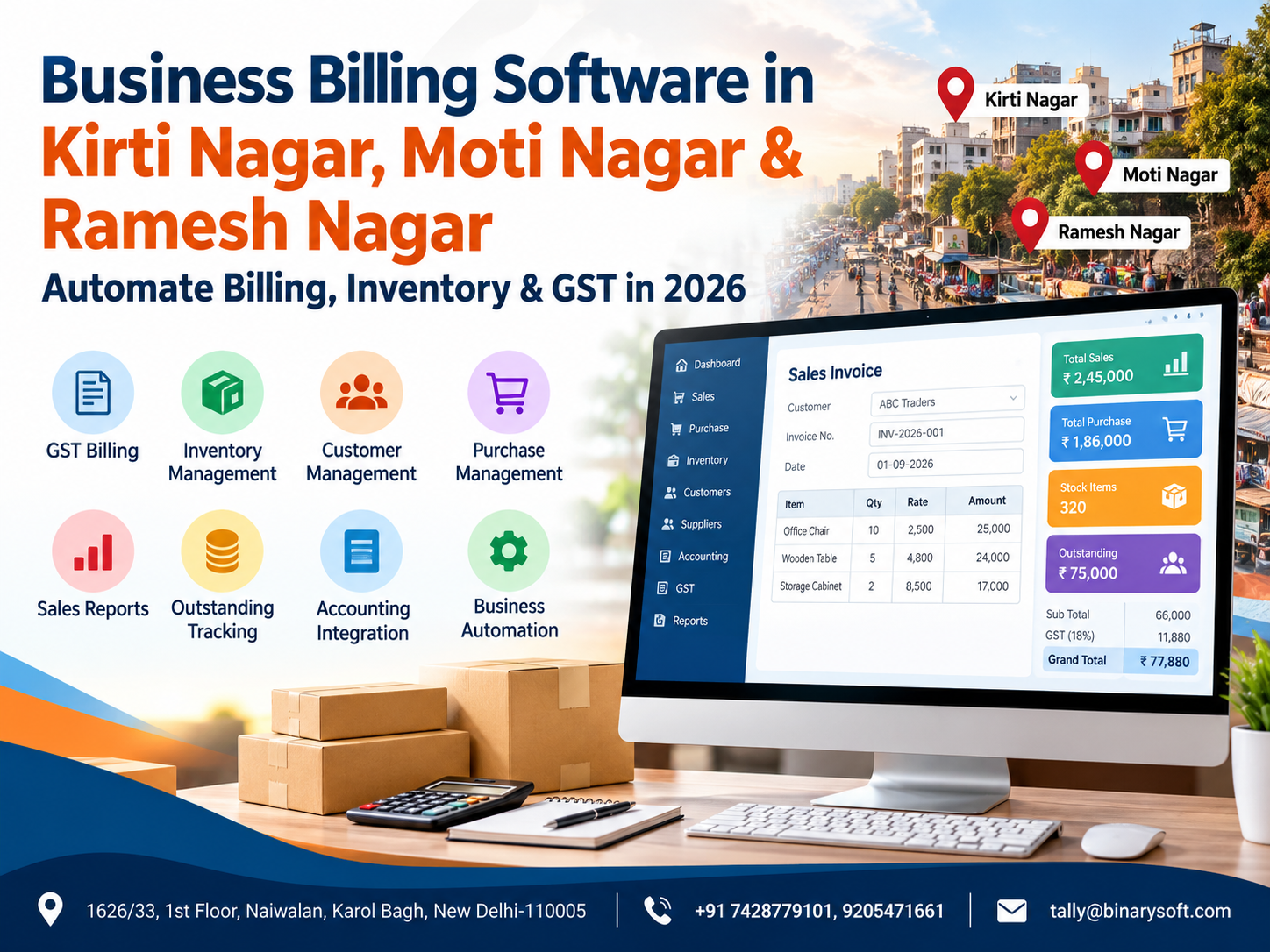
In 2026, businesses across Kirti Nagar, Moti Nagar and Ramesh Nagar are dealing with faster customer expectations, tighter stock control, digital payments and increasing pressure to keep billing and GST records accurate. Manual billing, Excel-based inventory tracking and disconnected accounting processes can make everyday operations slower and harder to monitor. A modern business billing software can bring sales invoices, inventory, customer records, purchase entries, GST information and accounting data into a more organized workflow. For wholesalers, manufacturers, retailers, distributors and growing local businesses, automation can reduce repetitive work and provide better visibility into sales and stock. The objective is not simply to generate an invoice faster. It is to create a connected business process where owners can understand what was sold, what remains in stock, what customers owe and how the business is performing.
Why Billing Automation Matters in Kirti Nagar, Moti Nagar & Ramesh Nagar
Delhi's business markets are changing quickly.
A customer may expect an invoice within minutes. A supplier may require immediate purchase information. A business owner may want to check today's sales while travelling. At the same time, stock has to be tracked, GST records have to be maintained and outstanding payments need regular monitoring.
When these activities are managed manually, the same information may have to be entered several times.
For example:
Sales → Invoice → Stock Reduction → Customer Ledger → GST Records → Accounting Reports
With integrated billing and accounting software, these activities can be connected within a single business workflow.
This is particularly useful for businesses operating in commercial areas such as:
- Kirti Nagar
- Moti Nagar
- Ramesh Nagar
- Najafgarh Road
- Patel Road
- Punjabi Bagh
- Rajouri Garden
- Naraina
- West Delhi industrial and commercial areas
The exact software configuration depends on the nature and size of the business, but the fundamental objective remains the same: less repetitive work and better control over business information.
A Story from a Growing Delhi Business
Consider a small wholesale business operating around the Kirti Nagar commercial area.
The business started with a few customers and a manageable number of invoices every day. Initially, handwritten bills and Excel sheets seemed sufficient.
As orders increased, the situation changed.
More customers meant more invoices. More products meant more stock entries. Purchases arrived from multiple suppliers. Some customers purchased on credit, while others paid immediately.
The owner started spending evenings checking whether the stock figures were correct.
One day, a customer urgently requested an invoice and availability confirmation for several products. The salesperson checked one sheet, the store employee checked another record and the owner finally confirmed the quantity manually.
The sale was completed, but valuable time was lost.
The problem was not a lack of hard work.
The problem was that the business had grown faster than its system.
After moving to an integrated billing, inventory and accounting workflow, the business could maintain sales, purchases, stock and customer accounts in a more structured manner.
That change is important for many growing businesses.
Business growth should reduce dependence on manual work—not increase it.
What Is Business Billing Software?
Business billing software is a digital system designed to help businesses create invoices, record sales, manage customers, track inventory and maintain financial information.
Depending on the software and configuration, businesses can manage:
- Sales invoices
- Purchase invoices
- GST billing
- Customer ledgers
- Supplier accounts
- Inventory
- Stock movements
- Payment receipts
- Outstanding balances
- Credit sales
- Business expenses
- Financial reports
- GST-related reports
- Profit and loss information
For businesses using accounting software such as TallyPrime, billing can become part of a broader accounting and inventory management system rather than remaining a separate activity.
Business Billing Software for Kirti Nagar
Kirti Nagar is well known for its furniture, interior, manufacturing, trading and commercial businesses.
Such businesses may handle a combination of:
- Multiple products
- Different product specifications
- Wholesale orders
- Retail sales
- Customer credit
- Supplier purchases
- Stock transfers
- Delivery-related transactions
- GST invoices
A billing system designed around the business workflow can make these processes easier to manage.
For example, a furniture or interior-related business may need to maintain product descriptions, quantities, rates, customer information and tax details on invoices.
An integrated system can also provide management reports that help the owner understand sales and stock movements.
Billing Software for Moti Nagar Businesses
Moti Nagar has a diverse business environment, including retailers, distributors, service providers, manufacturers and commercial establishments.
Different businesses have different billing requirements.
A retailer may focus heavily on:
Fast Billing + Inventory + Customer Management
A distributor may require:
Sales + Purchase + Stock + Outstanding + GST
A service business may focus more on:
Customer Records + Invoicing + Receivables + Accounting
Therefore, choosing billing software should not be based only on the invoice screen.
The entire business process should be considered.
Business Billing Software for Ramesh Nagar
For growing businesses in Ramesh Nagar, billing automation can help create a more organized sales and accounting workflow.
Instead of maintaining separate records for:
- Sales
- Purchases
- Customers
- Suppliers
- Stock
- Payments
- Expenses
businesses can use an integrated software environment where relevant transactions are connected.
This can make it easier for business owners and accountants to retrieve information when required.
Key Features to Look for in Business Billing Software
1. GST Billing
Businesses need accurate invoices containing relevant transaction and tax information.
A suitable billing system can help prepare GST-compliant invoices based on the configured business requirements.
Businesses should still verify applicable tax rates, GST classifications and compliance requirements with their accountant or tax professional.
2. Inventory Management
Inventory is one of the biggest areas where manual processes can create problems.
A good inventory system can help track:
- Opening stock
- Purchases
- Sales
- Closing stock
- Stock transfers
- Product-wise movement
- Warehouse or location-wise stock
- Reorder requirements
For businesses dealing with hundreds or thousands of products, automated inventory tracking can become particularly valuable.
3. Sales Invoice Management
Instead of preparing invoices manually, businesses can generate invoices using predefined company, customer and product information.
This can reduce repetitive data entry.
Businesses may also configure invoice formats according to their operational and branding requirements.
4. Purchase Management
Purchase transactions affect both accounting and inventory.
Recording purchases systematically helps businesses maintain supplier information and understand how stock is entering the business.
Purchase records can also support better analysis of:
- Supplier purchases
- Product costs
- Purchase quantities
- Outstanding supplier payments
- Stock availability
5. Customer Outstanding Management
Credit sales can create cash-flow pressure when outstanding payments are not monitored properly.
Billing and accounting software can help maintain customer ledgers and identify outstanding balances.
Business owners can then review:
- Customer-wise outstanding
- Due amounts
- Payment history
- Credit transactions
- Receivables
This gives management better visibility over money that needs to be collected.
Why Integration Between Billing and Accounting Matters
Imagine generating an invoice in one application and then manually entering the same transaction into accounting software.
That creates unnecessary duplication.
An integrated system can connect billing with accounting.
A typical workflow can look like:
Customer Order
↓
Sales Invoice
↓
Inventory Update
↓
Customer Ledger Update
↓
Accounting Entry
↓
Business Reports
This approach can save time and reduce repetitive entry.
Billing Software vs Excel for Business Management
Excel remains useful for many business activities.
However, as transaction volumes increase, businesses may find it difficult to use spreadsheets as the primary system for billing and inventory.
| Requirement | Excel-Based Process | Integrated Billing Software |
|---|
| Invoice generation |
Manual/template based |
Structured billing |
| Inventory tracking |
Manual formulas/entries |
Automatic transaction-linked updates |
| Customer ledger |
Separate sheets |
Integrated records |
| Purchase management |
Separate entries |
Connected workflow |
| Outstanding tracking |
Manual reconciliation |
Dedicated reports |
| GST information |
Requires careful setup |
Built into accounting workflow |
| Business reporting |
Often requires customization |
Available through reports |
| Multi-user operations |
Requires careful file management |
Designed for business workflows |
The right choice depends on business size, transaction volume and operational requirements.
How Automation Can Help Business Owners
Automation is not only about saving a few minutes while preparing an invoice.
The larger benefit is visibility.
A business owner may want answers to questions such as:
- How much did we sell today?
- Which products are selling faster?
- Which customers have outstanding payments?
- What stock is currently available?
- How much did we purchase this month?
- Which suppliers have pending payments?
- What are our expenses?
- What is the current financial position?
When business information is properly recorded, reports can help answer these questions more efficiently.
TallyPrime for Billing, Accounting & Inventory
For businesses looking for a broader accounting and business-management platform, TallyPrime can be configured for billing, accounting, inventory and GST-related business processes.
Depending on the business requirements, TallyPrime can support workflows involving:
- Sales
- Purchases
- Accounting
- Inventory
- GST
- Receivables
- Payables
- Banking
- Business reports
The exact features and configuration should be selected according to the business's transaction structure and requirements.
For businesses in Kirti Nagar, Moti Nagar and Ramesh Nagar, professional implementation can also help ensure that masters, ledgers, stock items, tax settings and invoice formats are configured correctly.
Benefits of Business Billing Automation in 2026
Faster Invoicing
Sales invoices can be prepared using stored customer and product information, helping reduce repetitive typing.
Better Stock Visibility
Every recorded sale or purchase can contribute to a more organized inventory record.
Improved Customer Management
Customer ledgers and outstanding reports make it easier to monitor receivables.
Better Purchase Control
Businesses can review purchase transactions and supplier balances from structured records.
Reduced Duplicate Data Entry
Connecting billing with accounting and inventory can reduce the need to enter the same transaction multiple times.
Easier Reporting
Business owners can access reports to understand sales, purchases, stock and financial information.
Better Business Control
Instead of relying entirely on memory, notebooks and scattered spreadsheets, management can use centralized business data.
Who Can Use Business Billing Software?
Business billing and accounting software can be useful for many types of businesses in West Delhi.
Retail Stores
Retailers can manage sales billing, inventory and customer transactions.
Wholesalers
Wholesale businesses can manage bulk sales, customer credit and inventory.
Distributors
Distributors can manage purchases, sales, stock and receivables.
Manufacturers
Manufacturers may require inventory, production and accounting workflows.
Furniture Businesses
Businesses dealing with furniture and interior products can maintain detailed product and sales information.
Electrical & Hardware Businesses
Large product inventories make structured inventory management particularly useful.
Garment & Textile Businesses
Businesses can manage products, sales and inventory according to their operational requirements.
Service Businesses
Service providers can use billing and accounting functionality for customer invoicing and financial tracking.
How to Choose the Right Billing Software
Before purchasing or implementing software, businesses should evaluate their actual workflow.
Ask these questions:
Does the software support GST billing?
Tax configuration should match the business's applicable requirements.
Can it manage inventory?
If stock is important to the business, inventory functionality should be evaluated carefully.
Can it handle credit sales?
Customer outstanding management is essential for businesses selling on credit.
Can it generate useful reports?
The software should provide reports that management actually needs.
Can multiple users work with it?
Growing businesses may require different users for billing, accounts, management and inventory.
Is data backup available?
Business records are valuable. Backup and security should therefore be considered before implementation.
Can the software grow with the business?
A solution that works for 50 invoices a month may not necessarily be suitable when the business reaches 1,000 invoices.
Common Billing Problems Businesses Face
Many businesses experience similar problems before automation.
Manual Invoice Errors
Typing customer names, product descriptions and amounts repeatedly increases the possibility of mistakes.
Stock Mismatch
When sales and purchase records are not updated consistently, physical stock and system stock can differ.
Delayed Payment Follow-Up
Without proper outstanding reports, customer payments may be followed up late.
Scattered Data
Business information may be distributed across notebooks, Excel files, WhatsApp messages and different computers.
Lack of Real-Time Visibility
Owners may need to contact staff just to find basic information about sales or stock.
Automation aims to bring these processes into a more structured system.
Business Automation Is More Than Billing
A common misconception is that business automation simply means replacing a handwritten invoice with a computer-generated invoice.
True automation goes further.
A connected business system can bring together:
Billing + Inventory + Accounting + Customers + Suppliers + GST + Reports
When these areas work together, business owners can spend less time searching for information and more time managing the business.
Local Business Advantage: Kirti Nagar, Moti Nagar & Ramesh Nagar
Businesses operating in these areas often deal with customers and suppliers across Delhi and NCR.
A structured digital system can make it easier to manage transactions regardless of where the customer or supplier is located.
For example:
Kirti Nagar Business
Furniture order → Sales invoice → Stock update → Customer ledger → Payment tracking
Moti Nagar Distributor
Purchase → Stock received → Sales invoice → Stock reduction → Customer outstanding
Ramesh Nagar Retailer
Customer sale → Invoice → Inventory update → Payment entry → Daily sales report
These examples show why billing should be considered part of the overall business process.
Implementation Process for Business Billing Software
A professional implementation can generally follow these stages.
Step 1: Understand the Business
First identify the business type, products, customers, suppliers and transaction volumes.
Step 2: Configure Company Details
Business information, financial year and required accounting settings are configured.
Step 3: Create Ledgers
Customer, supplier, income, expense, tax and other required ledgers are created.
Step 4: Configure Inventory
Stock groups, units, items and other relevant inventory information are configured.
Step 5: Configure Invoice Format
The business invoice can be configured according to its operational requirements.
Step 6: Import Existing Data
Where appropriate, existing customer, supplier, stock or accounting data can be migrated after validation.
Step 7: Testing
Sample sales, purchases, receipts and other transactions should be tested.
Step 8: User Training
Employees should understand the correct process for billing, inventory and accounting entries.
Step 9: Go Live
Once the system has been tested, the business can begin using the configured workflow.
Step 10: Ongoing Support
Regular support can help businesses resolve operational questions and maintain the system as requirements change.
Why Professional Implementation Matters
Software alone does not automatically solve business-process problems.
Incorrect ledger creation, wrong stock units, duplicate masters or inappropriate tax configuration can create reporting issues.
Professional implementation can help businesses:
- Understand their workflow
- Configure the system correctly
- Migrate relevant data
- Train users
- Test transactions
- Create required reports
- Establish a consistent billing process
This can be particularly useful for businesses moving from manual billing or spreadsheets to an integrated accounting system.
Security and Data Backup
Business accounting data contains valuable information.
Businesses should consider:
- Regular backups
- User access controls
- Strong passwords
- Proper authorization
- Secure computers and networks
- Controlled access to financial reports
- Regular verification of backup availability
Data security should be treated as part of business management rather than an afterthought.
Cloud-Based Business Management
Some businesses require access to accounting and billing information from different locations.
Cloud-based solutions can be useful when authorized users need access while working from:
- Office
- Warehouse
- Home
- Branch location
- Client location
However, cloud hosting should be selected according to the business's security, performance, connectivity and access requirements.
The Future of Business Billing in Delhi
Business operations are becoming increasingly digital.
Customers expect faster service. Owners want immediate information. Accountants need organized records. Businesses need better control over inventory and receivables.
This makes automation increasingly relevant for small and medium-sized businesses.
The goal is not to make business complicated with more technology.
The goal is to make everyday business activities simpler and more organized.
A well-configured billing and accounting system can become the foundation for that transition.
Why Businesses Choose Binarysoft Technologies
Binarysoft Technologies provides business software solutions and Tally-related services for businesses looking to improve billing, accounting and inventory workflows.
As an Authorized Tally Partner, Binarysoft Technologies can assist businesses with software selection, implementation, configuration, training and support based on their operational requirements.
Businesses in and around Kirti Nagar, Moti Nagar, Ramesh Nagar and other Delhi commercial areas can discuss their billing and accounting requirements before selecting a suitable configuration.
Binarysoft Technologies
Authorized Tally Partner
Location:
1626/33, 1st Floor, Naiwalan, Karol Bagh, New Delhi – 110005, INDIA
Contact:
+91 7428779101
+91 9205471661
Email:
tally@binarysoft.com
Business Hours:
10:00 AM – 6:00 PM, Monday–Friday
Conclusion
Business billing in 2026 is no longer only about creating an invoice. For growing businesses in Kirti Nagar, Moti Nagar and Ramesh Nagar, billing can be connected with inventory, accounting, customer management, purchases, GST-related records and business reporting.
Moving from manual records to an integrated billing and accounting system can help reduce repetitive data entry and give business owners better access to important information.
Whether the business is a retailer, wholesaler, distributor, manufacturer, furniture dealer or service provider, the right configuration should be based on its actual workflow, transaction volume and reporting requirements.
With proper implementation, training and ongoing support, business billing software can become an important part of a more organized and scalable business operation.
Frequently Asked Questions
What is business billing software?
Business billing software is a digital system used to create invoices and manage related business activities such as sales, purchases, inventory, customer accounts and accounting records.
Is billing software useful for businesses in Kirti Nagar?
Yes. Businesses in Kirti Nagar can use billing software for sales invoicing, inventory management, customer accounts, purchases and accounting, depending on their requirements.
CA. Aarav Bhandari specializes in GST compliance, accounting systems, and business advisory services. He regularly writes about tax updates, accounting automation, and financial best practices to help businesses improve efficiency and maintain statutory compliance.