Call CA Tally HelpDesk
+91 9205471661,
7428779101
What Changed in 2026 for Retail Businesses?
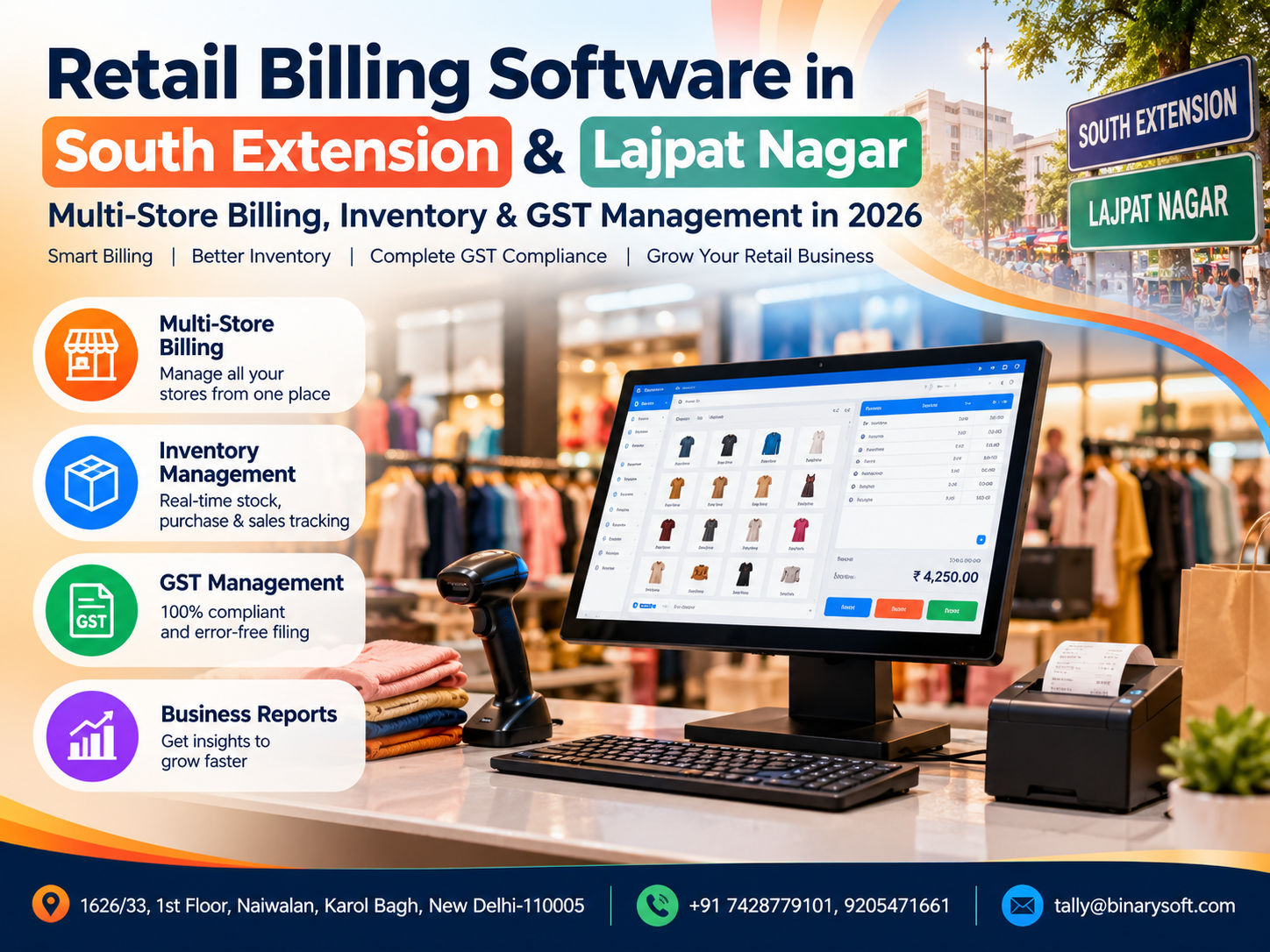
In 2026, retail businesses in South Extension and Lajpat Nagar are dealing with something bigger than simply generating bills quickly. Customers expect faster checkout, multiple payment options and accurate invoices, while business owners need real-time stock visibility, GST-ready accounting and control over multiple stores. In recent months, the pressure to connect billing, inventory, purchasing, accounting and compliance has increased as retailers manage more products, online enquiries and branch-level transactions. A disconnected billing counter or manually updated Excel sheet can quickly create stock mismatches, delayed replenishment and uncertainty over actual profitability. The benefit of moving to an integrated retail billing and inventory system is straightforward: every sale can update stock and accounts immediately, while management gets a clearer view of sales, inventory and outstanding amounts. For growing retailers, smarter billing is becoming the operational backbone connecting the counter, warehouse, accounts team and management.
Retail Management Is No Longer Just About Making an Invoice
South Extension and Lajpat Nagar are among Delhi's prominent shopping destinations. Retailers operating in these markets can deal with high customer footfall, large product ranges, seasonal demand and intense competition.
Whether the business sells garments, footwear, electronics, cosmetics, jewellery, home furnishing, accessories, mobile products or general merchandise, billing is only one part of everyday retail management.
A modern retailer may need to know:
Which products are selling fastest?
Which items have remained unsold for months?
How much stock is available at each location?
Which branch generated the highest sales today?
What is the current GST liability?
Which supplier payments are pending?
What is the gross margin on a particular category?
Has stock been transferred from one store to another?
Which products need immediate replenishment?
Answering these questions manually becomes increasingly difficult as a business grows.
This is where integrated retail billing, inventory and accounting software can make a significant difference.
Why Retailers in South Extension & Lajpat Nagar Need Better Billing Systems
Traditional billing software was primarily designed to generate invoices and print receipts. Modern retail management demands much more.
Businesses need billing software that can connect sales transactions with inventory, purchases, GST, accounting and management reporting.
Imagine operating two retail stores and one warehouse.
A customer buys five products from Store A. Another employee transfers 20 units from the warehouse to Store B. Meanwhile, a purchase order for 100 units is received from a supplier.
If these transactions are maintained separately, the owner may not know the actual available inventory without calling employees or checking several reports.
With an integrated system, each transaction can be recorded within a connected business workflow.
Sales reduce inventory.
Purchases increase inventory.
Stock transfers update location-wise quantities.
Accounting entries reflect transactions.
GST-related information remains available for compliance and reconciliation.
Management reports provide visibility into overall business performance.
That integration is particularly valuable for retailers expanding beyond a single counter or store.
A South Delhi Retailer's Story: When Growth Created More Stress Than Success
Consider the example of a fictional apparel retailer operating a busy shop in Lajpat Nagar.
For years, the owner managed the business personally. He knew many regular customers, remembered his important suppliers and could almost estimate stock levels simply by looking around the shop.
Then the business grew.
A second outlet was opened closer to South Extension. Sales increased, more employees were hired and the number of product variants expanded dramatically.
Growth should have felt exciting.
Instead, every evening became stressful.
One store would call asking whether a particular size was available at the other location. The accountant maintained purchase records separately. Employees prepared stock-transfer notes manually. During busy weekends, some inventory movements were recorded late.
One evening, a customer visited specifically for a product that the system appeared to show as available.
The employee searched the shelves.
Nothing.
The customer waited, became frustrated and eventually left.
The owner later discovered that the item had been transferred to the second store but the stock record had not been updated properly.
It wasn't a massive financial loss by itself.
But it exposed a bigger problem.
The business had grown faster than its management system.
After implementing a structured multi-location billing and inventory process, the owner could see store-wise stock, monitor transfers and review sales without repeatedly calling employees.
The biggest improvement wasn't merely faster billing.
It was confidence in the information being used to make decisions.
That is the real value of an integrated retail management system.
What Is Multi-Store Retail Billing Software?
Multi-store retail billing software is designed to help businesses manage sales and operational information across more than one retail location.
Instead of maintaining completely separate records for each shop, businesses can structure their information so management can monitor multiple locations more efficiently.
Depending on the software configuration and business requirements, retailers may manage:
Store-wise billing
Location-wise inventory
Warehouses and godowns
Purchase transactions
Stock transfers
Customer accounts
Supplier accounts
GST-related transactions
Receivables and payables
Cash and bank transactions
Profitability reports
Management reports
This provides a more consolidated view of the business.
Store-Wise Inventory Management
Inventory is one of the biggest investments for many retail businesses.
Too much stock blocks working capital.
Too little stock can lead to missed sales.
Incorrect stock information creates confusion.
Retail software should therefore help businesses maintain accurate quantities across stores and warehouses.
For example, a retailer may maintain:
South Extension Store – 12 units
Lajpat Nagar Store – 7 units
Central Warehouse – 35 units
Total Stock – 54 units
Instead of simply knowing that 54 units exist somewhere in the business, management can understand exactly where the inventory is located.
That makes replenishment and stock transfers much easier to plan.
Faster Retail Billing at the Counter
During peak shopping hours, customers don't want to wait while staff struggle with slow billing processes.
Retail billing software should support quick item selection, accurate pricing, tax calculation and invoice generation.
Depending on the business setup, the billing workflow can also incorporate barcode-based product identification and different payment modes.
The objective is simple: reduce unnecessary steps between product selection and payment.
Faster billing can improve both customer experience and employee productivity.
Barcode-Based Billing and Inventory Control
For businesses handling hundreds or thousands of SKUs, barcode-based workflows can substantially reduce manual product identification.
Instead of typing item descriptions repeatedly, employees can scan products during billing.
A well-planned barcode workflow can help retailers improve:
Product identification
Billing speed
Stock accuracy
SKU management
Item tracking
Counter efficiency
Physical stock verification
For garment, footwear, electronics, cosmetics and accessory retailers, barcode management becomes especially valuable when products have multiple sizes, colours, models or variants.
Managing Size, Colour and Product Variants
Consider an apparel retailer selling one shirt design.
That single design may be available in:
Small
Medium
Large
XL
XXL
It may also come in black, white, blue and grey.
Suddenly, one product design becomes 20 different stock combinations.
If inventory isn't maintained at the variant level, staff may know that a shirt is "available" without knowing whether the required size and colour are actually in stock.
Structured inventory management helps retailers maintain more precise product information and improve availability checks.
Multi-Store Stock Transfers
One of the most important features for growing retail chains is stock transfer management.
Suppose a product is selling rapidly in South Extension but moving slowly in Lajpat Nagar.
Instead of ordering additional inventory immediately, management may decide to transfer stock between stores.
A structured transfer process helps maintain accurate location-wise records.
This can reduce unnecessary purchases and help businesses use existing inventory more efficiently.
Reorder Levels and Stock Planning
Retailers shouldn't have to discover that an important product is out of stock only when a customer asks for it.
Inventory systems can help businesses monitor stock levels and identify products approaching their desired minimum quantity.
This allows purchasing teams to act earlier.
Better replenishment planning can help reduce two costly situations:
Stock-outs, where demand exists but products aren't available.
Overstocking, where excessive quantities remain unsold and working capital gets blocked.
GST Billing and Compliance Management
GST is an important part of retail accounting in India.
Retail businesses need accurate classification, tax calculation and transaction records to support their compliance processes.
A properly configured accounting and billing system can help maintain GST-related information alongside normal business transactions.
This may include GST invoices, tax rates, HSN-related information, sales and purchase records, and reports used during return preparation and reconciliation.
However, software does not replace professional tax advice. Businesses should ensure their GST configuration and filings are reviewed according to applicable requirements.
Why Accounting Integration Matters
A billing system becomes much more valuable when sales transactions are connected with accounting.
Consider what happens after an invoice is generated.
The sale affects revenue.
GST may create tax liability.
Inventory quantity changes.
Cost of goods affects profitability.
Cash, bank, card or other payment records need to be maintained.
If all these records are maintained in disconnected systems, employees may spend additional time entering or reconciling the same information.
Integrated accounting reduces duplication and provides management with a clearer financial picture.
TallyPrime for Retail Business Management
TallyPrime is widely used by businesses for accounting, inventory and compliance-related workflows.
For retailers, a properly configured TallyPrime environment can bring multiple business processes together rather than treating billing and accounting as completely separate activities.
Depending on business requirements and configuration, retailers can use TallyPrime for areas such as sales and purchase transactions, inventory management, godown/location tracking, accounting, receivables, payables, GST-related records and business reporting.
For businesses already using Tally for accounting, extending the system into structured inventory and billing workflows may also reduce the need to maintain completely separate records.
Retail Billing Software for Clothing Stores
Fashion and apparel retailers face unique inventory challenges.
The same product may have several colours, sizes, designs and price points.
Retail software can help structure inventory around these variations, allowing employees and owners to understand what is actually available.
Historical sales information can also help identify popular categories and slow-moving products.
Retail Software for Footwear Stores
Footwear businesses face similar variant-level challenges.
One shoe design can exist in multiple sizes and colours.
A product may sell strongly in size 8 while size 11 remains on the shelf.
Maintaining detailed inventory records helps retailers make better purchasing decisions instead of simply reordering the same quantities across every size.
Electronics and Mobile Retailers
Electronics retailers often need detailed item tracking because of high product values and rapidly changing models.
Accurate product identification and stock information are particularly important.
A structured inventory system helps management understand what has been purchased, sold and remains available.
Cosmetics and Beauty Retailers
Cosmetics businesses can manage large numbers of products, brands, shades and categories.
Fast-moving products may need frequent replenishment, while slow-moving products can occupy shelf space and working capital.
Category-wise and item-wise reporting helps management identify these patterns more clearly.
Managing Multiple Payment Modes
Today's retail customers may pay through several methods.
Cash, cards, UPI and other approved payment channels may all be part of the daily collection process.
At the end of the day, management needs to understand how much money was collected through each mode and whether the records reconcile correctly.
A structured billing and accounting workflow makes this reconciliation easier.
Real-Time Business Visibility for Owners
One of the biggest problems in a multi-store business is delayed information.
An owner should not have to wait until the end of the month to understand how stores are performing.
Good business reporting can help answer questions such as:
What were today's sales?
Which store generated more revenue?
Which product category performed best?
Which items are running low?
What payments are outstanding?
How much inventory is held at each location?
Which products are moving slowly?
These insights help business owners move from reactive management toward more informed decision-making.
Identifying Fast-Moving and Slow-Moving Stock
Not every product deserves equal shelf space or purchasing priority.
Some products sell almost immediately after arrival.
Others remain in inventory for months.
Without reports, both products may simply appear as "stock."
Inventory analysis can help management identify movement patterns.
For slow-moving inventory, a retailer might consider reducing future purchase quantities, transferring stock to another location, adjusting merchandising, or using an appropriate promotional strategy.
For fast-moving inventory, timely replenishment can help prevent missed sales.
Purchase and Supplier Management
Retail management doesn't begin when products reach the shop.
Purchasing decisions affect margins, stock availability and working capital.
An integrated business system can help maintain supplier transactions, purchase records and outstanding balances.
This allows management to connect what was purchased with what was eventually sold.
That connection is essential for understanding the economics of retail operations.
Receivables and Payables Management
Some retail and distribution businesses also deal with credit customers.
At the same time, suppliers may provide credit periods.
Without proper accounting records, receivables and payables can become difficult to monitor.
Integrated accounting helps businesses review customer outstanding amounts and supplier liabilities in a structured manner.
This can support better cash-flow planning.
Protecting Profit Margins
A product may generate impressive sales without producing an equally impressive profit.
Retailers therefore need to look beyond turnover.
Management reporting should help businesses examine product costs, selling prices, discounts and margins.
For example, Store A might generate higher revenue while Store B produces a stronger margin because of a different product mix or discount strategy.
This is why sales figures alone don't tell the whole story.
Reduce Dependence on Manual Excel Sheets
Excel remains extremely useful for analysis and reporting, but maintaining core operational transactions across multiple independent spreadsheets can create challenges.
Different employees may maintain different versions.
A formula can be accidentally changed.
Stock updates may be delayed.
Files may not be synchronized.
Management may struggle to determine which file contains the latest information.
For growing retailers, the core transaction system should ideally provide a consistent source of business information, with Excel used where appropriate for additional analysis rather than becoming the only operational database.
Benefits for South Extension Retail Businesses
South Extension retailers frequently serve customers looking for branded fashion, jewellery, footwear, lifestyle products and other premium retail categories.
For these businesses, customer experience matters.
A well-managed billing and inventory process can help reduce checkout delays, improve product availability information and give management better control over valuable inventory.
If a customer asks whether another branch has a particular item, reliable location-wise inventory information can also help staff respond more confidently.
Benefits for Lajpat Nagar Retail Businesses
Lajpat Nagar businesses can experience high transaction volumes, especially during weekends, festivals and wedding seasons.
During busy periods, even small operational inefficiencies can multiply quickly.
Faster billing, accurate stock information and better inventory replenishment become particularly important when transaction volumes rise.
Retail software can help owners maintain control without requiring them to personally supervise every transaction.
Preparing for Seasonal Retail Demand
Delhi retailers experience major demand changes during festivals, weddings and seasonal shopping periods.
Historical transaction data can help businesses understand which categories previously performed strongly.
This can support better purchase planning before the next peak period.
Instead of relying entirely on intuition, retailers can combine experience with actual sales information.
Multi-Store Retail Expansion
A business that operates one store today may open another location tomorrow.
The software architecture should therefore be considered with future growth in mind.
Before selecting a retail management solution, businesses should consider whether it can support additional locations, more users, larger inventory volumes and increasingly detailed reporting.
Choosing only for today's requirements can create another migration challenge later.
How to Choose Retail Billing Software in 2026
Before implementing a system, retailers should evaluate their actual workflow rather than simply choosing the software with the longest feature list.
Important considerations include billing speed, inventory requirements, barcode workflows, multi-location stock management, GST-related requirements, accounting integration, user access, reporting requirements, backup processes and implementation support.
Businesses should also identify their most painful existing problems.
For one retailer, the priority may be faster billing.
For another, it may be stock control.
For a growing chain, it could be centralized visibility across stores.
The right implementation should solve the real operational problems first.
Why Implementation and Support Matter
Software itself is only part of a successful retail automation project.
Configuration, data setup, employee training and ongoing support are equally important.
Poor implementation can leave employees confused even when the underlying software is capable.
A structured implementation should understand the business's billing workflow, inventory structure, stores, warehouses, tax requirements, reports and management expectations.
Employees should also know how transactions need to be recorded consistently.
Role of Binarysoft Technologies
Binarysoft Technologies helps businesses evaluate and implement Tally-based accounting, billing and inventory solutions according to their operational requirements.
As an Authorized Tally Partner, Binarysoft Technologies can assist businesses with TallyPrime licensing, implementation, configuration, inventory setup, billing workflows, training and support.
For retailers in South Extension, Lajpat Nagar and other parts of Delhi, the objective should not simply be installing accounting software.
The objective should be creating a structured business workflow in which sales, inventory and accounts work together.
From Billing Counter to Business Intelligence
The biggest shift in modern retail management is the way transaction data can be used.
Every invoice contains information.
Every purchase creates information.
Every stock transfer creates information.
Every return creates information.
When this information is properly organized, retailers can use it to understand demand, improve inventory planning, monitor branch performance and make more informed business decisions.
That is why retail billing software should no longer be viewed merely as an invoice-printing application.
It can become an important source of operational intelligence.
Conclusion
Retail businesses in South Extension and Lajpat Nagar operate in highly competitive markets where customers expect speed, availability and professional service. At the same time, owners need stronger control over stock, purchases, billing, GST-related records, accounting and profitability.
As a business expands from one counter to multiple stores or warehouses, manual processes become harder to manage. Stock transfers can be missed, product availability becomes uncertain, reconciliation consumes time and management decisions may depend on outdated information.
A properly configured retail billing, inventory and accounting solution can bring these processes together.
The goal is not automation simply for the sake of technology. It is to make everyday retail operations more accurate, visible and manageable.
For retailers planning to expand in 2026 and beyond, building a connected billing and inventory system today can provide a stronger operational foundation for tomorrow.
Powered by Binarysoft Technologies
Authorized Tally Partner
Location: 1626/33, 1st Floor, Naiwalan, Karol Bagh, New Delhi – 110005, INDIA
Contact us: +91 7428779101, 9205471661
Email us: tally@binarysoft.com
Business Hours: 10:00 AM – 6:00 PM, Mon–Fri
Frequently Asked Questions
What is retail billing software?
Retail billing software helps businesses create sales invoices and manage transaction records. More comprehensive solutions can also integrate inventory, purchases, accounting, GST-related information and management reporting.
Can retail software manage multiple stores?
Yes. Depending on the software and configuration, multi-store systems can maintain store-wise or location-wise inventory, transactions and reports.
CA. Priya Tanvi specializes in accounting compliance, GST advisory, and business reporting for small and growing enterprises. She works with business owners to improve record-keeping and financial clarity. Her articles focus on practical compliance solutions and operational discipline.