Call CA Tally HelpDesk
+91 9205471661,
7428779101
What Changed in 2026: MSME Payments Are Now a Serious Accounting, Tax and Cash-Flow Priority
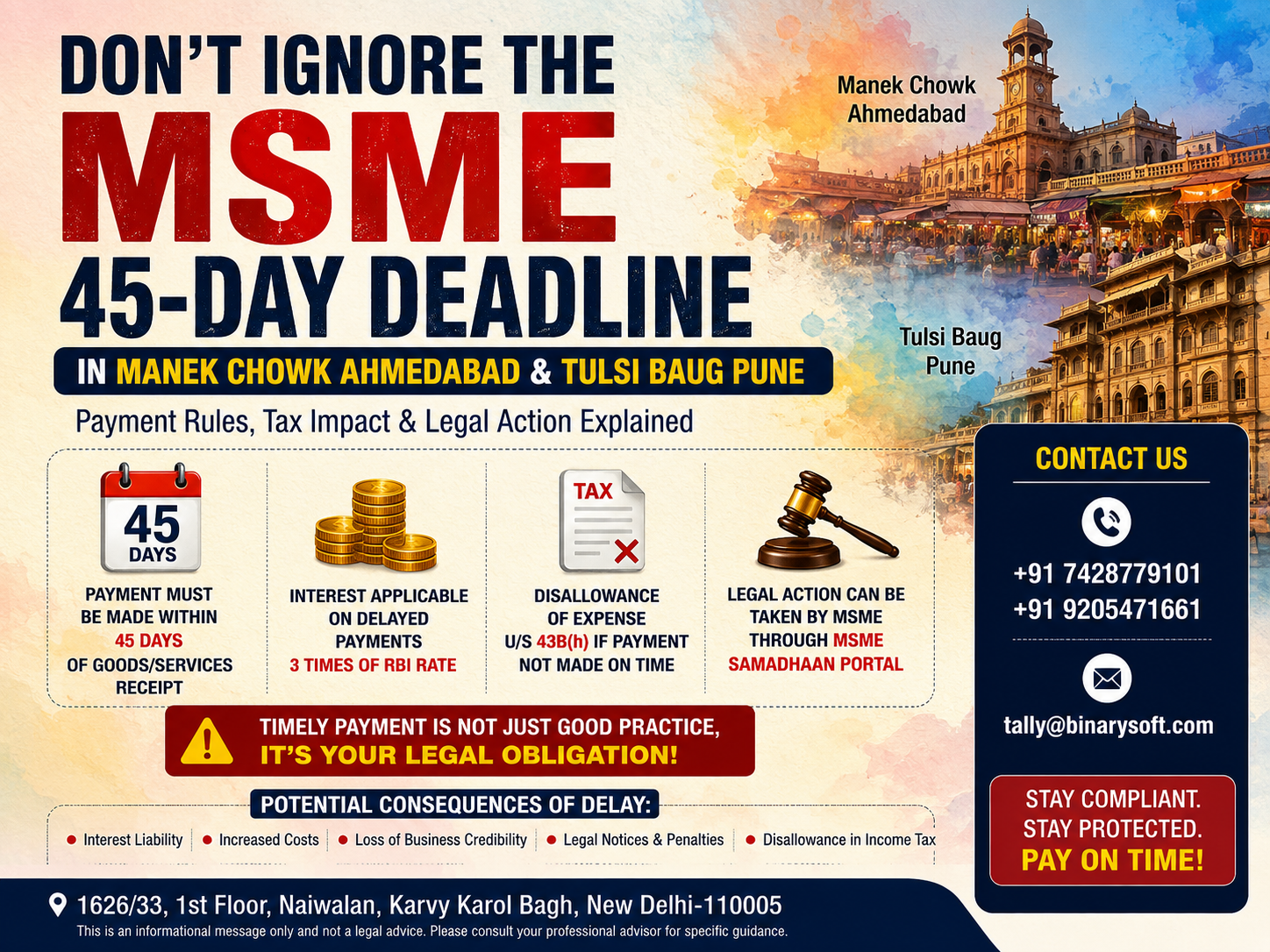
In 2026, businesses operating in busy commercial markets such as Manek Chowk Ahmedabad and Tulsi Baug Pune cannot afford to treat unpaid MSME supplier bills as ordinary outstanding creditors. The pressure is coming from several directions at once: the MSMED Act continues to impose strict payment timelines for eligible Micro and Small Enterprises, delayed payments can attract substantial statutory interest, and income-tax rules can affect when certain overdue expenses are allowed as deductions. At the same time, India moved to the Income-tax Act, 2025 for Tax Year 2026–27 onwards, making accurate accounting classification and updated compliance systems even more important. For traders, wholesalers, retailers and growing businesses, the practical benefit of acting early is significant: identify eligible MSME suppliers, record acceptance dates correctly, monitor due dates, schedule payments before they become overdue and maintain documentary evidence. A simple payment-control system today can prevent tax complications, supplier disputes and avoidable cash-flow pressure tomorrow.
Why the MSME 45-Day Payment Rule Matters in 2026
Markets such as Manek Chowk in Ahmedabad and Tulsi Baug in Pune depend on an enormous network of suppliers, manufacturers, service providers, distributors and small businesses.
A retailer may purchase packaging material from one supplier, garments from another, printing services from a third and shop equipment from yet another.
When business is moving quickly, invoices often enter the accounting system with credit periods of 30, 45, 60 or even 90 days.
But where an eligible Micro or Small Enterprise is involved, businesses need to understand that their normal commercial credit practice cannot simply override the statutory MSME payment framework.
Under Section 15 of the Micro, Small and Medium Enterprises Development Act, 2006, the payment period agreed in writing between the buyer and supplier cannot exceed 45 days from the day of acceptance or deemed acceptance.
Where there is no written agreement, the statutory framework operates with reference to the “appointed day”, linked to the prescribed 15-day period.
Therefore, “45 days” should not be understood as an automatic credit period available on every MSME invoice.
That distinction is extremely important.
Understanding the MSME Payment Timeline
Businesses should think about MSME payment compliance in two common situations.
Situation 1: There Is a Written Agreement
Suppose a buyer and eligible Micro or Small Enterprise have agreed to a 30-day payment period.
The buyer should follow the agreed 30-day period.
The fact that the law provides an outer ceiling of 45 days does not automatically convert a 30-day agreement into a 45-day agreement.
Similarly, an agreement attempting to provide 60 or 90 days cannot simply be relied upon to defeat the statutory maximum applicable under the MSMED Act.
Situation 2: There Is No Written Agreement
Where there is no written payment agreement, businesses need to examine the statutory “appointed day” mechanism rather than automatically assuming they have 45 days.
This is why businesses should record not only invoice dates but also delivery, acceptance and, where relevant, objection or dispute dates.
The Most Common Mistake: “Every MSME Invoice Has a 45-Day Due Date”
This is one of the most dangerous misunderstandings.
The MSMED Act does not simply say that every buyer always gets 45 days to pay.
The actual due date can depend on:
- Whether there is a written agreement
- The agreed payment period
- Date of acceptance
- Date of deemed acceptance
- Whether a written objection was raised regarding the goods or services
- The supplier's eligible MSME status
For accounting teams, therefore, calculating “invoice date + 45 days” across the entire purchase ledger may not be sufficient.
A Manek Chowk Story: When One Outstanding Ledger Became a Serious Problem
Consider a fictional example inspired by the everyday realities of a busy trading market.
Rajesh runs a growing wholesale business near Manek Chowk, Ahmedabad. Festival demand had been excellent. Orders were coming quickly, customers were buying in bulk and his accountant was processing dozens of purchase invoices every week.
One of his smaller suppliers repeatedly requested payment.
“Sir, please clear the old invoices. We need the money to purchase raw material.”
Rajesh was not refusing payment. His business simply followed a 60-day vendor cycle, and he assumed another few weeks would make little difference.
Then his accountant began reviewing the supplier master and outstanding bills.
The supplier was an eligible Micro Enterprise.
Several invoices required immediate attention.
Suddenly, what Rajesh considered a routine payable became a compliance, taxation and supplier-relationship issue.
More importantly, the supplier was struggling to pay workers and purchase materials because the buyer's delayed payment had blocked its working capital.
Rajesh cleared the eligible dues and changed the company's process.
From then on, his accounting team maintained separate MSME classifications, payment due dates and weekly ageing reports.
The lesson was simple: an outstanding invoice may look like one line in a buyer's ledger, but for a Micro Enterprise, that same invoice can represent salaries, rent, raw materials and survival.
What Happens If a Buyer Delays Payment?
The MSMED Act provides significant consequences for delayed payments to eligible Micro and Small Enterprises.
Under Section 16, where a buyer fails to make payment as required, the buyer can become liable for compound interest with monthly rests at three times the bank rate notified by the Reserve Bank of India.
That makes MSME delayed-payment interest fundamentally different from an ordinary vendor late-payment charge.
Businesses should therefore not treat MSME interest exposure as something that can safely be ignored until year-end.
Simple Example of the Business Impact
Suppose a Tulsi Baug retailer purchases eligible goods or services from a qualifying Micro Enterprise.
Invoice amount: Rs. 5,00,000
Assume the applicable statutory payment deadline expires and the amount remains outstanding.
The business now potentially faces more than a simple Rs. 5 lakh creditor balance.
It may have to consider:
- Statutory delayed-payment interest
- Income-tax implications
- MSME disclosure requirements where applicable
- Vendor disputes
- MSEFC proceedings
- Working-capital pressure
- Damage to supplier relationships
- Additional accounting and reconciliation work
The longer an eligible invoice remains unresolved, the greater the potential problem becomes.
MSME 45-Day Rule and Income Tax: Why Businesses Must Be Careful
The tax dimension made MSME payment monitoring even more important.
For periods governed by the Income-tax Act, 1961, Section 43B(h), introduced by the Finance Act, 2023, provides for actual-payment-based treatment of sums payable to qualifying Micro or Small Enterprises where payment is made beyond the time allowed under Section 15 of the MSMED Act.
In practical terms, an otherwise deductible purchase or business expense could face disallowance in the relevant year if the qualifying MSME amount was not paid within the prescribed MSMED Act timeline.
The Income Tax Department's guidance confirms the application of Section 43B(h) to amounts payable to Micro or Small Enterprises beyond the Section 15 timeline.
Businesses should therefore not assume that merely recording the purchase or expense in the books automatically secures the deduction for that year.
Important 2026 Update: India Has Moved to the Income-tax Act, 2025
This point deserves special attention in any article discussing MSME tax compliance in 2026.
From 1 April 2026, the Income-tax Act, 2025 replaced the Income-tax Act, 1961 for Tax Year 2026–27 onwards.
However, earlier tax years continue to be governed by the old Act under the applicable transitional provisions.
Therefore, businesses and accountants may encounter references to Section 43B(h) when dealing with earlier periods, while compliance for Tax Year 2026–27 onwards must be mapped to the corresponding provisions of the Income-tax Act, 2025 and Income-tax Rules, 2026.
Businesses should not blindly copy old section numbers into their 2026–27 compliance procedures.
The underlying MSME payment discipline remains extremely important, but accounting software, tax-working templates, ERP configurations and professional checklists should be updated for the new Act.
What Does This Mean for FY 2025–26 Closing?
This distinction becomes particularly important when preparing accounts and returns relating to periods ending before 1 April 2026.
The Income Tax Department has clarified that earlier periods remain governed by the Income-tax Act, 1961.
Therefore, while filing returns for AY 2026–27 relating to FY 2025–26, businesses still need to consider the provisions applicable under the old Act, including Section 43B(h), where relevant.
This makes supplier-wise MSME reconciliation essential before finalising the tax computation.
Does the Tax Disallowance Apply to Medium Enterprises?
A common source of confusion is the term “MSME”.
MSME collectively includes:
Micro Enterprises
Small Enterprises
Medium Enterprises
However, the delayed-payment tax provision historically associated with Section 43B(h) specifically refers to sums payable to a Micro or Small Enterprise within the meaning of the MSMED Act.
Therefore, businesses should not simply create one generic “MSME = Yes” field and assume every MSME supplier receives identical tax treatment.
Supplier classification matters.
Why Udyam Details Should Be Collected From Vendors
One of the first practical steps for businesses in Manek Chowk, Tulsi Baug and other commercial areas is to maintain reliable supplier information.
The purchase or accounts team should obtain appropriate MSME/Udyam details from suppliers and maintain supporting records.
The supplier master can include information such as:
Supplier name
GSTIN
PAN
Udyam Registration Number
Enterprise classification
Nature of activity
Effective registration details
Invoice number
Invoice date
Acceptance date
Agreed credit period
Payment due date
Actual payment date
Outstanding amount
This creates a much stronger compliance trail than trying to collect everything at the end of the financial year.
Important: MSME Registration Alone Does Not Answer Every Question
Businesses should avoid making tax decisions merely because a vendor has sent an Udyam certificate.
Questions may still need to be examined regarding the supplier's classification, nature of activity, registration details and applicability of the particular provision.
Official MSME guidance concerning delayed-payment mechanisms also contains specific eligibility conditions.
For complicated cases, obtain advice from a qualified tax or legal professional rather than automatically applying a generic rule.
MSME Delayed Payment Interest Can Be Expensive
The interest provision under the MSMED Act is intentionally stringent.
Section 16 provides for compound interest with monthly rests at three times the bank rate notified by the Reserve Bank of India when payment is delayed beyond the applicable statutory period.
For businesses accustomed to negotiating ordinary commercial interest at 12%, 15% or 18%, this statutory framework can create an unexpectedly large liability.
More importantly, Section 23 of the MSMED Act provides that interest payable or paid by a buyer under the Act is not allowed as a deduction for income-tax computation.
This creates another reason to avoid unnecessary payment delays.
Legal Action: What Can an Unpaid Micro or Small Enterprise Do?
Delayed payment is not merely an accounting issue.
The MSMED Act provides a dispute-resolution mechanism involving Micro and Small Enterprise Facilitation Councils.
Eligible suppliers can seek recovery of qualifying delayed payments through the applicable mechanism.
The Ministry of MSME's Samadhaan framework facilitates delayed-payment applications by eligible Micro and Small Enterprises.
The concerned MSEFC can examine the case and issue directions regarding payment of dues and applicable interest.
For a buyer, therefore, continuously ignoring legitimate MSME invoices can eventually move the matter from:
Purchase ledger
to
Payment reminder
to
Formal dispute
to
MSEFC proceedings.
That transition can create significant management, legal and financial pressure.
MSME Samadhaan and the Growing Digital Compliance Environment
The Government's digital infrastructure around delayed MSME payments continues to evolve.
MSME Samadhaan provides a framework relating to delayed-payment applications, while the Ministry has also been developing an Online Dispute Resolution mechanism for delayed payments.
For businesses, this reinforces an important point:
Digital accounting should be matched by digital compliance readiness.
Vendor documents, purchase orders, invoices, delivery records, acceptance records, email correspondence and payment information should be properly maintained.
What Documents Can Become Important During a Dispute?
Businesses should maintain proper supporting records such as:
- Purchase order
- Work order
- Written agreement
- Supplier invoice
- Delivery challan
- Goods receipt records
- Service completion evidence
- Acceptance records
- Written objections regarding defective goods or services
- Email correspondence
- Udyam registration details
- Payment advice
- Bank transaction proof
- Credit notes
- Debit notes
- Ledger confirmation
The exact documents required will depend on the facts of the case.
Good documentation can make the difference between a controlled reconciliation and a prolonged dispute.
The 15-Day Objection Issue Businesses Should Understand
Acceptance and deemed acceptance under the MSMED framework are important concepts.
If there is a genuine objection regarding goods or services, the timing and documentation of that objection can become relevant.
Businesses should therefore avoid informal practices such as:
“Material was defective, so we didn't pay.”
If there is a genuine quality, quantity or service dispute, document it promptly and properly.
Verbal conversations can be difficult to prove months later.
Why Tulsi Baug Retailers Need MSME Ageing Reports
Tulsi Baug has a highly active retail and trading ecosystem.
Businesses dealing with numerous vendors can easily accumulate hundreds of purchase bills.
Traditional ageing might show:
0–30 days
31–60 days
61–90 days
More than 90 days
But MSME monitoring requires a more compliance-oriented approach.
A better report can show:
Supplier
Micro/Small/Medium/Other
Invoice Date
Acceptance Date
Agreed Credit Days
Statutory Due Date
Outstanding Amount
Days Remaining
Overdue Days
Payment Status
This turns an ordinary creditor report into a payment-control dashboard.
Don't Wait Until March to Check MSME Creditors
A common accounting mistake is conducting the MSME review only during financial-year closing.
By then, overdue invoices may already have crossed the statutory deadline.
Instead, businesses should monitor the payable ledger throughout the year.
A weekly or fortnightly MSME ageing review is far more useful than a once-a-year exercise.
How TallyPrime Can Help Businesses Strengthen Payment Monitoring
Accounting software such as TallyPrime can help businesses organise supplier ledgers, bill-wise outstanding amounts, credit periods, purchase transactions and payment information.
The key is not simply installing accounting software.
The business must configure and use its accounting process correctly.
Useful practices can include:
Supplier-wise ledger management
Bill-wise tracking
Credit-period configuration
Outstanding payable reports
Ageing analysis
Payment planning
Bank reconciliation
Purchase voucher documentation
Supplier classification using appropriate internal fields or processes
Regular data backup
Management reporting
The exact configuration should depend on the organisation's workflow and compliance requirements.
A Practical MSME Payment Workflow for 2026
A business can build the following process.
Step 1: Collect Vendor Information
Obtain required vendor details when onboarding a new supplier.
Step 2: Verify Classification
Identify whether the supplier is Micro, Small, Medium or outside the relevant MSME category.
Step 3: Record the Transaction Correctly
Enter purchase invoices promptly instead of keeping invoices outside the accounting system.
Step 4: Record the Correct Acceptance Information
Maintain delivery and acceptance records where relevant.
Step 5: Record the Agreed Credit Period
Don't automatically enter 45 days for every MSME supplier.
Step 6: Calculate the Applicable Due Date
Apply the MSMED Act rules according to the actual transaction and agreement.
Step 7: Generate MSME Outstanding Reports
Review invoices approaching their deadlines.
Step 8: Prioritise Payments
Include statutory MSME deadlines in the cash-flow plan.
Step 9: Reconcile Bank Payments
Make sure payments shown in the bank are correctly adjusted against invoices.
Step 10: Review Before Tax Finalisation
Reconcile outstanding qualifying MSME balances with tax and audit workings.
Example: Why Invoice Date Alone May Not Be Enough
Suppose goods are delivered on 1 September.
The supplier issues an invoice on the same date.
The buyer formally accepts the goods on 1 September.
There is a written agreement providing payment within 30 days.
The buyer should not automatically tell the accounts department:
“This is an MSME, so pay it within 45 days.”
The agreed period is shorter.
The accounts team should monitor the actual applicable payment deadline.
This is why compliance should be transaction-based rather than based on a simplistic “45-day” formula.
How MSME Compliance Affects Cash-Flow Planning
The MSME payment framework creates a direct connection between compliance and working-capital management.
Suppose a business normally receives customer payments after 60 days but must pay qualifying suppliers within a shorter period.
That creates a cash-flow mismatch.
The solution is not to ignore MSME payments.
Instead, management needs better cash-flow planning.
Businesses can:
Negotiate customer credit periods
Improve collection follow-up
Request customer advances
Prepare weekly cash-flow forecasts
Reduce unnecessary inventory
Prioritise statutory and high-risk payments
Use banking facilities responsibly where appropriate
Monitor slow-moving receivables
This is where accounting data becomes a management tool rather than merely a record of historical transactions.
What Manek Chowk Businesses Should Review Immediately
Businesses operating around Manek Chowk should examine their current purchase ledger and identify vendors that qualify as Micro or Small Enterprises.
Particular attention should be given to:
Old outstanding invoices
Long credit periods
Invoices approaching the applicable deadline
Unadjusted payments
Missing Udyam information
Disputed invoices
Purchase returns
Debit notes
Advances
Supplier balances carried forward from earlier periods
The goal should be to understand the real payable position before an invoice becomes a compliance problem.
What Tulsi Baug Businesses Should Review Immediately
Retailers, wholesalers and other businesses in Tulsi Baug should focus especially on high-volume vendor environments.
When hundreds of bills are received every month, manual follow-up becomes unreliable.
A structured accounting system should distinguish between:
Normal trade creditors
Eligible Micro suppliers
Eligible Small suppliers
Medium Enterprises
Other suppliers
Disputed invoices
Payments under processing
Overdue invoices
This gives owners and accountants a clear priority list.
Buyer-Side MSME Compliance Checklist
Before finalising your monthly accounts, ask:
Do we know which suppliers are Micro or Small Enterprises?
Do we have updated supporting information?
Have all purchase invoices been entered?
Are acceptance dates available where required?
Do we know the agreed credit terms?
Which invoices are due within the next seven days?
Which invoices have already crossed their applicable deadlines?
Have payments been adjusted invoice-wise?
Are any invoices genuinely disputed?
Are written objections documented?
Are debit and credit notes properly recorded?
Does the purchase ledger reconcile with supplier statements?
Are applicable tax consequences being reviewed?
If several answers are “No,” the business needs a stronger payable-management process.
Supplier-Side Checklist for Micro and Small Enterprises
Suppliers also need good records.
Maintain:
Valid registration information
Correct invoices
Purchase/work orders
Proof of supply
Delivery documentation
Acceptance correspondence
Customer ledger
Payment reminders
Bank statements
Outstanding confirmations
Written communication
Proper documentation can significantly strengthen a supplier's position when pursuing delayed dues.
Don't Confuse GST Compliance With MSME Payment Compliance
A GST-compliant purchase invoice does not automatically mean that MSME payment compliance has been completed.
GST and MSME payment rules operate under different legal frameworks.
A business may have:
Correct GST invoice
Correct Input Tax Credit treatment
Correct purchase voucher
Correct supplier GSTIN
but still have a delayed-payment issue.
Therefore, accounts teams need separate controls for GST, TDS, income tax and MSME compliance.
MSME Payment Rules Are Also About Supplier Relationships
Legal provisions are important, but there is a commercial reality behind them.
Micro and Small Enterprises often operate with limited working capital.
When a large customer delays a Rs. 2 lakh, Rs. 5 lakh or Rs. 10 lakh payment, the supplier may struggle to:
Purchase raw materials
Pay employees
Pay electricity bills
Meet GST obligations
Pay rent
Fulfil new orders
Maintain production
One buyer's “just another outstanding invoice” can become another entrepreneur's biggest financial worry.
Paying eligible suppliers on time therefore supports both compliance and a healthier supply chain.
How Business Owners Can Build a 7-Day Warning System
One practical solution is to identify invoices approaching their due dates.
For example:
More than 15 days remaining – Normal
8–15 days remaining – Review
1–7 days remaining – Payment priority
Due today – Immediate action
Overdue – Escalate to accounts and management
Such an internal system helps prevent accidental delays.
The exact categorisation is an internal management choice; the legal due date itself must still be calculated according to applicable law and transaction facts.
Role of the Accountant in MSME Compliance
In 2026, an accountant's responsibility goes beyond recording purchases and making bank entries.
A strong accounts team should proactively tell management:
“These MSME invoices are approaching their applicable payment dates.”
That information allows the owner or finance manager to plan funds before the problem becomes urgent.
Why Management Dashboards Matter
Business owners usually do not want to inspect hundreds of ledger entries.
They need exceptions.
A useful management dashboard could show:
Total MSME outstanding
Micro Enterprise outstanding
Small Enterprise outstanding
Amount due within 7 days
Amount due within 15 days
Amount already overdue
Oldest unpaid invoice
Top suppliers by outstanding amount
Disputed amounts
Payments planned this week
This provides actionable information instead of raw accounting data.
Financial Year-End MSME Review
Before finalising accounts, businesses should perform a dedicated MSME reconciliation.
The review should include:
Supplier master verification
Outstanding ledger analysis
Invoice-wise ageing
Classification verification
Acceptance-date review
Payment-date verification
Bank reconciliation
Debit/credit note reconciliation
Applicable interest review
Income-tax treatment
Required financial-statement disclosures
Tax audit reporting, where applicable
Supporting-document retention
This should be done with the business's accountant, tax professional or auditor based on the facts of each case.
Why 2026 Requires Better Accounting-System Configuration
The Income-tax Act, 2025 became effective from 1 April 2026, while earlier periods continue under the previous Act.
The Income Tax Department has specifically indicated that businesses may need to update ERP and other systems for new section numbering, terminology and reporting requirements under the new Act.
This makes 2026 an important transition year for accounting teams.
Old spreadsheets, old tax templates and old compliance notes should not automatically be reused without review.
Benefits of Proper MSME Payment Management
Businesses that establish a disciplined MSME payment process can gain several operational advantages:
Better cash-flow visibility
Lower risk of statutory interest
Reduced tax-compliance risk
Fewer supplier disputes
Better vendor relationships
Improved purchase planning
Cleaner year-end accounts
Faster audit preparation
Better management reporting
Reduced dependence on manual reminders
Most importantly, management knows about a potential problem before the deadline passes.
Why Businesses in Manek Chowk Ahmedabad & Tulsi Baug Pune Should Act Now
Both markets represent the kind of commercial environments where supplier volumes can be high and payment cycles can become complicated.
A growing business may have 50, 100 or even hundreds of vendor invoices outstanding at different stages.
The owner cannot realistically remember every due date.
That is precisely why accounting systems and internal processes must do the monitoring.
The right question is no longer:
“When does this supplier call us for payment?”
The better question is:
“When does our system tell us the payment requires action?”
That small change in mindset can prevent a large compliance problem.
Conclusion
The MSME payment deadline should not be treated as another year-end accounting formality.
For eligible Micro and Small Enterprise transactions, businesses must understand the payment timelines under the MSMED Act, including the role of written agreements, acceptance or deemed acceptance and the statutory maximum period. Delayed payment can attract compound interest with monthly rests at three times the RBI-notified bank rate, and tax consequences can also arise under the applicable income-tax framework. The transition to the Income-tax Act, 2025 from 1 April 2026 makes updated accounting and tax procedures even more important.
For businesses in Manek Chowk Ahmedabad and Tulsi Baug Pune, the practical strategy is straightforward: maintain accurate vendor classification, record invoices promptly, monitor applicable due dates, reconcile payments regularly and review MSME outstanding balances before they become overdue.
Good MSME compliance is not only about avoiding legal action. It protects cash flow, tax positions, supplier relationships and the long-term stability of the business.
Frequently Asked Questions
What is the MSME 45-day payment rule?
Under Section 15 of the MSMED Act, where a written agreement exists, the agreed payment period cannot exceed 45 days from the day of acceptance or deemed acceptance. However, 45 days should not be treated as an automatic payment period for every transaction.
Does every MSME supplier automatically get the same 45-day rule?
No. Businesses need to consider the supplier's eligibility, written agreement, acceptance/deemed acceptance and other relevant facts.
CA. Aarav Bhandari specializes in GST compliance, accounting systems, and business advisory services. He regularly writes about tax updates, accounting automation, and financial best practices to help businesses improve efficiency and maintain statutory compliance.