Call CA Tally HelpDesk
+91 9205471661,
7428779101
In today's fast-moving business environment, managing financial transactions accurately is essential for maintaining profitability, controlling expenses and ensuring sustainable business growth. Indian businesses process numerous banking transactions every day, including customer receipts, supplier payments, digital transfers, cheque deposits, bank charges and other financial activities.
Managing these transactions manually can lead to accounting errors, duplicate entries, delayed reconciliation and inaccurate financial reports. As businesses expand, maintaining consistency between accounting records and actual bank transactions becomes increasingly challenging.
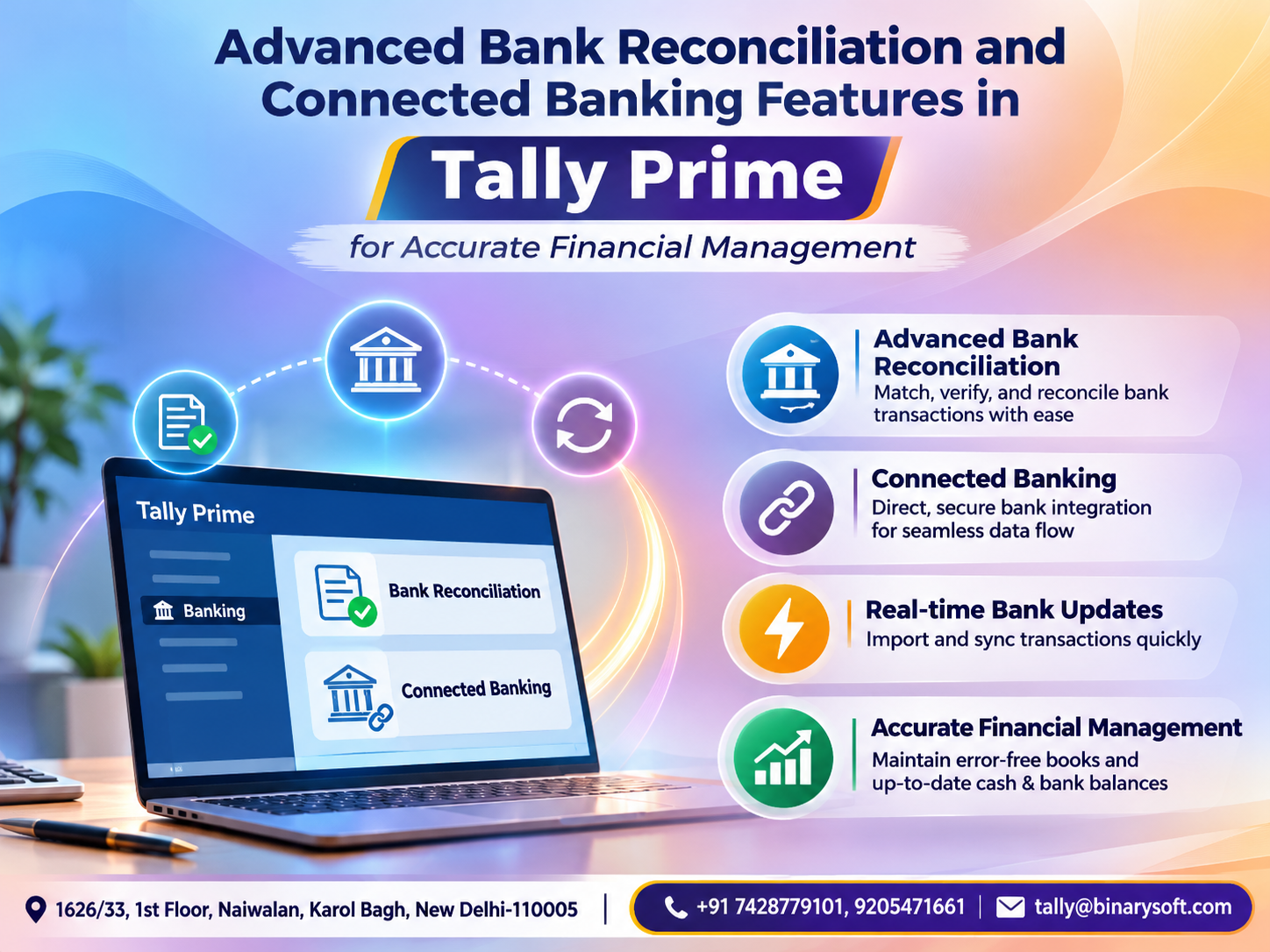
Tally Prime offers advanced Bank Reconciliation and Connected Banking features that help businesses streamline banking operations, improve financial accuracy and reduce repetitive accounting tasks.
From importing bank statements and matching transactions to monitoring outstanding payments and accessing supported banking services, Tally Prime provides an integrated accounting environment for efficient financial management.
Whether you operate a retail store, wholesale distribution company, manufacturing enterprise, service-based organization or growing MSME, these banking capabilities can help you maintain better control over your financial resources.
What Is Bank Reconciliation in Tally Prime?
Bank Reconciliation is the process of comparing transactions recorded in a company's accounting books with transactions appearing in its bank statements.
The primary objective is to identify differences between accounting records and actual banking activities, ensuring that financial information remains accurate and reliable.
Differences may arise due to uncleared cheques, unrecorded bank charges, delayed deposits, interest credits, duplicate entries or incorrect transaction amounts.
Tally Prime helps businesses identify these discrepancies and maintain organized banking records through its Bank Reconciliation Statement, commonly known as BRS.
Instead of manually comparing every transaction using printed bank statements or spreadsheets, businesses can use supported reconciliation features to simplify the process and focus on resolving genuine discrepancies.
What Is Connected Banking in Tally Prime?
Connected Banking is a digitally enabled facility that connects supported banking services with the accounting environment of Tally Prime.
It helps businesses streamline banking activities without repeatedly switching between accounting software, internet banking portals and separate financial records.
Depending on the supported bank, software version and service configuration, businesses can access banking information, retrieve bank statements, initiate payments and simplify reconciliation.
Connected Banking combines accounting and banking workflows, providing business owners and accounts teams with better visibility into their financial transactions.
Why Advanced Bank Reconciliation Is Important for Indian Businesses
As India continues to adopt digital payment systems, businesses increasingly receive and make payments through UPI, NEFT, RTGS, IMPS, payment gateways and online banking platforms.
While digital payments improve convenience, they also increase the volume of banking transactions that accountants must verify.
Advanced Bank Reconciliation in Tally Prime helps businesses overcome several financial management challenges:
-
Incorrect or duplicate accounting entries.
-
Unrecorded banking transactions.
-
Delayed customer payment identification.
-
Missing bank charges and interest entries.
-
Inaccurate financial statements.
-
Difficulties in tracking supplier payments.
-
Time-consuming manual reconciliation.
-
Poor cash flow visibility.
-
Delays in financial audits.
-
Differences between actual and recorded bank balances.
By maintaining regularly reconciled accounts, businesses can improve financial transparency and make more confident business decisions.
Advanced Bank Reconciliation Features in Tally Prime
1. Automatic Bank Reconciliation
Automatic Bank Reconciliation helps businesses compare imported banking transactions with existing accounting vouchers.
Tally Prime identifies matching transactions using available transaction information and configured matching rules.
Accountants can review matching transactions and complete reconciliation without manually checking every entry.
For businesses processing hundreds of transactions every month, this functionality can significantly reduce repetitive administrative work.
Automatic reconciliation also allows accounts teams to dedicate more attention to financial analysis, compliance and business planning.
2. Smart Identification of Exact Matches
Tally Prime can identify banking transactions that match existing accounting records based on relevant transaction information.
For example, if a customer payment of ₹75,000 has already been recorded in the books and the corresponding transaction appears in the bank statement, the software can identify it as an exact match when the required matching criteria are satisfied.
Businesses can also configure eligible exact matches for automatic reconciliation.
This feature helps reduce unnecessary manual verification and improves the accuracy of banking records.
3. Potential Transaction Matching
Sometimes, banking transactions may not match accounting records exactly due to differences in dates, transaction references or other information.
Tally Prime provides potential matching suggestions that help accountants investigate and reconcile these transactions.
For example, a supplier payment recorded on Monday may appear in the bank statement on Tuesday.
Accountants can review suggested matches, verify supporting documents and approve the correct transaction.
This functionality helps businesses resolve reconciliation differences more efficiently without incorrectly modifying their original accounting records.
4. Automatic Voucher Creation from Bank Statements
One of the most useful banking features in Tally Prime is the ability to create accounting vouchers using imported bank statement information.
Transactions that appear in the bank statement but have not yet been recorded in the accounting books can be identified for voucher creation.
Businesses can create individual vouchers, multiple vouchers or suitable consolidated vouchers.
This functionality is particularly helpful for recording recurring expenses, banking charges, customer receipts and other financial transactions.
Accountants should verify ledger classifications, transaction purposes and applicable tax treatment before accepting automatically prepared vouchers.
5. Manual Bank Reconciliation
Although automation simplifies many banking activities, certain transactions require individual verification.
Tally Prime continues to support manual reconciliation, allowing accountants to handle exceptional transactions according to their accounting requirements.
Manual reconciliation is useful for cheque clearance, unusual payment arrangements, complex adjustments and transactions requiring additional investigation.
Combining automated and manual reconciliation provides businesses with greater flexibility and financial control.
Advanced Connected Banking Features in Tally Prime
1. Access Real-Time Bank Balances
Connected Banking allows businesses to retrieve available bank balances directly within Tally Prime for supported and properly connected bank accounts.
Business owners can review available funds before approving supplier payments, purchasing inventory or making important financial commitments.
This reduces the need to repeatedly visit separate banking portals.
However, businesses should distinguish between their accounting book balance and available bank balance, as pending transactions and banking restrictions may create differences.
2. Retrieve Bank Statements Directly
Businesses using supported Connected Banking services can request bank statements from within their accounting environment.
This eliminates several manual steps associated with downloading, storing and importing banking documents.
Accounts teams can retrieve statements for selected periods and use the information for reconciliation and voucher creation.
Regular statement retrieval helps businesses maintain updated financial records and identify discrepancies earlier.
3. Secure Digital Payment Processing
Tally Prime supports integrated payment workflows with eligible banking institutions.
Businesses can prepare supplier payments, manage transaction information and complete supported payment processes through configured banking facilities.
This helps reduce repeated data entry and improves coordination between accounting and banking activities.
Organizations should establish proper payment approval procedures, ensuring that authorized personnel verify beneficiary details, payment amounts and supporting documents before releasing funds.
4. Payment Status Monitoring
Businesses often face difficulties determining whether payments have been successfully processed.
Supported payment status facilities help accounts teams monitor banking transactions and identify pending or completed payments.
This improves communication with suppliers and helps prevent unnecessary duplicate payment attempts.
Maintaining organized payment records also supports internal financial reviews and audit preparation.
5. Payment Links and UPI QR Codes
Businesses can use supported payment collection facilities to share payment links or UPI QR codes with customers.
These digital payment options make it more convenient for customers to complete payments.
Retailers, wholesalers and service providers can benefit from simplified payment collection processes while maintaining organized receivable records.
Availability depends on the configured payment services and applicable subscription requirements.
Step-by-Step Guide to Configure Bank Reconciliation in Tally Prime
Step 1: Create or Alter a Bank Ledger
Open Tally Prime and select the relevant company.
Create a new bank ledger or modify an existing ledger under the Bank Accounts group.
Enter the appropriate bank name, account number, IFSC and other required banking information.
Accurate bank ledger configuration helps ensure that statements and transactions are associated with the correct account.
Step 2: Configure Bank Reconciliation Settings
Access the bank ledger configuration and enable the available automatic reconciliation settings.
Businesses can configure preferred voucher types, transaction matching options and the reconciliation beginning date.
The reconciliation beginning date determines the starting point for the selected reconciliation workflow. Earlier outstanding transactions should be considered while configuring opening reconciliation records.
Step 3: Import the Bank Statement
Businesses can import bank statements downloaded from their banking portals.
Follow the process:
-
Open Gateway of Tally.
-
Press Alt + O to access Import.
-
Select Bank Statement.
-
Choose the appropriate bank ledger.
-
Select the bank statement file.
-
Preview and complete the import.
Standard bank statement imports support compatible Excel and CSV formats. Certain newer configurations also offer PDF processing through additional enabled services.
Step 4: Open the Banking Activities Report
Press Alt + G and search for Banking Activities.
Choose the appropriate bank account and access the bank reconciliation information.
The report helps businesses identify transactions available only in the books, transactions available only in the bank, reconciliation differences and relevant pending activities.
Step 5: Review and Reconcile Transactions
Review exact matches, potential matches and outstanding transactions.
Create missing accounting vouchers where necessary and investigate transactions that cannot be immediately identified.
Verify the reconciliation results before completing the financial reporting process.
Practical Example of Bank Reconciliation
Suppose a wholesale business has the following banking information at the end of the month.
|
Particulars
|
Amount
|
|---|
|
Balance as per accounting books
|
₹5,00,000
|
|
Cheques issued but not cleared
|
₹40,000
|
|
Deposits not yet credited
|
₹25,000
|
|
Unrecorded bank charges
|
₹1,500
|
|
Unrecorded bank interest received
|
₹2,500
|
|
Expected balance as per bank statement
|
₹5,16,000
|
Tally Prime helps accountants identify these differences and determine which transactions require accounting entries and which represent temporary timing differences.
Bank charges and interest should be recorded in the appropriate accounting ledgers. Uncleared cheques and pending deposits should be monitored until settlement.
This approach ensures that financial differences are properly explained rather than adjusted unnecessarily.
An Emotional Story: When Financial Uncertainty Almost Cost a Business Its Future
Sanjay, a fictional business owner in New Delhi, had spent fifteen years building his electrical goods distribution business.
What began as a small shop gradually developed into a successful wholesale enterprise employing more than twenty people.
As his business expanded, banking transactions increased rapidly. Customers made payments through UPI and bank transfers, while suppliers received payments through different banking channels.
Every month, Sanjay's accountant spent several days comparing spreadsheets, bank statements and handwritten payment records.
One morning, an important supplier called to report an outstanding payment. Sanjay believed the payment had already been completed, but his accounting records were unclear.
At the same time, he discovered several customer receipts that had not been properly identified.
The financial uncertainty affected his confidence. He worried about supplier relationships, employee salaries and the future of his business.
After introducing advanced Bank Reconciliation and Connected Banking in Tally Prime, his accounts team established a more systematic banking process.
Instead of waiting until month-end, employees began reviewing transactions regularly and investigating discrepancies promptly.
Sanjay gradually regained confidence in his financial records and could focus more on growing his business.
For entrepreneurs, accurate accounting is not just about balancing numbers. It is about protecting years of hard work, maintaining trusted relationships and securing the future of their families and employees.
Case Study 1: Wholesale Distribution Company in Delhi NCR
Business Background
Consider a wholesale consumer electronics distributor handling frequent customer receipts, supplier payments and interstate business transactions.
The organization maintains multiple bank accounts for everyday operations.
Business Challenges
Manual reconciliation created difficulties in identifying customer payments, tracking pending transactions, recording banking charges and preparing monthly financial reports.
Repeated transaction entry also increased the possibility of accounting errors.
Solution Using Tally Prime
The company introduced automatic Bank Reconciliation, bank statement imports and supported Connected Banking facilities.
Banking transactions were reviewed regularly, while bill-wise accounting helped employees allocate customer receipts against outstanding invoices.
Payment authorization procedures were also established.
Expected Business Benefits
The proposed implementation could reduce reconciliation workload, improve receivable management, minimize duplicate payment risks and strengthen financial reporting.
Management could gain better visibility into available funds and outstanding financial commitments.
Case Study 2: Manufacturing Business in Gujarat
Business Background
Consider a manufacturing enterprise supplying industrial components to customers across India.
The company manages raw material purchases, employee salaries, transportation expenses, machinery costs and supplier payments.
Business Challenges
The accounts department struggled with large transaction volumes, delayed bank reconciliation and difficulties identifying unrecorded expenses.
Financial reports were frequently delayed because banking discrepancies remained unresolved.
Solution Using Tally Prime
The organization introduced automated transaction matching, bank statement-based voucher creation and centralized banking reports.
Separate bank ledgers were maintained, along with appropriate expense classifications and financial approval procedures.
Regular reconciliation schedules helped the accounts department identify discrepancies before month-end.
Expected Business Benefits
The company could improve operational efficiency, strengthen cash flow planning, reduce manual accounting work and prepare financial statements more efficiently.
Both case studies are illustrative examples of how businesses can implement advanced banking functionality.
How Tally Prime Helps Different Business Industries
|
Business Industry
|
Banking and Reconciliation Benefits
|
|---|
|
Retail Stores
|
UPI receipts and daily sales verification
|
|
Wholesale Businesses
|
Customer collections and supplier payments
|
|
Manufacturing Companies
|
Expense tracking and vendor reconciliation
|
|
E-Commerce Businesses
|
Settlement and payment gateway reconciliation
|
|
Healthcare Organizations
|
Financial receipts and insurance payment tracking
|
|
Educational Institutions
|
Fee collection and expense management
|
|
Transport Companies
|
Fuel expenses and operational payments
|
|
Hospitality Businesses
|
Online booking receipts and supplier settlements
|
|
Service Providers
|
Professional fees and recurring expenses
|
|
MSMEs
|
Cash flow management and financial accuracy
|
Tally Prime on Cloud for Smarter Banking Management
Tally Prime on Cloud provides growing businesses with an additional opportunity to manage their accounting environment from different locations.
Authorized business owners, accountants and finance teams can access financial information remotely through compatible cloud hosting solutions.
This is particularly beneficial for organizations operating multiple branches or employing remote accounting professionals.
Businesses can review banking reports, monitor outstanding transactions and coordinate financial activities without depending entirely on a single office computer.
Cloud hosting can also support centralized accounting, scheduled backups, controlled user access and business continuity.
Organizations should evaluate hosting security, banking connectivity compatibility and subscription requirements before implementation.
Best Practices for Accurate Banking Management in Tally Prime
Businesses should establish regular reconciliation schedules rather than waiting until the end of the financial year.
Maintain separate ledgers for each bank account, verify customer payment references and investigate unidentified receipts promptly.
Avoid recording duplicate transactions when importing bank statements. Review automatically generated vouchers before accepting them.
Restrict sensitive banking operations to authorized employees and maintain appropriate payment approval controls.
Regularly back up accounting data and update the software to compatible versions.
These practices can help businesses maintain reliable financial information while reducing operational risks.
Conclusion
Advanced Bank Reconciliation and Connected Banking features in Tally Prime provide businesses with a powerful foundation for accurate financial management.
From automated transaction matching and bank statement imports to digital payment processing, voucher creation and banking reports, these features help simplify everyday accounting responsibilities.
Growing Indian businesses can benefit from reduced manual workload, improved financial transparency, better cash flow planning and more reliable accounting records.
By integrating suitable banking services with Tally Prime and adopting disciplined reconciliation practices, businesses can build a more efficient, financially organized and sustainable working environment.
Powered by Binarysoft Technologies
Authorized Tally Partner
Location: 1626/33, 1st Floor, Naiwalan, Karol Bagh, New Delhi – 110005, INDIA
Contact us: +91 7428779101, 9205471661
Email us: tally@binarysoft.com (10:00 AM – 6:00 PM, Mon–Fri)
Frequently Asked Questions
What is advanced Bank Reconciliation in Tally Prime?
Advanced Bank Reconciliation helps businesses compare accounting transactions with bank statements using automated matching, suggested matches and manual reconciliation facilities.
What is Connected Banking in Tally Prime?
Connected Banking allows businesses to access supported banking services, retrieve bank statements, check balances and manage eligible payment activities within Tally Prime.
Which banks support Connected Banking in Tally Prime?
Supported banking partners include Axis Bank, State Bank of India, ICICI Bank and Kotak Mahindra Bank. Specific facilities depend on account eligibility and service configuration.
CA. Shaurya Venkataraman specializes in business accounting, GST consultancy, and financial analysis. His articles focus on simplifying complex financial concepts and helping businesses improve operational efficiency.