Call CA Tally HelpDesk
+91 9205471661,
7428779101
Why Modern Businesses Need Smarter Invoicing and Accounting
Every successful business depends on accurate billing, efficient accounting, timely payments and reliable financial information. Whether you operate a retail store, wholesale distribution company, manufacturing unit, consultancy firm or service-based organization, managing these activities manually can consume valuable time and create unnecessary complications.
In 2026, Indian businesses face increasing expectations for accurate GST compliance, professional invoices, digital payments, inventory visibility and faster financial decision-making.
This is where Tally Prime becomes an important business management solution.
Beyond traditional bookkeeping, Tally Prime offers additional invoicing and accounting capabilities that help businesses simplify daily transactions, maintain organized financial records, monitor outstanding payments and understand profitability.
From creating customized GST invoices to managing multiple companies, tracking stock movements and preparing detailed financial reports, Tally Prime brings several business operations into one integrated environment.
For growing businesses, these capabilities can reduce repetitive work, improve accounting accuracy and provide better control over financial activities.
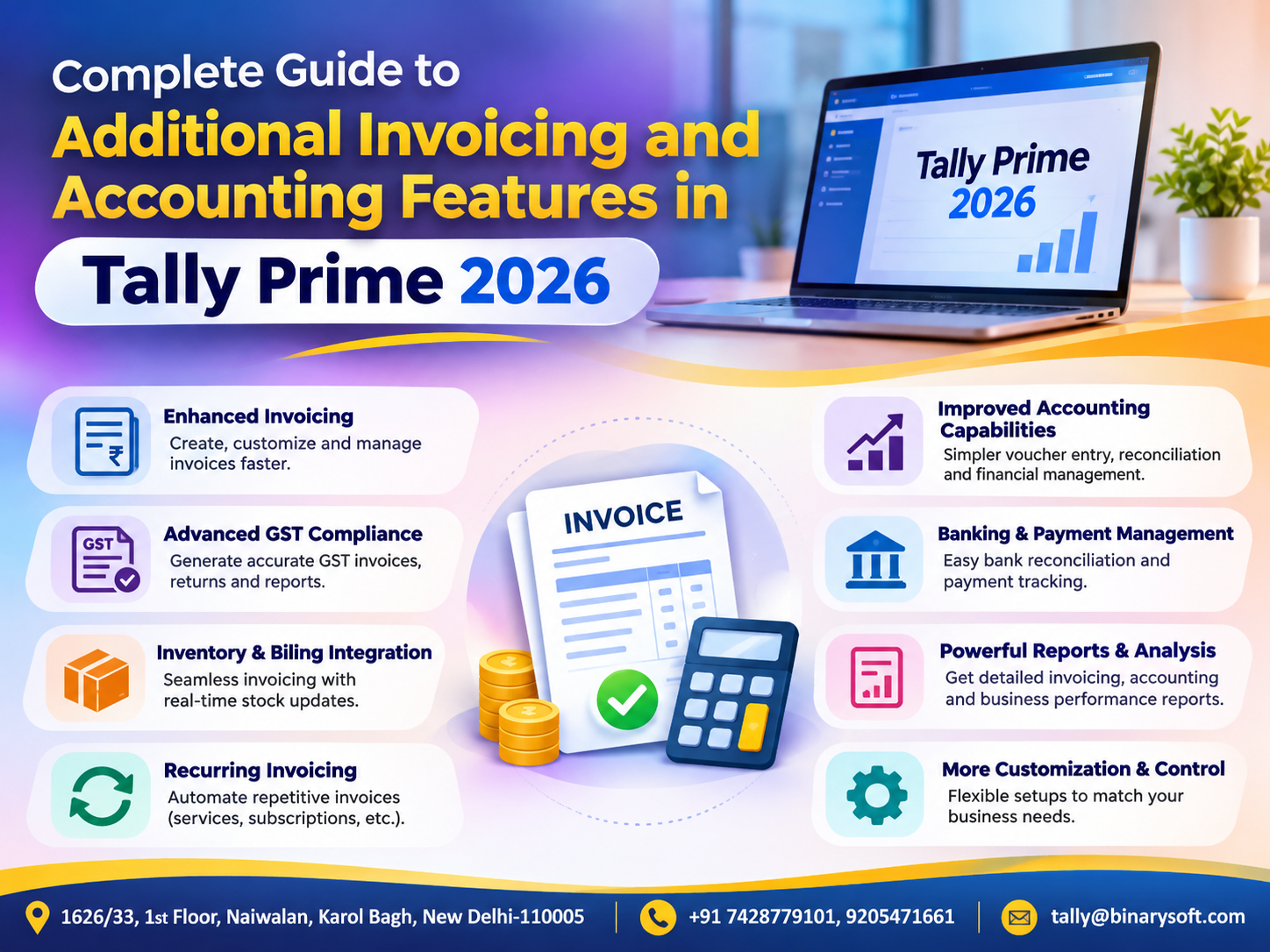
This comprehensive guide explains the additional invoicing and accounting features available in Tally Prime, their practical business benefits and how Indian companies can use them to improve efficiency in 2026.
1. Advanced Invoice Creation for Professional Business Billing
Invoicing is one of the most important activities in any business. An invoice communicates transaction details, supports payment collection and provides essential information for accounting and taxation.
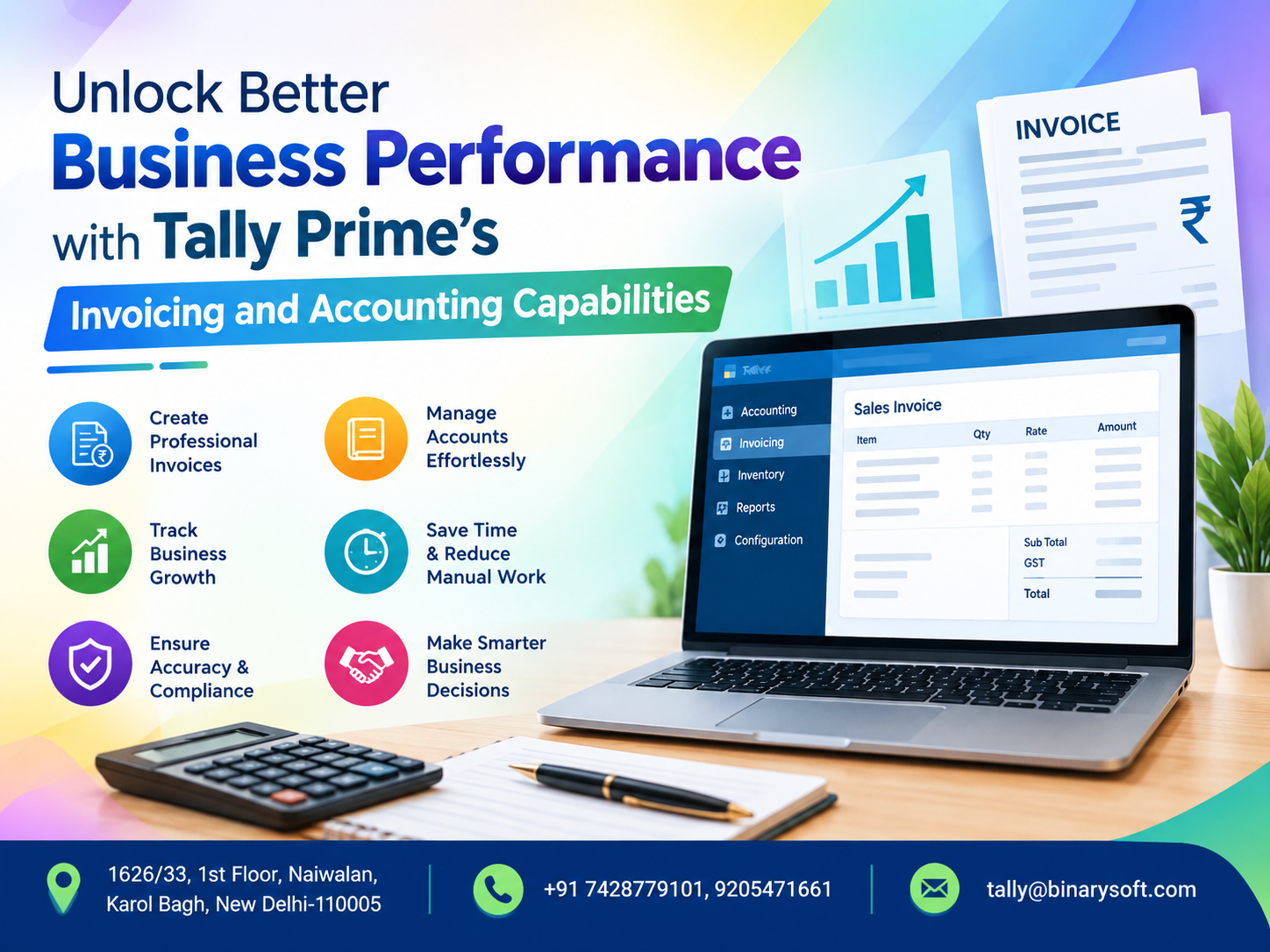
Tally Prime enables businesses to create professional invoices while recording the corresponding accounting transactions.
Key invoicing capabilities
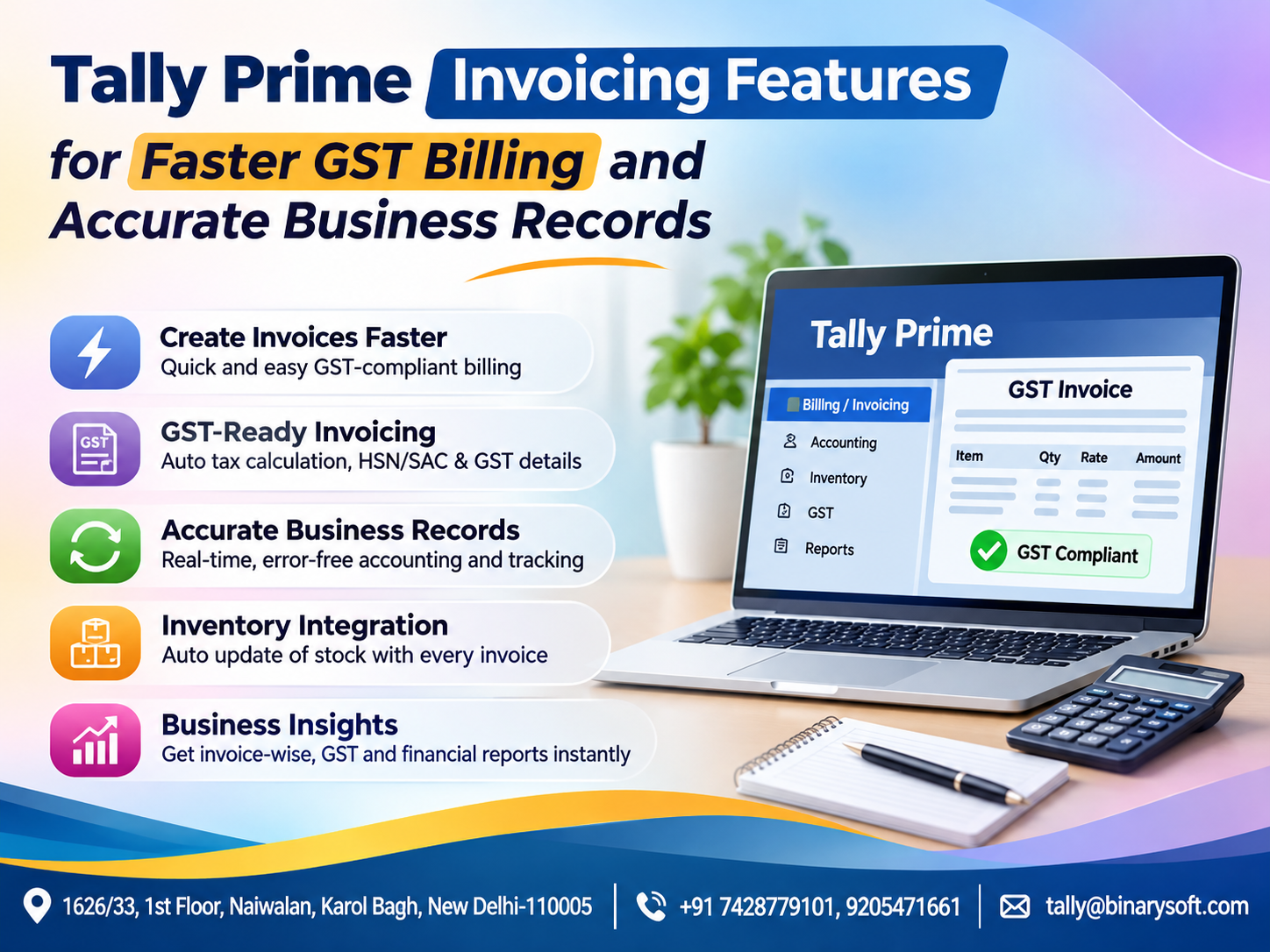
Sales invoices: Generate invoices for products or services with customer details, quantities, rates, taxes and transaction values.
Multiple invoice formats: Configure invoice layouts according to business requirements, including item-wise billing and accounting-based invoices.
GST-compliant invoicing: Include applicable GST information, HSN or SAC classifications, taxable values and tax amounts.
Discount management: Apply discounts according to the transaction and configured billing structure.
Additional charges: Record freight, packing, handling and other applicable charges.
Invoice printing and sharing: Print invoices or export them in supported formats for customer communication.
How businesses benefit
A wholesale distributor processing hundreds of invoices every month can significantly improve consistency by maintaining customer masters, stock items, tax classifications and pricing information in Tally Prime.
Instead of repeatedly entering identical information, employees can select existing records and complete invoices more efficiently.
The result is a smoother billing process with fewer opportunities for manual mistakes.
2. GST Billing and Tax Calculation Features
GST compliance remains an essential requirement for many Indian businesses.
Incorrect tax calculations, missing invoice information and inconsistent records can create difficulties during return preparation and reconciliation.
Tally Prime helps businesses maintain GST-related transaction information within their accounting system.
Important GST billing features
-
Calculation of CGST, SGST, IGST and applicable cess.
-
Maintenance of GSTIN and registration details.
-
HSN and SAC classification for goods and services.
-
Recording of taxable, exempt and other applicable supplies.
-
GST-related sales and purchase reporting.
-
Identification of certain missing or inconsistent transaction details.
-
Support for e-invoicing and e-way bill workflows, subject to eligibility and supported functionality.
Practical example
Consider a Delhi-based electronics distributor selling goods to customers in Delhi and Maharashtra.
For an eligible intra-state transaction, CGST and SGST apply. For an eligible inter-state transaction, IGST generally applies.
With properly configured GST details, Tally Prime helps calculate the relevant taxes and maintain transaction records.
Businesses should still verify product classifications, applicable rates, place-of-supply rules and current compliance requirements.
3. Customized Invoices That Strengthen Business Identity
A professional invoice creates a positive impression and helps customers understand payment obligations.
Different industries require different invoice information.
A manufacturer may need product specifications and dispatch details, while a consultancy firm may require service descriptions, project references and payment terms.
Tally Prime provides invoice configuration options that support various business requirements.
Common customization requirements
Businesses may configure invoices to display company details, billing and shipping addresses, bank information, tax details, item descriptions and payment instructions.
Additional fields or specialized layouts may require customization depending on the installed version and business requirements.
Why customization matters
Clear invoices reduce customer confusion and help accounts teams resolve billing questions faster.
For example, including a purchase order reference can help a corporate customer match an invoice with its internal procurement records.
Similarly, clearly displayed bank details can simplify payment processing.
4. Automated Accounting Entries from Business Transactions
One of the biggest advantages of integrated invoicing and accounting software is the ability to reduce duplicate data entry.
When a sales invoice is recorded correctly in Tally Prime, the corresponding accounting impact is reflected in the books.
Businesses do not need to maintain completely separate records for every invoice and its related accounting entry.
How this improves operations
Suppose a business sells goods worth ₹50,000 plus applicable GST.
After recording the invoice, the relevant sales, customer and tax ledgers are updated according to the voucher configuration.
This information becomes available for accounting reports and customer outstanding analysis.
The same integrated approach supports purchase transactions, receipts, payments and other accounting activities.
Business advantage: Employees can focus more on reviewing transactions and resolving exceptions rather than repeatedly entering the same information.
5. Credit Notes, Debit Notes and Sales Return Management
Business transactions do not always end after an invoice is generated.
Customers may return products, request adjustments or report differences in the billed amount. Suppliers may also issue adjustments for returned goods or revised charges.
Tally Prime supports credit notes and debit notes to record such transactions systematically.
Practical applications
Sales returns: Record returned goods and adjust customer balances and inventory where applicable.
Purchase returns: Maintain supplier-related adjustments and corresponding accounting records.
Price differences: Record legitimate billing adjustments without losing the original transaction history.
GST adjustments: Account for applicable tax corrections according to prevailing GST rules.
Proper documentation helps businesses maintain accurate financial records and simplifies reconciliation.
6. Customer Outstanding and Payment Tracking
Delayed customer payments can create serious cash flow problems, even for profitable businesses.
Tally Prime provides bill-wise accounting facilities to help businesses monitor receivables and payables.
Important features
Businesses can maintain invoice-wise outstanding balances, track due dates, review customer ledgers and identify overdue payments.
The Bills Receivable and Bills Payable reports provide useful information for collection and payment planning.
How to use this feature
-
Enable bill-wise tracking for relevant party ledgers.
-
Record sales invoices with appropriate bill references.
-
Specify credit periods or due dates.
-
Record receipts against the correct outstanding invoices.
-
Review pending bills regularly.
Businesses can use this information to prioritize collection calls and avoid overlooking overdue invoices.
For companies operating on credit, outstanding management is not simply an accounting feature. It is an important part of financial discipline.
7. Payment Requests and Digital Invoice Sharing
Modern customers increasingly prefer convenient digital payment options.
Tally Prime supports payment request workflows through eligible payment integrations, including payment links and QR-based options.
Businesses can also share invoices and other documents using supported email and WhatsApp Business integrations.
Business advantages
Digital sharing reduces the time between invoice preparation and customer communication.
Payment requests can make it easier for customers to complete transactions without manually entering lengthy bank details.
However, businesses should continue reconciling actual receipts with invoices rather than assuming that sharing a payment link confirms payment.
8. Inventory-Linked Invoicing and Stock Management
For businesses selling physical products, invoicing and inventory should work together.
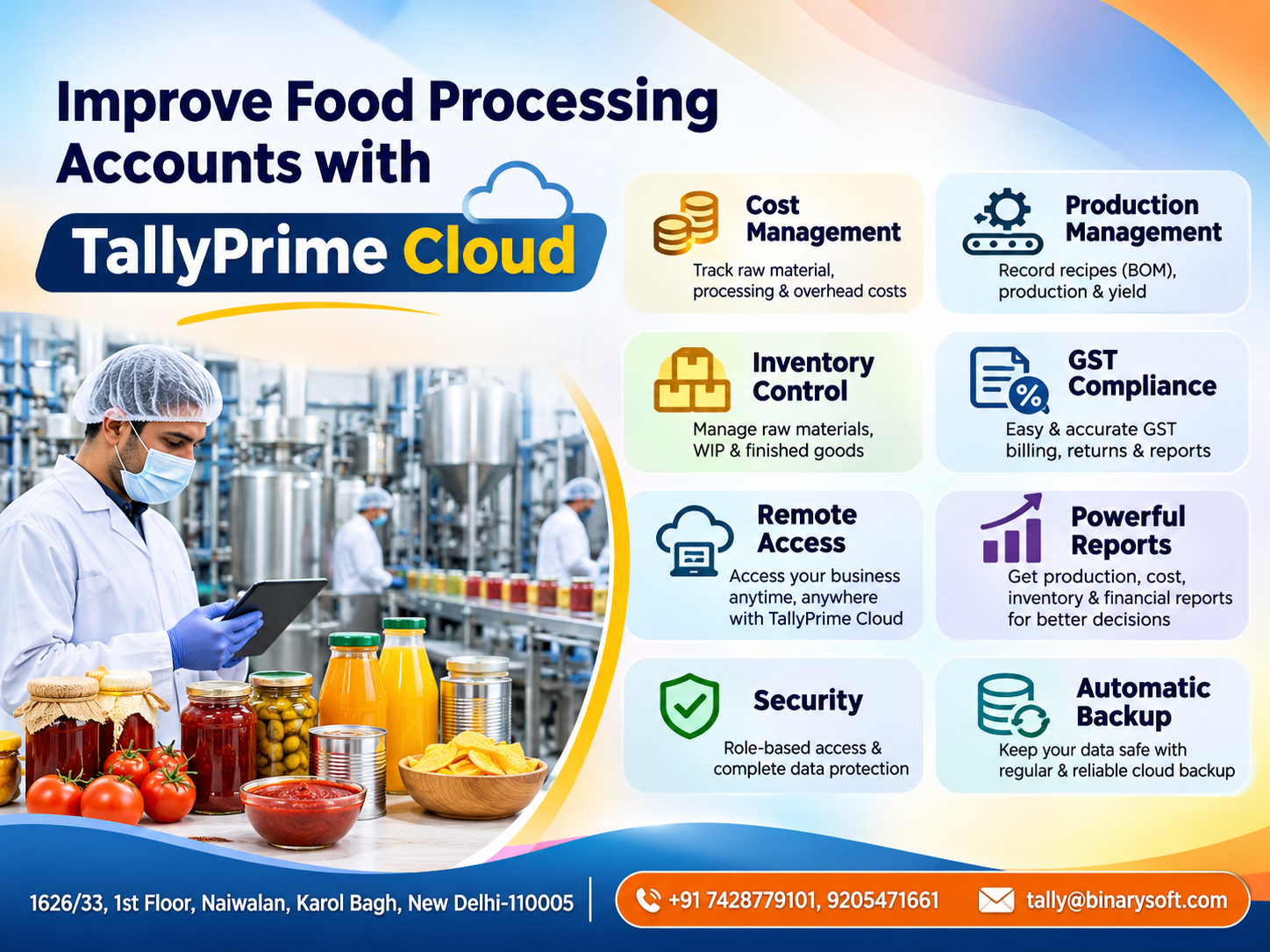
Tally Prime integrates stock-related transactions with accounting information, allowing businesses to monitor inventory alongside sales and purchases.
Inventory features
Stock groups and categories: Organize products according to business requirements.
Units of measurement: Maintain quantities in pieces, kilograms, boxes, metres or other appropriate units.
Godown management: Track inventory across different storage locations.
Batch tracking: Maintain batch-wise information where required.
Reorder levels: Identify products approaching configured stock thresholds.
Stock reports: Review stock availability, movement and valuation.
Practical application
A distributor selling electrical equipment can create stock items for cables, switches, lighting products and accessories.
When inventory-linked sales invoices are recorded, stock balances are updated according to the transaction.
This helps employees identify available quantities and reduces dependence on separate manual stock registers.
9. Bank Reconciliation and Connected Banking
Bank reconciliation ensures that accounting records agree with actual bank transactions.
Without regular reconciliation, businesses may overlook bank charges, missing receipts, duplicate entries or unrecorded payments.
Tally Prime provides bank reconciliation facilities and, for supported banks and configurations, connected banking capabilities.
Key banking functions
-
Import supported bank statements.
-
Match bank transactions with accounting entries.
-
Identify unreconciled transactions.
-
Create accounting vouchers from selected bank transactions.
-
Review bank balances and payment information.
-
Manage supported electronic payment workflows.
Connected banking availability depends on the bank, software release, service eligibility and configuration.
Why reconciliation matters
Consider a company receiving 60 customer payments every day.
Matching each transaction manually can be time-consuming.
By importing bank transactions and reviewing suggested matches, the accounts team can reduce repetitive work and concentrate on unmatched entries.
This improves the reliability of cash and bank balances.
10. Cost Centre Accounting for Department-Wise Profitability
Many businesses need to understand expenses and income beyond their overall profit and loss statement.
A company may operate multiple branches, departments, projects or sales teams.
Tally Prime supports cost centres and cost categories to help allocate relevant transactions.
Example
A consultancy firm manages three projects:
|
Project
|
Revenue
|
Expenses
|
Surplus
|
|---|
|
Project A
|
₹5,00,000
|
₹3,20,000
|
₹1,80,000
|
|
Project B
|
₹3,50,000
|
₹2,80,000
|
₹70,000
|
|
Project C
|
₹4,00,000
|
₹3,10,000
|
₹90,000
|
Illustrative figures. The surplus shown is before unallocated overheads and other adjustments.
Cost centre reporting helps management compare project performance and identify areas requiring attention.
11. Multi-Currency Accounting for International Business
Companies dealing with overseas customers or suppliers often need to record transactions in foreign currencies.
Tally Prime supports multi-currency accounting, allowing businesses to maintain foreign currency information alongside their base currency.
This is useful for importers, exporters, consulting companies and international service providers.
Businesses can maintain exchange rates, record foreign currency transactions and account for exchange differences where applicable.
Correct exchange rate selection and accounting treatment remain important for reliable financial reporting.
12. Financial Reports and Business Dashboards
Accounting records become more valuable when management can use them to make decisions.
Tally Prime provides financial and operational reports that help businesses understand their performance.
Important reports
Profit and Loss Account: Review income, expenses and profitability.
Balance Sheet: Understand assets, liabilities and capital.
Cash Flow Statement: Analyze cash inflows and outflows.
Trial Balance: Review ledger balances and accounting consistency.
Sales and Purchase Registers: Examine transaction activity.
Outstanding Reports: Monitor customer collections and supplier payments.
Stock Reports: Review inventory balances and movements.
Business Dashboards: Analyze selected financial and operational indicators visually.
Managers can use these reports to identify unusual expenses, slow-moving inventory, payment delays and changes in business performance.
13. Additional Tally Prime Features Introduced in 2026
Tally Prime's 2026 releases have brought several improvements that are particularly relevant to invoicing and accounting.
Invoice print templates
Release 7.1 introduced ready-to-use invoice templates with personalization options, including branding, formatting and terms and conditions.
Release 7.2 extended invoice print templates to purchase orders and introduced an option to automatically save configuration changes to user templates.
Flexible discount management
Businesses can apply discounts by percentage, amount or both, providing greater flexibility in transaction recording.
Improved GST workflows
Recent enhancements include improvements to Input Tax Credit reconciliation, e-invoicing sessions and GSTR-9 preparation.
Release 7.2 supports extended e-invoicing and e-way bill login sessions of up to 30 days, where enabled.
Secure email communication
OAuth-based email authentication supports secure document communication through compatible email providers.
Financial statement improvements
Release 7.1 added support for financial statements aligned with Schedule III Division I, helping applicable businesses prepare structured reporting information.
These capabilities depend on the installed release, licensing, configuration and applicable regulatory requirements.
14. A Business Owner's Story: When One Missed Invoice Changed Everything
At 9:30 PM, Rajesh was still sitting inside his small electrical wholesale shop in Delhi.
The shutters were half closed, but his workday was far from over.
A customer had called asking why a payment was being demanded for an invoice that had already been settled. Another customer wanted a duplicate invoice. Meanwhile, Rajesh could not determine whether his warehouse had enough stock to fulfill a large order the following morning.
His business was growing, but so were the problems.
He maintained sales records in one spreadsheet, customer payments in another and inventory quantities in a handwritten register.
His father had started the business with a simple belief: every customer should receive the correct bill and every supplier should be paid on time.
Rajesh felt that he was failing to maintain that standard.
One evening, his daughter asked why he was always working after dinner.
That question stayed with him.
He decided to reorganize his accounting processes using Tally Prime.
First, he created accurate customer and supplier ledgers. Then he configured stock items, GST details, invoice numbering and bill-wise outstanding tracking.
His accountant helped reconcile old balances before moving to a more consistent daily workflow.
Gradually, Rajesh began seeing the difference.
Invoices became easier to locate. Customer balances could be reviewed before collection calls. Stock information was more organized, and daily sales were reflected in accounting reports.
Most importantly, he no longer needed to spend every evening comparing multiple registers.
The business had not changed overnight. But the way he managed it had.
One evening, he reached home in time for dinner.
His daughter smiled and asked, "Papa, no office work today?"
Rajesh smiled back.
For him, better accounting was no longer just about numbers. It meant having more time for the people who mattered most.
This is an illustrative story reflecting common challenges faced by small business owners.
15. Case Study One: Wholesale Distributor Improves Billing and Collection Control
Business background
A fictional Delhi-based electrical goods distributor processes approximately 1,200 invoices every month.
The business sells products to retailers on credit and manages stock across two warehouses.
Challenges
The company experiences billing delays, inconsistent stock records and difficulty identifying overdue customer payments.
Its accounting team frequently spends additional time matching receipts against invoices.
Tally Prime implementation
The distributor configures GST invoicing, stock groups, godown management, bill-wise accounting and bank reconciliation.
Customer credit periods are standardized, and the accounts team reviews outstanding reports weekly.
Illustrative results after three months
|
Performance indicator
|
Before
|
After
|
|---|
|
Average invoice preparation
|
6 minutes
|
3 minutes
|
|
Monthly billing corrections
|
35
|
12
|
|
Overdue customer invoices
|
140
|
85
|
|
Monthly reconciliation effort
|
20 hours
|
9 hours
|
These figures represent a hypothetical implementation scenario, not independently verified customer results.
Key learning
Integrating billing, inventory and receivables can improve operational control, particularly when employees follow consistent transaction-entry procedures.
16. Case Study Two: Consultancy Firm Improves Project Accounting
Business background
A fictional Bengaluru-based consultancy firm manages accounting and advisory projects for corporate clients.
The firm handles recurring service invoices, project expenses, employee reimbursements and GST-related transactions.
Challenges
Management struggles to determine which projects are profitable.
Some customer invoices are delayed because project completion details are not communicated promptly to the accounts team.
Expenses are recorded correctly at company level but are not consistently allocated to individual projects.
Tally Prime implementation
The firm introduces cost centre accounting, structured service ledgers, GST invoicing and bill-wise receivable tracking.
Each project receives a cost centre, and relevant expenses are allocated accordingly.
Illustrative results
The firm reduces the time required to prepare internal project profitability summaries from several working days to a few hours after accounts are updated.
Management can compare project revenue with directly allocated costs and identify projects needing attention.
Key learning
Accurate accounting is important, but meaningful classification of transactions is what makes management reporting useful.
17. How to Configure Tally Prime for Better Invoicing and Accounting
Businesses planning to improve their accounting workflow can follow a structured implementation process.
Step 1: Create or review company details
Enter the company name, financial year, accounting period, address and applicable statutory registration information.
Step 2: Configure accounting and GST features
Use the applicable company features and configuration options to enable inventory, GST, bill-wise details and other required capabilities.
Step 3: Create accurate masters
Configure customers, suppliers, sales ledgers, purchase ledgers, stock items, units and tax classifications.
Step 4: Set up invoice formats
Configure numbering, print templates, payment terms and the information required on invoices.
Step 5: Test and validate
Record sample transactions and verify accounting entries, tax calculations, inventory movements and reports before routine use.
18. Data Security, Backup and Accounting Controls
Financial information is among the most valuable records maintained by a business.
Tally Prime provides user security, access controls and data management capabilities that can support better accounting governance.
Businesses should assign appropriate user permissions, maintain reliable backups and review important accounting changes.
Scheduled backup capabilities can help reduce dependence on manual backup routines when correctly configured.
Edit Log functionality, where available and enabled, supports review of changes to accounting records.
However, software security also depends on responsible administration, secure devices, strong authentication practices and tested backup restoration procedures.
19. Common Accounting Mistakes Businesses Should Avoid
Even advanced accounting software cannot compensate for incorrect transaction data.
Businesses should avoid creating duplicate customer ledgers, selecting incorrect GST classifications, recording receipts against the wrong invoices and failing to reconcile bank balances.
Other common problems include inconsistent inventory units, missing expense allocations and delayed transaction entry.
A monthly accounting review should include customer balances, supplier balances, bank reconciliation, stock valuation and tax-related exception reports.
Regular review helps identify problems before they become significant.
20. Why Tally Prime Is Valuable for Growing Indian Businesses
Growing businesses need accounting systems that can handle increasing transaction volumes without creating unnecessary administrative work.
Tally Prime combines invoicing, accounting, inventory, taxation and reporting in one environment.
This integration can improve consistency and reduce dependence on disconnected spreadsheets.
Businesses can start with essential accounting features and introduce additional capabilities as their requirements become more complex.
A small retailer may initially focus on GST billing and stock tracking, while a larger distributor may require godown management, cost centres, credit control and connected banking.
The important factor is choosing the right configuration for the business rather than enabling every available feature.
Conclusion: Build a More Efficient Business with Tally Prime in 2026
Efficient invoicing and accounting are essential for sustainable business growth.
Tally Prime offers a comprehensive range of features that help Indian businesses manage professional billing, GST-related transactions, customer payments, supplier balances, inventory, banking and financial reporting.
Its additional capabilities, including invoice customization, bill-wise accounting, cost centres, bank reconciliation and modern reporting tools, make it useful for businesses seeking better operational control.
The enhancements introduced in 2026 further strengthen document customization, accounting flexibility and compliance-related workflows.
However, the greatest benefits come from correct configuration, accurate data entry, employee training and regular financial reviews.
For businesses planning to improve their accounting systems, adopting a structured Tally Prime workflow can be an important step toward greater efficiency, financial clarity and long-term growth.
Powered by Binarysoft Technologies
Authorized Tally Partner
Location: 1626/33, 1st Floor, Naiwalan, Karol Bagh, New Delhi – 110005, INDIA
Contact us: +91 7428779101, 9205471661
Email us: tally@binarysoft.com
Business Hours: 10:00 AM – 6:00 PM, Monday to Friday
CA. Samarth Toshniwal works on business accounting, taxation, and transaction reconciliation. His professional focus is on helping enterprises maintain organized financial records and develop efficient accounting practices.