Call CA Tally HelpDesk
+91 9205471661,
7428779101
Why Smart Inventory Management Is Essential for Business Growth in 2026
Every successful business depends on maintaining the right products, in the right quantities, at the right time.
Whether you operate a retail store, wholesale distribution company, manufacturing unit, pharmaceutical business or electronics showroom, inventory plays an important role in profitability and customer satisfaction.
However, managing inventory is becoming increasingly challenging.
Businesses must handle fluctuating customer demand, rising storage expenses, supplier delays, product shortages and excess stock.
Traditional stock registers and disconnected spreadsheets often fail to provide the visibility required for effective inventory management.
A business may have thousands of products in its warehouse but still experience financial difficulties because too much money is invested in slow-moving inventory.
Another business may lose valuable customers because popular products are unavailable when orders arrive.
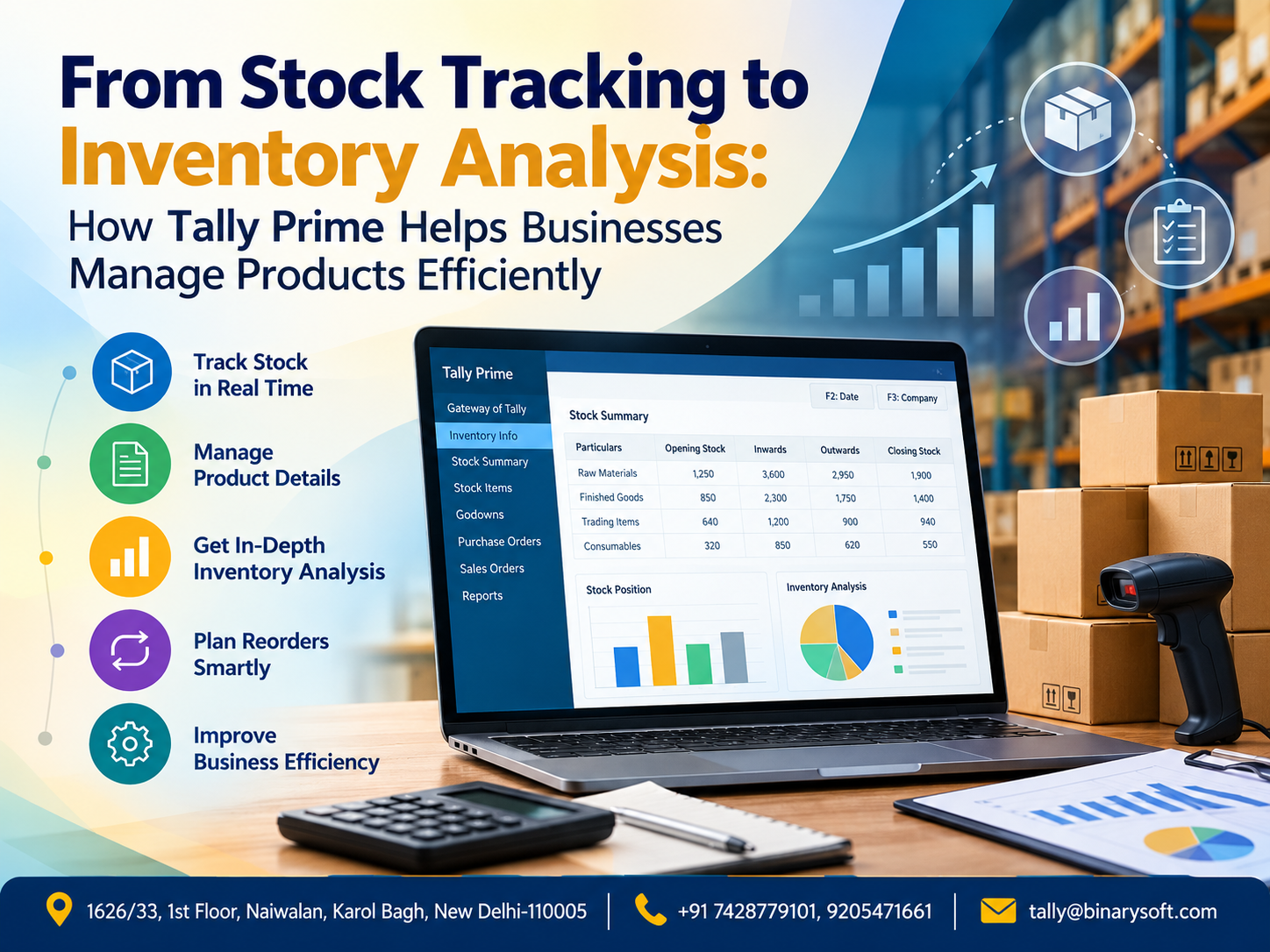
Tally Prime helps businesses move beyond basic stock tracking towards structured inventory analysis, enabling better purchasing decisions, improved stock visibility and stronger financial control.
With features such as Stock Summary, Movement Analysis, Stock Ageing, Reorder Levels, Godown Management and Inventory Valuation, businesses can understand how products move through their operations.
In 2026, effective inventory management is not simply about counting products. It is about understanding which products generate revenue, which products consume working capital and how inventory decisions influence business growth.
The Story of a Business Owner Who Had a Full Warehouse but an Empty Bank Account
Rohit operated a successful electrical goods distribution business in Delhi.
For nearly twelve years, he had supplied electrical switches, cables, lighting products and accessories to retailers across the city.
His warehouse was always full.
Whenever suppliers offered discounts, Rohit purchased additional products because he believed maintaining large inventory quantities would protect his business from shortages.
Initially, the strategy appeared successful.
Customers appreciated product availability, and sales continued increasing.
However, over time, Rohit noticed something troubling.
Despite maintaining inventory worth several lakh rupees, his business frequently struggled to pay suppliers on time.
One evening, an important supplier called to request payment for overdue invoices.
Rohit looked around his warehouse.
Hundreds of cartons were stacked from floor to ceiling.
Yet he did not have sufficient cash available to settle the outstanding amount.
His accountant explained that a significant portion of the company's money was tied up in products that had not sold for months.
Some lighting models had become outdated.
Several electrical accessories were no longer popular.
Meanwhile, fast-selling products were frequently unavailable.
Rohit felt disappointed.
He had spent years working long hours to build the business, but poor inventory decisions were threatening everything he had achieved.
His son asked him a simple question:
"If the warehouse is full, why are you worried about money?"
Rohit realized that he had been measuring business success by the quantity of products stored rather than the profitability of products sold.
He decided to improve his inventory management system using Tally Prime.
His team organized stock items, recorded inventory movements and began reviewing stock summaries and movement reports regularly.
Gradually, Rohit identified slow-moving products and adjusted his purchasing strategy.
Instead of purchasing large quantities based only on supplier discounts, he began considering actual sales movement and inventory requirements.
The improvement gave him something more valuable than additional warehouse space.
It gave him financial clarity.
The lesson is powerful: a warehouse full of products does not guarantee a profitable business. Smart inventory decisions do.
This is an illustrative story based on common inventory management challenges.
1. Understanding Stock Tracking and Inventory Analysis
Stock tracking and inventory analysis are closely connected, but they serve different purposes.
What Is Stock Tracking?
Stock tracking involves monitoring the quantity and movement of products within a business.
It answers questions such as:
-
How many units are currently available?
-
Which products were purchased?
-
Which products were sold?
-
Where are products stored?
-
How much stock remains after transactions?
Accurate stock tracking helps businesses maintain reliable inventory records.
What Is Inventory Analysis?
Inventory analysis examines stock information to support business decisions.
It helps management understand which products sell quickly, which products remain unsold and how inventory affects profitability.
For example, a retailer may have 500 units of a product in stock.
Basic stock tracking confirms that quantity.
Inventory analysis helps determine whether those 500 units represent healthy stock availability or excessive investment in a slow-moving product.
Tally Prime supports both activities through integrated inventory records and analytical reports.
2. Stock Item Management in Tally Prime
Effective inventory management begins with organizing products correctly.
Tally Prime allows businesses to create stock items and classify them according to operational requirements.
Stock Groups
Stock groups help organize similar products.
For example, an electronics distributor may create groups for televisions, refrigerators, washing machines and accessories.
Stock Categories
Stock categories provide another way to classify products.
Businesses may organize products according to brand, size, model or other characteristics.
Units of Measurement
Tally Prime supports different units of measurement.
Products may be measured in pieces, kilograms, litres, metres, boxes or other appropriate units.
Stock Item Details
Businesses can maintain relevant information such as item names, opening quantities, rates and inventory classifications.
A well-organized inventory structure makes reporting easier and reduces confusion during daily transactions.
3. Real-Time Stock Tracking Through Tally Prime
One of the most useful inventory features in Tally Prime is the ability to update stock records as transactions are entered.
When businesses record purchases, sales and other inventory movements, the relevant stock balances are updated.
Purchase Transactions
Recording a purchase increases the relevant stock quantity when the transaction is configured to affect inventory.
Sales Transactions
Recording a sales transaction reduces the relevant stock quantity.
Stock Transfers
Stock Journal vouchers can record transfers between warehouses or storage locations.
Stock Adjustments
Physical Stock vouchers help businesses record differences identified during stock verification.
Stock Summary
The Stock Summary report provides information about opening stock, inward movements, outward movements and closing stock.
These capabilities help businesses maintain current inventory information without repeatedly updating separate registers.
However, accurate results depend on timely transaction entry and correct inventory configuration.
4. Stock Summary: Understand Your Available Inventory
The Stock Summary report is one of the most important tools for inventory monitoring.
It provides an overview of recorded stock quantities, rates and values.
Businesses can use the report to understand their current inventory position.
Product-Wise Stock Visibility
Management can review individual stock items and identify available quantities.
Stock Group Analysis
Products can be reviewed according to their assigned stock groups.
Inventory Valuation
The report provides inventory values based on the configured valuation method.
Transaction Details
Users can examine underlying inventory transactions through detailed reports.
Profitability Review
Relevant report configurations can help businesses examine stock-related profitability.
For example, a wholesale distributor may discover that certain products represent a substantial portion of total inventory value.
Management can then review whether those products are generating sufficient sales.
Stock Summary transforms recorded inventory transactions into useful information for daily business decisions.
5. Movement Analysis: Identify Fast-Moving and Slow-Moving Products
Not every product contributes equally to business performance.
Some products sell frequently, while others remain in storage for long periods.
Movement Analysis helps businesses examine the inward and outward movement of inventory.
Fast-Moving Products
These products experience frequent sales or consumption.
Businesses may need to maintain appropriate stock levels to avoid shortages.
Slow-Moving Products
These products sell less frequently.
Excessive investment in slow-moving inventory can reduce working capital availability.
Purchase and Sales Comparison
Movement reports help businesses compare stock received and stock issued over selected periods.
Better Purchasing Decisions
Management can use movement information to identify products requiring replenishment.
For example, a mobile accessories distributor may discover that charging cables sell consistently while certain older phone covers have limited demand.
This information can help the business revise purchasing quantities.
Instead of treating every product equally, management can allocate inventory investment according to actual demand.
6. Stock Ageing Analysis: Identify Products That Remain Unsold
Inventory ageing is an important indicator of stock efficiency.
Products stored for long periods may become outdated, damaged or difficult to sell.
Tally Prime provides Stock Ageing Analysis for reviewing how long inventory has been held.
Identify Old Inventory
Businesses can examine stock according to ageing periods.
Review Slow-Moving Products
Older stock can be investigated to understand why products have not sold.
Reduce Obsolescence Risk
Businesses dealing with electronics, fashion products or other changing product categories can use ageing information to identify potential obsolescence risks.
Improve Inventory Planning
Ageing reports help management evaluate whether purchasing quantities should be adjusted.
For example, a retailer may identify products that have remained unsold for more than six months.
Management can consider appropriate promotional activities, supplier discussions or revised purchasing strategies.
Ageing analysis is particularly useful when combined with sales movement and inventory valuation reports.
7. Reorder Levels: Maintain Stock Without Excessive Purchasing
Inventory shortages can lead to lost sales.
Excess inventory can increase storage expenses and block working capital.
Tally Prime allows businesses to configure reorder levels for stock items.
A reorder level represents the minimum stock quantity at which replenishment should be considered.
Practical Example
A hardware distributor sells approximately 20 units of a particular product every day.
Its supplier normally requires five days to deliver additional stock.
The business may calculate expected demand during the supplier lead time and add an appropriate safety stock allowance.
If expected lead-time demand is 100 units and safety stock is 40 units, a possible reorder point is 140 units.
Management can use this calculation to configure an appropriate reorder level.
Tally Prime's Reorder Status report helps businesses review replenishment requirements.
The reorder point should be reviewed periodically because customer demand and supplier delivery times may change.
8. Godown Management: Control Inventory Across Multiple Locations
Businesses frequently store products in multiple warehouses, branches and storage facilities.
Without proper location-wise inventory records, management may struggle to determine where products are available.
Tally Prime supports godown or location management.
Multiple Warehouse Tracking
Businesses can create separate locations for warehouses, branches and storage areas.
Stock Transfers
Inventory transfers between locations can be recorded through appropriate Stock Journal vouchers.
Location-Wise Stock Reports
Godown Summary helps businesses review stock quantities and values for individual locations.
Third-Party Stock Tracking
Businesses can maintain suitable records for stock sent to job workers, consignment agents or other third parties.
Better Distribution Planning
Location-wise inventory visibility can help businesses coordinate product availability across branches.
For example, a distributor may discover that one warehouse has excess stock while another location is experiencing shortages.
Management can consider transferring products instead of immediately purchasing additional inventory.
9. Batch-Wise Inventory Management
Batch tracking is particularly useful for businesses dealing with products that have manufacturing dates, expiry dates or identifiable production batches.
Tally Prime supports batch-wise inventory management.
Businesses can maintain batch details for relevant stock items.
Pharmaceutical Businesses
Batch information can support the tracking of medicines according to manufacturing and expiry details.
Food Businesses
Businesses can monitor packaged products with limited shelf lives.
Manufacturing Companies
Batch records can help distinguish production lots.
Product Traceability
Batch-wise records can assist businesses in identifying relevant stock during returns or quality-related investigations.
Proper batch tracking improves inventory organization and supports more systematic product handling.
10. Case Study One: Wholesale Distributor Improves Stock Availability
Business Background
A wholesale electrical goods distributor supplied products to retailers across Delhi NCR.
The company maintained thousands of stock items and handled frequent customer orders.
Challenges
The business experienced repeated stock shortages despite maintaining substantial inventory.
Purchasing decisions were based mainly on employee estimates.
Slow-moving products occupied valuable warehouse space.
Tally Prime Implementation
The company introduced structured stock groups and inventory records.
Purchase and sales transactions were recorded against relevant stock items.
Management began reviewing Stock Summary, Movement Analysis and Reorder Status reports.
Business Improvements
The distributor gained better visibility into product movement.
Fast-selling products could be identified more easily.
Management also became more aware of products that were consuming working capital without generating sufficient sales.
Key Learning
Inventory analysis helps wholesalers move from reactive purchasing towards more informed stock planning.
This is an illustrative case study demonstrating a possible business implementation.
11. Case Study Two: Manufacturing Company Improves Raw Material Control
Business Background
A manufacturing company produced packaging materials for industrial customers.
Its operations required paper, adhesives, printing materials and other production inputs.
Challenges
The company frequently experienced differences between physical stock and recorded material quantities.
Production teams occasionally requested additional materials because existing stock information was unreliable.
Management also struggled to monitor material consumption.
Tally Prime Implementation
The business configured raw material stock items and relevant inventory locations.
Manufacturing-related stock movements were recorded using appropriate inventory vouchers.
The company introduced periodic physical stock verification.
Management began reviewing inventory movement and consumption reports.
Business Improvements
The company established more organized material records.
Production teams gained clearer information about recorded stock availability.
Management could examine material consumption and investigate unusual differences.
Key Learning
Accurate raw material tracking supports production planning, cost monitoring and better inventory control.
This case study is illustrative and does not represent independently verified customer results.
12. Inventory Valuation: Understand the Financial Value of Stock
Inventory represents an important business asset.
Accurate stock valuation helps businesses understand the amount of money invested in products.
Tally Prime supports different inventory valuation methods according to business requirements.
FIFO Valuation
First In, First Out assumes that earlier inventory purchases are consumed or sold first for valuation purposes.
Average Cost Valuation
Average costing uses an applicable average cost calculation to determine inventory values.
Other Valuation Methods
Additional valuation options may be available according to the stock item configuration and installed software version.
Businesses should select methods that are appropriate for their accounting policies and applicable reporting requirements.
Inventory valuation affects financial statements and profitability analysis.
Therefore, valuation methods should be configured carefully and reviewed with accounting professionals where necessary.
13. How Inventory Analysis Improves Business Profitability
Inventory decisions directly influence working capital and profitability.
Reduced Excess Stock
Movement and ageing reports help identify products that may not require further purchasing.
Better Product Availability
Reorder planning supports timely replenishment of frequently demanded products.
Improved Cash Flow
Reducing unnecessary inventory purchases can release funds for other business requirements.
Lower Storage Costs
Better inventory planning can reduce avoidable warehouse expenses.
Improved Purchasing Discipline
Management can use historical stock movement to evaluate purchasing requirements.
Better Pricing Decisions
Inventory costs and stock-related profitability information can support pricing reviews.
The greatest benefit comes from combining inventory reports with business judgment and accurate transaction records.
14. Step-by-Step Guide to Inventory Management in Tally Prime
Businesses can establish a structured inventory management process using the following steps.
Step 1: Create Your Company
Open Tally Prime and create or select the company.
Verify the financial year and relevant company information.
Step 2: Configure Inventory Features
Enable the inventory capabilities required for your business.
Step 3: Create Stock Groups
Organize products into suitable groups such as electronics, hardware, raw materials or finished goods.
Step 4: Create Stock Items
Enter product names, units of measurement and relevant opening stock details.
Step 5: Configure Godowns
Create inventory locations if your business operates multiple warehouses or storage areas.
Step 6: Record Purchases
Use Purchase vouchers or suitable inventory vouchers to record incoming stock.
Step 7: Record Sales
Record sales transactions against the relevant stock items.
Step 8: Review Stock Summary
Press Alt+G, search for Stock Summary and open the report.
Review available quantities, rates and stock values.
Step 9: Analyse Product Movement
Press Alt+G and select Stock Item Movement Analysis.
Choose a product to review inward and outward movements.
Step 10: Review Stock Ageing
Open Stock Ageing Analysis to examine older inventory where the required batch configuration is enabled.
Step 11: Configure Reorder Levels
Set appropriate reorder quantities and review Reorder Status.
Step 12: Verify Physical Stock
Conduct periodic physical stock counts and record necessary adjustments after investigation and approval.
15. Inventory Management with Tally Prime on Cloud
Businesses operating from multiple locations may require flexible access to inventory and accounting information.
Tally Prime can be used in a suitable cloud-hosted environment.
Remote Access
Authorized users can access the hosted accounting environment from supported locations.
Centralized Inventory Records
A centrally managed company dataset can help reduce dependence on separate local records.
Team Collaboration
Employees can work according to licensing arrangements, user permissions and hosting configuration.
Backup Management
Suitable hosting services may provide scheduled backup and recovery arrangements.
Business Continuity
Cloud hosting can reduce dependence on a single office computer, although availability still depends on connectivity and infrastructure reliability.
Businesses should evaluate hosting security, backup policies, performance and licensing before implementation.
16. Common Inventory Management Mistakes Businesses Should Avoid
Even advanced inventory software requires disciplined business procedures.
Incorrect Opening Stock
Inaccurate opening quantities can affect subsequent stock balances.
Duplicate Stock Items
Creating multiple records for the same product can produce confusing inventory reports.
Delayed Transaction Entry
Late recording of purchases or sales can make inventory information unreliable.
Ignoring Slow-Moving Stock
Businesses may continue purchasing products without reviewing actual demand.
Poor Warehouse Coordination
Unrecorded stock transfers can create location-wise discrepancies.
Missing Physical Verification
Software records should be checked against physical inventory periodically.
Incorrect Units of Measurement
Inconsistent units can create significant quantity differences.
Avoiding these mistakes helps businesses maintain more reliable inventory information.
17. Inventory Management in 2026: From Product Records to Business Intelligence
Inventory management is becoming increasingly important as businesses face changing customer expectations and competitive market conditions.
Customers expect product availability, accurate order information and timely delivery.
Businesses must balance these expectations against the financial cost of maintaining inventory.
Tally Prime helps organizations review recorded stock quantities, product movements, inventory values and replenishment requirements.
Instead of relying entirely on assumptions, management can use inventory reports to support purchasing and operational decisions.
For retailers, this means understanding which products deserve more shelf space.
For wholesalers, it means monitoring product movement and warehouse availability.
For manufacturers, it means maintaining better visibility into raw materials and finished goods.
For growing businesses, it means creating organized inventory processes that can support expansion.
The future of inventory management is not about storing more products. It is about managing the right products more efficiently.
Conclusion: Transform Stock Tracking into Smarter Inventory Decisions with Tally Prime
Inventory management is one of the most important factors influencing business profitability and operational efficiency.
Poor stock visibility can lead to shortages, excessive purchasing, delayed deliveries and unnecessary working capital pressure.
Tally Prime helps businesses address these challenges through integrated inventory management and analytical reporting.
Features such as Stock Summary, Movement Analysis, Stock Ageing, Reorder Levels, Godown Management and Inventory Valuation provide useful information for daily operations.
Businesses can use these capabilities to monitor products, evaluate stock movement and improve purchasing decisions.
However, successful inventory management also requires accurate transaction entry, employee training, physical stock verification and regular management reviews.
For retailers, wholesalers, distributors and manufacturers, Tally Prime provides a practical foundation for improving inventory visibility and financial control.
When businesses understand what they have, what they sell and what they need, inventory becomes a powerful tool for sustainable growth rather than a financial burden.
Powered by Binarysoft Technologies
Authorized Tally Partner
Binarysoft Technologies helps businesses implement and use Tally Prime for inventory management, accounting, GST-related processes, financial reporting and cloud-based business operations.
Our services include Tally Prime implementation, stock item configuration, warehouse management setup, inventory reporting, employee training, technical support and assistance with Tally on Cloud solutions.
Location: 1626/33, 1st Floor, Naiwalan, Karol Bagh, New Delhi – 110005, INDIA
Contact Us: +91 7428779101, 9205471661
Email Us: tally@binarysoft.com
Business Hours: 10:00 AM – 6:00 PM, Monday to Friday
Frequently Asked Questions
What is inventory management in Tally Prime?
Inventory management in Tally Prime involves maintaining stock items, recording inventory transactions, tracking product movements and reviewing inventory reports to support business operations.
Can Tally Prime automatically update stock quantities?
Yes. Properly configured purchase, sales and inventory transactions update relevant stock records when they are entered into the system.
CA. Vivaan Deshmukh focuses on financial reporting, audit procedures, and taxation. He shares practical insights on accounting software, business process optimization, and compliance management for SMEs and growing enterprises.