Call CA Tally HelpDesk
+91 9205471661,
7428779101

Why Modern Businesses Need Smarter Accounting
Running a successful business requires more than generating sales and purchasing products. Every transaction must be recorded accurately, every invoice must contain the correct information, and every financial report must reflect the actual position of the business.
For many small and medium-sized businesses in India, managing sales invoices, purchase entries, GST calculations, inventory records and financial accounts can become complicated.
A retailer may issue dozens of invoices daily. A wholesaler may purchase products from multiple suppliers, while a manufacturer must monitor raw materials, production costs and customer payments.
When these activities are managed through separate spreadsheets or manual records, mistakes can occur. Duplicate entries, incorrect tax calculations, missing purchase invoices and delayed financial reporting may affect profitability and business decisions.
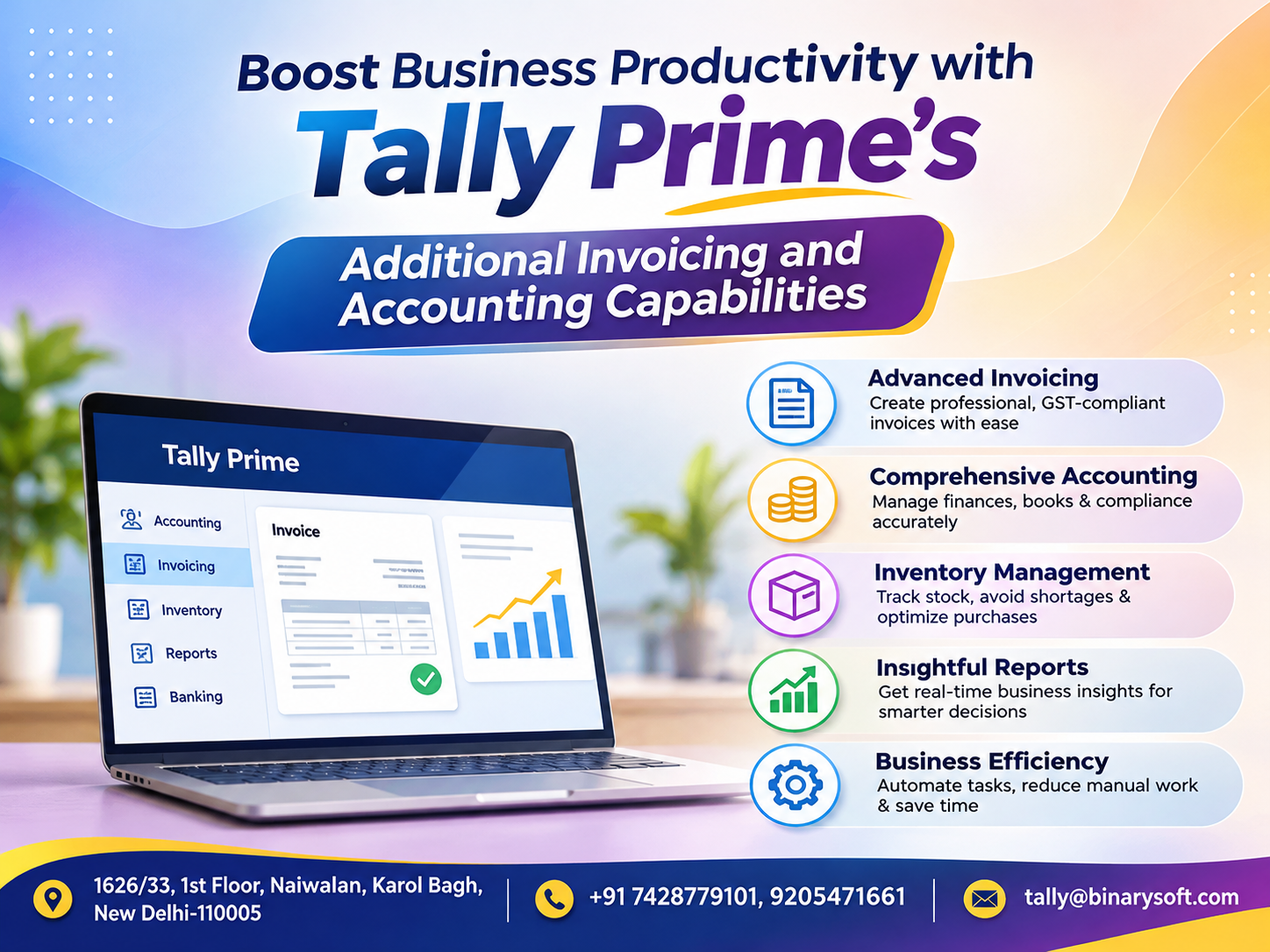
Tally Prime provides an integrated accounting and business management environment that connects sales, purchases, inventory and financial records.
Instead of maintaining disconnected records, businesses can organize transactions within a structured accounting system.
This improves financial visibility, reduces repetitive work and helps business owners make informed decisions.
Whether you manage a retail store, wholesale distribution business, manufacturing unit or professional service company, understanding how to use Tally Prime effectively can make everyday accounting more organized and efficient.
1. Understanding the Importance of Integrated Business Accounting
Sales, purchases and financial accounting are closely connected.
When a business sells goods, the transaction may affect sales revenue, customer receivables, applicable taxes and inventory quantities.
Similarly, purchasing goods can affect supplier balances, purchase accounts, input tax records and stock availability.
If these records are maintained separately, accounting teams must repeatedly update multiple systems.
An integrated accounting process reduces this duplication.
How Tally Prime Supports Integration
Tally Prime connects relevant accounting and inventory information through transaction vouchers.
For example, recording an inventory-based sales invoice can update the associated sales ledger, customer balance, tax accounts and stock records according to the configured transaction.
This helps businesses maintain consistent financial information.
The major advantages include:
-
Reduced repetitive data entry.
-
Better transaction accuracy.
-
Organized customer and supplier accounts.
-
Improved inventory visibility.
-
Faster access to financial reports.
-
Easier reconciliation of accounting records.
-
Better monitoring of business profitability.
An integrated accounting system becomes especially valuable as transaction volumes increase.
2. Simplifying Sales Invoice Management with Tally Prime
Sales invoicing is one of the most important activities in everyday business operations.
A sales invoice records the products or services supplied to a customer and establishes the amount payable.
Businesses must ensure that invoices contain accurate customer details, item descriptions, quantities, prices, taxes and payment terms.
Sales Invoicing Features
Tally Prime supports accounting invoices and item-based invoices, depending on business requirements.
Businesses can maintain customer ledgers, create stock items, configure tax-related information and record sales transactions.
For inventory-based businesses, sales invoices can also update stock quantities when the relevant inventory features are enabled and correctly configured.
How to Create a Sales Invoice in Tally Prime
-
Open the required company in Tally Prime.
-
Navigate to Vouchers and select Sales using F8.
-
Choose the appropriate invoice mode.
-
Select the customer ledger.
-
Enter the stock items or accounting particulars.
-
Specify quantities, rates and applicable taxes.
-
Review the invoice total and transaction details.
-
Save the invoice and print or share it as required.
Example
A wholesale distributor sells the following products:
|
Product
|
Quantity
|
Rate
|
Taxable Value
|
|---|
|
LED Lights
|
50
|
₹400
|
₹20,000
|
|
Electrical Switches
|
100
|
₹150
|
₹15,000
|
|
Total
|
|
|
₹35,000
|
If both products attract an illustrative GST rate of 18%, the GST amount would be ₹6,300 and the invoice total ₹41,300.
Actual tax rates and treatment must be verified for the applicable products and transaction.
By configuring the relevant tax details, businesses can use Tally Prime to calculate applicable taxes and maintain corresponding accounting records.
3. Improving GST Billing Accuracy
GST compliance is an important consideration for registered businesses in India.
Incorrect invoice details, tax classifications or transaction records may create reconciliation problems and compliance risks.
Tally Prime supports GST-related accounting and invoicing features that help businesses maintain organized tax information.
Important GST Billing Capabilities
Businesses can configure GST registration details, maintain relevant tax ledgers, specify applicable tax classifications and record taxable transactions.
Depending on the transaction type and configuration, Tally Prime can help calculate CGST, SGST or IGST.
Businesses can also review GST-related reports to identify inconsistencies requiring correction.
Benefits for Businesses
Accurate GST invoicing helps reduce manual calculation errors and improves the consistency of sales records.
It also supports reconciliation between accounting records and GST reporting requirements.
Businesses should regularly verify GSTIN details, applicable rates, place-of-supply information and tax treatment.
Where e-invoicing or e-way bill requirements apply, businesses must also follow the relevant eligibility rules and statutory procedures.
4. Streamlining Purchase Entries and Supplier Accounting
Purchase management is equally important for maintaining accurate financial accounts.
Businesses purchase raw materials, finished goods, office supplies, equipment and services from different suppliers.
Each purchase may involve supplier invoices, tax details, payment terms and inventory movements.
Tally Prime helps businesses record these transactions in an organized manner.
How to Record a Purchase Entry
-
Open the required company.
-
Navigate to Vouchers.
-
Select Purchase using F9.
-
Choose the appropriate purchase voucher mode.
-
Select the supplier ledger.
-
Enter purchase invoice details.
-
Add stock items or accounting particulars.
-
Apply the relevant taxes.
-
Verify the transaction and save the voucher.
Practical Example
A retailer purchases goods worth ₹80,000 from a supplier.
Assuming the goods attract 18% GST, the illustrative invoice value becomes ₹94,400.
The purchase entry can record the purchase amount, applicable tax components and supplier liability.
Where inventory accounting is enabled, the transaction can also update relevant stock records.
This helps maintain consistency between purchase documentation, inventory and financial accounts.
5. Managing Supplier Outstanding Payments
Recording purchases is only one part of supplier accounting.
Businesses must also track unpaid supplier invoices and schedule payments according to agreed terms.
Tally Prime supports bill-wise accounting and supplier outstanding reports.
These features help businesses review pending purchase invoices, due dates and outstanding amounts.
For example, a distributor purchasing goods from ten suppliers can use supplier ledger information to understand upcoming payment commitments.
This reduces dependence on manual payment registers and supports better cash flow planning.
Accurate supplier accounting also helps identify duplicate entries, incorrect payment adjustments and unreconciled balances.
6. Connecting Sales and Purchases with Inventory Management
Inventory plays a major role in trading and manufacturing businesses.
Without accurate stock information, businesses may purchase unnecessary products or accept customer orders for unavailable items.
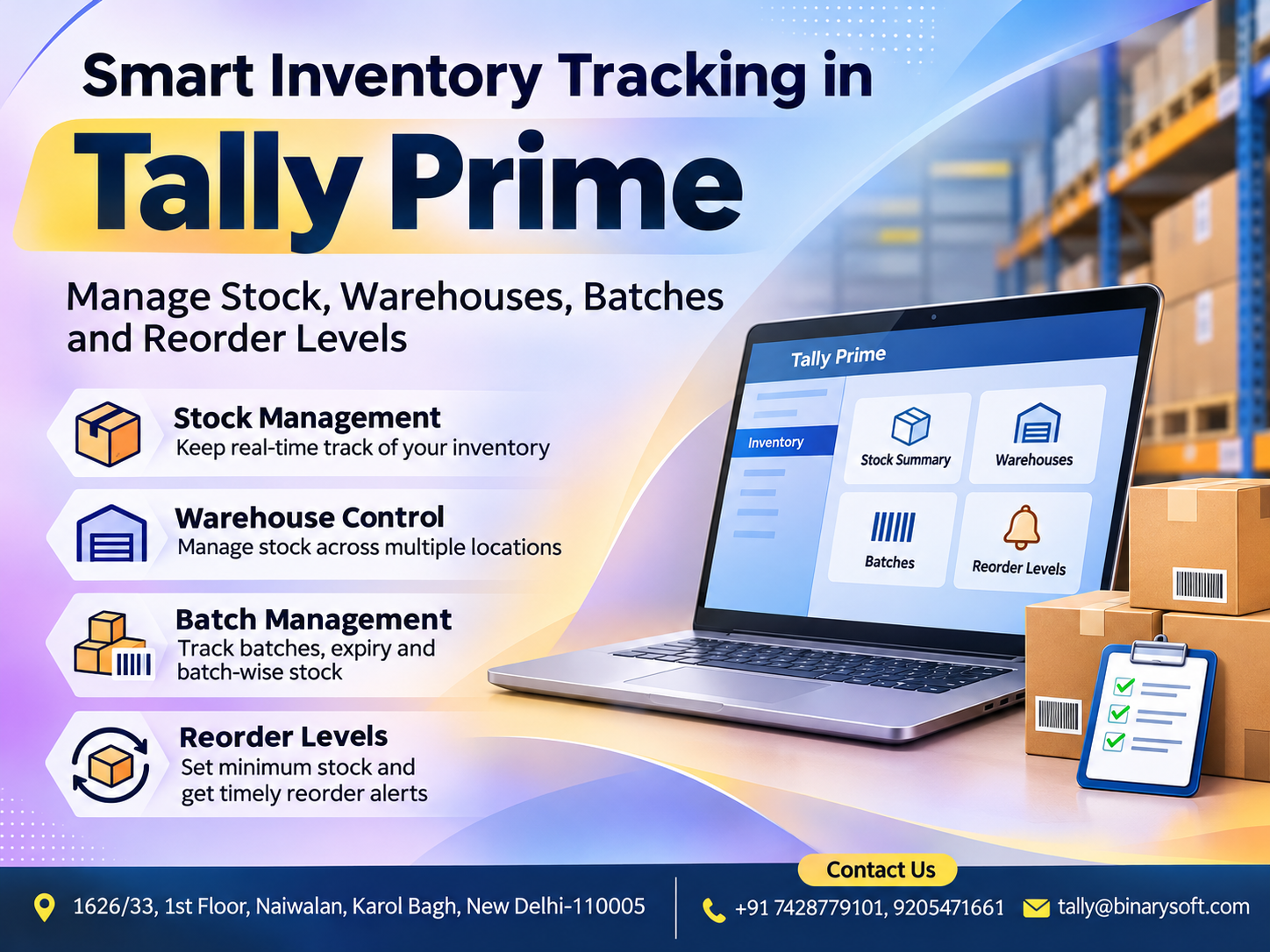
Tally Prime supports inventory features such as stock items, stock groups, units of measurement, godowns and relevant stock reports.
Benefits of Integrated Inventory Accounting
When configured appropriately, inventory-based sales and purchase vouchers update stock quantities.
Businesses can review available stock, stock movement and inventory valuation information.
For example, a wholesaler purchasing 500 units and selling 320 units can review the remaining stock balance of 180 units, assuming no other stock movements.
This visibility helps management plan purchases and reduce stock shortages.
Features such as reorder levels and godown-wise tracking can further support inventory planning for businesses with suitable requirements.
7. Managing Financial Accounts with Greater Accuracy
Financial accounting provides the foundation for evaluating business performance.
Tally Prime maintains accounting information through ledgers and transaction vouchers, helping businesses organize income, expenses, assets and liabilities.
Common voucher types include sales, purchases, receipts, payments, contra entries and journal entries.
For example, when a customer pays an outstanding invoice, the receipt voucher records the payment against the appropriate account. Correct bill allocation also reduces the corresponding customer outstanding balance.
This eliminates the need to maintain separate manual registers for every transaction.
Key Financial Reports
|
Financial Report
|
Business Purpose
|
|---|
|
Profit and Loss Account
|
Evaluate income, expenses and profitability
|
|
Balance Sheet
|
Review assets, liabilities and capital
|
|
Trial Balance
|
Verify ledger balances
|
|
Cash Flow
|
Understand cash and bank movements
|
|
Sales Register
|
Analyze recorded sales transactions
|
|
Purchase Register
|
Review purchases and supplier transactions
|
|
Outstanding Reports
|
Monitor customer collections and supplier payments
|
These reports help business owners understand financial performance without manually consolidating every transaction.
8. Improving Accounts Receivable and Accounts Payable Management
A profitable business can still experience financial difficulties when customer payments are delayed.
Accounts receivable represents amounts customers owe the business, while accounts payable represents amounts payable to suppliers.
Tally Prime supports bill-wise accounting, allowing businesses to maintain invoice-level outstanding records.
Practical Example
A business has the following financial position:
|
Particulars
|
Amount
|
|---|
|
Outstanding customer invoices
|
₹8,50,000
|
|
Outstanding supplier invoices
|
₹5,20,000
|
|
Available cash and bank balance
|
₹2,00,000
|
Although the business has substantial receivables, those amounts may not be immediately available.
Management must therefore consider payment due dates and expected collection schedules before committing to additional purchases.
Regularly reviewing outstanding reports helps businesses prioritize collections, schedule supplier payments and maintain better financial discipline.
9. The Emotional Story: A Small Business Owner Who Almost Lost His Dream
When Amit opened his first hardware shop in Delhi, he had one dream: to build a successful business that would provide financial security for his family.
His father had invested retirement savings to help him start the shop.
During the first few years, Amit managed everything personally. He purchased materials, handled customers, prepared invoices and maintained handwritten accounting records.
As the business expanded, the number of daily transactions increased.
At first, Amit considered this growth a sign of success.
But the growing workload brought unexpected problems.
Some purchase invoices were recorded twice. Customer payments were not always adjusted correctly, and stock records frequently differed from actual inventory.
One evening, a supplier demanded payment for an invoice Amit believed had already been settled.
After searching through several registers and spreadsheets, he discovered that his accounting records were incomplete.
The situation became even more stressful when he struggled to calculate the money available for his next inventory purchase.
His father quietly asked, "You work from morning until night. Why does the business still create so much worry?"
That question stayed with Amit.
He realized that working harder would not solve problems caused by disorganized accounting.
He decided to implement Tally Prime and establish a structured process for recording business transactions.
Sales invoices were entered consistently, purchase bills were organized, and customer and supplier ledgers were reviewed regularly.
Inventory transactions were connected with the accounting process, helping him identify differences more quickly.
Within a few months, Amit had better visibility into his business.
He could review outstanding payments, verify supplier balances and understand financial performance without searching through piles of paperwork.
His business still required effort, careful planning and customer relationships. But accounting was no longer the source of constant uncertainty.
The biggest improvement was personal.
Amit could finally spend evenings with his family without worrying about missing invoices.
The lesson: Business success is not only about increasing sales. It is also about building systems that protect your time, money and peace of mind.
This is an illustrative fictional story reflecting common challenges faced by growing businesses.
10. Case Study One: Wholesale Trading Business Improves Invoice Accuracy
Business Background
A wholesale electrical goods distributor handled approximately 1,200 sales invoices and 350 purchase invoices every month.
The business relied on spreadsheets for billing and separate registers for inventory tracking.
Challenges
The company experienced invoice duplication, incorrect customer balances, inconsistent inventory records and delays in preparing monthly financial statements.
Implementation with Tally Prime
The business introduced structured customer and supplier ledgers, item-based sales invoicing, purchase voucher recording and bill-wise accounting.
Its accounting team also started reviewing sales registers, purchase registers and outstanding reports every week.
Illustrative Results
|
Performance Indicator
|
Before
|
After
|
|---|
|
Average invoice preparation time
|
8 minutes
|
4 minutes
|
|
Monthly invoice corrections
|
45
|
12
|
|
Monthly accounts preparation
|
5 days
|
2 days
|
|
Inventory reconciliation
|
Manual
|
Report-assisted
|
The company improved invoice consistency and reduced repetitive accounting work.
Management also gained clearer visibility into customer outstanding balances and product movements.
Key takeaway: Integrated sales, purchase and inventory accounting can reduce administrative effort when supported by accurate transaction entry and regular reconciliation.
This hypothetical case study demonstrates possible operational improvements, not verified customer results.
11. Case Study Two: Manufacturing Business Strengthens Purchase and Financial Control
Business Background
A small packaging manufacturer purchased raw materials from several suppliers and supplied finished products to regional distributors.
The business generated approximately ₹40 lakh in monthly sales.
Challenges
Management struggled to match purchase invoices with material receipts, monitor supplier payments and determine the financial impact of production-related expenses.
Monthly profitability reports were often delayed.
Implementation with Tally Prime
The manufacturer configured purchase ledgers, supplier accounts, inventory items and financial reporting processes.
Purchase invoices were entered against appropriate suppliers, and relevant inventory movements were recorded systematically.
Management introduced monthly reviews of purchases, expenses, outstanding payments and profitability.
Illustrative Results
|
Area
|
Earlier Process
|
Improved Process
|
|---|
|
Purchase recording
|
Separate registers
|
Structured vouchers
|
|
Supplier balances
|
Manual reconciliation
|
Ledger-based review
|
|
Stock visibility
|
Periodic spreadsheets
|
Inventory reports
|
|
Financial review
|
Delayed
|
Monthly
|
|
Expense monitoring
|
Limited
|
Ledger-based analysis
|
The company gained better control over its accounting information and could identify unusual expenses more quickly.
Key takeaway: Accurate purchase records and integrated financial reporting help manufacturers evaluate costs and improve operational planning.
This hypothetical example is provided for educational purposes.
12. How Tally Prime Supports Better Business Decisions
Accounting software becomes more valuable when business owners use financial information to make decisions.
Tally Prime provides reports that help management evaluate revenue trends, purchasing patterns, operating expenses and financial obligations.
For example, a retailer can compare monthly sales performance with purchase values to understand whether inventory investment is increasing faster than revenue.
A distributor can review customer outstanding balances before approving additional credit.
A manufacturer can examine purchase and expense accounts to identify areas where costs require attention.
Financial reports also help businesses prepare budgets, evaluate profitability and plan future investment.
However, accurate decision-making depends on timely transaction entry, appropriate ledger classification and regular verification of records.
13. Reducing Accounting Errors Through Better Processes
Although Tally Prime supports integrated accounting, software alone cannot eliminate every error.
Businesses should establish clear procedures for entering and verifying transactions.
Recommended Accounting Practices
Maintain accurate masters: Customer, supplier, stock item and tax information should be reviewed regularly.
Avoid duplicate entries: Supplier invoice numbers and transaction references should be checked before recording purchases.
Reconcile bank accounts: Bank transactions should be compared with accounting records frequently.
Verify GST information: Applicable rates, classifications and transaction details should be checked before finalizing invoices.
Review financial reports: Unusual balances and unexpected changes should be investigated.
Maintain backups: Business data should be protected through appropriate backup and recovery procedures.
These practices help improve the reliability of financial information and reduce avoidable accounting problems.
14. Using Tally Prime for Different Types of Businesses
Tally Prime can support businesses with different accounting requirements.
Retail businesses can manage customer invoices, purchases, stock movements and daily financial transactions.
Wholesale distributors can track credit sales, supplier purchases, inventory quantities and outstanding balances.
Manufacturing businesses can maintain raw material records, relevant inventory transactions and financial accounts.
Professional service providers can use accounting invoices to record service income, expenses and customer payments.
Growing MSMEs can benefit from integrated financial reporting, helping owners understand business performance without maintaining multiple disconnected accounting systems.
The most suitable configuration depends on transaction volume, inventory requirements, tax obligations and business workflows.
15. Tally Prime on Cloud for Flexible Business Accounting
Businesses operating from multiple locations may require secure access to accounting information outside their main office.
Tally Prime can be deployed through suitable hosted environments, allowing authorized users to work with accounting data remotely.
A properly configured Tally on Cloud arrangement may help businesses support remote accounting teams, branch coordination and centralized financial recordkeeping.
For example, a business owner travelling outside Delhi may need to review financial reports while the accounting team continues recording transactions from the office.
A hosted arrangement can support this workflow when appropriate access permissions and connectivity are available.
However, businesses should evaluate hosting security, backup arrangements, licensing, performance and user access controls before selecting a cloud solution.
16. How Binarysoft Technologies Can Help Your Business
Implementing Tally Prime successfully requires more than installing accounting software.
Businesses need suitable ledger structures, invoice configurations, inventory settings and financial reporting processes.
Binarysoft Technologies, an Authorized Tally Partner, can assist businesses in evaluating and implementing Tally Prime according to their operational requirements.
Support may include accounting setup, GST billing configuration, purchase and sales workflows, inventory management, financial reporting and user training.
Businesses exploring remote accounting can also discuss suitable Tally on Cloud arrangements.
The objective is to create an organized accounting environment that supports efficient operations and reliable business information.
Conclusion
Managing sales invoices, purchase entries and financial accounts accurately is essential for sustainable business growth.
Manual accounting processes and disconnected records can increase administrative work, create errors and delay important financial decisions.
Tally Prime helps businesses connect sales, purchases, inventory and accounting information through a structured transaction system.
Its invoicing, voucher management, GST-related features, outstanding reports and financial statements provide valuable support for everyday business operations.
By implementing appropriate accounting practices and reviewing reports regularly, businesses can improve accuracy, reduce repetitive work and strengthen financial control.
Whether you operate a retail store, wholesale business, manufacturing unit or professional consultancy, Tally Prime can help transform accounting from a routine administrative responsibility into a valuable source of business insight.
Better accounting creates better visibility. Better visibility supports smarter decisions. And smarter decisions help businesses grow with confidence.
Powered by Binarysoft Technologies
Authorized Tally Partner
Location: 1626/33, 1st Floor, Naiwalan, Karol Bagh, New Delhi – 110005, INDIA
Contact Us: +91 7428779101, 9205471661
Email: tally@binarysoft.com
Business Hours: 10:00 AM – 6:00 PM, Monday to Friday
Frequently Asked Questions
How does Tally Prime simplify sales invoicing?
Tally Prime allows businesses to create sales invoices using customer ledgers, stock items, quantities, rates and applicable taxes. Relevant accounting and inventory records are updated according to the transaction configuration, reducing repetitive manual work.
How do I create a sales invoice in Tally Prime?
Open Vouchers, select Sales using F8, choose the appropriate invoice mode, enter customer and product details, apply applicable taxes, verify the invoice and save the transaction.
CA. Arvindh Khetwaani is a Chartered Accountant with experience in financial reporting, compliance management, and accounting software implementation. He has assisted businesses in adopting structured inventory and billing practices, and his articles focus on accuracy, controls, and sustainable business growth.