Call CA Tally HelpDesk
+91 9205471661,
7428779101
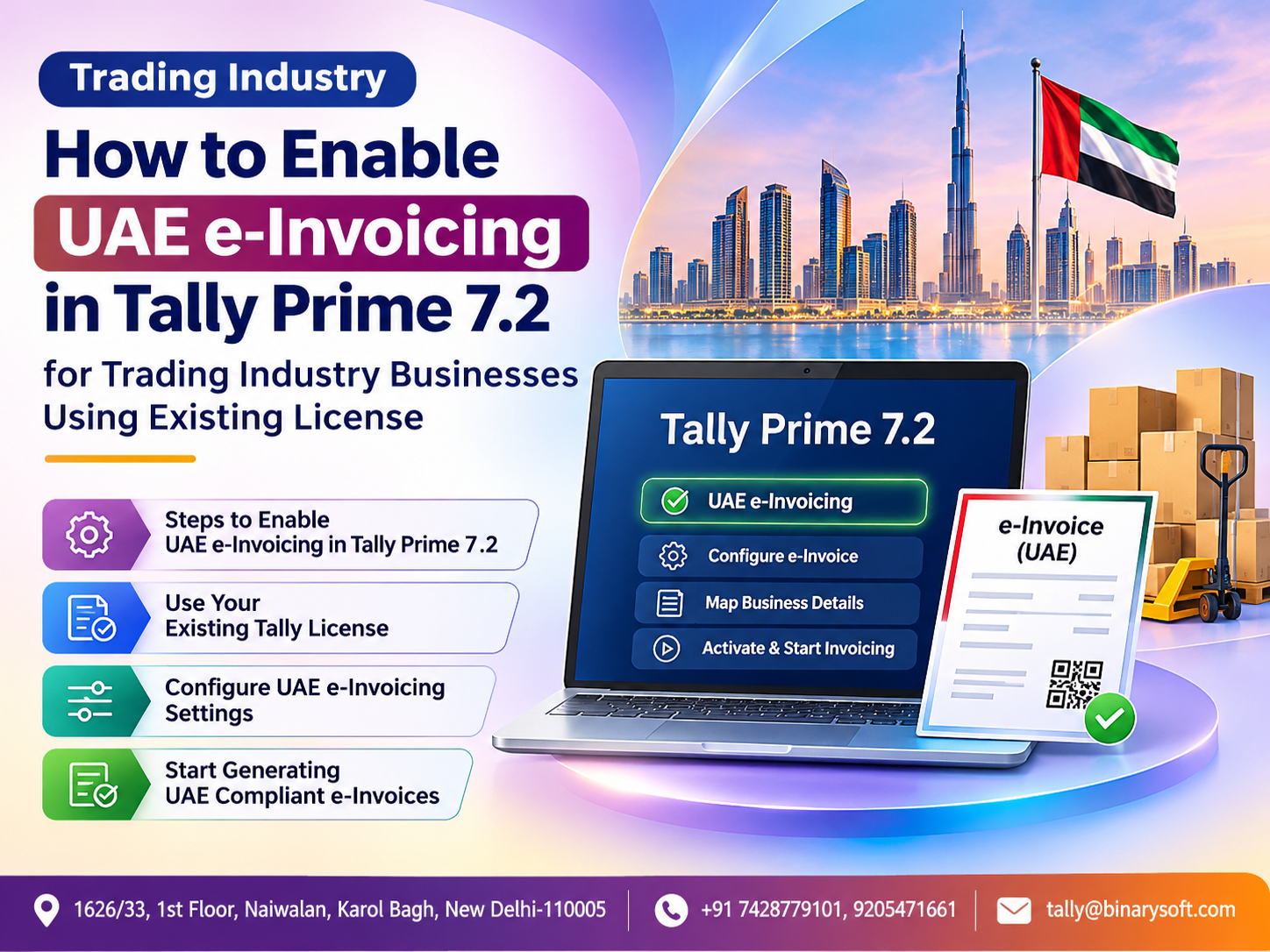
Introduction: A New Era of Digital Invoicing for UAE Trading Businesses
The trading industry in the United Arab Emirates is entering an important period of digital transformation. From wholesale distributors and import-export companies to electronics traders, building material suppliers, and general merchandise businesses, organizations increasingly need faster invoicing, accurate accounting, and better control over financial transactions.
For businesses already using Tally Prime 7.2, the transition toward electronic invoicing raises an important question: Can UAE e-Invoicing be enabled using an existing Tally Prime license?
The answer depends on the license's regional eligibility, available software features, supported integrations, and the UAE's technical and regulatory requirements. An existing license may provide a useful foundation for accounting and invoice preparation, but it should not be assumed that every license automatically supports compliant UAE e-invoice transmission.
UAE e-Invoicing is more than generating a PDF invoice or sending a bill through email. It involves creating structured electronic invoice data and exchanging it through an approved digital framework.
For trading companies handling hundreds or thousands of transactions, preparing for this change is an opportunity to improve operational efficiency, reduce manual errors, and strengthen financial transparency.
This guide explains how trading businesses can review their existing Tally Prime 7.2 setup, configure relevant accounting features, prepare for UAE e-Invoicing, and manage sales, purchases, inventory, VAT, and financial reporting more effectively.
Understanding UAE e-Invoicing and Its Importance for the Trading Industry
UAE e-Invoicing is a digital invoicing framework designed to standardize how eligible businesses generate, exchange, and report invoice information.
Unlike traditional invoicing, where a business prepares a document and sends it directly to a customer, structured electronic invoicing uses standardized machine-readable data.
This allows participating systems to exchange invoice information more consistently and reduces dependence on manual data entry.
Why Trading Businesses Need to Prepare
Trading companies typically handle several types of transactions, including domestic sales, bulk purchases, imports, exports, customer returns, supplier credit notes, and intercompany transfers.
Each transaction may involve different tax treatments, customer information, product descriptions, and payment conditions.
A structured invoicing process can help businesses:
-
Reduce repetitive invoice entry and manual corrections.
-
Improve customer and supplier information accuracy.
-
Maintain consistent transaction records.
-
Support VAT reconciliation and financial reporting.
-
Improve invoice processing and payment follow-up.
-
Prepare for digital compliance requirements.
-
Strengthen visibility across multiple branches and warehouses.
For a trading organization, accurate invoicing is closely connected to inventory control, cash flow, and customer relationships.
Can You Enable UAE e-Invoicing in Tally Prime 7.2 Using an Existing License?
Many businesses already maintain their accounting records in Tally Prime and would prefer to continue using their familiar software rather than replace their accounting system.
This is understandable because existing records may include years of customer transactions, supplier balances, stock information, outstanding invoices, and financial statements.
However, three separate requirements must be considered.
First: Software License Eligibility
The business should verify whether its existing Tally Prime 7.2 license supports the required UAE accounting configuration and whether any regional activation, license change, or additional entitlement is necessary.
Second: Accounting and VAT Configuration
The company must ensure that its accounting data, tax ledgers, sales vouchers, customer records, and invoice details are correctly configured for UAE transactions.
Third: Compliant Electronic Invoice Exchange
A compliant UAE e-invoice generally requires structured electronic data and transmission through the applicable accredited service-provider framework.
A standard invoice printed from Tally Prime is not automatically a compliant UAE e-invoice.
Therefore, the practical objective is to use the existing accounting system wherever technically supported while verifying whether additional integration or service-provider connectivity is required.
Step-by-Step Guide to Enable UAE e-Invoicing in Tally Prime 7.2
Before beginning, take a secure backup of your company data and confirm that your Tally Prime installation is updated to the required build.
Step 1: Check Your Existing License
Open Tally Prime 7.2 and review the license information.
Confirm the following:
-
Your Tally Prime license is active.
-
Your Tally Software Services (TSS) subscription is active.
-
You have permission to access company features and VAT-related functions.
-
Your company is configured for UAE accounting requirements.
-
Your internet connection is available for electronic invoice services.
As of November 2026, UAE e-Invoicing registration is supported with an Indian Tally Prime license, although a transition to an International license is expected to become necessary. Businesses should verify their eligibility before relying on their current license for long-term operations.
Step 2: Open Your UAE Company
Launch Tally Prime 7.2 and select the company for which electronic invoicing is required.
Verify the company's legal name, registered address, country, emirate, currency, VAT registration information, and other statutory details.
For UAE e-Invoicing, the company's base currency must currently be AED.
Trading businesses operating in multiple countries should maintain appropriate company configurations for each jurisdiction rather than changing an Indian company's statutory settings without reviewing the accounting consequences.
Step 3: Enable VAT and e-Invoicing
Open the company features using F11 (Company Features).
Review the statutory and taxation settings and enable Value Added Tax where applicable.
Then locate the UAE e-Invoicing option and enable it.
Enter the applicable date according to your company's implementation requirements. The software allows an e-Invoicing applicable date from 1 July 2026 onward, but this does not mean every business became legally obligated on that date.
Save the configuration using Ctrl+A.
If the e-Invoicing option is not visible, check the software build, company country, user permissions, VAT settings, and subscription status.
Step 4: Configure Customer and Supplier Ledgers
Accurate party information is essential for electronic invoicing.
Open the relevant customer or supplier ledger and review the mailing details, registration type, VAT Tax Registration Number (TRN), and other required identification fields.
Depending on the transaction, additional information may include the Tax Identification Number (TIN), Peppol identification, digital location, and digital identity details.
For a trading company, customer records should be reviewed before issuing electronic invoices, particularly where multiple branches or international buyers are involved.
Step 5: Update Stock Items and VAT Rates
Trading businesses depend on accurate stock records.
Review each product's description, unit of measurement, VAT classification, and applicable tax rate.
Map units of measurement to the required standardized Unit Quantity Codes (UQC).
For example, a company selling electrical components by piece and cables by metre should ensure both units have the correct electronic invoicing mappings.
Tally Prime 7.2 provides reporting facilities for updating VAT rates and unit mappings in bulk, reducing the need to modify every stock item separately.
Step 6: Complete e-Invoicing Registration
Once the company and master data are ready, proceed with the electronic invoicing registration process.
From the relevant exchange options, access the e-Invoice login and registration facilities.
Complete the required authentication and onboarding using the appropriate EmaraTax account information.
Follow the registration instructions and verify that the company has successfully completed the necessary steps.
Businesses operating multiple entities may need separate registration for each applicable TIN.
Step 7: Create a Sales Invoice
Open the sales voucher using the normal sales invoicing workflow.
Select the customer and enter the products sold, quantities, rates, VAT details, and other required information.
For example:
|
Invoice Particulars
|
Amount
|
|---|
|
Electronic Components – 100 Units
|
AED 20,000
|
|
VAT at 5%
|
AED 1,000
|
|
Total Invoice Value
|
AED 21,000
|
This example assumes the supply is subject to the standard UAE VAT rate.
After entering the details, review the invoice and save the voucher.
Step 8: Generate and Review the e-Invoice
Open the e-Invoice report to identify eligible transactions.
Review the invoice information and resolve any missing mandatory details.
Depending on the supported workflow, select individual invoices or process multiple eligible invoices together.
Submit the transactions through the configured electronic invoicing service and review their generation status.
Maintain records of successful exchanges, errors, and subsequent corrections.
A successful voucher save does not by itself confirm successful electronic invoice exchange.
UAE e-Invoicing Implementation Timeline for Trading Companies
Trading businesses should plan their implementation according to the applicable revenue threshold and regulatory requirements.
|
Business Category
|
ASP Appointment Deadline
|
Implementation Date
|
|---|
|
Annual revenue of AED 50 million or more
|
31 July 2026
|
1 January 2027
|
|
Annual revenue below AED 50 million
|
31 March 2027
|
1 July 2027
|
|
In-scope government entities
|
31 March 2027
|
1 October 2027
|
These dates provide an implementation framework, subject to applicable regulatory amendments and exclusions.
For trading businesses, early preparation can reduce the risk of last-minute problems involving customer records, product classifications, software configuration, and invoice validation.
How Tally Prime 7.2 Helps UAE Trading Businesses Beyond e-Invoicing
Electronic invoicing is only one part of effective trading business management.
A trading company also needs reliable stock information, supplier tracking, customer receivables, tax calculations, and profitability reports.
1. Inventory Management
Tally Prime helps businesses maintain stock groups, stock categories, units of measurement, and warehouse information.
A wholesale distributor can track incoming purchases, outgoing sales, available quantities, and product movement.
This improves visibility into stock availability and reduces the possibility of accepting orders without sufficient inventory.
2. Purchase and Sales Management
Trading businesses can record purchase orders, sales orders, purchase vouchers, and sales invoices.
Connecting these activities through consistent accounting procedures helps employees identify pending orders, supplier obligations, and customer commitments.
3. VAT Accounting
Correct VAT accounting is important for UAE businesses.
Tally Prime supports the recording and reporting of VAT-related transactions, subject to proper company configuration.
Businesses can review taxable sales, purchase-related VAT, and other relevant transaction information before preparing statutory returns.
4. Customer Outstanding Management
Late customer payments can create significant pressure on trading companies.
Outstanding reports help identify unpaid invoices, overdue customers, and amounts requiring collection.
A business owner can use these reports to prioritize payment follow-ups and improve working capital management.
5. Supplier Payment Tracking
Trading companies frequently purchase goods on credit.
Tally Prime can help maintain supplier balances, outstanding purchase invoices, and payment records.
This makes it easier to plan payments without losing visibility into available cash.
6. Financial Reporting
Business owners can review financial statements and operational reports, including:
-
Balance Sheet
-
Profit and Loss Account
-
Stock Summary
-
Sales Register
-
Purchase Register
-
Receivables and Payables
-
Cash and Bank Books
-
VAT-related Reports
These reports help management evaluate sales performance, profitability, and financial commitments.
An Emotional Story: When a Small Trading Business Decided to Change
The following story is fictional and illustrates a common business challenge.
Ahmed had spent nearly eighteen years building his electrical trading business in Dubai.
What began as a small shop supplying electrical fittings had gradually developed into a respected distribution operation serving contractors, retailers, and maintenance companies.
His business was growing, but the paperwork was becoming overwhelming.
Every evening, Ahmed remained in the office after his employees had gone home. He checked invoices, reviewed customer balances, and searched for missing documents.
His daughter often called him during dinner.
“Papa, are you coming home today?”
He always replied, “Just another fifteen minutes.”
But those fifteen minutes regularly became two hours.
One afternoon, a major customer questioned several invoice details. The accounts team needed additional time to locate the records and confirm the correct amounts.
Ahmed realized that his company had grown beyond the manual processes he had relied on for years.
Instead of immediately purchasing a completely new accounting system, he asked his accountant to evaluate their existing Tally Prime installation.
They reviewed customer ledgers, VAT settings, stock classifications, and electronic invoicing requirements.
The team corrected inconsistent records, established approval procedures, and began preparing for structured electronic invoice exchange.
The transition required effort, but employees gradually became more confident in the accuracy of their records.
Ahmed could now review business information without waiting for piles of printed documents to be checked.
One evening, he closed his office on time.
When his daughter asked whether he would join the family for dinner, he answered, “Yes, I am already on my way.”
For Ahmed, digital transformation was not simply about adopting new technology.
It was about building a business that could grow without taking away every evening from his family.
Case Study 1: Electronics Trading Distributor Improves Invoice Accuracy
Illustrative case study using hypothetical business data.
Business Background
A Dubai-based electronics distributor supplied computer accessories, networking equipment, and electrical products to corporate customers.
The company processed approximately 1,200 sales invoices every month.
Its accounting team faced difficulties maintaining consistent customer tax information and identifying incorrect product classifications.
Challenges
The main problems included incomplete customer records, inconsistent stock descriptions, invoice corrections, and delays in monthly VAT reconciliation.
Employees often had to contact customers to verify missing details.
Implementation
The company reviewed its Tally Prime 7.2 configuration and prepared its records for UAE e-Invoicing.
The accounting team standardized customer ledgers, verified VAT registration details, corrected stock item information, and mapped units of measurement.
They also established a daily procedure for reviewing invoices before electronic submission.
Illustrative Results
After implementing the revised workflow, the company projected a reduction in routine invoice corrections and faster reconciliation.
In a sample internal assessment, the team estimated that invoice verification time could decline from approximately six minutes to three minutes per invoice.
Across 1,200 invoices, this would represent a potential saving of 60 staff-hours per month.
These figures are illustrative and not independently measured results.
Key Learning
Accurate master data is just as important as electronic invoice generation.
Businesses that clean their accounting records before implementation are better positioned to avoid repeated validation errors.
Case Study 2: Building Materials Trader Strengthens Financial Control
Illustrative case study using hypothetical business data.
Business Background
A Sharjah-based building materials trader supplied cement, plumbing accessories, hardware, and construction materials to contractors.
The company operated two warehouses and offered credit facilities to regular customers.
Its management wanted better visibility into sales invoices, outstanding receivables, and inventory movement.
Challenges
The business faced delayed customer payments, inconsistent product units, manual document checking, and difficulty reconciling branch-level transactions.
Implementation
The company reviewed its existing accounting environment and prepared for UAE e-Invoicing.
Its accounting team standardized product records, checked VAT settings, updated customer information, and introduced regular reviews of outstanding invoices.
Warehouse and accounting employees coordinated more closely to ensure that invoiced quantities matched dispatched goods.
Illustrative Results
The company modeled a potential reduction in invoice correction rates from 8% to 3% following improved data validation.
For 800 monthly invoices, this would mean reducing corrections from approximately 64 to 24 invoices.
The business also expected better visibility into overdue receivables through more consistent reporting.
Key Learning
Electronic invoicing works best when it is supported by strong inventory procedures, accurate accounting records, and regular financial reviews.
Common UAE e-Invoicing Challenges and How to Avoid Them
Even with the correct software, trading businesses may encounter difficulties during electronic invoicing implementation.
Incorrect Customer Registration Details
Missing or incorrect customer TRNs and identification details can create validation problems.
Businesses should periodically review customer master records and verify the information required for electronic invoice exchange.
Incorrect Product Units
A mismatch between product units and standardized electronic invoicing codes may prevent successful processing.
Trading businesses should check unit mappings before generating invoices.
Unsupported Transaction Types
As of November 2026, some transaction scenarios in Tally Prime 7.2 have limitations. These include certain tax-inclusive invoices, invoices with discounts or additional charges, reverse-charge transactions, and self-billed invoices.
Businesses should test their normal invoicing scenarios before going live and confirm whether an updated software build supports their requirements.
Inactive Software Subscription
An inactive TSS subscription can prevent access to electronic invoicing services.
Check subscription validity and renewal requirements before implementation.
Missing Invoice Validation
Submitting invoices without checking mandatory information may result in errors.
A daily invoice review procedure can help employees identify missing information before submission.
Best Practices for Successful UAE e-Invoicing Implementation
Trading companies should approach electronic invoicing as a business process improvement project rather than simply activating a software feature.
Begin by reviewing company information, customer records, stock items, and VAT configurations.
Assign responsibility for checking invoice accuracy and maintaining registration information.
Train employees who create sales invoices, issue credit notes, and manage customer accounts.
Establish clear procedures for handling rejected invoices and correcting transaction details.
Maintain secure backups and restrict sensitive accounting functions to authorized employees.
Finally, monitor electronic invoice generation and exchange reports regularly to identify issues before they affect customers or compliance.
Why Existing Tally Prime Users Should Prepare Early
Businesses already using Tally Prime 7.2 may have an advantage because their accounting records, customer information, and inventory data are maintained within a familiar environment.
Rather than rebuilding every business process, they can focus on reviewing the existing setup, correcting missing information, and preparing the electronic invoicing workflow.
However, the ability to use an existing license depends on the applicable software licensing conditions and subscription status.
Businesses should confirm long-term licensing eligibility and supported functionality before making implementation commitments.
Early preparation can help reduce disruption, improve employee confidence, and create a smoother transition to digital invoicing.
Conclusion
UAE e-Invoicing represents an important development for trading businesses seeking greater efficiency, transparency, and accuracy in their financial operations.
With Tally Prime 7.2, eligible businesses can configure company information, update customer and supplier records, manage VAT details, prepare structured invoice information, and use supported electronic invoicing services.
For companies already using Tally Prime, the existing license may provide a starting point, subject to license eligibility, active TSS subscription, and any future regional licensing requirements.
Successful implementation requires more than enabling an option. It depends on accurate master data, correct tax classifications, employee training, reliable invoice validation, and appropriate electronic exchange arrangements.
Trading businesses that prepare early can strengthen their accounting procedures while positioning themselves for the UAE's evolving digital compliance environment.
Powered by Binarysoft Technologies
Authorized Tally Partner
Location: 1626/33, 1st Floor, Naiwalan, Karol Bagh, New Delhi – 110005, INDIA
Contact Us: +91 7428779101, 9205471661
Email Us: tally@binarysoft.com
Business Hours: 10:00 AM – 6:00 PM, Monday to Friday
Frequently Asked Questions
Can I enable UAE e-Invoicing in Tally Prime 7.2 using my existing license?
Yes, an eligible existing Tally Prime license can currently support UAE e-Invoicing registration, subject to the required configuration and active subscription. However, businesses should verify future International license requirements before relying on their current license for continued use.
Is UAE e-Invoicing available in Tally Prime 7.2?
Yes. Tally Prime 7.2 includes UAE e-Invoicing functionality for configuring relevant records, registering for electronic invoicing, generating supported e-invoices, and reviewing their status.
CA. Rudransh Suryavanshi focuses on GST compliance, financial management, and internal controls. He regularly contributes content on business accounting solutions and effective tax planning strategies.