Call CA Tally HelpDesk
+91 9205471661,
7428779101
Introduction: Why Correct Medicine HSN Classification Matters in 2026
A small mistake in a medicine invoice can create a much bigger problem than an incorrect tax calculation. For a pharmacy owner, pharmaceutical distributor or healthcare supplier, it can affect customer pricing, GST returns, inventory valuation and business profitability.
India's GST rate changes effective from 22 September 2025 significantly altered taxation for pharmaceutical products. Most medicines previously attracting 12% GST moved to the 5% category, while specified life-saving medicines received exemption.
These changes make it particularly important for businesses to review their medicine masters, HSN classifications and tax rates during 2026.
However, every product sold in a medical store is not automatically classified as medicine. Tablets, injections, vaccines, medical devices, cosmetics, nutritional supplements and surgical products may fall under different HSN headings.
Correct classification requires examining the product's composition, therapeutic purpose, packaging and applicable GST notification.
For businesses managing hundreds of products, manually maintaining these details can become challenging.
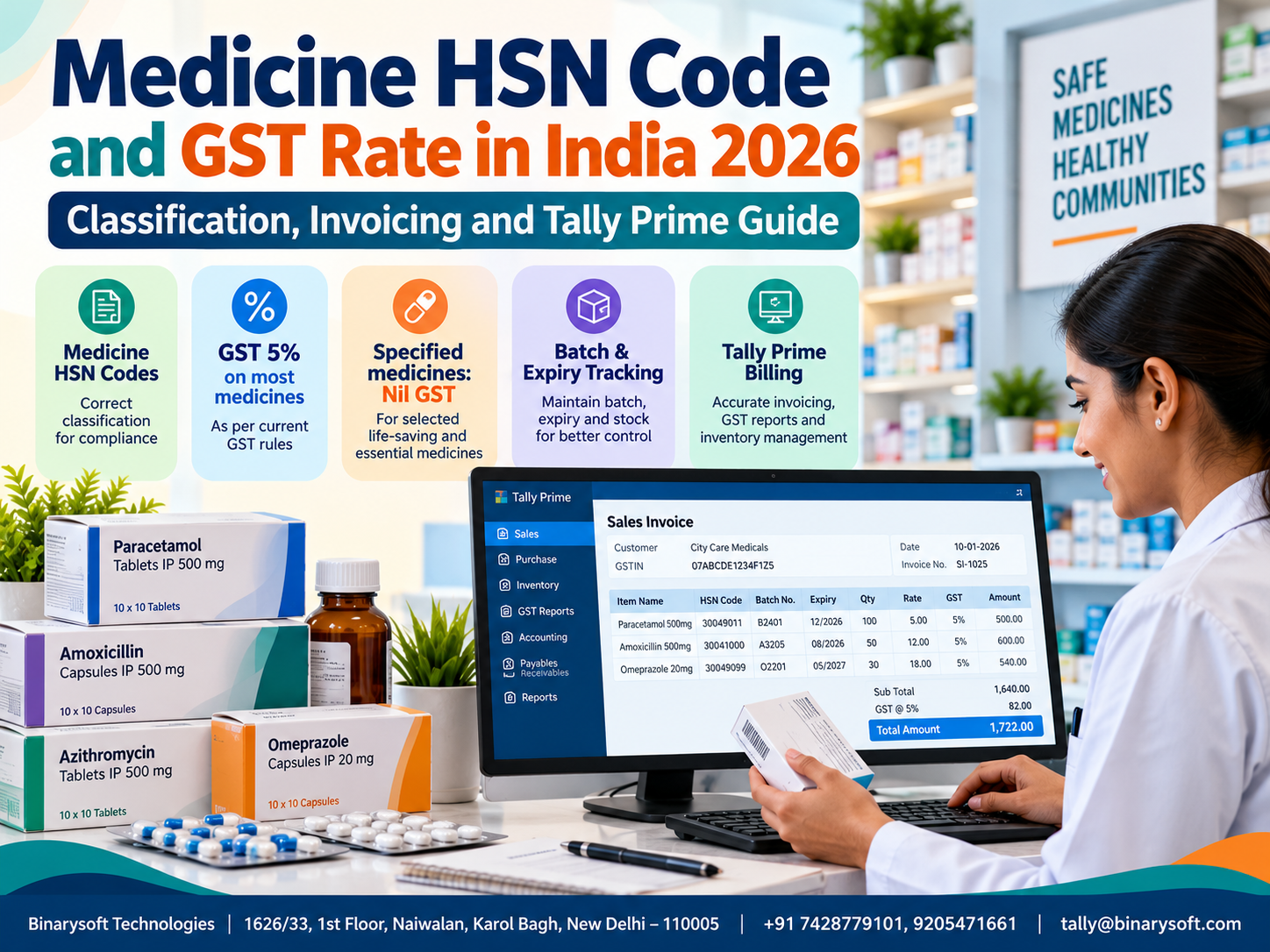
Tally Prime helps by organizing medicine inventory, tax classifications, purchase records, sales invoices and GST reports within a structured accounting system.
This guide explains medicine HSN codes, applicable GST rates, invoicing practices, common classification mistakes and practical methods for managing pharmaceutical accounting efficiently.
A Pharmacy Owner's Story: When an Incorrect GST Rate Affected a Family's Medicine Budget
It was a busy evening at a neighborhood pharmacy in Delhi.
Rohit, the pharmacy owner, was preparing monthly sales reports when an elderly customer entered the store carrying a prescription.
The customer explained that his wife required medicines regularly for a chronic medical condition. Their monthly medical expenses had become difficult to manage.
After preparing the bill, Rohit noticed that his billing software was still applying an outdated GST rate to one of the medicines.
He checked the product classification and discovered that the applicable tax rate had changed.
The difference on a single purchase was relatively small, but the customer bought the same medicine every month.
Rohit corrected the applicable tax configuration and reviewed the product's permitted selling price.
The customer appreciated the explanation. For him, even modest savings mattered because medicine was a recurring necessity.
Later that evening, Rohit reviewed his inventory records and found that several other products required GST rate verification.
He realized that outdated tax masters were not merely an accounting inconvenience. They could affect the prices customers paid and the accuracy of his business records.
His pharmacy introduced a structured product-master review and GST billing process using Tally Prime.
This is an illustrative story reflecting the importance of accurate medicine taxation and responsible pharmacy billing.
1. What Is an HSN Code for Medicines?
HSN stands for Harmonized System of Nomenclature.
It is an internationally recognized classification system used to identify goods for taxation and trade.
Under India's GST framework, HSN codes help determine the applicable tax classification and support standardized invoice and return reporting.
Medicines and pharmaceutical products are primarily classified under Chapter 30.
However, Chapter 30 contains several headings covering different pharmaceutical preparations.
A product's exact HSN classification depends on its characteristics and the relevant tariff description.
For example, retail-packed tablets generally fall under heading 3004, while certain bulk medicinal preparations may fall under heading 3003.
The correct classification is important because products with similar commercial descriptions may have different tax treatment.
2. Important Medicine HSN Codes Under GST
The following table summarizes major pharmaceutical HSN headings.
|
HSN heading
|
Product classification
|
|---|
|
3001
|
Certain organotherapeutic substances and extracts
|
|
3002
|
Vaccines, antisera, blood fractions and specified biological products
|
|
3003
|
Certain medicaments not packed in measured doses or retail packs
|
|
3004
|
Medicaments in measured doses or retail packaging
|
|
3005
|
Medicated dressings, bandages and similar pharmaceutical articles
|
|
3006
|
Specified pharmaceutical goods and preparations
|
These are broad four-digit headings. The appropriate six-digit or eight-digit classification must be selected according to the actual product.
Businesses should not assign the same HSN code to every item simply because it is sold through a pharmacy.
3. GST Rate on Medicines in India in 2026
The GST rate rationalization implemented from 22 September 2025 reduced the general GST rate on many medicines from 12% to 5%.
Specified life-saving and critical medicines are exempt under the relevant notifications.
Most regular medicines
5%
Subject to product classification
Specified exempt medicines
Nil
Only where notified exemption applies
General medicine GST rates
|
Medicine category
|
Indicative GST treatment
|
|---|
|
Regular allopathic tablets and capsules
|
5%
|
|
Prescription syrups and medicinal preparations
|
Generally 5%
|
|
Antibiotic medicines
|
Generally 5%
|
|
Insulin preparations
|
Generally 5%
|
|
Vaccines
|
Generally 5%, subject to classification
|
|
Ayurvedic, Unani and homeopathic medicaments
|
Generally 5% where covered
|
|
Specifically notified life-saving medicines
|
Nil
|
|
Other healthcare and wellness products
|
Product-specific rate
|
These are indicative categories, not a substitute for product-level classification. Businesses must verify the exact notified entry and any exemption before billing.
4. Understanding HSN Code 3004 for Medicines
HSN heading 3004 is particularly important for pharmacies and pharmaceutical distributors.
It generally covers medicaments consisting of mixed or unmixed products intended for therapeutic or prophylactic use, put up in measured doses or forms suitable for retail sale.
Examples commonly include tablets, capsules, syrups, injections, ointments and other retail medicinal preparations.
The heading contains detailed subheadings for different types of medicines.
A pharmacy selling multiple pharmaceutical brands should maintain the appropriate HSN classification for each product in its inventory master.
For example, antibiotic tablets and insulin preparations may share the broad heading 3004 but require different detailed classifications.
Proper product-level configuration helps avoid incorrect HSN reporting.
5. GST Exemption for Specified Life-Saving Medicines
Certain medicines used in the treatment of serious or rare diseases receive Nil GST treatment under applicable notifications.
These exemptions are intended to reduce the tax burden on specified medical treatments.
However, exemption is not determined merely by whether a medicine is expensive, imported or used for a serious illness.
The product must satisfy the exact description and conditions of the relevant exemption entry.
Pharmaceutical businesses should maintain a separate list of exempt medicines and verify the notification applicable to each product.
This is particularly important because exempt outward supplies may affect input tax credit treatment and related accounting calculations.
6. Difference Between Medicines, Supplements and Cosmetics
A common GST classification mistake occurs when businesses treat every healthcare product as a medicine.
Medicines are generally intended for therapeutic or preventive use, while nutritional supplements may primarily provide dietary support.
Cosmetics are usually intended for beauty, grooming or external personal care.
Classification depends on the actual product, its composition, claims, regulatory characteristics and tariff provisions.
For example, a medicated skin treatment may require different classification from an ordinary cosmetic cream.
Similarly, a nutritional powder is not automatically classified under Chapter 30 simply because it is sold by a medical store.
Correct product classification should be established before applying GST rates.
7. How to Calculate GST on Medicine Sales
Consider a pharmaceutical distributor selling taxable medicines worth ₹50,000 before GST.
Assume the applicable GST rate is 5%.
|
Particulars
|
Amount
|
|---|
|
Taxable value
|
₹50,000
|
|
GST at 5%
|
₹2,500
|
|
Total invoice value
|
₹52,500
|
For an eligible intrastate supply, the 5% GST is generally divided into 2.5% CGST and 2.5% SGST.
For an interstate supply, 5% IGST generally applies.
The final invoice must also respect applicable medicine pricing rules, including maximum retail price restrictions.
8. GST Invoicing Requirements for Medical Stores
A GST-compliant pharmaceutical invoice should contain the applicable prescribed details.
These generally include the supplier's name, address and GSTIN, invoice number, invoice date, product description, HSN code, taxable value, tax rate and tax amount.
Where required, recipient GSTIN and place-of-supply information must also be included.
Pharmaceutical businesses commonly maintain additional information such as batch number, expiry date and product quantity for inventory control and regulatory traceability.
These additional fields are especially valuable when handling medicine returns, recalls and expired stock.
9. How Tally Prime Helps Pharmaceutical Businesses
Tally Prime provides accounting and inventory features that can support medicine wholesalers, distributors and pharmacies.
GST-compliant billing
Businesses can configure applicable GST rates and HSN information for stock items and generate invoices using those classifications.
Batch-wise inventory management
Batch tracking helps businesses monitor stock received from different manufacturing batches.
Expiry-date information can support inventory review and identification of medicines requiring attention.
Purchase and sales accounting
Medicine purchases, sales, credit notes and debit notes can be recorded within the same accounting system.
GST reporting
Tally Prime supports GST reports that help businesses review outward supplies, purchase records and tax calculations.
Outstanding payment management
Pharmaceutical distributors can monitor customer balances, payment terms and overdue invoices.
Inventory valuation
Stock reports help businesses assess quantities, movement and inventory values.
Businesses should verify that their installed release and configuration support the specific pharmaceutical workflow required, including any specialized MRP or regulatory billing requirements.
10. Managing Medicine Batch Numbers and Expiry Dates
Batch tracking is an important inventory control requirement for pharmaceutical businesses.
Medicines may arrive in multiple batches, each having a different manufacturing date, expiry date and purchase cost.
A pharmacy must maintain sufficient records to identify products nearing expiry and support returns or recalls.
For example, a distributor may purchase 500 strips of a medicine in January and another 700 strips in March.
Although the product name is identical, the two batches may have different expiry dates.
With appropriate batch-wise inventory configuration, Tally Prime can help maintain separate stock information for these batches.
Businesses should establish regular expiry reviews and prevent expired medicines from being supplied.
11. Managing GST on Medicine Returns and Credit Notes
Medicine returns are common in pharmaceutical distribution.
Retailers may return damaged products, incorrect supplies or medicines approaching expiry, depending on contractual arrangements and applicable regulations.
When a return qualifies for a GST credit note, the supplier should issue and report the document according to the relevant GST provisions.
The credit note should correctly reflect the original transaction, taxable value and applicable tax adjustment.
Businesses should also distinguish commercial returns from GST credit-note adjustments, particularly where statutory time limits apply.
Tally Prime can help record sales returns, purchase returns and related accounting adjustments.
12. Case Study One: Delhi Pharmaceutical Distributor Improves GST Billing Accuracy
Illustrative case study
A pharmaceutical distributor operating in Delhi supplied medicines to more than 150 retail pharmacies.
Its inventory contained approximately 2,500 products, including tablets, injections, syrups and selected healthcare products.
Following the GST rate changes, the company discovered that several stock items still carried outdated tax configurations.
The accounting team reviewed product classifications and updated the applicable GST details.
It also introduced structured inventory masters and batch-wise stock records in Tally Prime.
Sales invoices were generated using the verified tax classifications.
The company could then review GST summaries more efficiently and identify incorrectly configured items before return filing.
The improved workflow reduced repeated manual corrections and strengthened invoice consistency across customers.
13. Case Study Two: Medical Store Reduces Expiry-Related Inventory Problems
Illustrative case study
A neighborhood pharmacy in New Delhi maintained medicines from multiple manufacturers.
The owner frequently struggled to identify which products were approaching expiry because stock records were maintained manually.
The pharmacy introduced batch-wise inventory tracking and regular stock reviews.
Medicine records were organized by product, batch and expiry information.
GST classifications were also reviewed to ensure that taxable and exempt products were treated correctly.
Using Tally Prime for accounting and inventory reporting helped the business improve stock visibility and maintain more consistent billing records.
The owner gained better control over purchases, sales and inventory decisions.
14. Common Medicine HSN and GST Billing Mistakes
Pharmaceutical businesses should avoid several recurring errors.
One common mistake is applying a single GST rate to every item sold in a medical store.
Another is continuing to use outdated tax rates after a notification becomes effective.
Businesses may also select incorrect HSN codes, fail to distinguish exempt medicines, overlook expiry dates or record returns without appropriate supporting documents.
Incorrect GSTIN information and mismatches between sales invoices and GST returns can create additional compliance difficulties.
Regular verification of product masters, GST rates and accounting reports helps reduce these risks.
15. Best Practices for Pharmaceutical GST Compliance in 2026
Businesses should maintain a verified medicine master containing product descriptions, HSN classifications, applicable GST rates and relevant inventory information.
GST rates should be reviewed whenever official notifications change.
Pharmacies and distributors should also monitor medicine pricing restrictions, maintain batch records and reconcile sales and purchase transactions regularly.
A structured review process can include checking tax classifications before new products are added, reviewing exceptional transactions and validating GST reports before filing.
Tally Prime can support these activities through centralized accounting and inventory management.
For complex pharmaceutical products, professional classification advice may be necessary.
Conclusion
Correct medicine HSN classification and GST billing are essential for pharmacies, pharmaceutical distributors, healthcare suppliers and other businesses handling medicinal products.
The GST changes effective from September 2025 made it important for businesses to review existing product masters and ensure that current rates are correctly applied.
Most regular medicines generally attract 5% GST, while specified medicines qualify for Nil GST treatment.
However, classification must always be based on the exact product description and applicable notification.
Tally Prime helps businesses organize medicine billing, inventory records, batch tracking, financial reporting and GST compliance.
By maintaining accurate product information and reviewing tax configurations regularly, pharmaceutical businesses can improve operational efficiency, reduce reporting mistakes and provide more reliable service to customers.
Professional Tally Prime and Pharmaceutical GST Accounting Assistance
Powered by Binarysoft Technologies
Authorized Tally Partner
Location: 1626/33, 1st Floor, Naiwalan, Karol Bagh, New Delhi – 110005, INDIA
Contact Us: +91 7428779101, 9205471661
Email: tally@binarysoft.com
Business Hours: 10:00 AM – 6:00 PM, Monday to Friday
Frequently Asked Questions
Why is correct HSN classification important?
Correct HSN classification supports accurate GST calculations, compliant invoicing, return reporting and reliable accounting records.
How should a pharmacy manage GST on medicine returns?
Returns should be recorded using appropriate documentation and credit-note treatment where applicable, subject to GST requirements and statutory deadlines.
Can Tally Prime track medicine expiry dates?
Tally Prime supports batch-wise inventory features that can help maintain expiry-related information and stock records when appropriately configured.
Is the GST rate the same for medicines and nutritional supplements?
Not necessarily. Nutritional supplements may fall under different tariff headings and GST entries depending on their composition and classification.
CA. Atharv Nambiar provides advisory services in accounting, audit, and taxation. He shares practical guidance on financial reporting, business controls, and technology adoption for modern organizations.