Call CA Tally HelpDesk
+91 9205471661,
7428779101
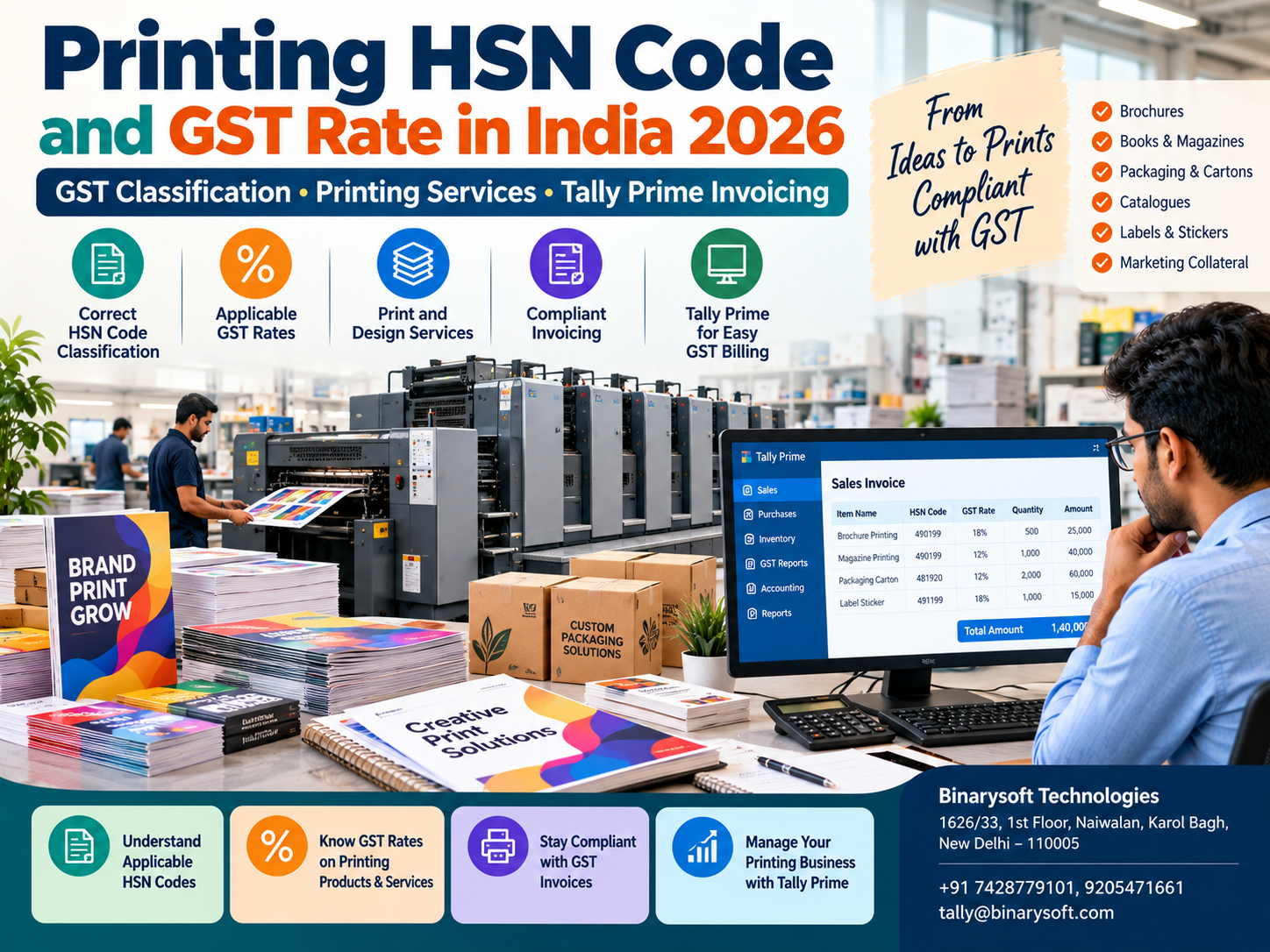
Introduction: Why Correct Printing HSN Classification Matters in 2026
India's printing industry serves almost every sector of the economy. From school textbooks and business brochures to product packaging, labels, advertising posters and wedding invitations, printed materials remain essential for communication and commerce.
However, GST compliance can become complicated because different printing activities may attract different tax treatments.
A printing press manufacturing books may face different GST rules from a digital printer producing advertising banners. Similarly, printing on paper supplied by a customer may be classified differently from selling finished printed products.
The GST rate changes introduced from September 2025 have made it particularly important for printing businesses to review their product classifications, service codes and invoicing configurations during 2026.
Incorrect classification can lead to underpayment or overpayment of GST, customer disputes, input tax credit complications and return mismatches.
For businesses managing numerous printing orders, paper purchases, ink consumption and customer invoices, manual accounting can become time-consuming.
Tally Prime helps organize sales, purchases, inventory, GST classifications, receivables and financial reports within one accounting environment.
This guide explains printing HSN codes, GST rates, service classification, invoicing requirements and practical accounting methods for growing printing businesses.
A Printing Press Owner's Story: When One GST Mistake Threatened a Major Customer Relationship
It was nearly 9 PM when Sandeep, the owner of a small printing press in Delhi, received an unexpected call from one of his largest customers.
His company had recently completed a major printing order involving advertising brochures, promotional posters and product catalogues.
The customer had received the invoice but questioned the GST rate applied to several items.
Sandeep had used the same tax configuration for every printed product because that was how his billing system had been set up years earlier.
His accountant reviewed the invoice and discovered that the products needed separate classification.
The customer requested a corrected invoice and supporting explanation before processing payment.
For Sandeep, the delayed payment was worrying. He had paper suppliers to pay, employees expecting salaries and another large printing order waiting for production.
That evening, he realized that inaccurate tax classification could affect the financial stability of his business.
The following week, Sandeep reorganized his accounting process.
He created separate product categories for books, brochures, advertising materials, labels and printing services.
He also introduced structured GST classifications and inventory records using Tally Prime.
The business began reviewing tax treatment before issuing invoices rather than correcting mistakes afterward.
Over time, the improved process helped reduce billing disputes and gave Sandeep greater confidence when negotiating with customers.
This illustrative story reflects the financial and emotional challenges that GST classification mistakes can create for small printing businesses.
1. What Is an HSN Code for Printing?
HSN stands for Harmonized System of Nomenclature.
It is an internationally recognized system used to classify goods for taxation and trade.
Under GST, HSN codes identify products, while Service Accounting Codes, commonly called SAC codes, identify services.
Printing businesses may need both HSN and SAC classifications because their activities can involve manufacturing finished goods, supplying printed materials or providing printing services.
For example, a finished printed book may fall under HSN heading 4901, while a printing service may fall under SAC heading 9989.
The correct classification depends on the actual nature of the supply.
Simply describing a transaction as printing is not sufficient to determine the applicable GST rate.
2. Important Printing HSN Codes in India
Printed products are commonly classified under Chapters 48 and 49 of the Customs Tariff.
Chapter 48 generally covers paper, paperboard and certain articles made from these materials.
Chapter 49 covers printed books, newspapers, pictures and other products of the printing industry.
|
HSN code
|
Product description
|
|---|
|
4901
|
Printed books, brochures, leaflets and similar printed matter
|
|
4902
|
Newspapers, journals and periodicals
|
|
4903
|
Children's picture, drawing and colouring books
|
|
4904
|
Printed or manuscript music
|
|
4905
|
Printed maps, charts and atlases
|
|
4909
|
Printed postcards, greeting and invitation cards
|
|
4910
|
Printed calendars
|
|
4911
|
Advertising material, commercial catalogues, posters and other printed matter
|
|
4821
|
Paper or paperboard labels
|
|
4819
|
Paperboard cartons, boxes and certain packing containers
|
These are broad classification headings. Businesses should verify the appropriate detailed HSN code according to the finished product.
3. GST Rate on Printing Products in India in 2026
Printing products do not attract one universal GST rate.
Some publications are exempt, certain printed materials attract 5%, and many commercial printing products attract 18%.
Specified publications
Nil
Qualifying printed books and newspapers
Specified printed matter
5%
Qualifying brochures and leaflets
Commercial printing
18%
Many advertising products and services
Indicative GST rate classification
|
Printed product
|
GST treatment
|
|---|
|
Qualifying printed books
|
Nil
|
|
Qualifying newspapers and periodicals
|
Nil
|
|
Children's picture and colouring books
|
Nil, where covered
|
|
Brochures and leaflets
|
Generally 5%
|
|
Commercial advertising posters
|
Generally 18%
|
|
Trade advertising material and catalogues
|
Generally 18%
|
|
Printed greeting and invitation cards
|
Generally 18%
|
|
Printed calendars
|
Generally 18%
|
|
Commercial labels and stickers
|
Product-specific, often 18%
|
|
Printing services
|
Depends on service classification
|
The applicable rate must be determined from the product description and current GST notifications, not merely the broad HSN heading.
4. Understanding HSN Code 4901 for Printed Books and Brochures
HSN heading 4901 covers printed books, brochures, leaflets and similar printed matter.
However, products within the same heading may have different GST treatment.
Qualifying printed books are generally exempt, while specified brochures and leaflets attract 5% GST.
The distinction depends on the product's characteristics and the applicable notification entry.
For example, a conventional educational textbook may qualify for exemption, while a promotional leaflet distributed by a commercial business may attract GST.
Printing companies should maintain separate inventory and tax classifications for these products.
This is particularly important for printing presses that manufacture both educational publications and commercial advertising materials.
5. GST on Advertising Posters, Catalogues and Promotional Printing
Commercial advertising materials commonly fall under HSN heading 4911.
This category can include advertising posters, trade catalogues, printed promotional materials and similar products.
Many goods covered by heading 4911 attract 18% GST.
A printing business producing promotional posters for a retail chain should therefore examine whether the finished product falls under this heading.
Similarly, commercial catalogues used to advertise products may require treatment different from ordinary printed books.
Correct classification should be completed before generating the customer invoice.
6. GST on Printing Services: SAC Codes 9988 and 9989
Printing services are generally classified according to the nature of the activity and the contractual arrangement.
SAC heading 9988 broadly covers manufacturing services on physical inputs owned by others.
SAC heading 9989 covers other manufacturing services, including certain printing and reproduction services.
The distinction is particularly relevant when determining whether the printer supplies the physical materials or performs printing on materials belonging to the customer.
Printing job work and publisher-related printing arrangements may qualify for specific concessional entries, while other commercial printing services may attract the general applicable rate.
The exact rate depends on the current notification, ownership of inputs, nature of the finished product and service description.
7. Difference Between Printing Goods and Printing Services
Consider two printing businesses.
The first business manufactures and sells finished advertising posters using its own materials.
The second business prints designs on paper supplied by a customer.
Although both businesses use printing machines, the nature of their supplies may differ.
The first transaction may be classified as a supply of finished goods, while the second may qualify as a printing or manufacturing service.
However, ownership of paper alone does not settle every classification question.
For composite supplies, the predominant element and contractual terms must also be considered.
Businesses should review purchase orders, material ownership and final deliverables before determining GST treatment.
8. How to Calculate GST on Printing Invoices
Consider a commercial printer supplying advertising posters worth ₹80,000.
Assume the finished products attract 18% GST.
|
Particulars
|
Amount
|
|---|
|
Taxable value
|
₹80,000
|
|
GST at 18%
|
₹14,400
|
|
Total invoice value
|
₹94,400
|
For an eligible intrastate supply, GST is generally divided into 9% CGST and 9% SGST.
For an interstate supply, 18% IGST generally applies.
A business supplying products with different GST rates should show the appropriate classification and tax calculation for each invoice line.
9. GST Invoicing Requirements for Printing Businesses
A GST-compliant printing invoice should contain the prescribed supplier and transaction details.
These generally include the supplier's name, address and GSTIN, invoice number, date, recipient information where required, product or service description, HSN or SAC code, taxable value and applicable tax amounts.
Printing businesses may also include order numbers, paper specifications, printing quantities, finishing details and delivery information.
These additional details help customers verify the work completed and simplify internal accounting.
For example, an invoice for brochure printing may mention paper quality, number of copies, colour specifications and finishing charges.
Where printing and design are supplied together, the tax treatment should reflect the actual contractual arrangement.
10. How Tally Prime Helps Printing Businesses
Tally Prime provides accounting, invoicing and inventory features useful for printing presses and commercial printing companies.
GST-compliant invoicing
Businesses can configure appropriate GST classifications and generate invoices for different printed products and services.
Material inventory management
Paper, ink, printing plates, packaging materials and other consumables can be maintained as inventory items.
Purchase accounting
Purchases of paper, ink, machinery consumables and other business materials can be recorded systematically.
Sales and customer accounting
Printing companies can maintain customer ledgers, record sales invoices and monitor outstanding payments.
GST reporting
Tally Prime provides GST reports that help businesses review taxable supplies, tax amounts and return-related information.
Cost monitoring
Businesses can use appropriate accounting classifications, cost centres and inventory records to improve visibility into production-related expenses.
Financial reporting
Profit and loss statements, balance sheets and receivables reports help business owners understand overall financial performance.
For specialized printing production workflows, such as automated job estimation or machine-level scheduling, additional configuration or compatible integrations may be required.
11. Managing Paper, Ink and Printing Material Inventory
Inventory management is essential for printing businesses because raw materials represent a significant portion of production costs.
A printing press may purchase different grades of paper, printing inks, plates, binding materials, adhesives and packaging supplies.
Each material may have a different purchase price, GST classification and consumption pattern.
For example, a commercial printer may use coated paper for catalogues, uncoated paper for books and specialty paper for invitation cards.
Maintaining separate stock items helps management monitor consumption and identify shortages before production begins.
Tally Prime supports stock groups, stock items, units of measurement and godown-wise inventory records.
Businesses can also use appropriate manufacturing and stock journal workflows to account for material consumption and finished products.
Accurate inventory records improve purchasing decisions, reduce wastage and support more reliable production costing.
12. GST on Printing Job Work and Customer-Supplied Materials
Job work is common in the printing industry.
A customer may supply paper, fabric, packaging material or another physical input and request printing or finishing services.
The printing business charges for the work performed rather than selling the complete finished material as its own goods.
The GST treatment depends on the service classification, the ownership of materials, the nature of the printed product and the applicable notification.
Qualifying printing job-work services may receive concessional treatment, while other printing activities can attract different rates.
Businesses should not assume that all printing job work automatically attracts 5% GST.
For each arrangement, the invoice should clearly describe the service performed and identify the applicable SAC classification.
Where required, records of customer-owned materials should be maintained separately from business-owned inventory.
13. Case Study One: Delhi Offset Printing Business Improves GST Billing Accuracy
Illustrative case study
A commercial offset printing business in Naraina, Delhi, produced brochures, product catalogues, educational materials and promotional posters.
The company handled approximately 300 customer orders every month.
Previously, its accounting department used a common GST classification for most printing activities.
This created confusion when customers requested invoices for products with different tax treatments.
The business introduced a product classification review and reorganized its accounting records using Tally Prime.
Separate stock items and service ledgers were created for different printing activities.
The accounts team verified HSN and SAC classifications before configuring applicable tax rates.
Paper purchases, printing consumables, customer invoices and outstanding payments were maintained in a centralized accounting system.
The new process helped reduce manual corrections, improve invoice consistency and make GST reporting more organized.
Management also gained better visibility into material purchases and customer receivables.
14. Case Study Two: Digital Printing Company Strengthens Inventory and Payment Management
Illustrative case study
A digital printing company in Karol Bagh supplied advertising banners, retail signage, labels and promotional materials to local businesses.
The company experienced recurring problems with material wastage, delayed customer payments and inconsistent invoice descriptions.
Different employees handled quotations, production and billing.
As the business expanded, management found it increasingly difficult to compare order values with material costs and customer balances.
The company implemented a structured accounting workflow using Tally Prime.
Inventory records were maintained for printing media, consumables and finished products.
Customer ledgers were organized, GST classifications were reviewed and outstanding payment reports were generated regularly.
The business also introduced order-wise cost monitoring through suitable accounting classifications.
This helped management identify expensive production activities, follow up on overdue invoices and improve financial visibility.
The case demonstrates how accurate GST accounting and inventory control can support business growth.
15. Common Printing HSN and GST Classification Mistakes
Printing businesses should pay attention to several recurring compliance errors.
One common mistake is treating all printed products as taxable at the same rate.
Another is applying a goods HSN code when the transaction is actually a supply of services.
Businesses may also confuse printed books with promotional brochures or incorrectly classify advertising materials as educational publications.
Additional problems arise when invoices omit required HSN or SAC information, use outdated tax configurations or contain incorrect taxable values.
To reduce these risks, businesses should maintain a verified classification master and review GST notifications whenever tax rules change.
Accountants should also reconcile invoice records with GSTR-1 and GSTR-3B before filing.
16. Best Practices for Printing Business GST Compliance in 2026
A reliable GST compliance process begins with correct classification.
Printing businesses should maintain separate product and service categories, verify applicable GST rates and clearly document the nature of each customer order.
Purchase records should distinguish business-owned materials from customer-supplied inputs.
Inventory should be reviewed regularly to identify wastage, shortages and valuation differences.
Before issuing an invoice, the accounts team should confirm the relevant HSN or SAC code, taxable value, GST rate and place of supply.
Businesses should also review whether e-invoicing requirements apply to their aggregate turnover and registration circumstances.
Tally Prime can support these activities through structured accounting, GST reporting, inventory management and receivables monitoring.
For unusual printing contracts or composite supplies, professional classification advice may be appropriate.
Conclusion
Correct printing HSN classification and GST invoicing are essential for printing presses, digital printers, packaging manufacturers and commercial printing businesses.
Different products and services can attract different GST rates depending on their classification and the nature of the supply.
Printed books, brochures, advertising materials, labels, cartons and printing services should therefore be evaluated separately.
The GST changes introduced from September 2025 make regular review of tax classifications particularly important during 2026.
Tally Prime helps printing businesses maintain organized invoicing, inventory records, purchase accounting, GST reports and customer outstanding balances.
By combining accurate tax classification with reliable accounting processes, printing businesses can reduce compliance risks, improve financial control and build stronger customer relationships.
Professional Tally Prime and Printing Business GST Accounting Assistance
Powered by Binarysoft Technologies
Authorized Tally Partner
Location: 1626/33, 1st Floor, Naiwalan, Karol Bagh, New Delhi – 110005, INDIA
Contact Us: +91 7428779101, 9205471661
Email: tally@binarysoft.com
Business Hours: 10:00 AM – 6:00 PM, Monday to Friday
Frequently Asked Questions
What is the HSN code for printing in India?
Printing products commonly fall under Chapters 48 and 49. The applicable code depends on whether the product is a book, brochure, advertising poster, label, carton or another printed item.
What is the GST rate on printing services in 2026?
The rate depends on the service classification and contractual arrangement. Certain qualifying printing services receive concessional treatment, while many other commercial printing services attract 18% GST.
What is HSN code 4911?
HSN 4911 covers other printed matter, including various advertising materials, commercial catalogues, posters and printed pictures. Many products under this heading attract 18% GST.
Are printed books exempt from GST?
Qualifying printed books are generally exempt from GST. However, brochures, advertising materials and other printed products may have different tax treatment.
CA. Devansh Rathi works closely with wholesalers, distributors, and growing enterprises on taxation, reconciliations, and financial controls. His approach emphasizes accurate records, timely compliance, and efficient accounting systems.