7. How Tally Prime Simplifies Washing Machine GST Billing
Tally Prime provides accounting and inventory features that can help appliance businesses manage their daily transactions.
Instead of repeatedly entering tax details manually, businesses can maintain relevant information in stock items, ledgers, and GST configurations.
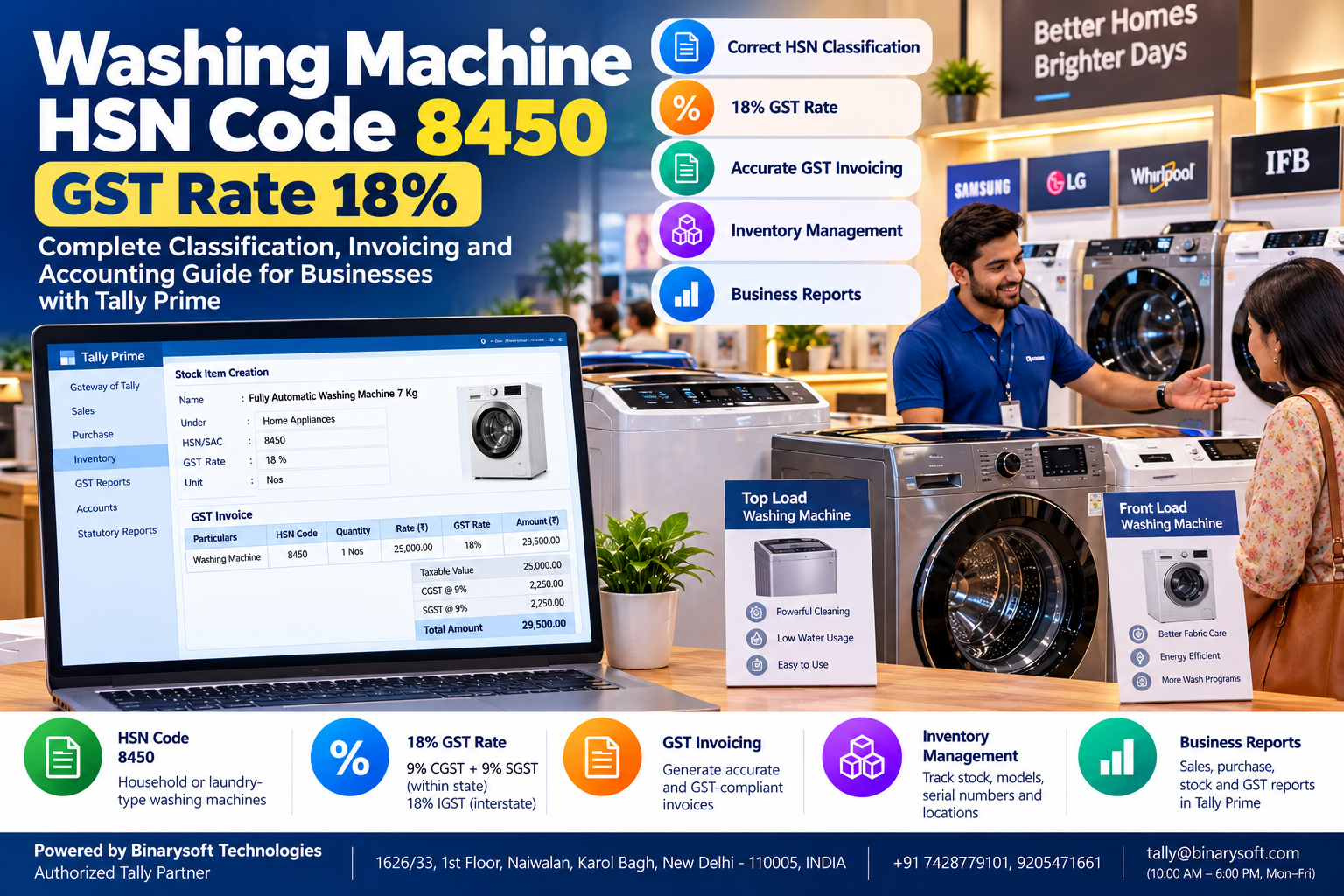
Creating washing machine stock items
A retailer can create separate stock items for different brands, models, capacities, and washing machine types.
For example:
|
Stock item
|
HSN heading
|
GST
|
|---|
|
Fully Automatic Washing Machine – 7 kg
|
8450
|
18%
|
|
Front-Load Washing Machine – 8 kg
|
8450
|
18%
|
|
Semi-Automatic Washing Machine – 6.5 kg
|
8450
|
18%
|
|
Washer-Dryer Combination
|
8450
|
18%
|
These are illustrative stock descriptions. The detailed HSN classification should be verified for each product.
Configuring GST in Tally Prime
Businesses can enable GST features and maintain applicable tax details.
A practical setup involves:
-
Opening the relevant company in Tally Prime.
-
Enabling GST under the applicable statutory settings.
-
Entering the company's GST registration details.
-
Creating washing machine stock items.
-
Configuring applicable HSN and GST information.
-
Creating customer and supplier ledgers.
-
Recording purchase and sales transactions.
-
Reviewing GST reports before filing.
The exact menu sequence may differ between Tally Prime releases.
Generating GST invoices
Once the relevant masters are configured, users can prepare sales invoices by selecting the customer, washing machine stock item, quantity, and selling price.
Tally Prime can calculate GST based on the configured tax treatment and transaction details.
This reduces repetitive manual work and helps maintain consistent invoice records.
8. Washing Machine Inventory Management in Tally Prime
Inventory management is particularly important for appliance dealers because washing machines are relatively high-value products.
A showroom may maintain multiple brands, capacities, colours, and models.
Without accurate stock records, businesses may experience inventory shortages, excess stock, incorrect deliveries, or difficulties matching purchases with sales.
Tally Prime helps businesses maintain stock-item records and monitor inward and outward movements.
Product-wise inventory tracking
Businesses can maintain separate items for different washing machine models.
This helps identify which products are selling quickly and which models are remaining in stock.
Godown and location management
Businesses operating a showroom and warehouse can use location-wise inventory records to monitor stock availability.
Serial number management
Appliance businesses often need to record serial numbers for warranty and customer-service purposes.
Where native voucher fields are insufficient, suitable additional fields or authorized customizations may be used to maintain serial-number information.
Stock valuation
Inventory valuation reports help businesses understand the financial value of unsold washing machines.
This supports purchasing decisions and working capital planning.
Purchase and sales analysis
Sales and purchase reports can help management understand product movement, inventory requirements, and business performance.
9. How Washing Machine Spare Parts Are Classified Under GST
Washing machine spare parts should not automatically be classified under the same tariff item as complete washing machines.
Different components may have their own applicable headings.
For example, motors, pumps, electronic components, hoses, and other parts may require separate classification depending on their characteristics and applicable tariff provisions.
Businesses should verify whether a part is specifically covered by the washing machine parts classification or another heading.
This is particularly important for repair workshops and appliance service centres that sell both spare parts and services.
10. GST Treatment of Installation, Delivery, and Repair Services
Appliance businesses may provide additional services such as installation, transportation, maintenance, and repairs.
The GST treatment depends on the nature of the transaction.
For example, separately supplied installation or repair services may require the appropriate Service Accounting Code (SAC).
Delivery charges may form part of the taxable value of the washing machine supply, depending on the contractual arrangement and valuation rules.
A bundled transaction must be evaluated under the applicable composite-supply or mixed-supply provisions.
Businesses should avoid applying one GST classification to every product and service without examining the actual transaction.
11. Case Study One: Washing Machine Retailer in Lajpat Nagar, Delhi
Illustrative case study.
A home appliance retailer in Lajpat Nagar sold washing machines, refrigerators, and other household products.
The business maintained inventory records in spreadsheets and prepared invoices using a separate billing process.
The challenge
As sales increased, the owner found it difficult to monitor product-wise inventory.
The accounting team also spent considerable time checking GST rates and reconciling sales information.
Occasional product classification mistakes created additional work during GST return preparation.
The solution
The business introduced Tally Prime for accounting and inventory management.
Separate stock items were created for washing machine models, with applicable GST information configured.
Sales invoices were recorded through the accounting system, while purchase entries updated inventory records.
The team also began reviewing GST reports before preparing returns.
The business outcome
The retailer gained better visibility into stock availability and product-wise sales.
Invoice preparation became more consistent, and the accounting team could investigate transactions through the underlying vouchers.
The owner could also make purchasing decisions using more reliable inventory information.
The case demonstrates how accurate GST configuration and inventory accounting can support the growth of a retail appliance business.
12. Case Study Two: Washing Machine Distributor in Noida
Illustrative case study.
A wholesale appliance distributor in Noida supplied washing machines to retailers across Delhi, Uttar Pradesh, and Haryana.
The company managed several brands and regularly processed interstate transactions.
The challenge
The finance team needed to distinguish intrastate and interstate supplies, maintain stock records, and reconcile customer balances.
Manual invoice preparation increased the possibility of incorrect tax-head selection.
The business also needed better information about outstanding payments and inventory movement.
The solution
The distributor adopted a structured Tally Prime workflow.
Customer ledgers were configured with relevant GST details, stock items were organized by model, and sales vouchers were recorded using the appropriate tax treatment.
Management reviewed outstanding receivables, stock summaries, and sales reports.
The business outcome
The distributor developed a more consistent invoicing process and improved visibility into receivables.
The accounting team could trace sales transactions and investigate GST reporting differences more efficiently.
Inventory reports also helped the business plan purchases according to dealer demand.
The example shows how GST accounting and inventory management can work together to support wholesale distribution.
13. Input Tax Credit on Washing Machine Purchases
Registered businesses purchasing washing machines for eligible business purposes may be entitled to input tax credit, subject to applicable GST conditions.
For example, a registered appliance dealer purchasing washing machines for resale may generally claim eligible ITC on the purchase GST.
However, ITC eligibility depends on requirements such as possession of prescribed documents, receipt of goods, supplier reporting, applicable restrictions, and other statutory conditions.
Businesses should reconcile purchase records with GSTR-2B and verify ITC eligibility before claiming credit.
Tally Prime can support purchase accounting and GST reconciliation workflows, depending on the installed release and enabled features.
14. Common GST Billing Mistakes Appliance Dealers Should Avoid
Businesses should pay particular attention to recurring errors.
One common mistake is using an incorrect or outdated GST rate in product masters.
Another is applying the wrong HSN code to a spare part or service.
Incorrect customer GSTIN details and place-of-supply information can also create reporting problems.
Some businesses fail to record credit notes for eligible sales returns, while others overlook differences between accounting records and GST returns.
A reliable review process should include checking product classifications, tax calculations, invoice particulars, and return reports before submission.
15. Why Accurate GST and Inventory Records Matter for Business Growth
Washing machine dealers often operate with substantial inventory investments.
A single showroom may hold numerous appliances, each representing money committed to stock.
If accounting information is incomplete, management may struggle to identify profitable models, slow-moving inventory, and outstanding customer payments.
Accurate GST invoicing supports compliance, while inventory reports improve operational decision-making.
Tally Prime can bring sales, purchases, inventory, receivables, and accounting information into a more consistent workflow.
For expanding appliance businesses, this creates a foundation for stronger financial management.
Conclusion
Understanding the correct washing machine HSN code and GST rate is essential for businesses involved in appliance retailing, wholesale distribution, and related activities.
Household and laundry-type washing machines generally fall under HSN heading 8450 and attract 18% GST in India.
However, businesses must verify detailed product classifications, especially for spare parts, industrial equipment, and separately supplied services.
Correct GST invoicing, accurate inventory records, and regular reconciliation help businesses reduce reporting errors and maintain customer confidence.
Tally Prime supports these objectives through GST accounting, invoicing, inventory tracking, voucher-level verification, and business reporting.
For growing appliance businesses, combining accurate tax classification with reliable accounting processes can improve operational efficiency, financial visibility, and long-term business stability.
Powered by Binarysoft Technologies Authorized Tally Partner
Location: 1626/33, 1st Floor, Naiwalan, Karol Bagh, New Delhi – 110005, INDIA
Contact us: +91 7428779101, 9205471661
Email us: tally@binarysoft.com
Business Hours: 10:00 AM – 6:00 PM, Monday to Friday