Call CA Tally HelpDesk
+91 9205471661,
7428779101
Introduction: Why GST Return Accuracy Matters in 2026
A small difference between two GST returns can create a much larger problem for a growing business.
An invoice omitted from GSTR-1, an incorrect input tax credit claim or a mismatch in GSTR-3B may affect tax liability, supplier relationships and compliance reviews.
As Indian businesses handle increasing transaction volumes, maintaining consistency across GST forms has become essential.
In 2026, businesses need to understand not only how to file returns but also how information flows between GSTR-1, GSTR-1A, GSTR-2B and GSTR-3B.
The GST portal uses data from different statements to help prepare return information and identify discrepancies. However, auto-populated figures still require verification.
An important distinction is that GSTR-3B cannot be revised after filing. Errors generally require correction through legally permitted adjustments in subsequent returns, subject to applicable conditions and deadlines.
This guide explains how the major GST forms differ, what to do when mistakes occur and how Tally Prime can support a reliable monthly reconciliation process.
An Emotional Story: One GST Error That Kept a Business Owner Awake
Sanjay operated a packaging materials business in Delhi.
His company supplied products to manufacturers across North India, and he had recently secured a major customer.
Every month, his accounts team prepared invoices, checked supplier bills and filed GST returns.
During a particularly busy period, an employee accidentally omitted a sales invoice while preparing GSTR-1.
The accounting records contained the invoice, but the filed GST statement did not.
A few weeks later, the customer contacted Sanjay because the invoice was missing from the expected GST information used for input tax credit reconciliation.
The customer was worried about the delay and questioned whether the supplier's records were reliable.
Sanjay felt deeply concerned. He had spent years building the business's reputation, and one reporting mistake threatened an important commercial relationship.
That evening, he sat with his accounts manager reviewing invoices and return records.
Instead of blaming the employee, Sanjay decided to introduce a more structured compliance process.
The team identified the reporting error, reviewed the legally available correction route and coordinated with its GST adviser.
It also introduced invoice-level reconciliation before each return filing.
Over time, the company improved its reporting accuracy and reduced last-minute corrections.
Sanjay learned that good compliance systems protect more than financial records. They also protect customer confidence and the livelihoods connected to a growing business.
This fictional story illustrates common GST reporting challenges faced by Indian businesses.
The lesson is clear: a small accounting error can affect business relationships, but careful reconciliation and timely correction can help prevent it from becoming a larger problem.
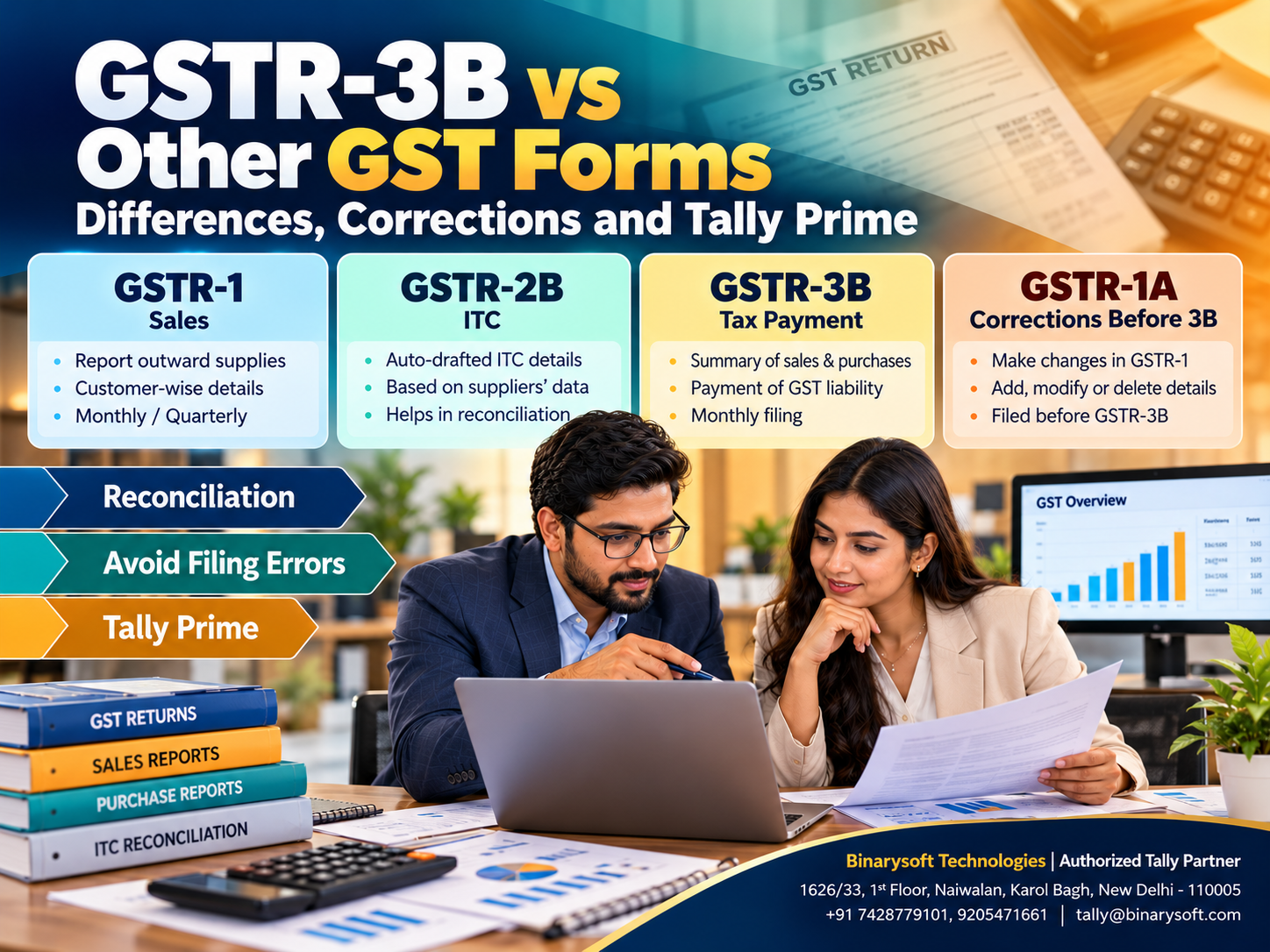
1. What Is GSTR-3B?
GSTR-3B is a summary return filed by regular GST taxpayers for the applicable tax period.
It reports outward tax liabilities, inward supplies attracting reverse charge, eligible input tax credit, adjustments and tax payments.
Unlike an invoice-level sales statement, GSTR-3B primarily summarizes tax information.
It also facilitates discharge of applicable GST liability through the electronic cash and credit ledgers.
Taxpayers generally file GSTR-3B monthly or quarterly, depending on eligibility and the selected filing arrangement.
2. What Is GSTR-1?
GSTR-1 is a statement of outward supplies made by a registered taxpayer.
It contains relevant sales invoice details, credit notes, debit notes, exports and other reportable outward transactions.
Information furnished in GSTR-1 helps populate recipient-side GST records and supports the system-generated information used for GSTR-3B.
For businesses selling to registered customers, accurate invoice reporting is particularly important because errors may affect the customer's ITC reconciliation.
3. What Is GSTR-2B?
GSTR-2B is an auto-generated input tax credit statement.
It is prepared using information furnished by suppliers and other applicable data sources.
Businesses use it to review available and restricted credit information and reconcile purchase records.
However, an entry appearing in GSTR-2B does not automatically guarantee ITC eligibility.
The recipient must still satisfy applicable legal conditions, including possession of appropriate documents and other statutory requirements.
4. Difference Between GSTR-3B and Other GST Forms
|
GST form
|
Main purpose
|
Filing nature
|
|---|
|
GSTR-1
|
Report outward supplies
|
Filed by applicable taxpayers
|
|
GSTR-1A
|
Amend or add certain outward supply records for the same period
|
Optional, before that period's GSTR-3B
|
|
GSTR-2A
|
View inward supply information
|
Dynamic, auto-generated statement
|
|
GSTR-2B
|
Review input tax credit information
|
Static statement generated for a tax period
|
|
GSTR-3B
|
Report summary liabilities, ITC and tax payment
|
Filed return
|
|
GSTR-9
|
Annual GST return
|
Filed where applicable
|
|
GSTR-9C
|
Annual reconciliation statement
|
Filed where applicable
|
|
CMP-08
|
Composition taxpayer tax payment statement
|
Filed by applicable composition taxpayers
|
Each form has a different function.
Businesses should not treat GSTR-1, GSTR-2B and GSTR-3B as interchangeable documents.
5. GSTR-1 vs GSTR-3B: The Main Differences
GSTR-1 focuses on outward supply details, while GSTR-3B summarizes tax liabilities and eligible credits.
For example, a business may report ₹12 lakh in taxable outward supplies in GSTR-1.
The corresponding information should generally reconcile with the relevant outward supply figures reported in GSTR-3B, after considering applicable adjustments and classification differences.
A mismatch may arise from omitted invoices, incorrect tax rates, credit notes or reporting errors.
Regular reconciliation helps identify such differences before they create compliance problems.
6. GSTR-2B vs GSTR-3B: Understanding Input Tax Credit
GSTR-2B helps taxpayers identify input tax credit information reported through the GST system.
GSTR-3B is where eligible ITC is declared and adjusted against applicable tax liabilities.
Suppose a business records eligible purchase GST of ₹90,000, but the relevant GSTR-2B reflects only ₹75,000.
The difference of ₹15,000 requires investigation.
Possible reasons include supplier filing delays, incorrect GSTIN details, missing invoices or transactions subject to special treatment.
Businesses should verify the underlying invoices and statutory ITC conditions before deciding the amount to claim.
7. Can a Filed GSTR-3B Be Revised?
No. A filed GSTR-3B cannot be directly revised.
If a taxpayer discovers an omission or incorrect detail after filing, the correction generally must be made through an appropriate subsequent return or other legally prescribed procedure.
The treatment depends on the nature of the mistake.
For example, an omitted outward tax liability may require reporting and payment in a subsequent period, together with applicable interest.
Incorrect ITC claims may require reversal and, where applicable, interest.
Businesses should not assume that every mistake can be corrected simply by changing the next return's figures.
8. What Is GSTR-1A and When Should It Be Used?
GSTR-1A provides an optional opportunity to correct certain outward supply details for the same tax period after GSTR-1 has been filed but before that period's GSTR-3B is filed.
It can be used to amend eligible records or add missed outward supply details.
For example, if a business files GSTR-1 and subsequently identifies an omitted invoice before filing GSTR-3B, it may use GSTR-1A to report the omission.
The corrected information can flow into the corresponding GSTR-3B.
GSTR-1A cannot be filed after GSTR-3B has been filed for that period.
It is therefore important to review GSTR-1 information before completing GSTR-3B.
9. How to Correct Mistakes in GSTR-1
If an error is identified before filing GSTR-3B for the same period, eligible corrections may be made through GSTR-1A.
If the period's GSTR-3B has already been filed, the taxpayer may need to use amendment facilities in a subsequent GSTR-1.
Examples include incorrect invoice values, GSTIN details and omitted invoices.
The appropriate correction depends on the transaction and the permitted amendment facility.
For invoices involving customers, businesses should also communicate corrections promptly to avoid unnecessary ITC disputes.
10. Time Limit for GST Return Corrections
The general statutory cut-off for correcting eligible omissions or incorrect particulars in relevant GST returns is 30 November following the end of the financial year concerned, or the date of furnishing the relevant annual return, whichever is earlier.
For example, an error relating to FY 2025–26 would generally need to be corrected by 30 November 2026, unless the relevant annual return is furnished earlier.
This deadline is subject to the specific statutory provision, applicable exceptions and any valid regulatory changes.
Businesses should not wait until the last permitted date.
Certain errors may involve additional restrictions or separate procedures.
11. Common GSTR-3B Filing Mistakes
Businesses frequently encounter errors such as:
-
Omitting taxable outward supplies
-
Selecting incorrect GST rates
-
Reporting IGST instead of CGST and SGST, or vice versa
-
Claiming ineligible input tax credit
-
Failing to report reverse charge liabilities
-
Incorrectly recording credit notes
-
Reporting the wrong taxable value
-
Overlooking ITC reversals
-
Failing to reconcile GSTR-1 and GSTR-3B
-
Using incomplete supplier invoice information
These mistakes may lead to tax differences, interest, notices or additional reconciliation work.
12. Step-by-Step Process to Correct GST Return Errors
Step 1: Identify the discrepancy
Compare filed GST returns with sales registers, purchase records and accounting reports.
Step 2: Determine the affected return
Identify whether the error relates to outward supply reporting, input tax credit, tax payment or another compliance requirement.
Step 3: Check whether the return has been filed
An unfiled draft may be correctable before submission, subject to portal controls.
A filed GSTR-3B cannot be directly revised.
Step 4: Select the legally permitted correction route
Use GSTR-1A, subsequent GSTR-1 amendments, subsequent GSTR-3B adjustments or other applicable procedures, depending on the mistake.
Step 5: Calculate tax and interest
If the error caused underpayment or an incorrect ITC claim, evaluate the additional liability and applicable interest.
Step 6: Maintain supporting documentation
Preserve invoices, credit notes, reconciliation statements and explanations of corrections.
Step 7: Verify the next return
Confirm that the adjustment has been reflected correctly and has not caused another mismatch.
13. Practical Example: GSTR-1 and GSTR-3B Mismatch
Consider a trading company with the following monthly figures:
|
Particulars
|
Taxable value
|
GST at 18%
|
|---|
|
Actual taxable sales
|
₹12,00,000
|
₹2,16,000
|
|
Sales reported in GSTR-1
|
₹12,00,000
|
₹2,16,000
|
|
Sales reported in GSTR-3B
|
₹11,00,000
|
₹1,98,000
|
|
Difference
|
₹1,00,000
|
₹18,000
|
In this example, GSTR-3B understates outward tax liability by ₹18,000.
The taxpayer should investigate the cause, determine the appropriate correction mechanism and evaluate interest liability.
The business should not simply ignore the difference because the invoice information appears correctly in GSTR-1.
14. Case Study One: A Delhi Wholesaler Corrects an Omitted Invoice
Illustrative case study — fictional business and figures.
A wholesale electrical goods distributor in Karol Bagh processed approximately 600 sales invoices every month.
During a busy reporting period, one invoice worth ₹2,00,000 was omitted from GSTR-1.
The error was discovered after GSTR-1 filing but before GSTR-3B filing.
The accounts team reviewed the original invoice and used the applicable GSTR-1A facility to report the missing transaction.
The corrected outward supply information was then considered while preparing GSTR-3B.
Management introduced a monthly comparison between the sales register and GST return data.
Key lesson: Reviewing GSTR-1 before filing GSTR-3B can provide an opportunity to identify and correct eligible errors within the same tax period.
15. Case Study Two: A Manufacturer Resolves an ITC Difference
Illustrative case study — fictional business and figures.
A packaging manufacturer in Faridabad recorded ₹4,50,000 in purchase-related GST during a month.
However, its GSTR-2B reflected a lower amount.
The accounts team identified several supplier invoices that were not appearing in the expected statement.
Instead of automatically claiming the full book amount, the company reviewed the invoices, supplier reporting status and applicable ITC conditions.
It contacted the relevant suppliers and maintained a reconciliation schedule for unresolved transactions.
Tally Prime supported purchase accounting and invoice-level review.
Key lesson: GSTR-2B reconciliation helps businesses identify supplier reporting issues and evaluate ITC eligibility before filing GSTR-3B.
16. How Tally Prime Helps with GSTR-3B Preparation
Tally Prime provides several features that support GST accounting and return preparation.
GST-enabled invoicing: Record sales with applicable GST classifications and rates.
Purchase accounting: Maintain supplier invoices and related input tax information.
GST reports: Review tax liability and input credit information derived from recorded transactions.
GSTR-1 preparation: Identify outward supply information and review reporting exceptions.
GSTR-3B reporting: Prepare and review relevant summary information based on accounting records.
ITC reconciliation: Use supported reconciliation capabilities to compare purchase information with available GST data.
Error identification: Review incomplete or inconsistent transaction details before return preparation.
Accounting corrections: Maintain appropriate voucher records and adjustments where required.
Available connected GST functions depend on the software release, subscription and configuration.
Tally Prime supports preparation and reconciliation but does not replace the taxpayer's responsibility to verify and file correct returns.
17. Step-by-Step GST Reconciliation in Tally Prime
Businesses can establish a structured monthly process.
First, ensure that all sales and purchase vouchers for the period have been recorded.
Next, review GST configurations, invoice dates, tax rates and customer or supplier GSTIN details.
Open the relevant GST reports in Tally Prime and investigate transaction exceptions.
Compare outward supply information with the corresponding GSTR-1 data.
Review GSTR-2B against purchase records and evaluate ITC differences.
Then compare the resulting tax liability and eligible ITC with the proposed GSTR-3B figures.
Resolve discrepancies before filing wherever possible.
Finally, preserve the reconciliation report and filed return acknowledgement for future reference.
18. Why GSTR-1, GSTR-2B and GSTR-3B Reconciliation Is Important
Reconciliation helps businesses maintain consistency between accounting records and GST statements.
It can identify omitted sales, duplicate invoices, incorrect tax rates and supplier reporting delays.
Regular reviews also support more reliable financial statements and reduce unnecessary disputes with customers.
For larger businesses, reconciliation should be performed monthly rather than only during annual return preparation.
Management should assign clear responsibilities and establish a review process for unresolved differences.
19. Best Practices to Avoid GST Return Mistakes
Businesses should maintain accurate customer and supplier masters, including GSTIN information.
Invoice numbering and tax classifications should be reviewed regularly.
Accounts teams should verify sales and purchase records before preparing returns.
GSTR-1 and GSTR-2B information should be reconciled with accounting records before GSTR-3B filing.
Corrections should be documented and reviewed by authorized personnel.
Businesses should also monitor statutory deadlines and keep their accounting software updated.
A consistent monthly checklist is often more effective than last-minute error correction.
Conclusion: Accurate GST Reconciliation Protects Business Compliance
GSTR-3B, GSTR-1, GSTR-1A and GSTR-2B serve different but closely connected purposes.
GSTR-1 reports outward supplies, GSTR-2B provides input tax credit information, and GSTR-3B summarizes tax liabilities, eligible credits and payments.
GSTR-1A offers an important correction opportunity before the corresponding GSTR-3B is filed.
Because a filed GSTR-3B cannot be directly revised, businesses must understand the permitted correction procedures and applicable statutory deadlines.
Tally Prime helps organize GST-enabled accounting records, prepare reports, identify exceptions and support reconciliation.
With accurate bookkeeping, regular reviews and timely professional guidance, businesses can reduce filing mistakes and build stronger GST compliance practices.
Powered by Binarysoft Technologies
Authorized Tally Partner
Location: 1626/33, 1st Floor, Naiwalan, Karol Bagh, New Delhi – 110005, INDIA
Contact Us: +91 7428779101, 9205471661
Email: tally@binarysoft.com
Business Hours: 10:00 AM – 6:00 PM, Monday to Friday
Frequently Asked Questions
How can I correct a missing invoice in GSTR-1?
If the corresponding GSTR-3B has not been filed, GSTR-1A may be available. Otherwise, the appropriate subsequent GSTR-1 amendment facility may be used, subject to applicable deadlines.
What is the deadline for correcting GST return mistakes?
The general deadline for eligible corrections is 30 November following the relevant financial year, or the date of filing the relevant annual return, whichever is earlier, subject to applicable provisions.
What happens if GSTR-1 and GSTR-3B do not match?
The difference should be investigated. Depending on the circumstances, it may indicate omitted transactions, incorrect reporting or unpaid tax liability.
How can Binarysoft Technologies help with GST compliance?
Binarysoft Technologies provides assistance with Tally Prime GST setup, accounting workflows, return preparation, ITC reconciliation, error identification and financial reporting.
CA. Harshit Gaurwaadi is a practicing Chartered Accountant with hands-on experience in accounting systems, GST compliance, and MSME advisory. He regularly works with small and mid-sized businesses to streamline inventory, billing, and statutory processes using modern accounting software. His articles focus on practical, ground-level challenges faced by Indian traders and professionals.








