Call CA Tally HelpDesk
+91 9205471661,
7428779101
Introduction: Why Every Growing Business Needs Smarter Accounting Knowledge in 2026
Running a successful business requires more than increasing sales. Behind every invoice, payment, purchase and stock movement lies a financial decision that can influence profitability. In 2026, Indian businesses face growing expectations for accurate GST compliance, faster invoicing, digital banking, better inventory control and timely financial reporting.
For many entrepreneurs, the biggest challenge is not a lack of customers but a lack of visibility into business operations. Sales may be increasing while outstanding payments remain unpaid. Inventory may be available in warehouses, yet purchasing decisions continue without reliable stock reports.
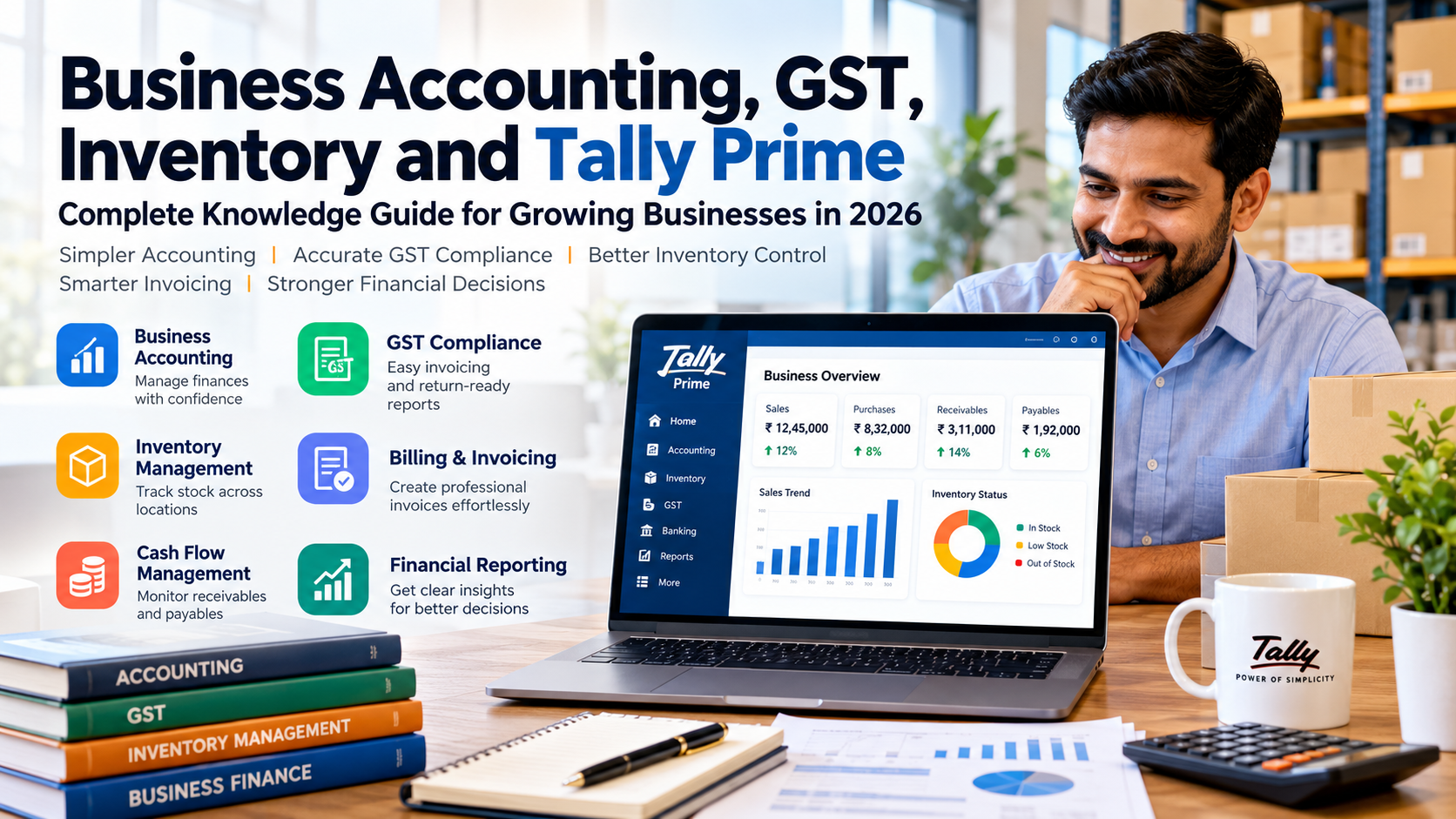
Modern accounting practices and digital business tools can help overcome these difficulties. Solutions such as Tally Prime support integrated accounting, invoicing, inventory management, taxation and business reporting.
This comprehensive knowledge guide explores the essential accounting and business-management topics that entrepreneurs, accountants, retailers, wholesalers, manufacturers and service providers should understand to build more efficient and financially resilient businesses.
1. The Changing Role of Accounting in Modern Businesses
Accounting was traditionally viewed as a recordkeeping activity. Business owners maintained purchase registers, sales records, payment vouchers and financial statements primarily for taxation and compliance.
Today, accounting information plays a much larger role.
A well-maintained accounting system helps businesses understand financial performance, monitor expenses, evaluate customer payment behaviour and make informed decisions.
For example, a wholesale distributor may generate substantial monthly revenue but experience financial pressure because customers take too long to clear invoices.
Without proper accounting reports, the owner may incorrectly assume that higher sales automatically mean better cash flow.
Modern accounting practices address this challenge by connecting financial transactions with operational information.
Important areas of business accounting
-
Sales and purchase accounting
-
Accounts receivable and payable
-
Cash and bank transactions
-
Expense management
-
Financial statements
-
Taxation and statutory compliance
-
Budgeting and financial planning
-
Profitability analysis
Tally Prime brings several of these functions into a unified accounting environment, helping businesses reduce duplicated work and improve record accuracy.
2. A Story of Business Growth, Financial Pressure and Digital Transformation
Rajesh operated a medium-sized electrical goods distribution business in Delhi. Over several years, he developed strong relationships with retailers and contractors.
His business generated regular orders, and customers trusted him for timely delivery.
However, despite growing sales, Rajesh frequently struggled to arrange funds for supplier payments.
His accountant maintained records in spreadsheets, while warehouse employees tracked inventory separately. Customer outstanding balances were reviewed only when payment disputes occurred.
One afternoon, a supplier refused to dispatch an important order because an earlier invoice remained unpaid.
Rajesh felt frustrated. His business was growing, yet he could not confidently determine how much money customers owed him or which products were generating profits.
He decided to reorganize the accounting process.
Customer balances, inventory records, sales invoices and purchase transactions were brought into a structured accounting system using Tally Prime.
Gradually, Rajesh gained better visibility into outstanding payments, available stock and business expenses.
Instead of depending entirely on manual reports, he could review updated financial information and identify potential problems earlier.
The biggest change was not simply adopting software. It was gaining greater confidence in everyday business decisions.
This is an illustrative story showing how integrated accounting can improve business visibility.
3. GST Accounting and Compliance for Indian Businesses
Goods and Services Tax is a significant part of business accounting in India.
Businesses registered under GST must maintain appropriate records, classify transactions correctly and comply with applicable return-filing requirements.
Incorrect GST calculations, missing invoice details or mismatched records can create additional reconciliation work and compliance risks.
Key GST topics businesses should understand
GST invoicing: Tax invoices should contain the applicable particulars, including GSTIN, invoice number, taxable value, tax rates and other prescribed information.
Input Tax Credit: Eligible businesses can claim input tax credit subject to statutory conditions and restrictions.
GSTR-1: This return reports applicable outward supply details.
GSTR-3B: This summary return is used to declare applicable tax liabilities and input tax credit and discharge tax obligations.
GST reconciliation: Businesses should compare accounting records with relevant GST portal information to identify discrepancies.
HSN and SAC classification: Correct classification supports appropriate tax treatment and reporting.
How Tally Prime helps with GST
Tally Prime supports GST-related transaction recording, tax calculations, invoice preparation and return-oriented reports.
Depending on the software release, configuration and enabled services, businesses may also use connected GST capabilities.
Regular reconciliation and review remain essential because accounting software does not eliminate the taxpayer's compliance responsibilities.
4. Inventory Management: Understanding What Your Business Really Owns
Inventory is one of the largest investments for many retailers, manufacturers and distributors.
Poor inventory management can create unnecessary purchasing costs, stock shortages, expired products and blocked working capital.
A business may maintain a profitable sales operation but still lose money through inaccurate stock records.
Essential inventory management practices
Stock classification: Organize products into appropriate groups, categories and units.
Stock movement tracking: Record purchases, sales, transfers and adjustments.
Godown management: Monitor inventory stored across different warehouses or locations.
Batch tracking: Maintain batch-related information where appropriate, particularly for products requiring traceability.
Reorder planning: Identify products approaching minimum stock levels.
Inventory valuation: Apply appropriate valuation methods consistently with the business's accounting requirements.
Inventory features in Tally Prime
Tally Prime supports stock items, stock groups, units of measurement, godowns, inventory vouchers and stock reporting.
Businesses can use these capabilities to review available quantities, stock movement and inventory values.
Proper configuration is especially important for organizations managing multiple product categories or warehouse locations.
5. Smarter Invoicing and Billing Management
An invoice is more than a request for payment. It is a financial record that supports revenue recognition, customer communication and taxation.
Manual invoicing can become difficult when transaction volumes increase.
Common problems include incorrect tax calculations, duplicate invoice numbers, missing customer information and delayed payment tracking.
Benefits of structured invoicing
-
More consistent invoice preparation
-
Reduced repetitive data entry
-
Better customer account tracking
-
Easier review of sales transactions
-
Improved visibility into unpaid invoices
-
Better coordination between billing and accounting
Tally Prime allows businesses to create sales vouchers and invoices while updating relevant accounting records.
Where inventory is enabled and configured, sales transactions can also affect stock records.
This integration helps maintain consistency between billing, accounting and inventory management.
6. Cash Flow Management and Outstanding Payment Control
A profitable business can still experience cash shortages.
This happens when income is recorded through credit sales but customer payments are received later.
Managing receivables and payables is therefore essential for maintaining working capital.
Practical cash flow strategies
Review customer outstanding balances regularly. Identify overdue invoices before they become serious collection problems.
Define credit terms. Establish clear payment periods and credit limits appropriate to customer relationships.
Monitor supplier obligations. Maintain visibility into upcoming payment commitments.
Separate profit from available cash. Accounting profit does not necessarily represent money available in the bank.
Prepare cash flow forecasts. Estimate expected receipts and payments to identify possible shortfalls.
Using Tally Prime for credit control
Tally Prime provides bill-wise accounting and outstanding reports that can help businesses monitor receivables and payables.
Businesses can review party balances, pending bills and ageing information when the relevant features are configured.
These reports support better payment follow-up and financial planning.
7. Banking and Financial Reconciliation
Banking activities are closely connected to everyday business operations.
Customer receipts, supplier payments, loan instalments, bank charges and other transactions must be recorded accurately.
When accounting records and bank statements do not match, businesses may struggle to determine their actual cash position.
Bank reconciliation helps identify differences between the bank balance shown in accounting records and the balance reported by the bank.
Common reconciliation issues
-
Payments recorded but not yet cleared
-
Deposits awaiting bank confirmation
-
Unrecorded bank charges
-
Duplicate transaction entries
-
Incorrect transaction dates or amounts
-
Interest credits or deductions requiring accounting entries
Tally Prime supports bank reconciliation and banking-related accounting activities. Available automation and connected banking capabilities depend on the applicable software version, bank support and configuration.
A consistent reconciliation process helps improve the reliability of financial reports.
8. Financial Reports Every Business Owner Should Understand
Financial statements are essential for understanding business performance.
Many entrepreneurs concentrate on daily sales without regularly examining profitability, liabilities and operating expenses.
A structured reporting system provides a clearer financial picture.
Profit and Loss Account
The Profit and Loss Account summarizes income and expenses for a specified period.
It helps business owners evaluate profitability and identify significant operating costs.
Balance Sheet
The Balance Sheet presents assets, liabilities and equity at a particular date.
It helps businesses assess their financial position and understand how resources are financed.
Cash Flow Statement
A Cash Flow Statement explains cash movements through operating, investing and financing activities.
It can help management understand why accounting profit differs from available cash.
Trial Balance
The Trial Balance summarizes ledger balances and supports the review of accounting records.
Although a balanced trial balance does not guarantee that every transaction is correct, it is an important accounting control.
How Tally Prime helps
Tally Prime provides financial and accounting reports, including the Balance Sheet, Profit and Loss Account, Trial Balance and relevant ledger statements.
These reports can help management identify changes in revenue, expenses, customer balances and overall financial performance.
9. Accounting Automation and Business Productivity
Manual accounting processes often involve repetitive tasks.
Employees may enter the same information into billing systems, spreadsheets, stock registers and accounting records.
This duplication increases administrative effort and creates opportunities for inconsistencies.
Accounting automation aims to reduce repetitive work while maintaining appropriate financial controls.
Activities that may benefit from automation
Automation should be introduced carefully.
Businesses must establish approval procedures, maintain backups and periodically verify transaction accuracy.
Tally Prime supports integrated accounting workflows and offers import, configuration and customization options that may reduce manual processing.
The suitability of specific automation features depends on business requirements and implementation.
10. Tally on Cloud and Remote Business Access
Business owners increasingly need access to financial information while travelling, working from another office or coordinating with accountants.
Traditional desktop installations may require users to work from a particular computer or network.
A properly configured cloud-hosted environment can provide additional flexibility.
Potential advantages of Tally on Cloud
Remote accessibility: Authorized users can access the hosted accounting environment from supported devices and locations.
Centralized business data: Teams can work with centrally hosted company data rather than maintaining disconnected copies.
Operational continuity: Suitable hosting, backup and recovery arrangements can reduce dependency on one office computer.
Multi-location coordination: Businesses operating across branches may benefit from centralized access.
IT management: A managed hosting arrangement can simplify some infrastructure responsibilities.
However, cloud hosting does not automatically guarantee uninterrupted access or data security.
Businesses should evaluate hosting reliability, access controls, backup policies, data protection arrangements and support availability before selecting a provider.
11. Case Study One: Improving Inventory Accuracy in a Wholesale Distribution Business
Illustrative case study
A wholesale electrical distributor managed more than 1,500 stock items across two warehouses.
The business used spreadsheets for purchase records and a separate billing application for customer invoices.
Warehouse employees frequently reported differences between physical stock and recorded quantities.
The company also faced problems with duplicate purchasing and delayed customer deliveries.
Challenges
The primary difficulties involved inaccurate stock information, limited warehouse visibility and inconsistent coordination between purchasing and billing teams.
Management could not easily identify slow-moving inventory or determine which products needed replenishment.
Solution
The distributor implemented a structured inventory and accounting process using Tally Prime.
Stock groups and stock items were organized systematically. Separate godowns were configured, and relevant purchase and sales transactions were recorded through integrated vouchers.
Employees also introduced regular stock verification and transaction review procedures.
Results
The business gained clearer visibility into warehouse stock, purchasing activity and inventory movement.
Management could review stock reports before placing new orders, while accounting personnel spent less time reconciling disconnected records.
The case demonstrates how software configuration combined with disciplined inventory procedures can support more reliable operational decisions.
12. Case Study Two: Better Payment Collection for a Service Business
Illustrative case study
A growing IT services company worked with approximately 80 recurring business customers.
Its invoices were prepared regularly, but payment follow-up depended on manual reminders.
Some customers had multiple unpaid invoices, and management lacked a consistent process for reviewing outstanding amounts.
Challenges
The company experienced unpredictable collections, delayed supplier payments and difficulty forecasting monthly cash requirements.
Although sales were increasing, available cash did not always match management's expectations.
Solution
The company introduced bill-wise accounting and structured receivables monitoring using Tally Prime.
Customer invoices were tracked against their respective payments.
The accounts team reviewed outstanding reports weekly and established a standard follow-up process for overdue invoices.
Management also began reviewing upcoming supplier obligations alongside expected customer receipts.
Results
The company developed a more organized collections process and improved visibility into expected cash inflows.
The accounts team could identify overdue invoices earlier and prioritize customer follow-ups.
The experience highlights the importance of connecting accounting information with practical credit-control procedures.
13. Choosing the Right Accounting System for Your Business
Accounting software should be selected according to business requirements rather than simply choosing the largest feature list.
A small retail shop may prioritize fast invoicing and stock tracking, while a manufacturer may need detailed inventory records and production-related accounting.
A professional services company may focus more heavily on expense management, project-related reporting and customer receivables.
Important selection criteria
|
Business requirement
|
What to evaluate
|
|---|
|
Accounting
|
Ledger management and financial reporting
|
|
GST compliance
|
Tax configuration and return-related reporting
|
|
Inventory
|
Stock items, godowns and movement tracking
|
|
Invoicing
|
Billing flexibility and customer records
|
|
Banking
|
Reconciliation and payment workflows
|
|
Reporting
|
Profitability and outstanding reports
|
|
Security
|
User permissions, backups and access controls
|
|
Scalability
|
Support for future transaction growth
|
|
Remote working
|
Suitable hosted or connected access
|
|
Support
|
Implementation, training and technical assistance
|
Tally Prime can be suitable for many Indian businesses seeking integrated accounting, GST, inventory and financial reporting capabilities.
However, businesses should evaluate industry-specific requirements, licensing, implementation costs and any required integrations before adoption.
14. Practical Steps to Implement Tally Prime Successfully
Successful accounting software implementation requires more than installing the application.
Businesses should begin by understanding their existing accounting processes and identifying operational problems.
Step 1: Assess current requirements
Review transaction volumes, GST registration details, inventory complexity, customer credit arrangements and reporting requirements.
Step 2: Create a structured accounting framework
Configure the company, ledgers, groups, tax-related settings and other relevant masters.
Step 3: Organize inventory information
Create stock items, stock groups, units and godowns where inventory accounting is required.
Step 4: Configure invoicing
Establish invoice formats, transaction settings and relevant tax information.
Step 5: Review opening balances
Verify ledger opening balances, outstanding bills and opening stock before beginning regular transaction processing.
Step 6: Establish user responsibilities
Assign appropriate permissions and responsibilities for billing, accounting, inventory and financial review.
Step 7: Train employees
Provide practical training for daily transactions, corrections, reporting and reconciliation.
Step 8: Introduce regular financial reviews
Review sales, expenses, inventory, bank balances and outstanding payments at suitable intervals.
Step 9: Maintain data protection procedures
Implement suitable backup schedules, access controls and recovery arrangements.
Step 10: Evaluate business performance
Use financial and operational reports to identify improvements and guide future decisions.
15. Why Business Education Matters as Much as Accounting Software
Accounting technology is most effective when users understand the business principles behind it.
A software application may calculate taxes, but users still need to understand the appropriate tax treatment.
An inventory system may display stock quantities, but employees must record transactions accurately.
A financial report may show declining margins, but management must investigate the underlying causes.
Continuous business education therefore remains essential.
Entrepreneurs and accounting professionals should develop practical knowledge of taxation, inventory valuation, financial reporting, cash flow management and internal controls.
They should also stay informed about applicable regulatory changes and software developments.
A business that combines accounting knowledge with suitable technology is better positioned to manage operational challenges.
16. Building a Future-Ready Accounting Strategy
Business accounting will continue to evolve as digital transactions, connected services and automation become more common.
However, the fundamental objectives remain consistent: accurate records, reliable reporting, regulatory compliance and effective financial control.
A future-ready accounting strategy should focus on several priorities.
Data accuracy: Ensure transactions are recorded consistently and verified regularly.
Process integration: Reduce unnecessary duplication between billing, accounting and inventory systems.
Financial visibility: Provide management with timely and meaningful reports.
Compliance readiness: Maintain appropriate records and review applicable regulatory requirements.
Employee capability: Invest in training and clearly defined responsibilities.
Business continuity: Maintain secure backups and documented recovery procedures.
Scalable operations: Select processes and technology that can adapt as transaction volumes increase.
By combining these practices, businesses can create a more dependable foundation for sustainable growth.
Conclusion
Modern business accounting is no longer limited to recording transactions and preparing tax returns. It plays a central role in financial planning, inventory control, customer payment management, banking and operational efficiency.
Businesses that maintain accurate financial records can identify problems earlier, make better purchasing decisions and manage working capital more effectively.
Tally Prime provides integrated capabilities for accounting, GST-related processes, inventory management, invoicing and financial reporting. With appropriate configuration, training and regular review, these capabilities can support more organized business operations.
The most valuable improvement comes from combining technology with sound accounting practices and informed management decisions.
For growing Indian businesses, investing in accounting knowledge and dependable financial systems is an important step toward long-term stability and growth.
Powered by Binarysoft Technologies
Authorized Tally Partner
Location: 1626/33, 1st Floor, Naiwalan, Karol Bagh, New Delhi – 110005, INDIA
Contact: +91 7428779101, 9205471661
Email: tally@binarysoft.com
Business Hours: 10:00 AM – 6:00 PM, Monday to Friday
Frequently Asked Questions
How can businesses get started with Tally Prime?
Businesses should assess their requirements, configure accounting and inventory masters, verify opening balances, train users and establish regular review and backup procedures. An experienced implementation partner can assist with setup and training.
Why is inventory management important for profitability?
Effective inventory management helps businesses reduce unnecessary purchases, identify slow-moving stock, prevent shortages and improve working capital utilization.
How often should businesses reconcile bank transactions?
The appropriate frequency depends on transaction volume and risk. Businesses with frequent transactions may benefit from daily reconciliation, while others may use weekly or monthly procedures.
Can Tally Prime be accessed remotely?
Tally Prime can be used through suitable remote-access or cloud-hosting arrangements, depending on licensing, infrastructure and configuration. Businesses should evaluate security and hosting reliability.
CA. Pankaj Bhadoria brings practical experience in GST, accounting, and business process consulting. He works closely with MSMEs to resolve compliance challenges and improve operational transparency. His articles aim to simplify complex regulations for everyday business use.