Call CA Tally HelpDesk
+91 9205471661,
7428779101
Introduction: Why India's MSME Success Stories Deserve Recognition in 2026
Behind every successful small business lies a journey filled with determination, financial challenges, difficult decisions and countless hours of hard work. In 2026, India's Micro, Small and Medium Enterprises continue to play a vital role in entrepreneurship, employment generation, manufacturing, services and local economic development.
Yet many remarkable businesses operate without widespread recognition. A woman entrepreneur building a manufacturing company, a young founder introducing innovative technology or a traditional family business expanding into new markets may achieve extraordinary results without attracting national attention.
MSME business excellence awards help bring these stories into the spotlight. They celebrate not only commercial achievements but also resilience, innovation, responsible leadership and contributions to society.
Recognition programs can inspire other entrepreneurs, strengthen business credibility and encourage organizations to adopt modern practices.
This comprehensive guide explores the importance of MSME awards, major recognition categories, business eligibility considerations, the role of digital transformation and how Tally Prime can help entrepreneurs build financially organized and growth-ready businesses.
1. Understanding MSME Business Excellence and Recognition Programs
MSME recognition programs celebrate the achievements of micro, small and medium enterprises that demonstrate outstanding performance in business development, innovation, technology adoption and social responsibility.
Unlike awards focused exclusively on revenue or profitability, many MSME initiatives also recognize entrepreneurial determination and meaningful community impact.
A business does not necessarily need to operate across multiple states or employ hundreds of people to demonstrate excellence.
A small manufacturing unit improving production efficiency, a rural enterprise creating local employment or a technology startup solving an important business problem may all represent valuable examples of entrepreneurial success.
What makes MSME recognition important?
Recognition can encourage business owners to reflect on their achievements, document improvements and identify future opportunities.
It may also create additional visibility among customers, suppliers, investors and business communities.
However, an award nomination or recognition should not be treated as a guarantee of financing, government benefits or future commercial success.
The greatest value comes from highlighting genuine achievements and encouraging responsible business development.
2. The Emotional Journey of an Entrepreneur Who Refused to Give Up
Meena started a small garment manufacturing business with three sewing machines and limited savings.
Her dream was simple: build a dependable source of income for her family while creating employment opportunities for women in her neighbourhood.
During the early years, she handled purchasing, production, customer communication and accounting almost entirely on her own.
Some months brought strong orders, while others created serious financial uncertainty.
When customer payments were delayed, Meena worried about paying workers on time.
As her business expanded, she realized that informal financial records were no longer sufficient.
She began maintaining structured accounting information, tracking customer balances and reviewing production-related expenses more carefully.
Gradually, the company introduced better inventory procedures and digital invoicing.
Several years later, Meena's business employed a larger team and supplied products to customers outside her local market.
When she learned about business recognition programs celebrating women entrepreneurs, she realized that her journey represented more than personal financial success.
Her company had created livelihoods, developed employee skills and demonstrated the determination required to build a business from limited resources.
For Meena, recognition was not simply about receiving a trophy. It was about acknowledging years of effort that often went unnoticed.
This is an illustrative story created to explain the emotional and practical importance of entrepreneurial recognition.
3. Major Categories of MSME Business Recognition
MSME recognition initiatives often organize achievements into categories reflecting different forms of business excellence.
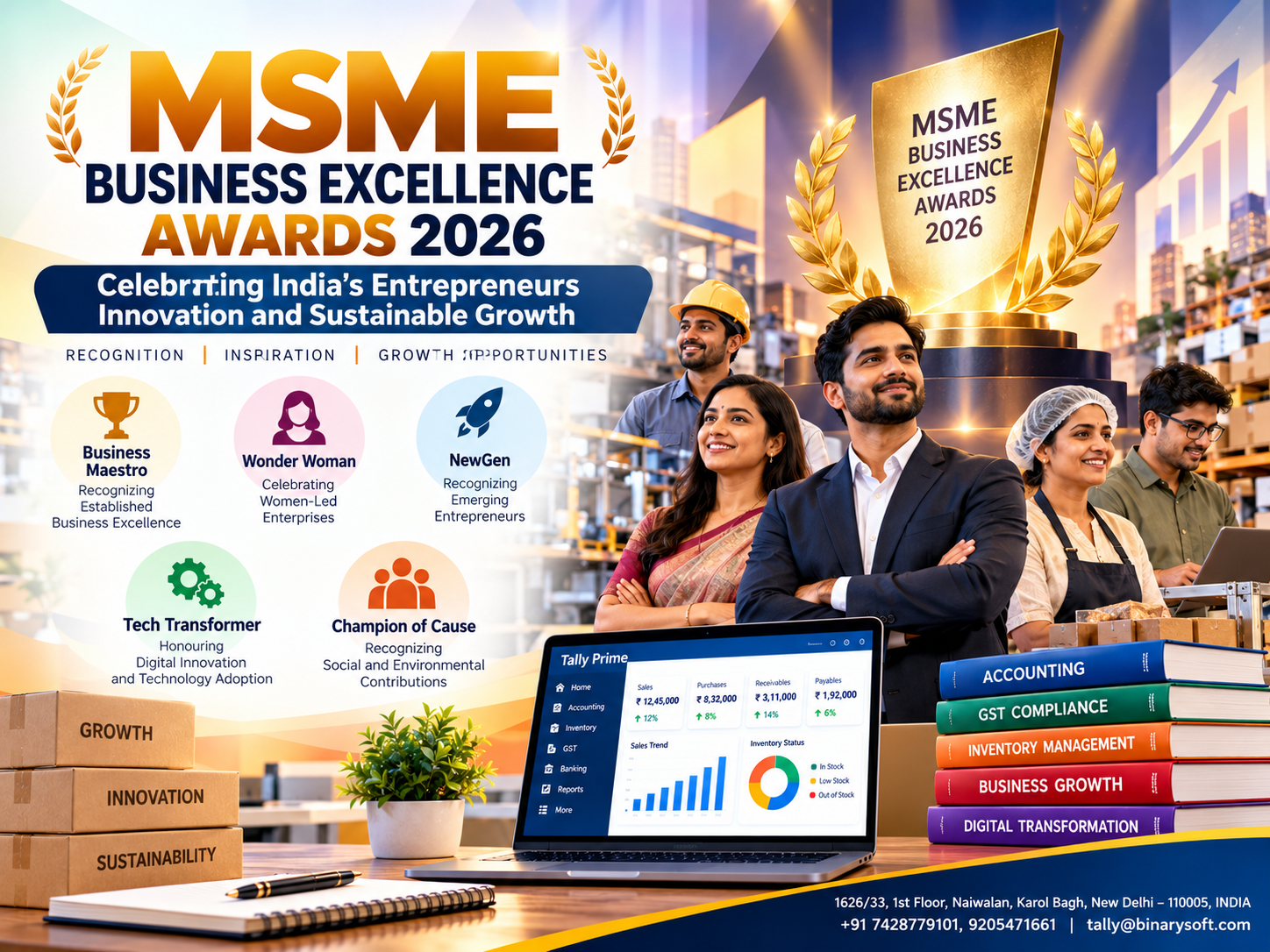
Five particularly relevant themes are established business leadership, women entrepreneurship, emerging entrepreneurs, technology transformation and social impact.
Business Maestro: Recognizing Established Business Excellence
This category celebrates enterprises that have demonstrated the ability to sustain operations, overcome challenges and build long-term success.
Established businesses frequently face difficulties related to market competition, customer retention, cost management and operational expansion.
Organizations demonstrating consistent leadership, financial discipline and adaptability provide valuable examples for other entrepreneurs.
Wonder Woman: Celebrating Women-Led Enterprises
Women entrepreneurs contribute significantly to business innovation, employment and community development.
Recognition in this category highlights women-led enterprises demonstrating leadership, resilience and meaningful business impact.
These businesses may operate in manufacturing, retail, technology, healthcare, education or other sectors.
NewGen: Recognizing Emerging Entrepreneurs
Young and emerging entrepreneurs frequently introduce new ideas, business models and technology-driven services.
This category celebrates a new generation of business owners developing innovative solutions and pursuing growth opportunities.
Tech Transformer: Recognizing Digital Innovation
Technology adoption can improve productivity, customer experience, financial visibility and operational efficiency.
Businesses introducing meaningful digital improvements may demonstrate excellence in this category.
Examples include integrated accounting systems, automated inventory processes, digital invoicing and data-driven reporting.
Champion of Cause: Recognizing Social and Environmental Contributions
Some businesses create value beyond commercial performance.
They may support employment for disadvantaged communities, improve environmental practices, encourage responsible sourcing or address important social challenges.
This category recognizes enterprises contributing meaningfully to society and the environment.
4. Why MSMEs Are Important to India's Economic Development
Micro, Small and Medium Enterprises form an essential part of India's business ecosystem.
They operate across manufacturing, trading, professional services, logistics, technology, agriculture-related activities and numerous other sectors.
MSMEs support employment generation, encourage local entrepreneurship and contribute to supply chains serving larger organizations.
Employment opportunities
Small businesses create jobs in urban, semi-urban and rural locations.
They also provide opportunities for employees to develop practical business and technical skills.
Entrepreneurship development
MSMEs enable individuals and families to establish businesses without necessarily requiring the infrastructure of large corporations.
Regional economic activity
Local enterprises contribute to commercial activity in industrial clusters, markets and smaller towns.
Supply chain participation
Many MSMEs provide materials, components, products and services to larger businesses.
Innovation
Smaller organizations can sometimes adapt quickly to changing customer requirements and experiment with new business approaches.
Recognizing successful MSMEs helps highlight these contributions and encourages broader entrepreneurial participation.
5. What Makes an MSME Worthy of Business Recognition?
Business excellence cannot be measured through turnover alone.
An enterprise may demonstrate outstanding performance through innovation, customer service, employee development, operational improvements or social impact.
Important evaluation considerations may include:
-
Business growth and sustainability
-
Entrepreneurial leadership
-
Product or service innovation
-
Financial and operational discipline
-
Technology adoption
-
Employment generation
-
Customer satisfaction
-
Social or environmental contribution
-
Ability to overcome significant challenges
The actual eligibility requirements and judging criteria depend on the individual recognition program.
Businesses should review the applicable rules before preparing nominations.
6. How Digital Transformation Strengthens MSME Growth
Digital transformation involves using suitable technology to improve business operations.
For MSMEs, this does not necessarily require expensive infrastructure or complicated enterprise systems.
Meaningful improvements can begin with structured accounting, digital invoices, inventory records and reliable financial reporting.
Important areas of digital transformation
Accounting modernization: Replacing disconnected records with organized accounting workflows.
Inventory management: Monitoring stock quantities, purchases, sales and warehouse movement.
Digital invoicing: Preparing consistent invoices and maintaining customer transaction records.
GST-related processes: Using appropriate accounting tools to support tax calculations and reporting.
Banking reconciliation: Reviewing differences between bank statements and accounting records.
Business reporting: Understanding profitability, expenses and outstanding balances.
Tally Prime supports several of these functions and can help businesses organize their financial operations.
Technology adoption becomes particularly valuable when employees receive appropriate training and management establishes reliable internal procedures.
7. How Tally Prime Helps MSMEs Build Stronger Businesses
Tally Prime can help MSMEs organize financial information, reduce repetitive accounting work and improve operational visibility.
For businesses preparing to expand, accurate financial records can support better planning and more informed decisions.
Accounting and financial management
Tally Prime supports ledger accounting, transaction recording, expense tracking and financial statements.
Business owners can review the Profit and Loss Account, Balance Sheet and Trial Balance to understand financial performance.
GST accounting and compliance
Businesses can use relevant GST features to record taxable transactions, prepare invoices and review GST-related reports.
Accurate classification and regular reconciliation remain important.
Inventory control
Manufacturers, retailers and distributors can manage stock items, godowns, purchase transactions and sales movements.
Inventory reports help businesses evaluate available quantities and stock values.
Customer outstanding management
Bill-wise accounting enables businesses to track pending customer payments and supplier obligations.
This can support better credit control and cash flow planning.
Banking and reconciliation
Bank reconciliation capabilities help businesses compare accounting records with bank transactions and investigate discrepancies.
Management reporting
Financial and operational reports can help entrepreneurs identify expense trends, customer payment delays and changes in profitability.
These capabilities can support the operational discipline associated with sustainable business growth.
8. MSME Registration and Business Documentation
Formal business records are important for entrepreneurs seeking recognition, financing or commercial opportunities.
In India, Udyam Registration is an important mechanism for identifying eligible MSMEs.
Businesses should understand the applicable classification requirements and maintain accurate registration information.
Important business documents
Depending on the award program, useful records may include:
-
Udyam Registration details, where applicable
-
Business incorporation or establishment documents
-
PAN and GST registration details, where applicable
-
Financial statements
-
Business performance summaries
-
Employee and operational information
-
Customer or project achievements
-
Technology adoption records
-
Evidence supporting social or environmental initiatives
Documentation requirements vary by program.
Businesses should avoid assuming that Udyam Registration alone establishes eligibility for every private recognition initiative.
9. Preparing a Strong MSME Award Nomination
A compelling nomination explains what makes a business distinctive.
Rather than relying only on promotional statements, entrepreneurs should present clear examples of challenges, actions and outcomes.
Step 1: Explain the business journey
Describe when the enterprise started, why it was established and which customer needs it addresses.
Step 2: Identify important challenges
Discuss meaningful obstacles such as limited financing, supply chain disruptions, operational inefficiencies or market competition.
Step 3: Highlight practical achievements
Provide evidence of business improvements, customer growth, innovation or employment generation.
Step 4: Demonstrate measurable outcomes
Where reliable data exists, include relevant figures such as revenue growth, production improvements or reduced processing time.
Step 5: Explain the wider impact
Describe how the business contributes to employees, customers, suppliers or communities.
Step 6: Verify the nomination
Ensure that all information is accurate, appropriately supported and consistent with the award program's requirements.
A clear and authentic business story is more valuable than exaggerated achievements.
10. Case Study One: A Manufacturing MSME Builds Growth Through Technology
Illustrative case study
A small auto-components manufacturer operated from an industrial area in Delhi NCR.
The company supplied components to several regional businesses.
Initially, accounting and inventory records were maintained separately.
Business challenges
Management faced difficulty tracking raw-material consumption, monitoring supplier balances and understanding production-related expenses.
The company also experienced delays when preparing financial information for business reviews.
Digital transformation
The manufacturer introduced structured accounting and inventory procedures using Tally Prime.
Stock items and purchase records were organized, supplier balances were reviewed regularly and financial reporting became part of monthly management meetings.
Employees received practical training to improve transaction accuracy.
Business outcomes
Management gained better visibility into inventory movement and financial obligations.
The company developed more consistent reporting procedures and could evaluate operating costs more systematically.
Why this business represents MSME excellence
The example demonstrates how a traditional manufacturing enterprise can strengthen operations through employee development, process improvements and technology adoption.
Its progress illustrates the qualities commonly associated with digital transformation recognition.
11. Case Study Two: A Women-Led Enterprise Creates Employment and Financial Stability
Illustrative case study
A woman entrepreneur established a small food-processing business supplying packaged products to local retailers.
The company began with limited equipment and a small workforce.
Over time, customer demand increased, creating opportunities to expand production.
Business challenges
The entrepreneur struggled with rising raw-material costs, customer credit arrangements and inconsistent financial reporting.
Without accurate expense information, pricing decisions became difficult.
Business improvements
The company introduced more structured accounting, inventory tracking and customer payment monitoring.
Tally Prime was used to record relevant business transactions and review financial reports.
Employees also received training in stock documentation and invoice preparation.
Business outcomes
The enterprise improved its understanding of operating expenses and outstanding payments.
Management became better equipped to evaluate expansion decisions and maintain organized financial records.
Why this business represents MSME excellence
The company's development reflects entrepreneurial resilience, women-led business leadership and the creation of employment opportunities.
The example also demonstrates how financial discipline can support responsible growth.
12. Business Benefits of Participating in MSME Recognition Programs
Participation in a credible recognition program can offer several potential benefits.
Improved business visibility
Recognition may introduce a business to customers, suppliers and professional communities that were previously unfamiliar with its achievements.
Stronger brand credibility
An independently evaluated award can help demonstrate business achievements, although it should not be presented as a guarantee of product quality or financial strength.
Entrepreneurial motivation
Recognition can acknowledge the contributions of founders, employees and other stakeholders.
Networking opportunities
Award-related events may create opportunities to connect with other entrepreneurs, professionals and industry participants.
Internal business evaluation
Preparing an application encourages organizations to review achievements, document progress and identify areas for improvement.
Employee engagement
Celebrating meaningful business milestones can help employees recognize the importance of their contributions.
These benefits are potential outcomes rather than guaranteed results.
13. Financial Management Challenges Faced by Growing MSMEs
Many MSMEs experience operational challenges as their transaction volumes increase.
A company may generate higher sales while struggling with delayed collections, rising expenses or inventory shortages.
Working capital pressure
Customer payment delays can reduce the funds available for supplier payments and daily operations.
Inaccurate financial records
Disconnected accounting systems can create inconsistencies and make financial reporting more difficult.
Inventory inefficiencies
Excess stock can block working capital, while shortages may disrupt customer deliveries.
Compliance responsibilities
Businesses must maintain appropriate records and meet applicable taxation and regulatory requirements.
Limited management information
Without timely financial reports, entrepreneurs may struggle to identify declining profitability or increasing expenses.
Integrated accounting systems and regular financial reviews can help businesses address these challenges.
14. Using Tally Prime to Monitor MSME Payments and Compliance
MSME-related payment monitoring is particularly important for businesses purchasing goods or services from micro and small enterprises.
Applicable legal requirements may affect payment timelines, interest obligations and income-tax treatment.
Tally Prime supports recording MSME details in relevant party masters and provides reports for monitoring qualifying outstanding transactions.
Useful MSME-related capabilities
Party classification: Maintain relevant enterprise-type and registration information.
Bill-wise tracking: Monitor supplier invoices and payment balances.
Outstanding MSME bills: Review pending amounts associated with relevant micro and small enterprise suppliers.
Credit-period monitoring: Examine outstanding transactions against configured credit periods.
MSME reporting: Prepare relevant reports and supporting information where the applicable software functionality is available.
Businesses should verify enterprise classification, effective dates and statutory requirements. Software-generated information should be reviewed before compliance reporting.
15. Building a Business Culture That Deserves Recognition
Winning an award should not be the only reason to improve business practices.
Sustainable excellence comes from developing a culture of responsibility, innovation and continuous improvement.
Businesses can strengthen this culture by establishing clear financial procedures, encouraging employee development and regularly evaluating performance.
Management should also create opportunities for employees to suggest improvements.
A warehouse employee may identify a better stock-verification procedure. An accountant may recommend a more effective reconciliation process.
Small operational improvements can collectively produce meaningful business benefits.
Entrepreneurs should also recognize that business growth must be supported by financial discipline.
Expanding sales without controlling expenses, inventory and customer credit can create unnecessary financial pressure.
A business culture focused on measurable improvements provides a stronger foundation for long-term success.
16. The Future of MSME Excellence in India
The future of India's MSME sector will be influenced by entrepreneurship, digital adoption, workforce development and changing market opportunities.
Businesses that combine operational knowledge with suitable technology may be better positioned to adapt to customer expectations and competition.
Financial transparency, reliable accounting records and responsible management will remain important.
At the same time, innovation does not always require sophisticated technology.
A small business introducing better inventory procedures, improving employee safety or developing environmentally responsible packaging may demonstrate meaningful progress.
Recognition programs can help highlight these achievements and encourage other enterprises to pursue similar improvements.
The central message for entrepreneurs is that business excellence is not defined only by size.
It is reflected in the ability to create value, overcome challenges, improve operations and contribute positively to the wider economy.
Conclusion
MSME business excellence awards celebrate the determination, innovation and achievements of entrepreneurs who contribute to India's economic development.
From established enterprises and women-led businesses to emerging founders and technology-driven organizations, recognition programs highlight different paths to success.
However, lasting business excellence requires more than public recognition.
Accurate accounting, financial discipline, responsible leadership, inventory management and employee development are essential foundations for sustainable growth.
Tally Prime can support MSMEs by bringing accounting, GST-related processes, inventory management, banking and financial reporting into an integrated business environment.
With appropriate implementation and training, businesses can improve operational visibility and make better-informed decisions.
For entrepreneurs pursuing growth in 2026 and beyond, the most important achievement is building an organization that continues creating value for customers, employees and communities.
Powered by Binarysoft Technologies
Authorized Tally Partner
Location: 1626/33, 1st Floor, Naiwalan, Karol Bagh, New Delhi – 110005, INDIA
Contact Us: +91 7428779101, 9205471661
Email: tally@binarysoft.com
Business Hours: 10:00 AM – 6:00 PM, Monday to Friday
Frequently Asked Questions
How can Binarysoft Technologies support MSME business growth?
Binarysoft Technologies can assist businesses with Tally Prime implementation, accounting configuration, GST-related workflows, inventory management, training and technical support according to their operational requirements.
How should entrepreneurs prepare for an MSME award nomination?
Entrepreneurs should document their business journey, explain significant challenges, provide evidence of achievements and follow the specific nomination requirements.
Why is digital transformation important for MSMEs?
Digital transformation can help businesses improve transaction accuracy, reduce repetitive work, strengthen reporting and gain better visibility into operations.
Can Tally Prime help businesses monitor MSME supplier payments?
Yes. Relevant Tally Prime features support MSME party information, outstanding bills and credit-period reporting, subject to correct configuration and applicable requirements.
CA. Devansh Rathi works closely with wholesalers, distributors, and growing enterprises on taxation, reconciliations, and financial controls. His approach emphasizes accurate records, timely compliance, and efficient accounting systems.