Call CA Tally HelpDesk
+91 9205471661,
7428779101
Introduction: Why Smart Business Decisions Matter More Than Ever
In 2026, running a successful business in India requires more than increasing sales. Business owners must also manage rising operating expenses, changing customer expectations, competitive pricing, inventory movement, payment delays and evolving compliance requirements.
A business may generate impressive revenue yet struggle to pay suppliers because customers have not settled outstanding invoices. Another may maintain strong sales but lose profitability because excess inventory consumes working capital.
These challenges demonstrate why financial discipline and timely information are essential for sustainable growth.
Smart business management involves understanding what is happening inside the organization, identifying potential problems early and taking practical action.
Accurate accounting, GST compliance, inventory visibility, credit management and technology adoption can help businesses make more informed decisions.
Tally Prime supports these activities by bringing financial accounting, invoicing, inventory records, taxation and reporting into a structured system.
For startups and MSMEs, this integration can reduce repetitive work and improve operational visibility.
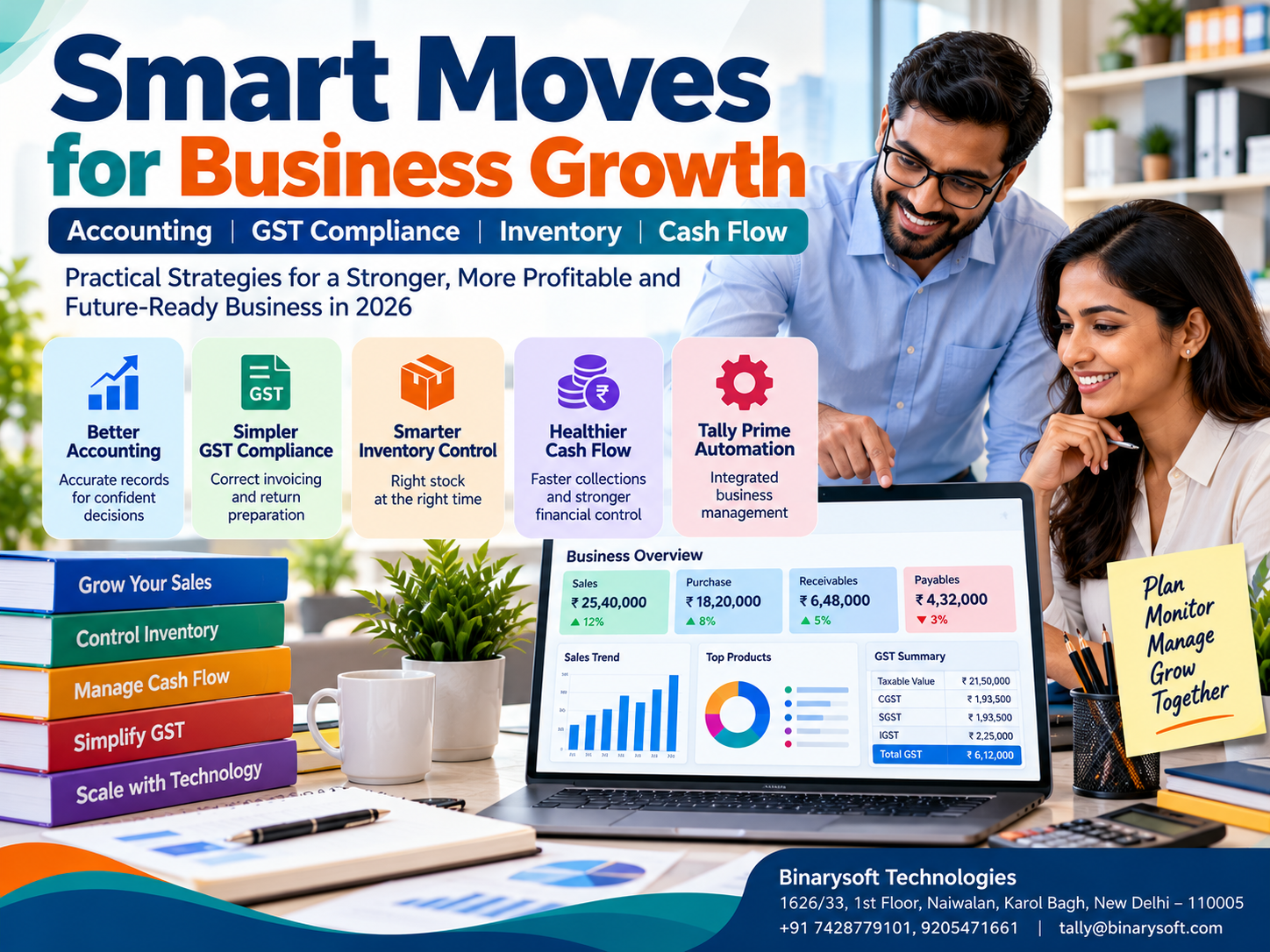
This guide explores important business management strategies, explains how to implement them and demonstrates how Tally Prime can support more confident financial decisions.
A Business Owner's Story: The Day Strong Sales Could Not Pay the Salaries
Rajesh owned a wholesale electrical goods business in Delhi.
For nearly twelve years, he had worked hard to build relationships with retailers, contractors and distributors.
His business had grown steadily, and monthly sales regularly crossed ₹40 lakh.
From the outside, everything appeared successful.
But one evening, just three days before employee salaries were due, Rajesh discovered that his bank balance was insufficient.
He checked his sales register. Revenue was strong.
He checked the warehouse. Goods worth several lakhs were sitting on the shelves.
Then his accountant prepared a list of outstanding customer invoices.
More than ₹28 lakh was awaiting collection, and several payments were overdue by more than 60 days.
Rajesh realized that he had been measuring success through sales rather than available cash.
He felt anxious. His employees depended on their salaries, suppliers were requesting payments, and his family had invested years of effort in the business.
The next morning, he introduced a weekly financial review.
Customer outstanding balances were monitored, credit limits were revised and slow-moving stock was identified.
He began using Tally Prime reports to understand receivables, inventory and cash flow more clearly.
Over the following months, the business improved its collection discipline and purchasing decisions.
Rajesh learned that growth without financial visibility can create unnecessary risk.
This illustrative story reflects a common challenge faced by growing Indian businesses.
1. What Are Smart Moves in Business Management?
Smart business moves are practical decisions that improve financial performance, operational efficiency and long-term stability.
They involve using reliable information rather than relying entirely on assumptions.
Examples include monitoring cash flow before approving major purchases, reviewing customer credit limits, reconciling GST records and identifying slow-moving inventory.
A smart decision does not always require a large investment.
Sometimes, improving an existing accounting process can create meaningful benefits.
For example, a business that reviews outstanding invoices every week may improve collections without increasing sales expenditure.
Similarly, accurate stock reports can prevent unnecessary purchases and reduce inventory holding costs.
The objective is to make business decisions more predictable, measurable and sustainable.
2. Build a Strong Accounting Foundation
Accurate accounting is the starting point for effective business management.
Every sale, purchase, payment, receipt and expense affects the financial position of an organization.
When transactions are recorded late or incorrectly, financial reports become less reliable.
Businesses should maintain properly classified ledgers, regularly reconcile bank accounts and review unusual transactions.
Daily bookkeeping helps prevent the accumulation of errors.
A structured accounting system also supports audit preparation, tax reporting and management decisions.
Tally Prime allows businesses to record transactions through accounting vouchers and generate financial statements such as the Balance Sheet and Profit and Loss Account.
These reports help owners understand profitability, liabilities, assets and overall business performance.
3. Improve Cash Flow Before Expanding Sales
Cash flow represents the movement of money into and out of a business.
Profitability and cash availability are related but different concepts.
A business may report a profit while facing a cash shortage because customers have not paid their invoices.
Consider the following example.
|
Particulars
|
Amount
|
|---|
|
Monthly sales
|
₹25,00,000
|
|
Customer collections
|
₹16,00,000
|
|
Supplier payments
|
₹12,00,000
|
|
Salaries and operating expenses
|
₹5,00,000
|
|
Net operating cash movement
|
-₹1,00,000
|
Although the business recorded substantial sales, its cash outflow exceeded customer collections during the month.
This situation can create pressure on working capital.
Businesses should monitor payment cycles, customer collections and upcoming liabilities.
Tally Prime supports receivables, payables and cash-flow reporting to help management identify potential shortages.
4. Strengthen Customer Credit Control
Offering credit can help businesses attract customers and increase sales.
However, uncontrolled credit can create serious financial problems.
Businesses should establish clear payment terms and appropriate credit limits.
Customer balances should be reviewed regularly, especially when invoices become overdue.
An aging analysis helps identify amounts outstanding for different periods.
For example, management may separately review invoices overdue by 1–30 days, 31–60 days and more than 60 days.
Tally Prime supports bill-wise outstanding reports and credit-limit configurations that help businesses monitor customer exposure.
Effective credit control can reduce collection delays and improve financial stability.
5. Make GST Compliance a Regular Business Process
GST compliance should not be treated as an activity performed only near return-filing deadlines.
Accurate GST reporting begins with correct transaction recording.
Businesses must maintain appropriate HSN or SAC classifications, tax rates, supplier information and invoice details.
Purchase records should be reconciled with relevant GST information to identify mismatches.
The GSTR-2B statement can help businesses review supplier-reported transactions, although ITC eligibility also depends on applicable legal conditions.
Tally Prime provides GST reports and reconciliation capabilities that can support the review process.
Depending on the installed release, configuration and connectivity, businesses can also use connected GST features.
Regular reviews help reduce last-minute corrections and improve the reliability of tax records.
6. Use Inventory Reports to Protect Working Capital
Inventory represents money invested in products and materials.
Excess stock can increase storage costs and tie up working capital.
Insufficient stock can lead to missed sales and dissatisfied customers.
Businesses should monitor stock movement, reorder requirements and inventory valuation.
Slow-moving items require particular attention because they may remain unsold for extended periods.
Tally Prime supports stock summaries, godown-wise inventory and other stock reports.
Businesses can use these reports to identify inventory imbalances and improve purchasing decisions.
For products requiring batch management, appropriate batch-wise records can provide additional visibility.
7. Monitor the Business Metrics That Actually Matter
Business owners often focus heavily on sales growth.
However, revenue alone does not reveal whether the organization is financially healthy.
A more complete management review should include profitability, customer collections, stock movement and working capital.
|
Business metric
|
Why it matters
|
|---|
|
Gross profit margin
|
Measures profitability after direct costs
|
|
Net profit margin
|
Shows overall earnings after expenses
|
|
Receivable aging
|
Identifies delayed customer payments
|
|
Inventory turnover
|
Measures how efficiently stock is sold
|
|
Cash-flow position
|
Indicates available liquidity
|
|
Payable aging
|
Helps plan supplier settlements
|
|
GST reconciliation differences
|
Highlights transactions needing review
|
|
Expense-to-sales ratio
|
Helps monitor operating efficiency
|
Tally Prime provides financial and operational reports that can support many of these calculations.
Businesses should select metrics relevant to their industry rather than tracking unnecessary information.
8. Improve Invoicing Accuracy and Customer Experience
Invoices are important financial and commercial documents.
They communicate the amount payable, applicable taxes, product details and payment terms.
Incorrect invoices can create disputes and delay collections.
Businesses should use consistent invoice numbering, accurate customer information and verified tax classifications.
Professional invoice formatting can also make documents easier for customers to understand.
Tally Prime supports configurable invoicing, GST calculations and various invoice formats.
Businesses can include relevant commercial details according to their requirements and available configuration.
Accurate invoicing supports both compliance and customer relationships.
9. Adopt Automation Without Losing Financial Control
Automation can reduce repetitive tasks, but it should be introduced carefully.
Businesses may automate routine calculations, report generation and supported connected workflows.
However, automation does not eliminate the need for verification.
Incorrect master data can still produce incorrect invoices or reports.
Before introducing new processes, businesses should review existing data, assign responsibilities and establish approval procedures.
Tally Prime helps automate accounting calculations and provides connected features for selected compliance and banking workflows.
Availability depends on the software release, subscriptions, bank support and configuration.
A successful automation strategy combines technology with regular human review.
10. How Tally Prime Helps Businesses Make Smarter Decisions
Tally Prime combines accounting, inventory and financial reporting capabilities that can help businesses manage daily operations.
Accounting and bookkeeping
Businesses can record sales, purchases, receipts, payments and journal entries through structured accounting vouchers.
GST management
Tally Prime supports GST invoicing, tax reports, reconciliation and selected connected compliance features.
Inventory control
Stock summaries, godown records and inventory reports help businesses monitor stock movement and valuation.
Credit and cash-flow management
Bill-wise receivables, payables and cash-flow reports provide information for payment planning.
Banking and reconciliation
Bank reconciliation features help businesses compare accounting records with bank transactions.
Management reporting
Profit and Loss Accounts, Balance Sheets and other reports provide financial information for decision-making.
Security and data protection
User permissions, data protection features and regular backups can help businesses manage accounting information more responsibly.
These capabilities can be especially useful when the accounting system is configured according to the organization's operations.
11. Develop a Monthly Financial Review Routine
Business owners should establish a regular financial review instead of waiting until year-end.
A monthly review can include sales performance, profitability, cash availability, customer outstanding balances and supplier obligations.
Management should also review slow-moving stock, unusual expenses and GST reconciliation differences.
A simple review process can identify issues before they become major financial problems.
For example, an increase in sales combined with declining cash availability may indicate longer collection periods.
Similarly, rising inventory without corresponding sales growth may indicate excess purchasing.
Tally Prime reports can provide much of the financial information needed for these reviews.
12. Case Study One: Delhi Wholesale Distributor Improves Cash Flow
Illustrative case study
A wholesale electrical goods distributor operating in Bhagirath Palace, Delhi, supplied products to retailers and contractors.
The business generated substantial monthly sales but experienced recurring cash shortages.
Customer payments were frequently delayed, and the owner had limited visibility into overdue invoices.
The company introduced a structured accounting process using Tally Prime.
Customer ledgers were organized, bill-wise outstanding tracking was enabled and credit limits were reviewed.
Management began examining receivable aging reports every week.
Purchasing decisions were also linked more closely to available stock and expected collections.
Over time, the business improved its payment follow-up process and reduced unnecessary inventory purchases.
The case demonstrates how financial visibility and credit discipline can support healthier working capital.
13. Case Study Two: Retail Business Reduces Inventory and GST Errors
Illustrative case study
A growing electronics retailer in Rohini maintained several hundred stock items across different product categories.
The business relied on spreadsheets for inventory and separate records for GST accounting.
As transaction volumes increased, staff members struggled to reconcile stock quantities with sales invoices.
The owner introduced Tally Prime for integrated inventory and accounting management.
Stock items were organized into product groups, and GST classifications were reviewed.
Sales and purchase transactions were recorded through a consistent workflow.
Management began reviewing stock summaries, profitability and tax reports regularly.
The improved process helped identify stock differences earlier and reduced repeated manual reconciliation.
The business also gained better visibility into customer balances and product movement.
14. Common Mistakes That Prevent Sustainable Business Growth
Several management mistakes can weaken otherwise successful businesses.
One is focusing only on revenue while ignoring cash flow.
Another is offering excessive customer credit without reviewing repayment behavior.
Businesses may also purchase inventory based on assumptions rather than actual demand.
Delayed bookkeeping, incomplete GST reconciliation and poor expense monitoring can create additional risks.
Technology investments may also fail when employees receive insufficient training or existing data is inaccurate.
Businesses should address these weaknesses through clear procedures, regular reviews and appropriate accounting tools.
15. Create a Practical 90-Day Business Improvement Plan
A structured improvement plan can help businesses move from identifying problems to taking measurable action.
|
Period
|
Main priorities
|
Expected outcome
|
|---|
|
Days 1–30
|
Review accounting records, GST masters, customer balances and inventory
|
Identify major financial and operational gaps
|
|
Days 31–60
|
Improve credit control, invoicing, stock tracking and reconciliation
|
Establish more reliable daily processes
|
|
Days 61–90
|
Review financial metrics, train employees and refine reporting
|
Strengthen management decisions and accountability
|
Businesses should assign responsibility for each activity and establish measurable targets.
For example, management may aim to reduce overdue receivables or improve inventory accuracy.
Progress should be reviewed regularly, and targets should be adjusted based on actual business conditions.
16. The Future of Smart Business Management in India
Indian businesses are increasingly adopting digital accounting, connected compliance systems and data-driven management practices.
The objective is not simply to replace manual work with software.
It is to improve the speed, consistency and quality of business decisions.
Reliable financial information can help entrepreneurs evaluate expansion plans, negotiate with suppliers and respond to changing customer demand.
However, sustainable growth still depends on disciplined management, ethical practices and customer relationships.
Technology provides valuable support, but business owners must interpret the information and take appropriate action.
Organizations that combine financial discipline with practical technology adoption are better positioned to manage uncertainty and pursue long-term growth.
Conclusion
Smart business growth requires more than increasing sales.
Businesses must understand cash flow, maintain accurate accounting records, control customer credit, manage inventory and remain prepared for GST compliance.
Regular financial reviews help identify problems early and support better planning.
Tally Prime provides integrated accounting, inventory, invoicing, taxation and reporting features that can support these activities.
For MSMEs, startups, retailers, wholesalers and distributors, structured accounting can reduce manual effort and improve financial visibility.
The most valuable business decisions are often those that protect cash, reduce unnecessary costs and strengthen customer relationships.
By adopting disciplined financial processes and using reliable business information, organizations can build stronger foundations for sustainable growth.
Professional Tally Prime and Business Accounting Assistance
Powered by Binarysoft Technologies
Authorized Tally Partner
Location: 1626/33, 1st Floor, Naiwalan, Karol Bagh, New Delhi – 110005, INDIA
Contact Us: +91 7428779101, 9205471661
Email: tally@binarysoft.com
Business Hours: 10:00 AM – 6:00 PM, Monday to Friday
Frequently Asked Questions
What is the first step toward smarter business management?
The first step is to maintain accurate, up-to-date accounting records and regularly review cash flow, profitability, outstanding payments and inventory.
Is accounting automation suitable for MSMEs?
Yes. Appropriate automation can reduce repetitive work and improve reporting consistency, provided the underlying data and procedures are reliable.
How does Tally Prime support GST compliance?
Tally Prime provides GST invoicing, reports, reconciliation features and supported connected services, depending on the installed release and configuration.
Can Tally Prime help reduce delayed customer payments?
Yes. Bill-wise outstanding reports, customer balances and credit-limit features can help businesses monitor receivables and improve collection follow-up.
CA. Arinav Chakraborty advises businesses on taxation, accounting systems, and financial planning. His professional interests include digital transformation, compliance management, and improving business efficiency through technology.