Call CA Tally HelpDesk
+91 9205471661,
7428779101
Introduction: Why Warehouse Visibility Is Essential for Business Success
Imagine a wholesale distributor operating three warehouses in Delhi, Noida and Gurugram.
A customer places an urgent order for 200 units of a popular product. The sales team checks the total inventory and finds 350 units available.
The order is confirmed immediately.
However, when the warehouse team begins preparing the shipment, they discover that only 80 units are available at the dispatch location.
The remaining stock is distributed across other warehouses.
The customer becomes frustrated, delivery is delayed and the business must arrange an urgent stock transfer.
Although the company had sufficient inventory overall, poor location-wise visibility created an avoidable problem.
This is where Godown Summary in Tally Prime becomes valuable.
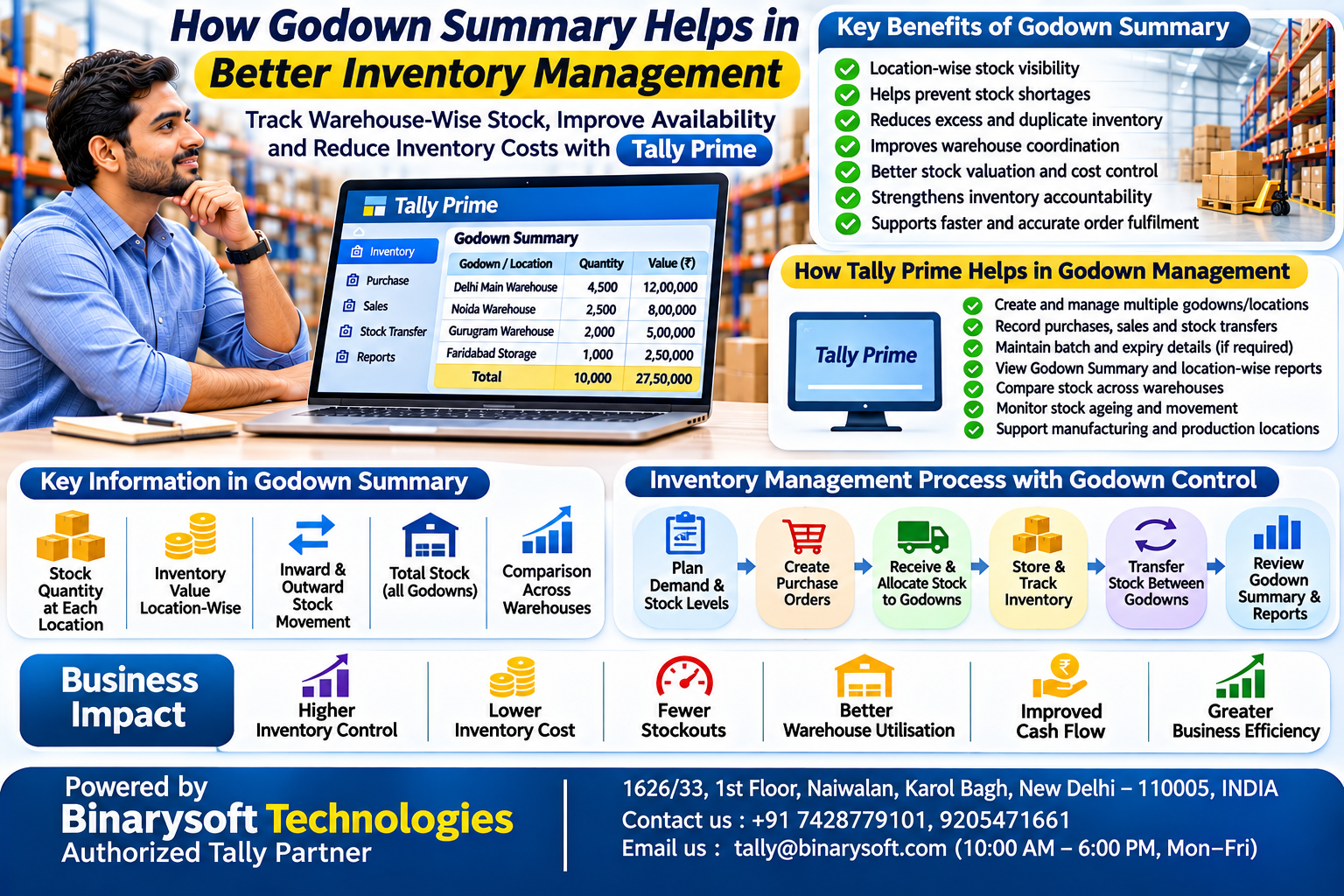
Godown Summary provides businesses with information about inventory maintained at different storage locations. It helps management understand where products are available, how much stock is held and what inventory value is associated with each location.
For retailers, wholesalers, distributors and manufacturers, this information supports better purchasing, warehouse coordination and order fulfilment.
As businesses expand into multiple branches or storage facilities, maintaining accurate godown-wise stock records becomes increasingly important.
This guide explains the meaning, importance, advantages and practical applications of Godown Summary, along with how businesses can use Tally Prime for more effective inventory management.
What Is a Godown in Inventory Management?
A godown is a physical or logical location used to store inventory.
In traditional business terminology, a godown generally refers to a warehouse or storage facility.
However, inventory software can also use godowns to represent separate branches, rooms, departments, racks or other identifiable stock locations.
For example, a distributor may maintain the following godowns:
Each location serves a different operational purpose.
Maintaining separate godown records allows businesses to identify the quantities and values of inventory held at individual locations.
This becomes particularly useful when stock frequently moves between branches or warehouses.
What Is Godown Summary in Tally Prime?
Godown Summary is an inventory report that provides a consolidated view of stock maintained across configured godowns or locations.
It helps businesses examine location-wise inventory balances and drill down into relevant stock details.
Instead of reviewing only the company's total inventory, management can analyse stock distribution across warehouses.
For example, a company may have 1,000 units of a product in total, distributed as follows:
|
Godown location
|
Available stock
|
|---|
|
Delhi Main Warehouse
|
450 units
|
|
Noida Branch
|
250 units
|
|
Gurugram Distribution Centre
|
200 units
|
|
Faridabad Storage Facility
|
100 units
|
|
Total
|
1,000 units
|
Without location-wise reporting, the business may know that 1,000 units exist but struggle to determine where those units are physically available.
Godown Summary helps bridge this information gap.
Why Godown Summary Is Important for Businesses
1. Provides Location-Wise Stock Visibility
One of the biggest advantages of Godown Summary is the ability to identify inventory held at different locations.
Management can review stock balances without contacting every warehouse individually.
This supports faster operational decisions.
2. Helps Prevent Stock Shortages
A business may have sufficient total inventory but insufficient stock at a particular branch.
Godown-wise reports help identify these differences before customer orders are confirmed.
Businesses can then plan transfers or adjust delivery commitments.
3. Reduces Excess Inventory
When individual branches maintain separate purchasing practices, unnecessary stock accumulation can occur.
Godown Summary helps management identify locations with excess inventory.
Instead of purchasing additional products, businesses may transfer available stock from another location.
4. Improves Warehouse Coordination
Multiple warehouses require consistent communication.
Location-wise inventory information helps purchasing, sales and warehouse teams work from the same records.
This can reduce confusion and improve dispatch planning.
5. Supports Better Inventory Valuation
Godown-wise stock values help businesses understand how inventory investment is distributed across storage locations.
Management can identify warehouses holding substantial inventory and review whether those quantities are commercially justified.
6. Strengthens Inventory Accountability
When stock is recorded against specific locations, businesses can assign responsibility for receiving, storing and dispatching goods.
This improves the investigation of stock differences and operational errors.
How Godown Summary Works: A Practical Example
Consider a distributor maintaining inventory across three warehouses.
Illustrative warehouse-wise inventory value
₹0₹350K₹700K₹1M₹1.4MDelhiNoidaGurugram
Hypothetical figures for illustration only.
|
Warehouse
|
Inventory value
|
Share of total
|
|---|
|
Delhi
|
₹12,00,000
|
48%
|
|
Noida
|
₹8,00,000
|
32%
|
|
Gurugram
|
₹5,00,000
|
20%
|
|
Total
|
₹25,00,000
|
100%
|
The report shows that nearly half of the company's inventory investment is concentrated in Delhi.
Management can compare these balances with actual customer demand at each location.
If Noida regularly experiences shortages while Delhi maintains excess stock, the company may consider internal transfers.
This approach can improve product availability without necessarily increasing total inventory investment.
Godown Summary vs Stock Summary: Understanding the Difference
Both reports are useful, but they answer different business questions.
|
Feature
|
Stock Summary
|
Godown Summary
|
|---|
|
Main purpose
|
Overall inventory position
|
Location-wise inventory position
|
|
Primary focus
|
Stock items and groups
|
Godowns and storage locations
|
|
Useful for
|
Reviewing product balances
|
Reviewing warehouse distribution
|
|
Typical decision
|
What should be purchased?
|
Where should stock be transferred?
|
|
Management benefit
|
Product-level visibility
|
Location-level visibility
|
Businesses operating from a single warehouse may rely heavily on Stock Summary.
Companies maintaining multiple warehouses or branches can benefit from using both reports together.
Key Advantages of Godown-Wise Inventory Management
Improved Order Fulfilment
Sales teams can identify the warehouse best positioned to fulfil customer requirements.
This can reduce unnecessary transfers and improve delivery planning.
Lower Transportation Expenses
Better stock distribution helps businesses avoid emergency transfers between distant warehouses.
Planned transfers may reduce transportation costs.
More Efficient Purchasing
Purchasing teams can review existing stock across locations before placing additional orders.
This helps prevent duplicate purchases.
Better Warehouse Space Utilisation
Godown-wise reports help identify locations with excessive stock concentration.
Management can redistribute inventory or review warehouse capacity requirements.
Reduced Inventory Discrepancies
Consistent location-wise records make it easier to investigate differences between physical stock and system balances.
Improved Working Capital
By making better use of existing inventory, businesses may reduce unnecessary purchases and release funds for other operational requirements.
How to Create and Manage Godowns in Tally Prime
Businesses can create individual godowns or organise them into hierarchical structures, depending on operational requirements.
Step 1: Create Godown Masters
In Tally Prime:
-
Press Alt+G (Go To).
-
Select Create Master.
-
Select Godowns.
-
Enter the godown name.
-
Choose Primary, Main Location, or an appropriate parent godown.
-
Press Ctrl+A to save.
For example, create Delhi Main Warehouse, Noida Warehouse and Gurugram Warehouse.
Step 2: Create Godown Hierarchies
Larger businesses can organise warehouses under regional parent locations.
For example:
North Region → Delhi Warehouse → Packaging Section
This structure supports consolidated reporting at regional level while preserving location-level details.
Step 3: Allocate Stock to Godowns
When recording purchase or inventory transactions, allocate stock to the appropriate godown.
If 500 units are received, the business might allocate 300 units to Delhi and 200 units to Noida.
Accurate allocation ensures that reports reflect the correct location-wise balances.
Step 4: Record Stock Transfers
Use Stock Journal vouchers when transferring products between godowns.
For example, transfer 50 units from Delhi Warehouse to Noida Warehouse.
Record the source godown, destination godown, stock item, quantity and relevant rate.
This updates the inventory position of the respective locations without treating the internal transfer as an external sale.
Step 5: Open Godown Summary
Navigate to:
Alt+G (Go To) → Godown Summary
The report displays inventory information for the configured locations.
Useful controls include:
|
Shortcut
|
Purpose
|
|---|
|
Shift+Enter
|
Expand stock details
|
|
Alt+F5
|
Detailed view
|
|
F4
|
Select a specific godown
|
|
Ctrl+H
|
Change to Monthly Summary
|
|
F7
|
Show Profit
|
|
Alt+C
|
Add a comparison column
|
These features allow businesses to examine stock availability, values and movements in greater detail.
Step 6: Review Monthly Inventory Movement
Drill down into a godown to examine monthly inward and outward movements.
This helps identify locations receiving more stock than they dispatch.
Step 7: Compare Godowns
Use report comparison columns to analyse quantities and values across locations.
For example, compare Delhi and Noida warehouses to identify products requiring redistribution.
Tally Prime supports godown creation, hierarchical locations, stock transfers, monthly reporting and warehouse comparisons.
How Godown Summary Helps Reduce Inventory Costs
Inventory expenses extend beyond the purchase price of products.
Businesses may incur warehouse rent, electricity, security, insurance, handling charges and transportation costs.
When inventory is poorly distributed, these expenses can increase unnecessarily.
For example, a company may purchase additional products for one branch despite having sufficient stock at another location.
By reviewing Godown Summary before purchasing, management can identify existing inventory that could fulfil the requirement.
The business can then compare the cost of transferring stock against the cost of purchasing additional products.
This approach may reduce duplicate purchases and unnecessary storage expenses.
Managing Multiple Warehouses with Tally Prime
Multiple-warehouse management becomes increasingly important as businesses expand.
A retailer may maintain a central warehouse and several stores.
A manufacturer may maintain separate locations for raw materials, production-stage inventory and finished goods.
A distributor may operate regional warehouses to serve customers more quickly.
Tally Prime supports these arrangements through location-wise inventory records.
Businesses can also use godowns to represent stock held by third parties, including job workers and consignment agents, when configured appropriately.
However, accurate reporting requires employees to record every relevant receipt, dispatch and transfer against the correct location.
Case Study 1: Improving Stock Distribution for a Delhi Electronics Distributor
Illustrative case study using hypothetical business figures.
A Delhi-based electronics distributor supplied computer accessories to retailers across the National Capital Region.
The company maintained warehouses in Delhi, Noida and Gurugram.
Its sales team frequently confirmed orders based on total inventory without checking stock availability at the dispatch location.
This resulted in urgent transfers, delayed deliveries and occasional unnecessary purchases.
Management introduced godown-wise inventory tracking in Tally Prime.
Each warehouse was configured as a separate godown, and internal transfers were recorded using Stock Journal vouchers.
Employees began reviewing Godown Summary before confirming large orders.
In this hypothetical six-month scenario, emergency stock transfers decreased from 24 to 11 per month.
The company also reduced duplicate purchasing and improved warehouse coordination.
The most important improvement was greater confidence in location-wise stock information.
Case Study 2: Better Raw Material Control for a Faridabad Furniture Manufacturer
Illustrative case study; results are hypothetical.
A furniture manufacturer in Faridabad maintained separate storage areas for timber, hardware, semi-finished furniture and completed products.
Previously, employees recorded inventory without consistently identifying the correct storage location.
Production supervisors frequently struggled to determine whether materials were available.
Management introduced a structured godown hierarchy.
Separate godowns were created for raw materials, production areas and finished goods.
Tally Prime helped record stock movements between these locations.
In this illustrative scenario, material-search delays decreased, production planning improved and physical stock verification became easier.
The case demonstrates how location-wise stock control can support manufacturing efficiency.
An Emotional Story: The Warehouse That Was Full, but the Business Was Struggling
The following fictional story illustrates the personal consequences of poor warehouse inventory control.
For more than twenty years, Mahesh operated a wholesale business in Delhi.
He started with a small shop and gradually expanded into three warehouses.
His family celebrated each new warehouse as a sign of success.
But as the business grew, managing inventory became increasingly difficult.
One afternoon, an important customer ordered products worth ₹2 lakh.
Mahesh checked his records and confidently promised immediate delivery.
However, the warehouse supervisor informed him that the required products were not available at the Delhi location.
The goods were stored in another warehouse, and arranging transportation would take two days.
The customer cancelled the order.
That evening, Mahesh returned home disappointed.
His daughter noticed his silence and asked what had happened.
He replied, "We have warehouses full of products, but I still cannot deliver what my customers need."
His daughter suggested organising inventory records according to storage locations.
They introduced separate godown records and began recording stock transfers consistently.
Every morning, the sales team reviewed location-wise availability before confirming orders.
Warehouse employees also conducted regular physical stock checks.
Over time, the business became more organised.
Mahesh could identify where products were stored and make better decisions about dispatches and transfers.
Most importantly, he regained confidence in the business he had spent decades building.
His experience illustrates a powerful lesson: business growth is not measured only by how much stock a company owns, but also by how effectively that stock is managed.
Common Mistakes in Godown-Wise Inventory Management
Businesses should avoid creating unnecessary godowns without a clear operational purpose.
Too many poorly organised locations can make data entry and reporting confusing.
Another common mistake is recording stock transfers without selecting the correct source and destination locations.
This can create misleading balances even when the company's total stock remains unchanged.
Businesses should also avoid relying entirely on software records without physical verification.
Incorrect quantities, unrecorded damage and delayed transaction entries can reduce report accuracy.
When products use different units of measurement, consolidated Godown Summary quantities and rates may not appear; inventory values can still be reviewed.
Finally, management should ensure that employees understand their responsibilities for receiving, transferring and dispatching stock.
Best Practices for Effective Godown Management
Establish clear naming conventions for warehouses and storage locations.
Record purchases, sales, transfers and returns promptly.
Review godown-wise balances before purchasing additional inventory.
Compare stock availability with customer demand at each location.
Conduct periodic physical verification and investigate discrepancies.
Use Stock Ageing Analysis alongside Godown Summary to identify older products at individual locations.
For businesses with multiple branches, establish a consistent procedure for requesting and approving internal stock transfers.
Regular management reviews can help ensure inventory is distributed according to operational requirements.
Conclusion
Godown Summary is a valuable inventory management report for businesses operating multiple warehouses, branches or storage locations.
It provides visibility into location-wise stock availability, inventory values, inward and outward movements, and warehouse-level performance.
By using this information effectively, businesses can reduce unnecessary purchases, improve stock distribution, minimise emergency transfers and support faster order fulfilment.
Tally Prime simplifies godown management through location masters, hierarchical storage structures, Stock Journal transfers and detailed inventory reports.
For Indian retailers, wholesalers, distributors and manufacturers, combining accurate godown records with regular physical verification can strengthen inventory control and improve operational efficiency.
The ultimate goal is straightforward: know exactly what inventory is available, where it is stored and how it can be used to fulfil business requirements efficiently.
Powered by Binarysoft Technologies
Authorized Tally Partner
Location: 1626/33, 1st Floor, Naiwalan, Karol Bagh, New Delhi – 110005, INDIA
Contact us: +91 7428779101, 9205471661
Email us: tally@binarysoft.com
Business Hours: 10:00 AM – 6:00 PM, Monday–Friday
Frequently Asked Questions
Can manufacturers use godowns to track production stages?
Yes. Manufacturers can configure locations for raw materials, production stages and finished goods, then record relevant stock movements.
Can I compare inventory across two warehouses?
Yes. Tally Prime provides comparison options within Godown Summary to examine inventory quantities and values across locations.
What is the difference between Stock Summary and Godown Summary?
Stock Summary focuses on overall inventory balances, while Godown Summary provides information organised by storage location.
How can Binarysoft Technologies help with godown management?
Binarysoft Technologies, an Authorized Tally Partner, can assist businesses with Tally Prime godown configuration, stock transfers, inventory reporting and related implementation support.
CA. Dhruv Bhandekar works with businesses on bookkeeping controls, GST reporting, and month-end accounting processes. His focus is on creating structured financial workflows that improve accuracy and reduce reconciliation issues.