Call CA Tally HelpDesk
+91 9205471661,
7428779101
Introduction: Why Inventory Valuation Can Change Your Business Profits
Imagine two businesses selling exactly the same products, purchasing identical quantities and generating equal sales revenue.
Surprisingly, their financial statements may show different profits.
How is that possible?
The answer often lies in the inventory valuation method used to calculate the cost of goods sold and closing stock.
Inventory valuation is one of the most important components of financial accounting, particularly for retailers, wholesalers, manufacturers and distribution businesses.
When purchase prices fluctuate, businesses must determine which inventory costs are assigned to products sold and which remain in closing stock.
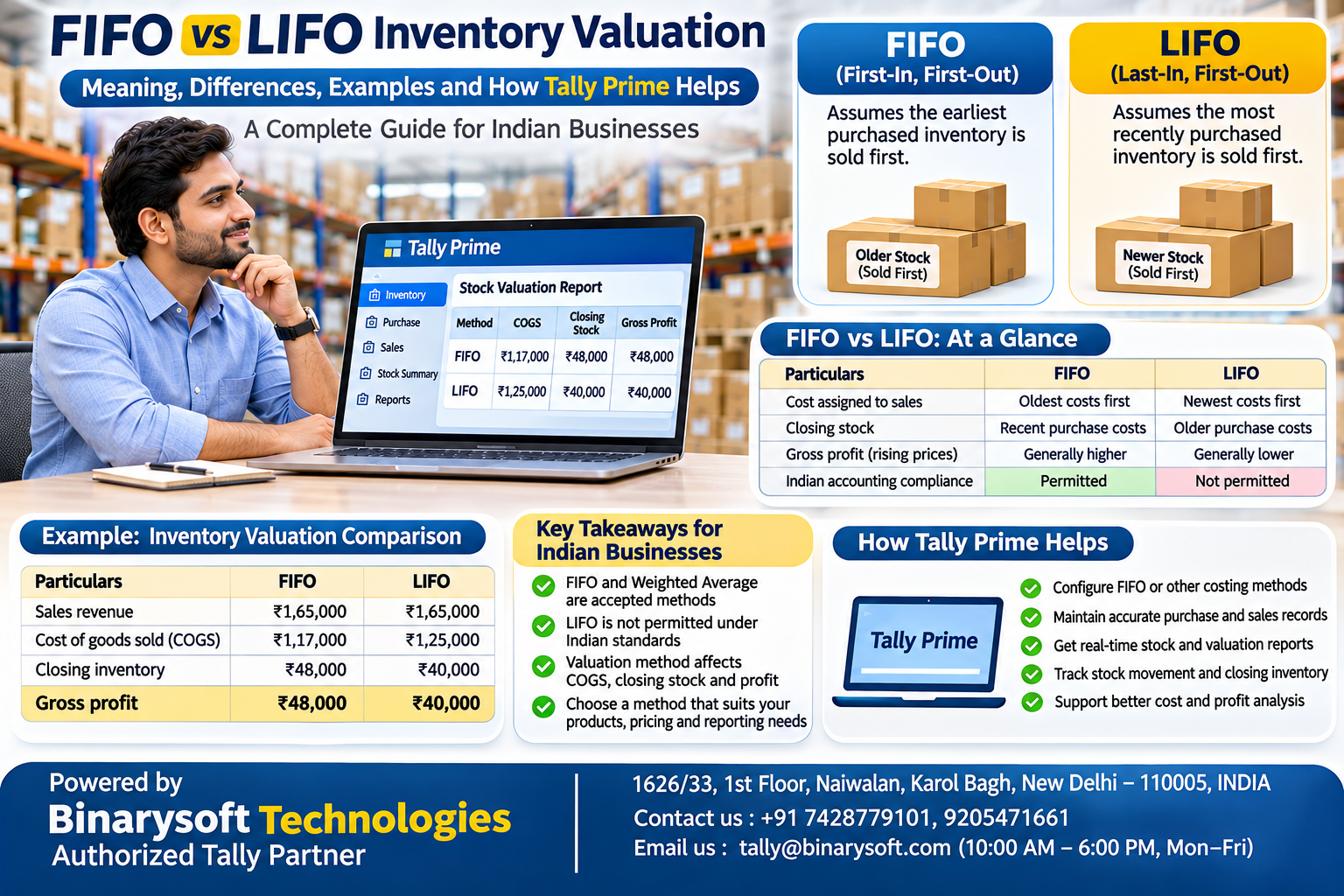
Two widely discussed methods are FIFO (First-In, First-Out) and LIFO (Last-In, First-Out).
Although both methods help explain inventory costing, they can produce significantly different financial results.
For Indian businesses, there is an important regulatory distinction: FIFO is an accepted inventory cost formula, whereas LIFO is not permitted for inventory valuation under Ind AS 2, AS 2 or ICDS-II. Weighted average cost is another accepted option for ordinarily interchangeable inventory.
Ministry of Corporate Affairs+1
This guide explains both methods, their financial impact and how Tally Prime can support accurate inventory valuation and better business decisions.
What Is Inventory Valuation?
Inventory valuation is the process of assigning a monetary value to products, raw materials, work-in-progress and finished goods held by a business.
The calculated value appears as inventory in financial statements and helps determine the cost of goods sold.
Inventory valuation is important because businesses often purchase identical products at different prices.
For example, a wholesaler may purchase a product for ₹100 in January, ₹110 in February and ₹120 in March.
When the business sells some of these products, it must determine the cost assigned to those sales.
Different inventory costing methods can produce different results.
Why Accurate Inventory Valuation Matters
Accurate inventory valuation helps businesses:
-
Calculate gross profit and cost of goods sold.
-
Report closing inventory correctly.
-
Understand changes in purchasing costs.
-
Make informed pricing decisions.
-
Identify excess or obsolete inventory.
-
Maintain reliable financial statements.
-
Support accounting and tax compliance.
Poor inventory valuation can distort profitability and lead to incorrect purchasing decisions.
What Is FIFO (First-In, First-Out)?
FIFO is an inventory costing method that assumes the earliest purchased or produced inventory is assigned to sales first.
Consequently, closing inventory generally reflects the cost of more recently purchased goods.
For example, a retailer purchases 100 units at ₹200 and subsequently purchases another 100 units at ₹220.
If the retailer sells 120 units, FIFO assigns the cost of the first 100 units at ₹200 and the next 20 units at ₹220.
The remaining 80 units are valued at ₹220 each.
FIFO is particularly relevant when businesses want a systematic method for valuing interchangeable inventory.
It also aligns naturally with physical stock rotation practices for products that should be dispatched in purchase-date order.
However, the accounting assumption does not automatically guarantee that warehouse staff physically dispatch older products first.
Advantages of FIFO
FIFO generally provides closing stock values closer to recent purchase costs when prices are increasing.
It is relatively straightforward to understand and is widely accepted under applicable accounting standards.
It also complements stock rotation practices that help reduce the risk of ageing inventory.
Disadvantages of FIFO
During inflation, FIFO may assign older, lower purchase costs to goods sold, resulting in higher reported gross profit.
This can create a difference between historical cost-based profitability and current replacement costs.
Businesses must also maintain accurate purchase and inventory records to calculate FIFO correctly.
What Is LIFO (Last-In, First-Out)?
LIFO is an inventory costing method that assumes the most recently purchased goods are assigned to sales first.
Under LIFO, closing inventory generally retains older purchase costs.
For example, a business purchases 100 units at ₹200 and another 100 units at ₹220.
If 120 units are sold, LIFO assigns 100 units at ₹220 and 20 units at ₹200 to cost of goods sold.
The remaining 80 units are valued at ₹200 each.
LIFO can help explain how recent purchasing costs affect reported margins, particularly during inflation.
However, LIFO is not an acceptable inventory cost formula for Indian financial reporting under Ind AS 2 or AS 2, nor for tax computation under ICDS-II. Its use is primarily relevant for educational comparisons and certain accounting environments outside India, such as eligible businesses applying US GAAP.
Ministry of Corporate Affairs+1
Advantages of LIFO in Permitted Accounting Environments
LIFO can match recent purchase costs against current sales revenue.
When costs are rising, this often results in higher reported cost of goods sold and lower gross profit compared with FIFO.
Disadvantages of LIFO
LIFO may leave closing inventory valued at historical costs that are significantly below recent purchase prices.
It can make comparisons between businesses more difficult and may not reflect physical stock movement.
Most importantly, Indian businesses cannot use LIFO as their statutory inventory cost formula under the standards discussed above.
FIFO vs LIFO: Key Differences
|
Comparison
|
FIFO
|
LIFO
|
|---|
|
Full form
|
First-In, First-Out
|
Last-In, First-Out
|
|
Cost assignment
|
Oldest costs first
|
Newest costs first
|
|
Closing stock
|
Recent purchase costs
|
Older purchase costs
|
|
Rising purchase prices
|
Lower COGS
|
Higher COGS
|
|
Gross profit during inflation
|
Generally higher
|
Generally lower
|
|
Falling purchase prices
|
Generally higher COGS
|
Generally lower COGS
|
|
Indian accounting compliance
|
Permitted
|
Not permitted
|
|
Typical relevance
|
Indian and international accounting
|
Certain US accounting environments
|
The actual financial impact depends on transaction timing, purchase costs, inventory quantities and applicable accounting rules.
FIFO vs LIFO Calculation With a Practical Example
Consider an electronics distributor purchasing wireless keyboards at different prices.
|
Purchase
|
Quantity
|
Rate
|
Total
|
|---|
|
January
|
100
|
₹500
|
₹50,000
|
|
February
|
100
|
₹550
|
₹55,000
|
|
March
|
100
|
₹600
|
₹60,000
|
|
Total
|
300
|
|
₹1,65,000
|
Assume the business sells 220 keyboards for ₹750 each.
Total sales revenue = 220 × ₹750 = ₹1,65,000.
Closing stock = 300 − 220 = 80 keyboards.
FIFO Calculation
Under FIFO, the first 100 keyboards sold are assigned the January cost, the next 100 the February cost and the remaining 20 the March cost.
Cost of goods sold:
(100 × ₹500) + (100 × ₹550) + (20 × ₹600)
FIFO COGS = ₹1,17,000
Closing inventory:
80 × ₹600 = ₹48,000
Gross profit:
₹1,65,000 − ₹1,17,000 = ₹48,000
LIFO Calculation
Under LIFO, the most recent purchase costs are assigned first.
Cost of goods sold:
(100 × ₹600) + (100 × ₹550) + (20 × ₹500)
LIFO COGS = ₹1,25,000
Closing inventory:
80 × ₹500 = ₹40,000
Gross profit:
₹1,65,000 − ₹1,25,000 = ₹40,000
FIFO vs LIFO Financial Results
Illustrative gross profit comparison
₹0₹15,000₹30,000₹45,000₹60,000FIFOLIFO
Same sales and purchase transactions; different cost assumptions.
|
Particulars
|
FIFO
|
LIFO
|
| Sales revenue |
₹1,65,000 |
₹1,65,000 |
| Cost of goods sold |
₹1,17,000 |
₹1,25,000 |
| Closing inventory |
₹48,000 |
₹40,000 |
|
Gross profit
|
₹48,000
|
₹40,000
|
The example demonstrates an ₹8,000 difference in gross profit despite identical business transactions.
This does not mean FIFO creates additional cash or sales. The difference arises from the accounting allocation of inventory costs.
Weighted Average Cost: An Important Alternative
Indian businesses should also understand the weighted average cost method.
This approach calculates an average unit cost from the total cost and quantity of available inventory.
Using the previous example:
Weighted average cost = ₹1,65,000 ÷ 300 = ₹550 per keyboard.
Closing inventory = 80 × ₹550 = ₹44,000.
Cost of goods sold = 220 × ₹550 = ₹1,21,000.
Gross profit = ₹44,000.
Weighted average costing can be particularly useful for interchangeable products purchased frequently at different rates.
It is also an accepted cost formula under Indian inventory accounting standards.
How Tally Prime Helps With FIFO and Inventory Valuation
Tally Prime helps businesses maintain inventory quantities, purchase costs, stock movements and closing stock values within an integrated accounting environment.
It provides costing options including FIFO, FIFO Perpetual, Average Cost, Monthly Average Cost, Standard Cost and LIFO variants. However, the availability of a method in software does not establish its suitability for statutory reporting. Indian businesses should select methods consistent with applicable accounting requirements.
Step 1: Create Stock Items
Create inventory masters for individual products with appropriate units of measurement and opening balances.
Step 2: Select the Appropriate Costing Method
Open the relevant stock item master and review its costing or valuation settings. Select FIFO or another appropriate method based on the company's accounting policy.
The exact configuration steps can vary by Tally Prime release.
Step 3: Record Purchase Transactions
Enter purchases with correct quantities, rates and dates.
Accurate transaction dates are particularly important for FIFO calculations.
Step 4: Record Sales Transactions
Record sales invoices and inventory movements consistently.
The software uses the recorded transactions and configured costing method to calculate inventory values.
Step 5: Review Stock Summary
Open Stock Summary to examine available quantities and closing stock values.
Businesses can also review relevant inventory movement and stock ageing reports.
Step 6: Verify Inventory Records
Compare system balances with physical stock and investigate differences.
Use appropriate inventory adjustment procedures when discrepancies are identified.
Step 7: Reconcile Financial Statements
Review closing stock valuation against the accounting records and applicable lower-of-cost-and-net-realisable-value requirements.
For Indian financial reporting, inventory is generally measured at the lower of cost and net realisable value.
Ministry of Corporate Affairs
Case Study 1: FIFO Inventory Valuation for a Delhi Electronics Distributor
Illustrative case study; figures and outcomes are hypothetical.
A Delhi-based electronics distributor purchased computer accessories at frequently changing prices.
The company initially relied on spreadsheets to calculate closing inventory.
As purchase volumes increased, management struggled to reconcile product costs and stock values.
The business introduced structured stock records and FIFO valuation through its accounting workflow.
Using Tally Prime, employees recorded purchase rates, sales quantities and inventory movements consistently.
Management also reviewed stock ageing information to identify products requiring attention.
In this illustrative scenario, the business reduced valuation discrepancies and completed monthly inventory reconciliation more efficiently.
The key improvement came from maintaining consistent costing policies and accurate transaction records rather than changing the physical quantity of stock.
Case Study 2: Inventory Valuation for a Furniture Manufacturer
Illustrative case study; not a verified customer account.
A furniture manufacturer in Faridabad purchased timber, hardware and finishing materials from multiple suppliers.
Material prices fluctuated throughout the year, creating difficulties in estimating product costs.
The company introduced more disciplined raw material tracking and reviewed FIFO and weighted average costing as permitted valuation alternatives.
Tally Prime was used to record purchases, material consumption and finished goods production.
Management could review stock values and better understand changes in material costs.
The company also implemented Bills of Materials to support production planning.
In this scenario, improved inventory records helped management prepare more reliable cost estimates and identify material wastage.
The lesson was clear: inventory valuation becomes more useful when combined with purchasing controls, production records and regular stock verification.
An Emotional Story: The Shopkeeper Who Discovered His Profits Were Misleading
The following is a fictional story created to illustrate the importance of inventory valuation.
For twenty-five years, Ramesh operated a wholesale business in Delhi.
He believed his business was profitable because customers continued placing orders and sales were increasing.
But every month, he faced the same problem.
There never seemed to be enough money to pay suppliers comfortably.
One evening, his daughter examined the company's stock records and noticed that inventory costs were not being calculated consistently.
Some products were recorded at old purchase prices, while others used recent rates without a defined accounting policy.
The reported profits were therefore unreliable.
Together, they organised the purchase records, reviewed stock quantities and introduced a consistent inventory valuation process.
They began using structured inventory reports to understand product costs and closing stock.
Gradually, Ramesh gained a clearer picture of his business performance.
He realised that strong sales alone did not guarantee healthy profits.
The most meaningful change was the confidence he gained from understanding his numbers.
For business owners like Ramesh, accurate inventory valuation represents more than an accounting requirement. It supports better decisions, financial stability and peace of mind.
Common Inventory Valuation Mistakes to Avoid
Businesses should avoid changing valuation methods simply to achieve a preferred profit figure.
They should also ensure that purchase costs are recorded correctly, including directly attributable costs where applicable.
Other common problems include incorrect opening balances, unrecorded stock losses, inconsistent units of measurement and failure to recognise obsolete inventory.
A company should not confuse FIFO accounting with physical stock rotation. Both require appropriate procedures.
Finally, businesses should periodically review inventory for damage, deterioration and declining selling prices.
Even when FIFO produces a calculated inventory cost, a write-down may be necessary if net realisable value is lower.
Which Inventory Valuation Method Should Indian Businesses Choose?
For interchangeable inventory, FIFO and weighted average cost are generally the principal accepted alternatives under Indian accounting standards.
FIFO may be suitable when businesses want closing inventory costs to reflect more recent purchases.
Weighted average cost may be practical for products purchased frequently at fluctuating prices.
Specific identification is relevant for qualifying non-interchangeable inventory and items associated with particular projects.
Businesses should select their method based on product characteristics, reporting requirements and accounting policies, ideally in consultation with their accountant.
Conclusion
FIFO and LIFO are important inventory valuation concepts that demonstrate how cost allocation affects closing stock, cost of goods sold and reported profitability.
FIFO assigns earlier purchase costs to sales first, while LIFO assigns more recent costs first.
During periods of rising purchase prices, FIFO generally produces lower cost of goods sold and higher reported gross profit than LIFO.
For Indian businesses, FIFO and weighted average costing are accepted methods for interchangeable inventory, while LIFO is not permitted under the relevant Indian accounting and tax standards.
Tally Prime supports inventory valuation through configurable costing methods, purchase and sales records, stock reports and integrated accounting information.
By maintaining accurate transactions and applying appropriate valuation policies consistently, businesses can improve financial reporting, purchasing decisions and long-term inventory control.
Accurate inventory valuation does not create profitability by itself, but it helps businesses understand profitability more reliably.
Powered by Binarysoft Technologies
Authorized Tally Partner
Location: 1626/33, 1st Floor, Naiwalan, Karol Bagh, New Delhi – 110005, INDIA
Contact us: +91 7428779101, 9205471661
Email us: tally@binarysoft.com
Business Hours: 10:00 AM – 6:00 PM, Monday–Friday
Frequently Asked Questions
Is FIFO suitable for perishable goods?
FIFO is commonly useful for such goods, but physical stock rotation should consider expiry dates. First-Expiry, First-Out may be more appropriate operationally.
Can inventory valuation methods affect taxable profits?
Yes. Inventory cost allocation can influence reported profit and taxable income, subject to applicable tax rules and accounting requirements.
How does FIFO affect profitability during inflation?
FIFO generally produces lower cost of goods sold and higher gross profit when purchase prices are rising, assuming other factors remain unchanged.
Which inventory valuation method is allowed in India?
FIFO and weighted average cost are permitted for ordinarily interchangeable inventory under applicable Indian accounting standards. Specific identification applies to qualifying items.
CA. Arinav Chakraborty advises businesses on taxation, accounting systems, and financial planning. His professional interests include digital transformation, compliance management, and improving business efficiency through technology.