Call CA Tally HelpDesk
+91 9205471661,
7428779101
Introduction: Why Understanding Different Types of Inventory Is Important
Every business depends on inventory in some form.
A retail shop stores products for customers. A manufacturer purchases raw materials and converts them into finished goods. A wholesaler maintains large quantities of merchandise for distribution.
Although these businesses operate differently, they share one important challenge: maintaining the right stock at the right time.
Imagine a retailer investing ₹15 lakh in merchandise without understanding which products sell quickly, which items remain unsold and which goods require immediate replenishment.
Some products may disappear from shelves within days, while others remain in storage for months.
The business may experience cash flow problems despite having substantial inventory.
This happens because inventory is not simply a collection of products. Different types of inventory serve different purposes and require different management strategies.
Understanding types of inventory or stock helps businesses improve purchasing decisions, control warehouse expenses, minimise wastage and maintain product availability.
Modern accounting and inventory software such as Tally Prime helps businesses organise stock into meaningful categories and monitor purchases, sales, stock transfers and inventory values.
This guide explores the major types of inventory, their importance, practical examples and how Indian businesses can manage them effectively.
What Is Inventory?
Inventory refers to goods and materials held by a business for sale, production or consumption during normal operations.
For a retailer, inventory primarily consists of merchandise purchased for resale.
For a manufacturer, inventory may include raw materials, work-in-progress and finished goods.
For a service-oriented business, certain materials and consumables may also require inventory tracking.
Inventory represents an important business investment because money remains tied up in products until they are sold or consumed.
Effective inventory management ensures that businesses maintain sufficient stock without unnecessarily increasing storage costs or blocking working capital.
Why Businesses Should Classify Inventory
Inventory classification helps businesses understand the purpose, movement and financial importance of different products.
Without proper classification, purchasing teams may treat every product in the same way.
However, frequently sold products require different controls from seasonal merchandise or slow-moving spare parts.
Proper inventory classification provides several advantages:
-
Better visibility into stock availability and product movement.
-
More accurate purchasing and replenishment decisions.
-
Reduced storage costs and unnecessary inventory investment.
-
Improved production planning and customer order fulfilment.
-
Better identification of obsolete, damaged and slow-moving products.
-
More reliable stock valuation and financial reporting.
Businesses should also understand that inventory can be classified in different ways.
Some classifications describe the production stage, while others describe the purpose, demand pattern or movement of stock.
For example, the same finished product may simultaneously be classified as finished goods, seasonal inventory and safety stock.
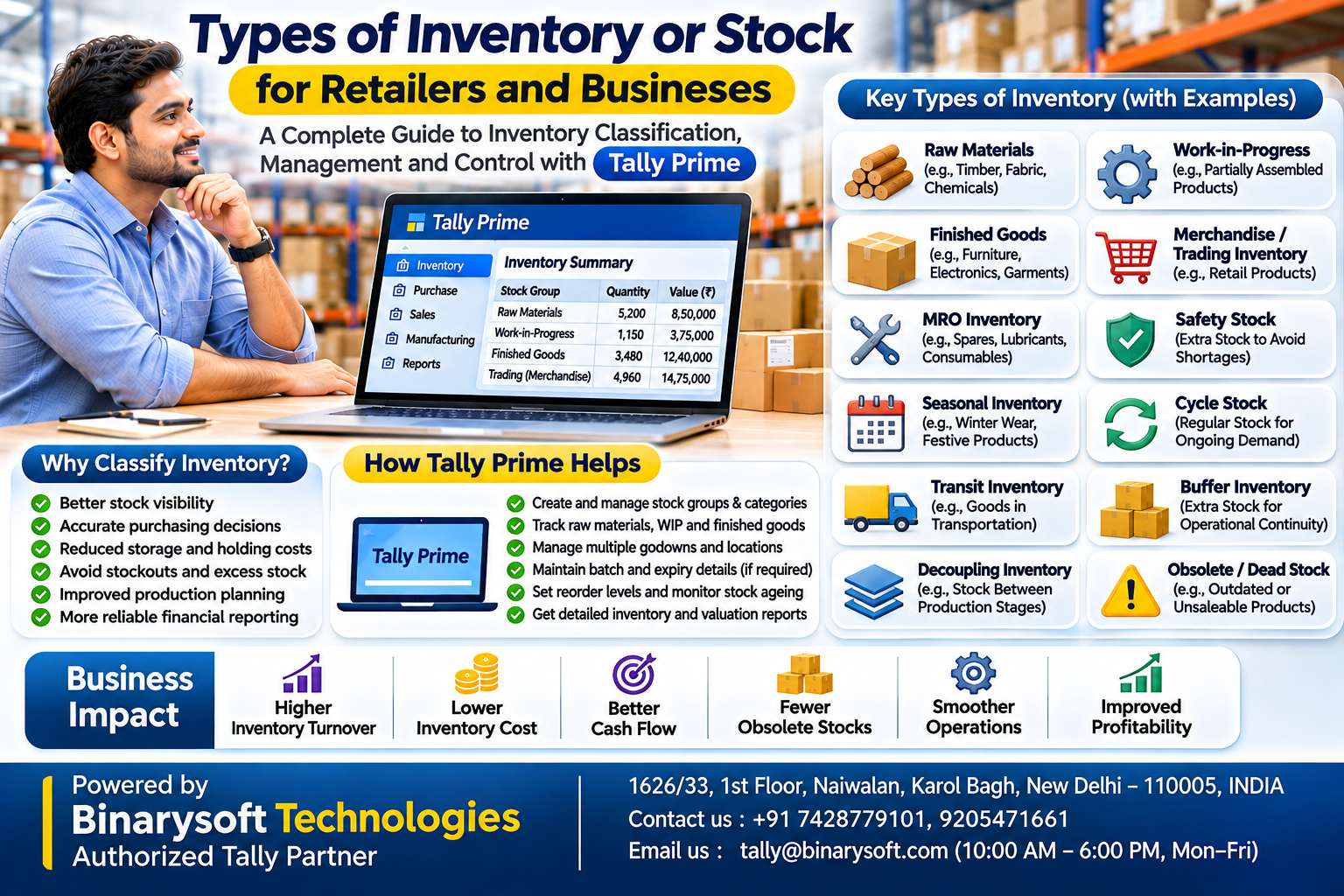
12 Important Types of Inventory for Retailers and Businesses
1. Raw Materials Inventory
Raw materials are basic materials purchased for manufacturing or producing finished goods.
These materials undergo processing, assembly or transformation before becoming saleable products.
For example, a furniture manufacturer may purchase timber, plywood, adhesives, screws and finishing materials.
A garment manufacturer may maintain fabric, thread, buttons and zippers.
Raw materials inventory is important because shortages can interrupt production.
However, purchasing excessive quantities increases storage costs and working capital requirements.
How Tally Prime helps: Businesses can create raw material stock items, organise them into stock groups and record purchases and consumption. Bills of Materials and manufacturing transactions support structured production records.
2. Work-in-Progress (WIP) Inventory
Work-in-progress inventory consists of products that have entered the manufacturing process but are not yet complete.
For example, a furniture manufacturer may have partially assembled office desks awaiting painting and finishing.
Similarly, a garment manufacturer may have stitched clothing awaiting final inspection and packaging.
WIP inventory represents materials, labour and production costs accumulated during manufacturing.
Excessive WIP can indicate production bottlenecks, inefficient scheduling or delays between manufacturing stages.
Businesses should monitor production progress and minimise unnecessary waiting periods.
Tally Prime supports manufacturing and inventory transactions that can help businesses record material consumption and production output. Detailed stage-wise WIP costing may require suitable accounting procedures or additional configuration.
3. Finished Goods Inventory
Finished goods are completed products ready for sale or distribution.
Examples include packaged food products, assembled furniture, garments, electronics and manufactured household products.
For manufacturers, finished goods represent the final output of production.
For retailers and wholesalers, purchased merchandise held for resale serves a similar commercial purpose, although it is normally classified as merchandise inventory.
Finished goods management requires accurate demand forecasting, warehouse organisation and sales coordination.
Excess finished goods may increase storage expenses, while insufficient stock can result in lost sales.
Tally Prime helps businesses maintain finished product records, monitor stock quantities and review sales and inventory reports.
4. Maintenance, Repair and Operations (MRO) Inventory
MRO inventory includes supplies and materials used to maintain business operations rather than becoming part of finished products.
Examples include machine lubricants, cleaning supplies, maintenance tools, replacement components and protective equipment.
These materials may not generate direct sales revenue, but they are essential for smooth operations.
A manufacturing unit may experience production downtime if an inexpensive machine component is unavailable.
Therefore, businesses should maintain suitable stock levels for critical maintenance items.
Tally Prime can help track MRO materials as inventory items where appropriate, allowing businesses to record purchases, consumption and available quantities.
The accounting treatment of these items depends on their nature and applicable policies.
5. Merchandise or Trading Inventory
Merchandise inventory consists of products purchased primarily for resale without substantial manufacturing or transformation.
This is one of the most important inventory categories for retailers, wholesalers and distributors.
For example, a mobile phone retailer purchases smartphones and accessories from suppliers and sells them to customers.
A grocery store purchases packaged food, beverages and household products for resale.
Trading inventory requires careful monitoring of purchase prices, selling prices, demand patterns and product availability.
Tally Prime helps businesses manage merchandise through stock items, purchase invoices, sales invoices, inventory valuation and stock reports.
6. Safety Stock Inventory
Safety stock is additional inventory maintained to protect against unexpected demand or supplier delays.
For example, a medical equipment distributor may maintain additional quantities of frequently required products to reduce the risk of shortages.
Safety stock is particularly important when demand is unpredictable or supplier lead times vary.
However, maintaining excessive safety stock can increase carrying costs.
Businesses should determine suitable quantities using demand variability, supplier reliability and service requirements.
Tally Prime provides historical stock movement information and reorder planning capabilities that can support safety stock decisions.
7. Seasonal Inventory
Seasonal inventory consists of products purchased or manufactured in anticipation of demand during particular periods.
Examples include winter clothing, festive decorations, school supplies and summer cooling appliances.
A retailer may purchase additional woollen garments before winter or festive merchandise ahead of Diwali.
Seasonal inventory requires careful forecasting because demand may decline sharply after the relevant season.
Unsold products may require discounts or extended storage.
Businesses can use historical sales reports in Tally Prime to examine previous demand patterns and plan future purchases.
8. Cycle Stock Inventory
Cycle stock represents inventory maintained to satisfy normal demand between replenishment orders.
For example, a retailer may purchase 500 units of a frequently sold product every month.
As customers purchase the product, available cycle stock gradually decreases until replenishment occurs.
Cycle stock levels depend on order quantities, demand and purchasing frequency.
Businesses can use Economic Order Quantity principles to balance ordering costs and holding costs.
Tally Prime provides purchasing and inventory movement records that can support these calculations.
9. Transit or Pipeline Inventory
Transit inventory consists of goods that are moving between suppliers, warehouses, production facilities or customers.
For example, a distributor may purchase products from Mumbai that require several days to reach Delhi.
During transportation, these products may represent inventory in transit, depending on ownership and contractual terms.
Businesses should distinguish goods physically received from goods still in transportation.
Tally Prime can support purchase and receipt-related records, but detailed in-transit tracking depends on the workflow and configuration used.
10. Buffer Inventory
Buffer inventory is additional stock maintained to protect operations against disruptions.
It is closely related to safety stock and the terms are sometimes used interchangeably.
Buffer inventory may be particularly useful when production schedules are uncertain or transportation delays are common.
For example, a manufacturing company may maintain extra packaging materials to avoid interrupting dispatches.
The objective is to balance operational reliability with inventory carrying costs.
11. Decoupling Inventory
Decoupling inventory is stock maintained between different production stages to prevent delays in one process from immediately affecting another.
Consider a factory where cutting, assembly and packaging operate at different speeds.
If the cutting process stops temporarily, a buffer of prepared components may allow assembly to continue.
This helps reduce production interruptions.
However, excessive decoupling inventory can increase work-in-progress and conceal operational inefficiencies.
Businesses should monitor production bottlenecks and establish suitable buffer quantities.
12. Obsolete, Damaged and Dead Stock
Obsolete inventory includes products that have become outdated or are no longer suitable for normal sale or use.
Damaged inventory refers to goods whose condition has deteriorated.
Dead stock generally describes products that have little or no realistic prospect of sale or consumption.
Examples include outdated electronic accessories, discontinued spare parts and damaged packaged goods.
These products can block working capital and occupy warehouse space.
Businesses should review stock ageing reports and assess whether inventory requires discounting, return, disposal or accounting write-down.
Tally Prime supports stock ageing and inventory movement analysis, helping management identify products requiring investigation.
Types of Inventory: Quick Comparison
|
Inventory type
|
Main purpose
|
Business example
|
|---|
|
Raw materials
|
Manufacturing input
|
Timber, fabric
|
|
Work-in-progress
|
Partially completed production
|
Unfinished furniture
|
|
Finished goods
|
Ready for sale
|
Packaged products
|
|
MRO supplies
|
Operational maintenance
|
Lubricants, spare parts
|
|
Merchandise
|
Resale
|
Retail electronics
|
|
Safety stock
|
Protection against shortages
|
Extra essential products
|
|
Seasonal stock
|
Seasonal demand
|
Winter clothing
|
|
Cycle stock
|
Normal sales demand
|
Regular monthly stock
|
|
Transit inventory
|
Goods being transported
|
Supplier shipments
|
|
Buffer stock
|
Operational continuity
|
Extra packaging
|
|
Decoupling inventory
|
Production-stage protection
|
Semi-finished components
|
|
Obsolete stock
|
Unsaleable or outdated goods
|
Discontinued products
|
These categories are not mutually exclusive, and a business may use several classifications for the same inventory item.
How to Calculate Inventory Requirements
Businesses should estimate inventory requirements using sales demand, purchasing lead times and operational risk.
A common reorder point formula is:
\[ \text{Reorder Point}=(\text{Daily Demand}\times\text{Lead Time})+\text{Safety Stock} \]
Suppose a distributor sells 25 units daily, requires six days for replenishment and maintains 50 units of safety stock.
Reorder point = (25 × 6) + 50 = 200 units.
When inventory position reaches 200 units, the business should review replenishment requirements.
Businesses should also monitor inventory turnover:
\[ \text{Inventory Turnover}=\frac{\text{Cost of Goods Sold}}{\text{Average Inventory}} \]
Higher turnover can indicate efficient stock movement, although the appropriate turnover rate varies by industry and product category.
These calculations help businesses make more disciplined purchasing decisions.
How Tally Prime Helps Manage Different Types of Inventory
Tally Prime combines inventory records with financial accounting, helping businesses monitor stock quantities, purchasing costs, sales transactions and warehouse movements.
Stock Groups and Categories
Businesses can create stock groups for raw materials, finished products, merchandise and other inventory classes.
Stock categories provide additional classification across groups.
Multiple Godown Management
Companies can maintain separate stock records for warehouses, branches and storage locations.
Godown Summary reports help management review location-wise inventory.
Manufacturing and Bills of Materials
Manufacturers can define Bills of Materials and record manufacturing transactions.
These capabilities support raw material consumption and finished goods production records.
Batch-Wise Inventory Tracking
Businesses dealing with products requiring batch or expiry monitoring can maintain relevant batch details.
This is particularly useful for food, pharmaceutical and cosmetic distribution businesses.
Reorder Planning
Tally Prime supports reorder levels and minimum order quantities, helping businesses identify replenishment requirements.
Stock Ageing and Movement Reports
Stock Ageing Analysis helps identify older inventory, while Movement Analysis provides information about stock transactions.
Inventory Valuation
Businesses can review inventory values using configured costing methods and appropriate accounting policies.
These features help connect operational inventory information with business financial records.
Case Study 1: Better Stock Classification for a Delhi Retail Business
Illustrative case study using hypothetical business figures.
A Delhi-based electronics retailer maintained smartphones, accessories, networking products and replacement components.
The business frequently experienced shortages of popular accessories while slower-selling products remained unsold.
Management introduced structured inventory classification.
Products were divided into merchandise, safety stock, seasonal stock and slow-moving inventory categories.
Using Tally Prime, the business organised stock items, maintained purchasing records and reviewed inventory movement reports.
In this illustrative scenario, excess inventory investment decreased by 18% over six months.
The company also improved replenishment planning for frequently sold products.
The key lesson was that understanding different inventory categories helped management allocate purchasing budgets more effectively.
Case Study 2: Inventory Control for a Furniture Manufacturer
Illustrative case study; results are hypothetical.
A furniture manufacturer in Faridabad maintained timber, plywood, hardware, partially assembled furniture and completed products.
Previously, the company recorded many materials without clearly distinguishing their production purpose.
This created difficulties in planning raw material purchases and estimating manufacturing requirements.
Management introduced separate classifications for raw materials, work-in-progress, finished goods and maintenance supplies.
Tally Prime was used to maintain stock records, Bills of Materials and manufacturing transactions.
The company also introduced periodic physical stock verification.
In this illustrative scenario, production delays caused by missing materials decreased, and purchasing became more predictable.
The experience demonstrates how inventory classification can support better manufacturing coordination.
An Emotional Story: When a Small Shopkeeper Learned That More Stock Does Not Mean More Success
The following is a fictional story illustrating the human impact of inventory management.
For nearly twenty years, Mohan operated a small retail business in Delhi.
He believed that maintaining large quantities of products was the best way to keep customers satisfied.
Whenever suppliers offered attractive discounts, he purchased additional merchandise.
Over time, his shop became crowded with products.
Some sold quickly, while others remained untouched for months.
Despite regular customer visits, Mohan struggled to pay suppliers and manage household expenses.
One evening, his daughter noticed him sitting quietly behind the counter.
She asked why he looked worried.
Mohan replied, "I have so much stock, but I don't have enough money to run the business."
Together, they began examining the products stored in the shop.
They discovered that frequently sold merchandise, seasonal goods and obsolete products were all being managed in the same way.
They reorganised inventory into meaningful categories and reviewed actual sales patterns.
Instead of purchasing large quantities of every product, they concentrated on items customers regularly needed.
They also identified older products suitable for promotions.
Gradually, unnecessary purchases decreased and stock availability became easier to manage.
Mohan realised that business success did not depend on filling every shelf.
It depended on understanding what customers wanted and managing available resources wisely.
His story highlights an important lesson: inventory should create business opportunities, not financial pressure.
Best Practices for Managing Different Inventory Types
Businesses should establish clear stock classifications and maintain accurate product records.
Purchasing decisions should consider demand, supplier lead times and available inventory.
Manufacturers should monitor raw materials, work-in-progress and finished goods separately.
Retailers should review merchandise movement, seasonal demand and slow-moving products regularly.
Warehouse teams should follow appropriate stock rotation procedures and conduct periodic physical verification.
Management should also review inventory investment alongside cash flow and profitability.
Software can provide useful information, but effective inventory control depends on disciplined processes and accurate transaction entry.
Common Inventory Management Mistakes
One common mistake is treating every inventory item as equally important.
High-value products may require stricter controls than inexpensive consumables.
Another mistake is maintaining excessive safety stock without reviewing actual demand.
Businesses should also avoid ignoring obsolete inventory, recording inconsistent units of measurement and failing to monitor goods transferred between locations.
For manufacturers, inadequate work-in-progress tracking can conceal production delays and cost overruns.
Regular inventory reviews help identify these problems before they become expensive.
Conclusion
Understanding different types of inventory is essential for effective purchasing, stock control, production planning and financial management.
Raw materials, work-in-progress, finished goods, merchandise, safety stock, seasonal inventory and maintenance supplies all serve different business purposes.
By classifying inventory correctly, businesses can reduce unnecessary purchases, improve product availability and protect working capital.
Tally Prime supports inventory management through stock groups, categories, godowns, batch tracking, manufacturing records, reorder planning and analytical reports.
For Indian retailers, wholesalers, distributors and manufacturers, combining accurate inventory records with practical stock management strategies can create a stronger foundation for sustainable growth.
The objective is not simply to maintain more inventory. It is to maintain the right type of inventory, in the right quantity, at the right time and at the right cost.
Powered by Binarysoft Technologies
Authorized Tally Partner
Location: 1626/33, 1st Floor, Naiwalan, Karol Bagh, New Delhi – 110005, INDIA
Contact us: +91 7428779101, 9205471661
Email us: tally@binarysoft.com
Business Hours: 10:00 AM – 6:00 PM, Monday–Friday
Frequently Asked Questions
What is the difference between cycle stock and safety stock?
Cycle stock meets normal demand between replenishment orders, while safety stock protects against unexpected shortages.
How does Tally Prime help with inventory management?
Tally Prime supports stock classification, purchase and sales transactions, multiple godowns, batch tracking, manufacturing records, inventory valuation and stock reports.
What is the difference between cycle stock and safety stock?
Cycle stock meets normal demand between replenishment orders, while safety stock protects against unexpected shortages.
How can businesses reduce obsolete inventory?
Businesses can reduce obsolete inventory through demand forecasting, stock ageing reviews, purchasing controls and suitable promotions or supplier return arrangements.
CA. Arnav Kankaria focuses on accounting automation, GST reconciliations, and financial record management. He helps businesses streamline routine accounting activities while maintaining reliable records for reporting and review.