Call CA Tally HelpDesk
+91 9205471661,
7428779101
Introduction: Customer Feedback Is Valuable Only When Businesses Take Action
Every business wants satisfied customers, repeat purchases and sustainable growth.
However, understanding customer expectations is becoming increasingly challenging.
Customers interact with businesses through websites, stores, sales representatives, customer support teams, social media and digital communication channels.
Each interaction creates opportunities to understand customer experiences.
Some customers provide positive reviews. Others complain about delivery delays, product quality, billing errors or slow responses.
Unfortunately, many organizations collect customer feedback without using it effectively.
Surveys are completed, complaints are recorded and reports are prepared, but meaningful improvements never happen.
This creates a gap between customer insights and business performance.
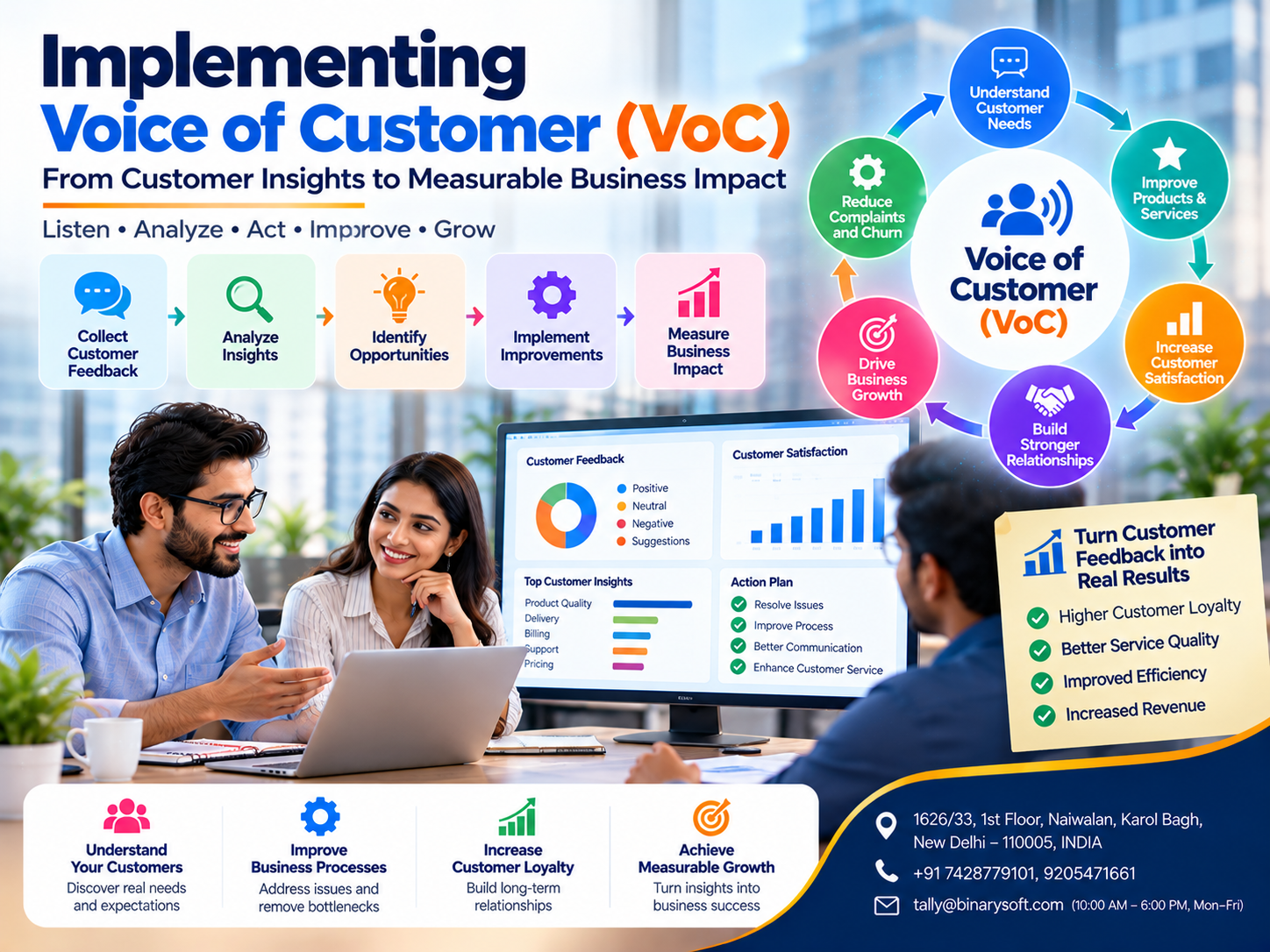
Implementing Voice of Customer (VoC) means transforming customer opinions, expectations and experiences into measurable improvements in products, services and operations.
A successful VoC program does not end when feedback is collected.
It involves analyzing customer concerns, identifying priorities, assigning responsibilities, implementing improvements and measuring results.
For businesses using Tally Prime, customer insights can also complement sales, inventory, receivables and financial reporting information.
This guide explains how organizations can move from collecting customer feedback to creating measurable business impact.
A Business Story: The Complaint That Saved a Family Business
Vikram operated a wholesale electrical products business in Delhi.
His father had established the company more than twenty years earlier.
What began as a small shop had grown into a distribution business serving contractors, retailers and commercial customers.
Vikram was proud of the company's reputation.
He believed that competitive pricing and good-quality products were the reasons customers continued purchasing from them.
However, during one financial year, several long-standing customers gradually reduced their orders.
The sales team blamed market competition.
Management responded by offering additional discounts.
Yet customer purchases continued declining.
One afternoon, Vikram called a customer who had worked with his father for almost fifteen years.
The customer explained that pricing was not the problem.
His company had experienced repeated delivery delays, inconsistent order updates and difficulties obtaining corrected invoices.
He told Vikram that he still trusted the products but had lost confidence in the service.
The conversation was painful.
Vikram realized that customers were leaving because the company had stopped understanding their daily problems.
Instead of introducing more discounts, he decided to listen.
He contacted existing customers, collected structured feedback and reviewed recurring complaints.
The findings revealed three major concerns: delivery communication, billing accuracy and slow complaint resolution.
Vikram assigned responsibility for each issue.
His accounting team improved invoice verification, warehouse employees introduced clearer dispatch updates and sales representatives began following up after deliveries.
Over the following months, customer communication improved.
Several customers appreciated the changes and gradually increased their engagement.
For Vikram, the greatest achievement was not simply protecting sales.
It was preserving the trust his father had spent decades building.
The lesson: customers often tell businesses exactly what needs improvement, but meaningful results appear only when someone listens and takes action.
This is an illustrative story created to demonstrate the importance of implementing customer feedback.
What Is Voice of Customer Implementation?
Voice of Customer implementation is the structured process of collecting, analyzing and acting on customer feedback to improve customer experiences and business outcomes.
It connects customer expectations with operational decisions.
A complete VoC implementation typically includes five stages:
-
Collect customer feedback from relevant channels.
-
Analyze feedback to identify recurring concerns.
-
Prioritize improvements according to customer and business impact.
-
Implement corrective actions.
-
Measure results and continuously improve.
This process is sometimes described as closing the customer feedback loop.
The objective is not merely to understand what customers think.
It is to use those insights to improve how the business operates.
Why Businesses Need a Structured VoC Strategy
Businesses receive customer feedback in many forms.
A sales representative may hear complaints during a meeting.
An accountant may receive questions about invoice discrepancies.
A customer support employee may handle repeated delivery enquiries.
Without a structured system, this information remains scattered across departments.
Important patterns may go unnoticed.
A VoC strategy helps organizations organize feedback, identify common problems and coordinate improvements.
It also establishes accountability.
When customers report an issue, employees should know who is responsible for investigating it and how progress will be measured.
A structured approach makes customer feedback more useful for business decisions.
7 Essential Steps for Implementing Voice of Customer Successfully
Step 1: Define Clear Business Objectives
Before collecting feedback, businesses should determine what they want to achieve.
Possible objectives include:
-
Improving customer satisfaction
-
Reducing delivery complaints
-
Increasing repeat purchases
-
Improving billing accuracy
-
Reducing customer support response times
-
Strengthening customer retention
Objectives should be specific and measurable.
For example, instead of stating that the company wants better service, management could aim to reduce recurring invoice complaints over the next quarter.
Clear objectives help teams focus on meaningful improvements.
Step 2: Identify Important Customer Touchpoints
Customer touchpoints are interactions between customers and the business.
They may include product enquiries, quotations, order placement, invoicing, delivery, payment collection and after-sales support.
Each touchpoint influences customer experience.
A customer may be satisfied with product quality but frustrated by delayed delivery updates.
Another customer may appreciate fast service but struggle with unclear invoices.
Mapping the customer journey helps businesses identify where feedback should be collected.
Step 3: Collect Feedback Through Multiple Channels
Different customers prefer different communication methods.
Businesses can collect feedback through surveys, interviews, online reviews, support conversations, feedback forms and direct customer meetings.
For example, a retailer may send a short survey after delivery.
A wholesale distributor may conduct periodic discussions with important customers.
A software company may collect feedback after support interactions.
Using multiple channels provides a broader understanding of customer experiences.
However, businesses should avoid collecting unnecessary personal information.
Step 4: Organize and Analyze Customer Feedback
Customer feedback becomes more valuable when it is categorized.
Common categories include:
-
Product quality
-
Pricing
-
Delivery
-
Billing
-
Customer support
-
Product availability
-
Communication
-
After-sales service
Businesses should identify recurring issues and investigate their underlying causes.
For example, repeated complaints about delayed invoices may indicate an internal approval problem rather than an issue with accounting software.
Analysis should distinguish between customer perceptions, observed facts and assumptions.
Step 5: Prioritize Improvements
Not every customer request can be implemented immediately.
Businesses should prioritize issues according to frequency, severity, customer impact, financial implications and implementation effort.
An issue affecting many customers may deserve immediate attention.
However, a serious problem affecting one customer may also require urgent action.
Management should evaluate both the scale and importance of each concern.
Step 6: Implement Corrective Actions
Feedback creates business value when it leads to practical improvements.
Corrective actions may include employee training, revised billing procedures, better delivery communication or product quality improvements.
Each action should have an assigned owner and a realistic completion date.
Employees should understand what needs to change and why.
Step 7: Measure Results and Close the Feedback Loop
After implementing improvements, businesses should evaluate whether customer experiences have changed.
They may compare satisfaction scores, complaint volumes, resolution times and repeat purchase patterns.
Where appropriate, customers should also be informed about improvements made in response to their feedback.
This demonstrates that their opinions are taken seriously.
How to Turn Customer Insights into Measurable Business Impact
Collecting feedback is only the beginning.
The real challenge is connecting customer insights with business results.
Consider a company receiving repeated complaints about billing errors.
Its VoC program identifies the problem.
Management investigates the invoicing process and introduces additional verification procedures.
The company then measures whether invoice corrections and related complaints decrease.
This creates a clear relationship between feedback, action and results.
Businesses should establish a baseline before implementing improvements.
Without an initial measurement, it becomes difficult to determine whether changes were effective.
Important VoC Performance Metrics
| Metric | What It Measures | Business Value |
|---|
| Customer Satisfaction Score (CSAT) |
Customer satisfaction with interactions |
Identifies service quality |
| Net Promoter Score (NPS) |
Willingness to recommend the business |
Tracks recommendation sentiment |
| Customer Effort Score (CES) |
Ease of completing an interaction |
Identifies customer difficulties |
| Customer Retention Rate |
Customers retained over time |
Evaluates relationship continuity |
| Complaint Resolution Time |
Time required to resolve issues |
Measures support responsiveness |
| Repeat Purchase Rate |
Customers making additional purchases |
Indicates purchasing behavior |
| Billing Error Rate |
Frequency of billing mistakes |
Measures process accuracy |
These metrics should be reviewed together.
For example, improved customer satisfaction does not automatically guarantee increased revenue.
Market conditions, pricing and product availability may also influence financial performance.
Understanding the Customer Feedback Loop
A customer feedback loop is a continuous process of listening, acting and reviewing outcomes.
It involves four important activities.
Listen: Collect feedback from customers.
Understand: Identify concerns, expectations and underlying causes.
Act: Implement improvements based on the findings.
Review: Measure results and communicate relevant changes.
A feedback loop should continue throughout the customer relationship.
Customer expectations change over time, and businesses must adapt accordingly.
How Tally Prime Supports Customer-Focused Business Decisions
Tally Prime is primarily an accounting, inventory and business management application.
It is not a dedicated VoC survey or customer experience management platform.
However, its financial and operational capabilities can complement customer feedback initiatives.
1. Improve Invoice Accuracy
Billing errors can create customer dissatisfaction.
Tally Prime supports sales invoicing and accounting records.
Businesses can establish appropriate invoice verification procedures to reduce avoidable mistakes.
2. Monitor Customer Outstanding Balances
Payment disagreements may affect customer relationships.
Tally Prime provides customer ledger and outstanding receivables information.
Accurate records can support clearer communication about amounts due.
3. Analyze Sales Patterns
Sales reports help businesses understand product performance and customer purchasing activity.
Management can compare these patterns with customer feedback.
For example, declining sales of a product may encourage further investigation into customer preferences.
However, sales trends alone do not explain why customers change their purchasing behavior.
4. Improve Inventory Visibility
Customers may become dissatisfied when frequently requested products are unavailable.
Tally Prime supports inventory accounting and stock reports.
Businesses can use this information to review stock availability and purchasing requirements.
5. Support Order Management
Depending on configuration, Tally Prime supports sales and purchase order-related workflows.
Organized transaction records can help teams coordinate order processing.
6. Review Customer Transaction History
Customer ledgers and sales information can help authorized employees understand historical business transactions.
These records may provide context when resolving customer queries.
7. Support Financial Planning
Customer experience improvements often require investment.
Businesses may need additional support employees, better logistics arrangements or improved internal systems.
Tally Prime financial reports can help management evaluate expenses, profitability and available resources.
8. Support Multi-Location Coordination
Businesses using appropriate multi-user or cloud-access arrangements may allow authorized teams to access accounting information from different locations.
This can improve coordination between sales, finance and management.
9. Complement Dedicated Feedback Tools
Businesses can use a separate customer feedback platform to collect surveys and complaints.
Tally Prime can provide relevant financial and transaction information for subsequent analysis.
Any data exchange should follow supported methods and appropriate privacy safeguards.
The key principle is to combine customer feedback with reliable business information rather than expecting accounting software to perform every customer experience function.
Practical Example: Improving Customer Experience Through Billing Accuracy
Imagine a wholesale distributor receiving frequent complaints about incorrect invoice quantities.
Customers report that invoice corrections delay payment processing.
The company collects feedback and categorizes complaints by invoice type.
Its accounting team reviews relevant transactions in Tally Prime.
Management discovers that manual quantity verification is inconsistent.
The company introduces an additional review step before invoices are finalized.
Employees receive training on the revised procedure.
Over time, management monitors the number of corrections and related customer complaints.
This example demonstrates how customer feedback can guide operational improvements.
VoC identifies the problem, while accounting information helps investigate and monitor the process.
Case Study 1: Retail Distributor Turns Customer Complaints into Service Improvements
Business: Illustrative electrical products distributor
Location: New Delhi
Challenge: Customer dissatisfaction caused by delayed communication and billing errors
A growing distributor operated from multiple locations.
Management noticed that several customers were reducing their purchase frequency.
Customer interviews revealed dissatisfaction with delivery communication and invoice corrections.
Solution
The company introduced a structured VoC program.
It collected feedback after major orders and categorized recurring complaints.
The sales team improved delivery communication.
The accounting department reviewed invoicing procedures and used Tally Prime to examine relevant transaction records.
Management assigned responsibility for resolving each major issue.
Illustrative Results
The business experienced:
-
More organized complaint handling
-
Better communication between departments
-
Improved invoice verification procedures
-
Greater visibility into customer concerns
-
Clearer accountability for service improvements
Key Lesson
Customer feedback becomes valuable when businesses use it to identify operational problems and implement measurable changes.
This case study is hypothetical and does not represent verified customer results.
Case Study 2: Manufacturing Company Improves Customer Retention Through VoC
Business: Illustrative furniture manufacturer
Location: Gurugram, Haryana
Challenge: Repeated complaints about product specifications and delivery commitments
A furniture manufacturer supplied products to offices and commercial customers.
Although product demand remained stable, management noticed increasing complaints about delivery schedules.
Some customers also reported differences between expected and delivered specifications.
Solution
The company introduced post-delivery surveys and periodic customer interviews.
Feedback was categorized into product quality, delivery, documentation and communication.
The production team reviewed specification-related complaints.
The accounting team used Tally Prime to examine relevant sales and inventory information.
Management introduced clearer communication procedures and monitored complaint trends.
Illustrative Results
The company achieved:
-
Better understanding of customer expectations
-
Improved coordination between production and sales
-
More structured complaint resolution
-
Better visibility into recurring operational issues
-
Stronger processes for reviewing customer feedback
Key Lesson
An effective VoC strategy connects customer expectations with practical changes in everyday business operations.
This case study is illustrative.
Common Challenges in Implementing Voice of Customer
Collecting Feedback Without Taking Action
Businesses sometimes invest in surveys without assigning responsibility for improvements.
This reduces the value of feedback collection.
Low Customer Participation
Customers may ignore lengthy questionnaires.
Short, relevant surveys can encourage participation.
Disconnected Departments
Customer feedback may remain within sales or support teams.
Important insights should reach the departments responsible for resolving problems.
Too Much Unstructured Information
Large volumes of comments can be difficult to analyze.
Categorization and consistent reporting help identify patterns.
Lack of Clear Performance Metrics
Without measurable objectives, businesses cannot reliably evaluate improvements.
Ignoring Positive Feedback
Positive customer experiences help identify strengths that businesses should preserve.
Overlooking Data Privacy
Feedback programs should collect only necessary information and protect customer data appropriately.
Best Practices for Successful VoC Implementation
Businesses should begin with a manageable number of objectives.
Customer feedback channels should be convenient and accessible.
Employees must understand how to record complaints and suggestions.
Feedback should be categorized consistently.
Management should review recurring concerns and assign action owners.
Important improvements should have measurable targets.
Customer information should be handled securely.
Organizations should also communicate relevant improvements to customers.
Most importantly, VoC should become part of regular business operations rather than a one-time survey activity.
The Role of Artificial Intelligence in Voice of Customer Analysis
Artificial intelligence can help businesses process large volumes of customer feedback.
AI-powered tools may assist with identifying recurring topics, categorizing comments and summarizing customer concerns.
For example, a company receiving thousands of support messages may use automated analysis to identify frequently mentioned delivery problems.
However, AI-generated findings require appropriate review.
Automated systems may misunderstand customer language, context or sentiment.
Businesses should also evaluate privacy and security requirements before processing customer information through AI services.
AI can support VoC analysis, but management remains responsible for business decisions and corrective actions.
The Future of Voice of Customer in Business Management
Customer expectations continue to evolve as digital services become more common.
Businesses increasingly need to understand customer experiences across physical and digital channels.
Future VoC programs are likely to emphasize faster feedback collection, coordinated customer journeys and more systematic performance measurement.
Organizations may also combine customer feedback with sales, service and operational information to identify improvement opportunities.
For Indian businesses, this approach can support better customer relationships and more informed planning.
However, technology alone cannot create customer loyalty.
Customers value consistent service, transparent communication and reliable problem resolution.
The businesses that succeed will be those that turn customer insights into meaningful actions.
Conclusion: Turn Customer Feedback into Meaningful Business Results
Implementing Voice of Customer is an important step toward building a customer-focused organization.
A successful VoC strategy involves collecting feedback, analyzing customer concerns, prioritizing improvements, implementing corrective actions and measuring results.
Businesses can use customer insights to improve products, reduce service problems, strengthen relationships and identify new opportunities.
However, feedback creates value only when it influences decisions.
For businesses using Tally Prime, accounting, sales, inventory and financial reports can complement customer experience initiatives.
Combining customer insights with reliable business information helps management investigate operational problems and evaluate improvements.
The true power of Voice of Customer lies not in how much feedback a business collects, but in how effectively it converts that feedback into better customer experiences and measurable business results.
Listening builds understanding.
Taking action builds trust.
Consistent improvement supports long-term business growth.
Improve Business Efficiency and Customer-Focused Operations with Tally Prime
Strengthen your accounting, invoicing, inventory management, GST-related recordkeeping and financial reporting with professional Tally Prime assistance.
Powered by Binarysoft Technologies
Authorized Tally Partner
Location: 1626/33, 1st Floor, Naiwalan, Karol Bagh, New Delhi – 110005, INDIA
Contact Us: +91 7428779101, 9205471661
Email: tally@binarysoft.com
Business Hours: 10:00 AM – 6:00 PM, Monday to Friday
Frequently Asked Questions
What is the most important factor in a successful VoC program?
The most important factor is taking meaningful action based on customer feedback and measuring whether those actions improve customer experiences.
How can Tally Prime support customer satisfaction?
Tally Prime can help businesses maintain accurate invoices, review customer balances, monitor inventory and organize relevant financial information.
Can artificial intelligence improve VoC analysis?
AI tools may help categorize feedback, identify recurring themes and summarize customer comments. Important findings should be reviewed for accuracy.
How does VoC improve customer retention?
VoC helps businesses identify dissatisfaction and address problems that may otherwise cause customers to leave.
CA. Advait Chitale advises businesses on taxation, audit, and financial controls. He is passionate about helping organizations adopt technology-driven accounting solutions that enhance productivity and ensure regulatory compliance.