Call CA Tally HelpDesk
+91 9205471661,
7428779101
Introduction: When Artificial Intelligence Gives the Right Format but the Wrong Answer
Imagine an accountant using artificial intelligence to process hundreds of supplier invoices.
The system produces beautifully organised data. Every field is correctly positioned, invoice numbers appear in the expected columns, and the output follows the required JSON format.
Everything looks perfect.
But there is a serious problem.
One invoice has been classified under the wrong expense category. Another contains an incorrect tax treatment. A third has been marked as a duplicate without sufficient evidence.
The AI has followed the formatting instructions, yet some of its business decisions are incorrect.
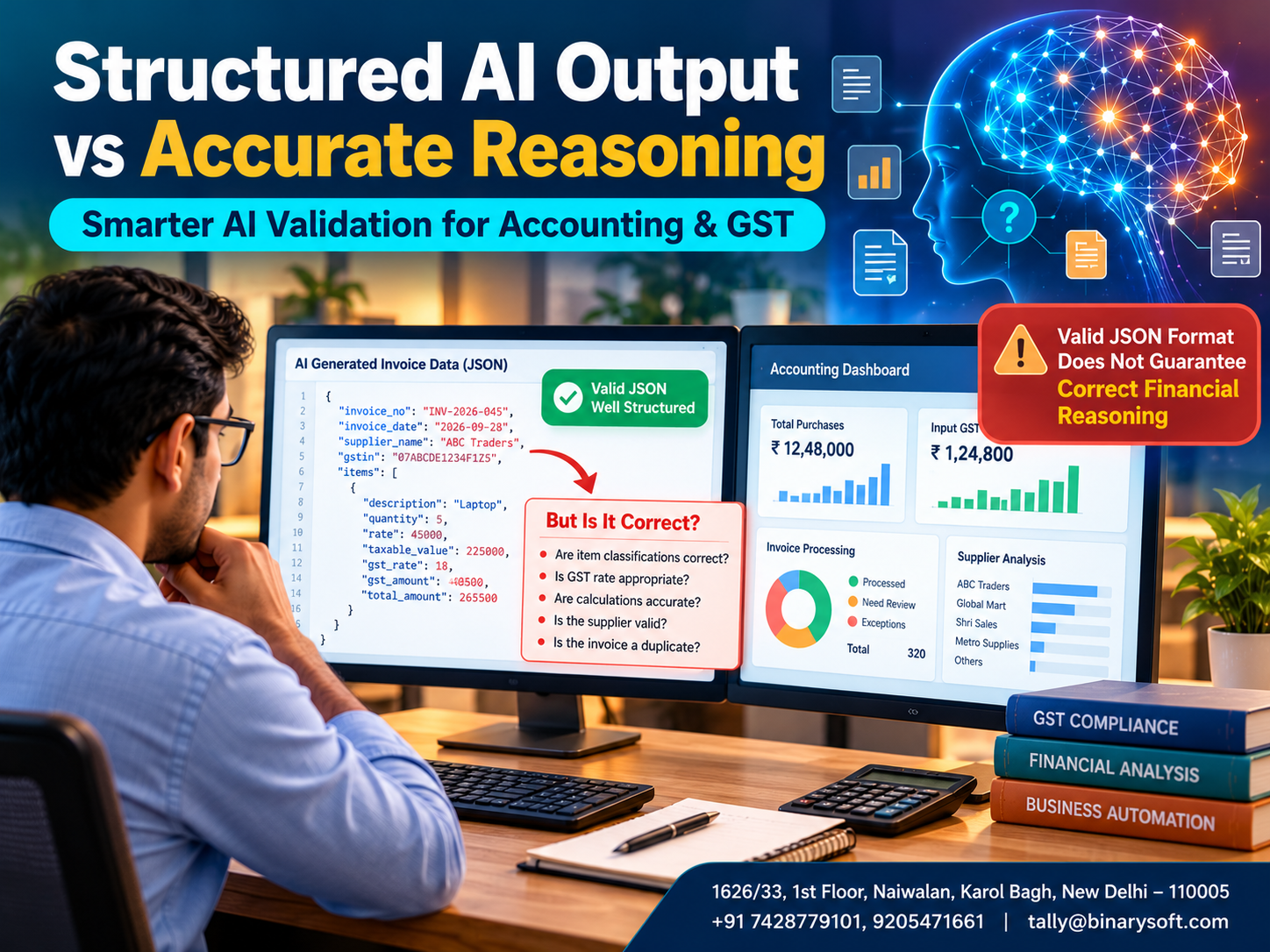
This illustrates an important challenge in modern artificial intelligence: producing perfectly structured information does not necessarily mean producing accurate or well-reasoned information.
Large Language Models (LLMs) are increasingly used for invoice extraction, document classification, financial analysis, customer support and business automation.
To integrate these systems with accounting applications, developers frequently require structured responses using JSON, XML or predefined schemas.
Structured output makes AI responses easier for software to process. However, overly restrictive output requirements can sometimes reduce the model's flexibility, encourage premature conclusions or make uncertainty difficult to express.
For Indian businesses adopting AI-powered accounting, understanding this trade-off is important.
This article explores how structured output works, why it can affect AI reasoning, the practical implications for accounting automation and how TallyPrime can support reliable financial workflows when combined with properly designed AI systems.
1. What Is Structured Output in Artificial Intelligence?
Structured output refers to information generated in a predefined, machine-readable format.
Instead of producing unrestricted paragraphs, an AI model must return data according to specified rules.
Common structured formats include JSON, XML, CSV and schema-based records.
For example, an AI system processing a purchase invoice might generate:
{
  "invoice_number": "INV-1045",
  "supplier": "ABC Traders",
  "taxable_amount": 50000,
  "gst_amount": 9000,
  "invoice_total": 59000
}
This format allows another application to identify individual values without interpreting a long paragraph.
Structured output is useful for connecting AI with accounting systems, databases, inventory applications and automated workflows.
However, structured formatting solves only one part of the problem.
It ensures that information follows an expected arrangement, but it does not independently establish whether the extracted information is correct.
2. Why Developers Use Structured AI Responses
Structured output has become important because businesses need predictable information.
Easier Software Integration
Applications can process predefined fields more reliably than unrestricted natural-language responses.
Consistent Data Presentation
A fixed schema ensures that information appears in a standard format.
This is useful when processing large numbers of transactions.
Automated Validation
Software can check whether required fields exist and whether values follow expected data types.
Reduced Manual Formatting
Employees do not need to manually reorganise AI-generated information before importing it into another system.
Faster Workflow Automation
Structured responses can support document processing, data entry preparation and reporting pipelines.
These benefits explain why structured output is widely used in business automation.
The challenge arises when developers treat structural correctness as equivalent to reasoning accuracy.
3. The Hidden Cost: How Structured Output Can Affect LLM Reasoning
Large Language Models generate responses by predicting sequences of tokens according to their training and the instructions they receive.
When a model must follow a restrictive schema, the set of acceptable outputs becomes narrower.
This can influence how the model expresses uncertainty, handles ambiguous information and approaches complex decisions.
Premature Classification
Suppose an AI model must classify every business expense as either capital expenditure or revenue expenditure.
Some transactions require additional information before a reliable classification can be made.
If the schema permits only two categories, the model may select one even when the available evidence is insufficient.
Missing Explanations
A restrictive format may allow only a numerical answer.
This can prevent the model from communicating important qualifications or assumptions.
Forced Confidence
A schema requiring a definite answer may discourage the model from indicating uncertainty.
Reduced Flexibility
Complex accounting situations often involve exceptions.
Rigid output structures may not accommodate unusual transactions or incomplete documents.
Confusion Between Validity and Accuracy
A response can be valid JSON while containing incorrect financial information.
The central concern is not that structured output is inherently harmful. It is that poorly designed constraints can interfere with the model's ability to handle complex or uncertain tasks.
The effect varies by model, task, prompting method and schema design. Structured output can also improve reliability when implemented appropriately.
4. Structured Output vs Free-Form AI Reasoning
The difference between structured and free-form responses becomes clearer when comparing how each approach handles the same question.
Suppose an AI system must evaluate whether a purchase invoice is eligible for input tax credit.
A free-form response may identify missing information, discuss possible restrictions and recommend further verification.
A restrictive structured response might return only:
Although the response is easy to process, it does not explain whether the model verified the relevant conditions.
A better schema might allow:
{
  "itc_status": "requires_review",
  "reason": "Supplier and eligibility details need verification",
  "confidence": "low",
  "human_review_required": true
}
This structure maintains machine readability while allowing uncertainty and exceptions.
|
Parameter
|
Free-form response
|
Structured response
|
|---|
|
Output flexibility
|
High
|
Schema-dependent
|
|
Software integration
|
Requires interpretation
|
Easier
|
|
Explanation of uncertainty
|
Generally easier
|
Must be designed into schema
|
|
Format consistency
|
Variable
|
More predictable
|
|
Accounting automation
|
Requires additional processing
|
Suitable with validation
|
|
Risk of incorrect conclusions
|
Still present
|
Still present
|
The most effective approach is often to allow adequate analysis before producing a validated final structure.
5. Why Reasoning Quality Matters More Than Formatting in Accounting
Accounting involves more than identifying numbers and placing them in columns.
A financial transaction may require interpretation of its commercial purpose, statutory treatment, supporting documents and accounting classification.
Consider a business purchasing a computer.
The invoice may contain a clear product description, supplier name, taxable value and GST amount.
An AI system can extract these details relatively easily.
However, deciding how the purchase should be recorded requires additional consideration.
The business may need to evaluate whether the purchase should be capitalised, whether depreciation applies and how GST should be treated.
These decisions cannot always be determined from invoice data alone.
A structured output system that immediately assigns an accounting ledger without sufficient context may produce misleading results.
This is why AI-assisted accounting systems should separate three responsibilities:
-
Extracting information from documents.
-
Evaluating the information against business rules.
-
Preparing transactions for verification and approval.
Each stage should have appropriate checks.
6. The Role of JSON Schemas in Business Automation
JSON schemas define the structure and permitted values of data exchanged between applications.
They can specify required fields, data types, acceptable values and validation conditions.
For example, an invoice schema may require an invoice number, date, supplier GSTIN, taxable amount and total amount.
This helps prevent incomplete or incorrectly formatted data from entering downstream systems.
However, a schema should not force the AI to invent missing information.
If a supplier GSTIN is unreadable, the model should be able to return a missing-value indicator instead of generating a plausible-looking number.
Similarly, if the invoice amount does not reconcile with the tax calculation, the system should flag an exception.
Recommended Schema Design Principles
-
Allow missing or unknown values where appropriate.
-
Include an exception or review status.
-
Separate extracted facts from inferred classifications.
-
Preserve references to source documents.
-
Validate calculations independently.
-
Require human approval for material financial decisions.
A well-designed schema supports both automation and accuracy.
7. How TallyPrime Can Support Reliable AI-Assisted Accounting
TallyPrime provides established accounting, GST, inventory and reporting functionality.
These capabilities can form part of a wider business automation workflow.
However, TallyPrime should not be assumed to automatically perform advanced LLM reasoning or schema-constrained AI processing. Such functionality requires an available supported feature or a separately designed integration.
Structured Accounting Records
TallyPrime maintains financial transactions through accounting vouchers and ledger masters.
This provides a consistent foundation for recording verified business transactions.
GST Invoice Management
Businesses can create and record GST invoices using configured tax details.
AI systems may assist with document extraction, while TallyPrime supports accounting entries and relevant GST reports.
Purchase and Sales Accounting
Verified transaction information can be entered into TallyPrime using supported workflows.
Where automation is required, businesses should evaluate suitable integration methods and validation controls.
Inventory Management
TallyPrime supports stock items, quantities, units and relevant inventory transactions.
AI-assisted document processing may help prepare information, but inventory updates must follow correct business rules.
Financial Reporting
Recorded transactions contribute to financial statements, ledger reports and outstanding summaries.
These reports can help businesses review the results of accounting automation.
User Permissions and Review
Businesses can establish suitable access controls and approval procedures to reduce the risk of incorrect entries.
AI should assist the accounting process rather than bypass important verification responsibilities.
8. An Emotional Story: The Invoice That Nearly Broke a Family Business
Consider the illustrative story of Mohan, a wholesale electrical goods trader in Delhi's Bhagirath Palace market.
His father established the business more than twenty-five years ago.
The family built its reputation through reliable deliveries, fair prices and long-standing supplier relationships.
As the business expanded, Mohan introduced automated document processing to reduce the accounting team's workload.
Initially, the results appeared impressive.
Supplier invoices were converted into neatly structured records. Every field followed the expected format, and the system processed documents much faster than manual entry.
But one month, a problem emerged.
A supplier invoice had been assigned to the wrong accounting category.
The information looked correct on the screen, so the mistake was not immediately noticed.
When the accounts department prepared its monthly review, the discrepancy created confusion about expenses and supplier balances.
Mohan spent hours reviewing transactions.
His father watched silently as the team searched for the source of the problem.
Finally, he said, “Technology should make our work easier, but we must never stop checking what it tells us.”
The words stayed with Mohan.
He realised that the system had been designed to produce complete answers even when the information was uncertain.
The business changed its approach.
Instead of automatically accepting every classification, the workflow began flagging ambiguous transactions for review.
The team introduced verification rules and required approval before important accounting entries were finalised.
The improvement was not about abandoning automation.
It was about using automation responsibly.
For Mohan, the experience reinforced an important lesson: trust in business is built through accuracy, accountability and the willingness to question information that appears correct.
9. Case Study 1: Wholesale Distributor Improves AI Invoice Classification
Illustrative case study — hypothetical figures, not verified customer results
Business Background
An electronics distributor operating in Nehru Place processes approximately 2,000 purchase invoices every month.
The company wants to reduce manual invoice classification and improve accounting efficiency.
Initial Problem
Its experimental AI system generated structured invoice records using a restrictive schema.
The schema required every invoice to be assigned to a specific expense or purchase category.
When documents contained ambiguous descriptions, the model sometimes selected a category without sufficient evidence.
Improved Approach
The company redesigned its workflow to allow uncertain classifications.
The updated system introduced exception statuses, confidence indicators and mandatory review for selected transactions.
Extracted invoice details were checked before accounting entry.
Illustrative Performance Comparison
|
Performance indicator
|
Initial workflow
|
Improved workflow target
|
|---|
|
Monthly invoices
|
2,000
|
2,000
|
|
Flagged for manual review
|
40
|
180
|
|
Incorrect classifications found after posting
|
30
|
8
|
|
Handling of uncertainty
|
Limited
|
Explicit review status
|
These figures demonstrate a possible trade-off rather than measured results.
Business Benefits
The improved workflow deliberately increased the number of transactions requiring review.
However, it reduced the target number of incorrect classifications reaching final accounting records.
The case illustrates why fewer manual interventions do not always indicate a better automation system.
10. Case Study 2: Manufacturing Business Strengthens GST Data Validation
Illustrative case study — proposed implementation
Business Background
A packaging manufacturer in Bawana Industrial Area purchases raw materials from multiple suppliers.
The company receives invoices with different formats, item descriptions and GST details.
Business Challenge
An experimental document extraction system occasionally produced complete JSON records even when source information was unclear.
The accounting team needed a method to distinguish reliable extraction from uncertain information.
Proposed Solution
The manufacturer introduced a staged verification process.
First, the AI extracted invoice details.
Second, a separate validation component checked required fields and arithmetic consistency.
Third, transactions with missing or conflicting information were flagged for review.
Finally, approved transactions were recorded in TallyPrime.
Expected Benefits
The company established internal targets to reduce incorrect voucher entries and improve the traceability of invoice corrections.
It also required employees to verify applicable GST treatment rather than relying exclusively on AI-generated classifications.
Key Learning
Separating document extraction from accounting validation can improve control over financial information.
Structured output remains useful, but its design should support uncertainty and independent verification.
11. Best Practices for Building Reliable Structured AI Workflows
Businesses adopting AI automation should focus on accuracy, transparency and accountability.
Separate Reasoning from Final Output
Allow the model to analyse relevant information before generating the required structured response. This does not require exposing private internal reasoning; a concise explanation of decisions and supporting evidence can be sufficient.
Include Uncertainty Fields
Schemas should permit responses such as unknown, requires_review or insufficient_information.
Validate Financial Calculations
Use deterministic calculations to verify invoice totals, GST amounts and arithmetic relationships rather than relying exclusively on language-model predictions.
Maintain Source Traceability
Store appropriate references to original invoices and supporting documents.
Establish Human Approval
Transactions involving uncertain classifications, unusual amounts or statutory interpretation should receive appropriate review.
Monitor Accuracy
Evaluate AI performance using representative business documents, including incomplete invoices and unusual transactions.
These practices can help businesses benefit from automation without sacrificing financial reliability.
12. The Future of AI Reasoning and Structured Accounting Automation
AI systems are increasingly being developed to combine flexible language understanding with predictable machine-readable outputs.
One promising approach is to separate analytical processing from the final response format.
Another is to use schemas that allow uncertainty, supporting evidence and exception handling.
For financial applications, developers can combine AI document interpretation with rule-based validation and human approval.
This hybrid approach may be more reliable than depending on a single model to extract, interpret, classify and approve transactions independently.
For businesses using TallyPrime, accurate ledgers, properly configured GST details and reliable transaction records remain essential foundations.
As AI capabilities evolve, businesses should prioritise tested integrations rather than assuming every new technology is suitable for financial operations.
13. How Binarysoft Technologies Can Help
Binarysoft Technologies assists businesses with TallyPrime accounting, GST invoicing, inventory management, financial reporting and related implementation requirements.
Businesses exploring AI-assisted accounting can begin by reviewing existing workflows and identifying activities suitable for automation.
Important considerations include transaction accuracy, integration compatibility, data security, exception handling and employee training.
A controlled implementation with regular verification can help organisations introduce new technology while maintaining dependable accounting records.
Conclusion
Structured output is an essential part of modern AI integration because it enables software applications to process information consistently.
However, a correctly formatted response does not guarantee that the underlying decision is accurate.
Overly restrictive schemas can make it difficult for AI models to express uncertainty, identify exceptions or communicate important qualifications.
For accounting and GST-related workflows, these limitations can have meaningful business consequences.
The most effective strategy combines structured information, appropriate analytical flexibility, independent validation and human oversight.
TallyPrime can provide a reliable accounting environment for recording and reviewing verified transactions, while suitable AI integrations may assist with repetitive processing tasks.
The future of intelligent business automation is not about forcing AI to provide an answer every time. It is about building systems that know when information is reliable, when further verification is necessary and when a human decision matters most.
Powered by Binarysoft Technologies Authorized Tally Partner
Location: 1626/33, 1st Floor, Naiwalan, Karol Bagh, New Delhi – 110005, INDIA
Contact us: +91 7428779101, 9205471661
Email: tally@binarysoft.com
Business Hours: 10:00 AM – 6:00 PM, Monday to Friday
Frequently Asked Questions
How should Indian businesses begin using AI for accounting automation?
Businesses should start with limited pilot projects, establish clear validation rules, maintain accurate accounting masters and require human approval for important financial decisions. Binarysoft Technologies can assist with evaluating TallyPrime-related implementation requirements.
What is the biggest risk of relying only on structured AI output?
The main risk is treating correctly formatted information as reliable even when the underlying extraction, interpretation or classification is wrong.
Can structured AI data be integrated with TallyPrime?
Potentially, through appropriately designed and supported integrations. Data must be validated and mapped correctly before creating accounting transactions.
Can TallyPrime help verify AI-generated accounting entries?
TallyPrime provides accounting ledgers, vouchers, GST reports and financial statements that can support review and reconciliation. It does not automatically guarantee the correctness of external AI-generated decisions.
CA. Rohin Mehtaal is a Chartered Accountant with experience in accounting systems, audit support, and GST compliance. He has assisted businesses in adopting structured financial processes and improving inventory accuracy. His writing emphasizes clarity, control, and data-driven decision making.