Call CA Tally HelpDesk
+91 9205471661,
7428779101
Introduction: Why Connected Accounting Is Becoming Essential for Indian Businesses
Running a business in India involves much more than recording sales and purchases. Business owners must manage GST compliance, generate invoices, monitor payments, reconcile bank transactions, maintain inventory and understand their financial position.
When these activities are handled through disconnected systems, employees often repeat the same work. Information must be copied between applications, invoices require additional processing, and financial reports may not reflect recent transactions.
For growing businesses, these inefficiencies can become expensive.
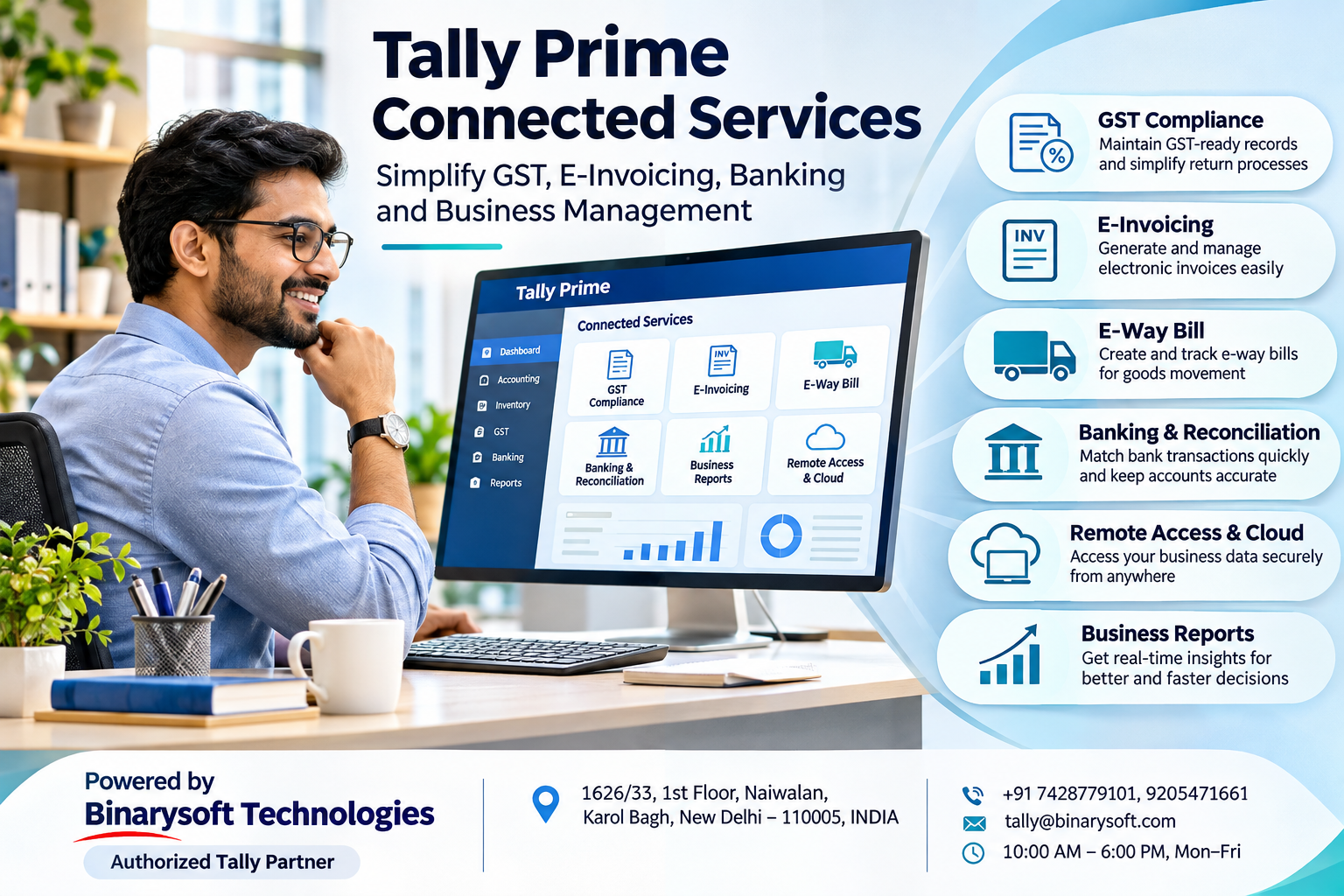
Tally Prime Connected Services provide a more integrated approach to business accounting, helping organizations manage eligible digital compliance and financial activities through their accounting environment.
Instead of treating accounting, taxation, banking and reporting as completely separate responsibilities, businesses can bring important activities closer together.
For manufacturers, wholesalers, retailers, distributors, service providers and professional firms, this approach can improve productivity and support better financial control.
In 2026, when businesses increasingly depend on timely information and accurate digital records, connected accounting offers practical advantages.
1. What Are Tally Prime Connected Services?
Tally Prime Connected Services are capabilities that connect accounting operations with supported external digital systems and services.
These services can help businesses perform eligible online activities without repeatedly transferring the same information between unrelated applications.
Depending on the software release, subscription, business eligibility and service configuration, connected capabilities may support:
-
GST-related data exchange and compliance activities.
-
Electronic invoice generation and management.
-
E-way bill activities for applicable goods movement.
-
Banking-related processes and reconciliation.
-
Digital document sharing and business reporting.
-
Secure access to selected business information.
The primary objective is to reduce unnecessary manual processes while keeping accounting information organized.
For example, when a business creates a GST sales invoice, the relevant transaction details are already recorded in its accounting system. Supported connected functions can reuse this information for subsequent compliance activities, reducing duplicate entry.
Connected accounting does not eliminate the need for verification. Businesses must still review transactions, confirm applicable tax rules and maintain proper access controls.
However, it can make these responsibilities easier to manage.
2. How Tally Prime Connected Services Improve GST Compliance
GST compliance is one of the most important responsibilities for Indian businesses. Incorrect tax calculations, incomplete invoice information and mismatched records can create unnecessary complications.
Tally Prime helps businesses maintain structured GST accounting records and prepare information for compliance activities.
Accurate GST invoicing
Businesses can configure GST details, tax classifications, HSN or SAC codes and customer registration information.
When a taxable invoice is created, the software can calculate applicable taxes based on the transaction configuration.
This helps businesses maintain consistent records for:
-
CGST and SGST transactions.
-
IGST transactions.
-
Eligible input tax credit tracking.
-
Taxable, exempt and other applicable supplies.
-
Credit notes and debit notes.
-
GST sales and purchase registers.
GST return preparation and reconciliation
Businesses can use GST reports to review outward supplies, purchase transactions and tax liabilities.
Supported connected GST functions may allow eligible businesses to exchange data with the GST system, retrieve information and perform reconciliation activities, depending on the installed release and enabled services.
This reduces the need to prepare the same information manually in several places.
Before filing returns, accountants should still verify invoice classifications, reconciliation differences, eligibility of input tax credit and the applicable reporting period.
Business benefit: Better-organized GST information can reduce last-minute compliance pressure and make monthly accounting more predictable.
3. E-Invoicing: Faster Invoice Processing and Better Accuracy
Electronic invoicing is an important requirement for businesses covered by India's e-invoicing rules.
For applicable transactions, invoices must be reported to the Invoice Registration Portal to obtain the required Invoice Reference Number (IRN) and related details.
Tally Prime supports e-invoicing workflows that can help eligible businesses generate and manage electronic invoices using information from their accounting records.
How the process works
A business first prepares its sales invoice with the correct customer details, tax classification and transaction values.
The relevant invoice information can then be submitted through supported e-invoicing connectivity, subject to configuration and eligibility.
After successful processing, the required electronic invoice details can be recorded against the transaction.
Businesses can then share the completed invoice with their customers.
Advantages of connected e-invoicing
Connected e-invoicing can reduce repeated data entry, improve consistency between accounting and invoice reporting, and simplify invoice tracking.
It can also make it easier to identify errors that require correction before an invoice is successfully registered.
Consider a distributor preparing dozens of invoices every day. Manually moving invoice information between applications takes time and increases the possibility of mistakes.
An integrated workflow allows the accounting team to spend more time checking transactions and less time reproducing information.
Businesses should verify current e-invoicing applicability, reporting deadlines and other statutory requirements before using these workflows.
4. E-Way Bill Management for Goods Movement
For businesses involved in transporting goods, e-way bill compliance can be another important responsibility.
Manufacturers, distributors and wholesalers frequently move goods between warehouses, branches, suppliers and customers.
Where an e-way bill is required, accurate transaction and transportation information is essential.
Tally Prime supports e-way bill-related processes that help businesses use accounting and invoice information for applicable goods movement.
Depending on available connectivity, businesses may be able to generate and manage e-way bill information through supported workflows.
Practical example
A wholesale electrical goods supplier in Delhi receives an order from a customer in Jaipur.
The accounts team prepares the sales invoice in Tally Prime and records the applicable GST information.
Where the transaction requires an e-way bill, the relevant details can be used for the e-way bill process.
This helps the business coordinate invoicing, dispatch documentation and accounting.
The result is a more organized workflow between the sales department, warehouse and accounts team.
5. Connected Banking and Faster Bank Reconciliation
Bank reconciliation is a regular challenge for many small and medium-sized businesses.
A company may receive payments through bank transfers, cheques, digital payment channels and other collection methods.
At the same time, it must record supplier payments, salaries, expenses, bank charges and other transactions.
When bank records and accounting entries are reviewed manually, reconciliation can become time-consuming.
Tally Prime provides banking and reconciliation capabilities that help accountants compare bank transactions with accounting records.
Supported banking features vary according to the bank, software release and service availability.
How businesses can use connected banking
A business can maintain bank ledgers, record receipts and payments, and review bank transactions against its books.
Where supported, bank statement import or connected banking functions can help streamline reconciliation.
This allows accountants to identify unmatched entries, incorrect amounts, missing transactions and other differences.
Why reconciliation matters
Imagine a business owner reviewing the company's bank balance and assuming that all customer payments have been collected.
However, the outstanding receivables report may show unpaid invoices, while the bank statement includes deposits that have not been correctly matched.
Regular reconciliation helps reveal these differences.
It supports more accurate cash flow monitoring and reduces uncertainty about available funds.
Business benefit: Faster reconciliation allows accountants to focus on exceptions instead of spending hours comparing every transaction manually.
6. Remote Access and Tally Prime Cloud for Flexible Business Operations
Business owners increasingly need financial information while travelling, meeting customers or managing multiple locations.
Traditional office-based accounting arrangements can make this difficult.
Tally Prime provides selected remote access and connected reporting capabilities, while a properly configured Tally Prime Cloud environment can provide broader access to the hosted accounting application.
These are different arrangements, and businesses should choose according to their operational requirements.
How cloud-based access helps
With an appropriately configured cloud hosting environment, authorized users can access the accounting application remotely through a supported connection.
This can help owners and accountants work from different locations without relying exclusively on a single office computer.
For example, a business owner attending a supplier meeting may need to check outstanding payments before confirming another purchase.
Remote access to current accounting information can support a more informed decision.
Security considerations
Businesses should use individual user accounts, strong authentication, appropriate permissions and secure remote connections.
Cloud hosting should also include a suitable backup and recovery arrangement.
A cloud environment does not automatically guarantee uninterrupted availability or data security. The hosting configuration and operating procedures remain important.
7. A Business Owner's Story: When Accounting Finally Became Less Stressful
The following is an illustrative story created to explain the everyday value of connected accounting.
For nearly fifteen years, Rajesh had operated a family-owned distribution business in Karol Bagh, New Delhi.
His father had started the business with a small shop, limited stock and a reputation for delivering orders on time.
Rajesh wanted to preserve that reputation while expanding the business.
But growth brought new challenges.
Customer invoices increased, supplier payments became harder to monitor, and GST compliance required more attention.
Every evening, Rajesh stayed at the office long after his employees had left.
He checked payment records, called customers about pending amounts and waited for the accounts team to finish its reports.
One evening, his daughter called and asked whether he would attend her school performance.
He promised he would try.
Unfortunately, an urgent reconciliation problem kept him at the office.
By the time he reached home, the performance was over.
His daughter had saved him a seat.
That moment made Rajesh realize that the business he was building for his family was taking away the time he wanted to spend with them.
He decided to improve the company's accounting processes.
The business organized its customer and supplier ledgers, reviewed its GST configuration, introduced more disciplined bank reconciliation and adopted suitable connected accounting workflows.
Rajesh also arranged secure remote access for authorized accounting work.
The transition required training and careful checking, but gradually the accounts team became more confident.
Invoices were easier to trace, outstanding payments became more visible and monthly reports required less last-minute preparation.
Rajesh still worked hard. Running a business had not suddenly become effortless.
But he no longer felt that every financial question required another late evening at the office.
Months later, he attended his daughter's next school performance.
This time, he arrived before it started.
For Rajesh, the real value of better accounting was not simply faster software.
It was having more control over his business and more time for the people who mattered.
8. Case Study One: A Delhi Wholesale Distributor Improves Invoice Management
Illustrative case study — figures are hypothetical, not verified customer results.
Business background
A medium-sized wholesale distributor in Delhi supplies electrical accessories to retailers across northern India.
The company processes approximately 80 sales invoices daily and maintains accounts for hundreds of customers.
Its accounting team previously relied on separate procedures for invoice preparation, GST-related activities and bank reconciliation.
Challenges
Employees repeatedly entered invoice information into different systems.
Customer payments were not always matched promptly, and management had difficulty identifying which customers required follow-up.
The company also faced additional work during monthly GST reviews.
Solution using Tally Prime
The business standardized its accounting records in Tally Prime.
It configured GST classifications, organized customer ledgers and used supported electronic invoicing and compliance functions where applicable.
The team introduced regular bank reconciliation and monitored customer outstanding reports.
Illustrative operational improvement
|
Activity
|
Before
|
After
|
|---|
|
Invoice processing
|
Repeated manual entry
|
More integrated workflow
|
|
GST review
|
Multiple manual checks
|
Structured reports and reconciliation
|
|
Customer collections
|
Irregular follow-up
|
Regular outstanding review
|
|
Bank reconciliation
|
Month-end workload
|
More frequent matching
|
Business outcome
The distributor gained a clearer view of receivables, invoice status and financial records.
Employees could investigate exceptions more quickly, while management had better information for collection planning.
The main lesson is that connected accounting becomes valuable when combined with disciplined business processes.
9. Case Study Two: A Manufacturing Company Connects Accounting and Inventory
Illustrative case study — not an actual customer testimonial.
Business background
A small manufacturing company in Faridabad produces industrial packaging materials.
The company purchases raw materials, processes customer orders and supplies finished goods to distributors.
Its management needs reliable information about inventory, production costs, customer invoices and supplier payments.
Challenges
The business maintained several operational spreadsheets alongside its accounting records.
Stock information was not always updated promptly, and management struggled to connect purchase costs with available inventory.
The accounts department also spent considerable time checking dispatch records against sales invoices.
Solution using Tally Prime
The company introduced structured inventory accounting with stock groups, stock items, units of measurement and godown records.
It linked inventory-related transactions with purchase and sales accounting.
Where relevant, the business used suitable e-invoicing and e-way bill workflows.
The accounts team also reviewed bank transactions and supplier outstanding reports regularly.
Business outcome
Management gained better visibility into inventory movement, purchase liabilities and customer receivables.
The company could review financial information without depending on several independently maintained spreadsheets.
Production and dispatch planning became easier because the team had a more consistent accounting record.
The case demonstrates how connected compliance features become even more useful when combined with core inventory and financial management.
10. Step-by-Step: How to Start Using Tally Prime Connected Services
Businesses can introduce connected services gradually rather than changing every accounting process at once.
Step 1: Review your accounting configuration
Confirm company details, GST registration information, customer ledgers, tax classifications and inventory settings.
Step 2: Check eligibility and available services
Verify your installed release, subscription, applicable compliance requirements and supported connectivity.
Step 3: Configure required features
Enable and configure appropriate GST, e-invoicing, e-way bill or banking features according to the business's needs.
Step 4: Train authorized employees
Explain how to create transactions, verify information, handle errors and review reports.
Step 5: Monitor results and improve
Review reconciliation differences, outstanding invoices, compliance reports and user access regularly.
11. Important Business Reports Available in Tally Prime
Connected services are most effective when businesses also make proper use of accounting reports.
The following reports can support everyday decision-making.
|
Report
|
Business purpose
|
|---|
|
Balance Sheet
|
Review assets, liabilities and financial position
|
|
Profit and Loss
|
Monitor income, expenses and profitability
|
|
Cash and Bank Books
|
Track recorded cash and banking transactions
|
|
Outstanding Receivables
|
Identify customer payments awaiting collection
|
|
Outstanding Payables
|
Plan supplier payments
|
|
Stock Summary
|
Review inventory quantities and values
|
|
GST Reports
|
Examine tax-related transactions and compliance information
|
|
Sales Register
|
Analyze recorded sales transactions
|
Business owners can use these reports to identify financial concerns earlier.
For example, increasing sales do not always mean improving cash flow. If customer payments remain outstanding, the business may still struggle to pay suppliers.
Reviewing sales, receivables and banking information together provides a more complete financial picture.
12. Key Benefits of Tally Prime Connected Services for Small and Medium Businesses
The value of connected accounting extends beyond individual software features.
Reduced repetitive work
When information can move through supported accounting and compliance workflows, employees spend less time entering the same details repeatedly.
Improved financial accuracy
Consistent records help reduce avoidable differences between invoices, ledgers and financial reports. Regular verification remains essential.
Better compliance readiness
Organized GST information, electronic invoice records and transaction reports can make statutory reviews easier to manage.
Faster financial decisions
Access to updated accounting reports helps owners evaluate collections, expenses, purchases and working capital requirements.
Improved collaboration
With appropriate permissions and remote access arrangements, business owners and accountants can coordinate work across locations.
Support for business growth
As transaction volumes increase, structured accounting processes can help businesses manage additional customers, suppliers and operational complexity.
13. Why Choose Binarysoft Technologies for Tally Prime Connected Services?
Introducing connected accounting successfully requires more than enabling software features.
Businesses need suitable configuration, employee training and dependable assistance when problems arise.
Binarysoft Technologies, an Authorized Tally Partner, helps businesses understand and implement Tally Prime accounting solutions according to their operational requirements.
Services may include assistance with software licensing, accounting configuration, GST-related features, inventory management, reporting and suitable remote-access arrangements.
Businesses can also seek guidance on organizing customer records, improving accounting workflows and identifying appropriate features for their industry.
Whether a company operates a retail shop, wholesale distribution business, manufacturing unit or professional services firm, the objective is to make financial management more efficient and manageable.
14. Conclusion: Build a More Connected and Confident Business
Modern business accounting is no longer limited to maintaining books and preparing year-end statements.
Companies need reliable information, organized compliance records, efficient payment tracking and access to financial reports when decisions must be made.
Tally Prime Connected Services help bring these responsibilities into a more coordinated accounting environment.
From GST-related workflows and electronic invoicing to banking reconciliation and financial reporting, connected capabilities can reduce unnecessary effort and improve visibility.
When combined with suitable cloud hosting, strong security practices and well-trained employees, these tools can also support flexible business operations.
For Indian businesses preparing for continued digital growth in 2026, connected accounting is an opportunity to improve control, reduce administrative pressure and spend more time serving customers.
The greatest benefit is not simply completing accounting tasks faster. It is building a business where financial information is dependable, employees work with greater confidence and owners can focus on sustainable growth.
Powered by Binarysoft Technologies
Authorized Tally Partner
Location: 1626/33, 1st Floor, Naiwalan, Karol Bagh, New Delhi – 110005, INDIA
Contact Us: +91 7428779101, 9205471661
Email: tally@binarysoft.com
Business Hours: 10:00 AM – 6:00 PM, Monday to Friday
Frequently Asked Questions
How can connected accounting improve cash flow management?
By maintaining accurate customer balances, supplier liabilities, banking transactions and financial reports, businesses can identify collection delays and plan payments more effectively.
Are Connected Services available in every Tally Prime edition?
Feature availability may depend on the edition, installed release, active subscription, geographic applicability and supported external services. Businesses should verify the requirements for each function.
Where can I get assistance with Tally Prime Connected Services in Delhi?
Businesses can contact Binarysoft Technologies, an Authorized Tally Partner in Karol Bagh, New Delhi, for guidance on Tally Prime licensing, accounting configuration, GST-related functionality and suitable connected accounting solutions.
Can I access Tally Prime from another location?
Selected remote-access capabilities may be available through supported services. Businesses can also consider properly configured Tally Prime Cloud hosting for broader remote application access.
CA. Yashvardhan Kedia focuses on taxation, business accounting, and compliance management for MSMEs. He helps business owners understand financial information and establish practical processes for maintaining accurate books.