Call CA Tally HelpDesk
+91 9205471661,
7428779101
Introduction: Why Accounting and Auditing Are Essential for Every Successful Business
Every successful business is built on trust, financial discipline and informed decision-making.
Whether you operate a small retail shop, a manufacturing company, a wholesale distribution business or a growing service organization, maintaining accurate financial records is essential for long-term success.
Businesses handle numerous financial transactions every day, including sales, purchases, expenses, customer payments, supplier invoices, employee salaries and tax obligations.
However, recording financial transactions is only one part of effective financial management.
Businesses must also verify whether their accounting records are accurate, complete and compliant with applicable requirements.
This is where accounting and auditing become important.
Accounting involves recording, classifying, summarizing and reporting financial transactions.
Auditing involves examining financial records, evaluating supporting evidence and assessing whether financial information is reliable and prepared according to applicable requirements.
Although accounting and auditing serve different purposes, they work together to improve financial transparency, accountability and business confidence.
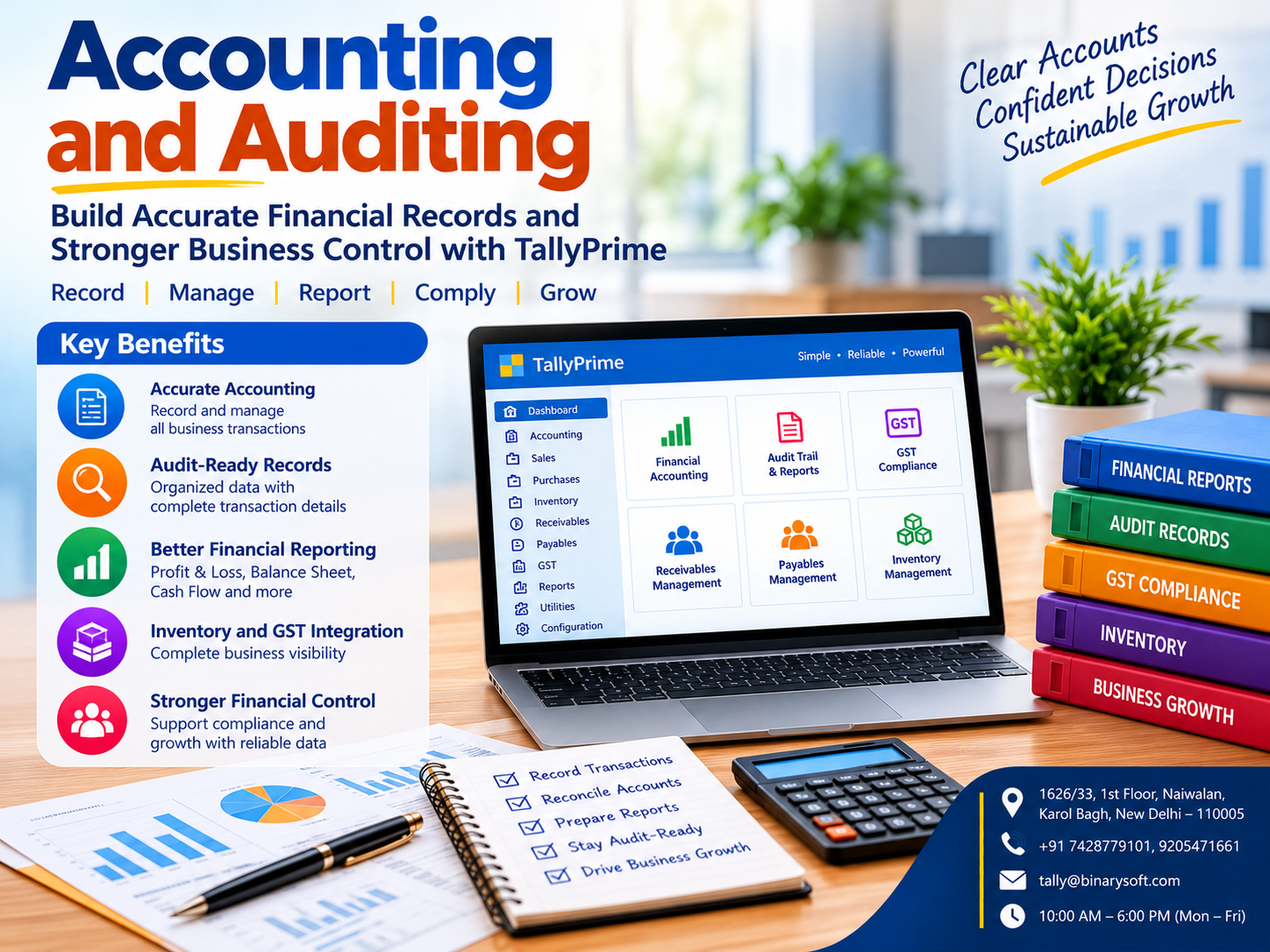
Modern accounting solutions such as TallyPrime help businesses maintain organized financial records, prepare reports, reconcile transactions and support audit preparation.
In this comprehensive guide, we will explore accounting and auditing, their differences, importance, benefits, practical examples and how TallyPrime supports better financial management.
1. What Is Accounting?
Accounting is the systematic process of identifying, recording, classifying, summarizing and reporting financial transactions.
It helps businesses understand their financial position and evaluate operational performance.
Accounting records include sales, purchases, receipts, payments, assets, liabilities, income and expenses.
Example of Accounting
Suppose a trading business sells products worth ₹80,000 on credit.
The transaction is recorded as:
| Account | Debit | Credit |
|---|
| Customer Account |
₹80,000 |
|
| Sales Account |
|
₹80,000 |
For simplicity, GST is excluded from this example.
The entry increases customer receivables and records sales revenue.
When the customer pays, the business records the receipt and reduces the outstanding balance.
Main Objectives of Accounting
Accounting helps businesses:
-
Maintain accurate financial records.
-
Monitor income and expenses.
-
Calculate profitability.
-
Track assets and liabilities.
-
Prepare financial statements.
-
Manage customer and supplier balances.
-
Support tax compliance.
-
Make informed financial decisions.
Accounting provides the financial information required for everyday business management.
2. What Is Auditing?
Auditing is the systematic examination of financial information, accounting records and supporting evidence.
A financial statement audit aims to provide an independent opinion on whether financial statements are prepared, in all material respects, according to the applicable financial reporting framework.
Auditors examine accounting records, verify selected transactions, evaluate relevant internal controls and assess financial reporting risks.
Example of Auditing
Suppose a company reports annual sales of ₹1 crore.
An auditor may examine selected sales invoices, customer balances, supporting documents and related accounting entries.
The auditor may also compare recorded transactions with bank receipts and other evidence.
The objective is to obtain sufficient appropriate audit evidence to support the audit opinion.
An audit provides reasonable assurance, not a guarantee that every error or fraud will be detected.
Main Objectives of Auditing
Auditing helps businesses:
-
Improve confidence in financial statements.
-
Identify material accounting errors.
-
Assess financial reporting risks.
-
Evaluate relevant internal controls.
-
Examine compliance with applicable reporting requirements.
-
Improve financial accountability.
-
Support stakeholder confidence.
Auditing plays an important role in strengthening trust in financial information.
3. Accounting vs Auditing: Key Differences
Although accounting and auditing are closely connected, their objectives and responsibilities differ.
| Basis | Accounting | Auditing |
|---|
| Meaning |
Recording and reporting financial transactions |
Examining financial information and supporting evidence |
| Main Objective |
Maintain financial records |
Provide assurance or evaluate controls |
| Nature |
Continuous financial activity |
Periodic or ongoing review |
| Responsibility |
Accountants and finance teams |
Auditors |
| Timing |
Throughout the accounting period |
According to the audit plan |
| Main Focus |
Transaction recording and reporting |
Verification, evidence and financial reporting risks |
| Output |
Financial statements and accounting reports |
Audit reports and findings |
| Independence |
Accountants may be company employees |
External auditors must satisfy independence requirements |
| Scope |
Bookkeeping, reporting and financial analysis |
Audit procedures based on objectives and risks |
| Software Support |
Transaction recording and financial reporting |
Audit trails, records and supporting reports |
Accounting prepares financial information, while auditing evaluates its reliability.
Both are important for maintaining financial discipline.
4. An Emotional Business Story: When One Accounting Error Threatened Years of Hard Work
For nearly eighteen years, Suresh had operated a successful textile distribution business in Delhi.
He started with a small shop and gradually expanded into a wholesale operation supplying fabrics to retailers across North India.
His business represented years of dedication, personal sacrifice and family support.
As sales increased, Suresh hired employees to manage billing, inventory and accounting.
He trusted his team and rarely examined financial reports personally.
One year, while preparing documents for a bank financing application, his accountant discovered several inconsistencies.
Some customer receipts had been allocated against incorrect invoices.
A few supplier balances did not match the statements received from vendors.
Certain expenses had also been recorded under inappropriate ledger accounts.
The differences created uncertainty about the company's financial position.
Suresh became deeply worried.
He had spent almost two decades building his business, yet he could not confidently explain some of the figures appearing in his accounts.
The bank requested additional financial information before proceeding with its assessment.
That evening, Suresh sat in his office reviewing old invoices.
He realized that running a successful business required more than generating sales. It required reliable financial records that others could trust.
He decided to improve the company's accounting procedures.
His team reorganized ledger classifications, reviewed outstanding balances, reconciled bank transactions and introduced regular financial checks.
They also began using TallyPrime more systematically.
Before the next financial review, the accountant verified important balances and prepared supporting schedules.
The improved records helped Suresh understand his company's financial position more clearly.
The experience changed his approach to business management.
He no longer considered accounting an activity performed only for tax returns.
He understood that accurate accounting and regular verification protected the business he had worked so hard to build.
The lesson was powerful: Financial transparency protects not only business profits but also the trust and confidence built over many years.
This is an illustrative story created to explain the importance of accounting and auditing.
5. Importance of Accounting for Business Success
Financial Transparency
Accounting provides a structured record of business transactions.
Reliable financial statements help owners, managers and other stakeholders understand the financial position of an organization.
Better Decision-Making
Financial information helps businesses evaluate revenue, expenses, profitability and available resources.
Management can use these insights to make purchasing, investment and operational decisions.
Regulatory Compliance
Businesses must maintain financial records according to applicable legal and reporting requirements.
Organized accounting supports compliance activities and preparation of statutory information.
Performance Evaluation
Accounting reports help businesses compare financial performance across different periods.
Management can identify trends, evaluate profitability and investigate increasing expenses.
Resource Allocation
Accurate financial information helps businesses determine where resources are required.
This supports budgeting, cost control and operational planning.
Investor and Lender Confidence
Reliable accounting records help investors and lenders evaluate business performance.
Financial transparency can support financing discussions and investment decisions.
6. Importance of Auditing for Businesses
Financial Accuracy and Reliability
Auditing evaluates financial information using appropriate procedures and supporting evidence.
This improves confidence in reported financial results.
Compliance Assessment
Auditors assess financial reporting against applicable accounting standards and relevant requirements within the audit's scope.
Fraud Risk Assessment
Auditors consider risks of material misstatement arising from fraud or error.
Audit procedures may identify suspicious transactions or inconsistencies.
However, an audit does not guarantee detection of every fraudulent activity.
Internal Control Evaluation
Auditing may involve examining controls related to financial reporting.
Weaknesses identified during the process can help management improve procedures.
Accountability
Independent examination encourages responsible financial reporting and strengthens management accountability.
Stakeholder Confidence
Audited financial statements can provide greater confidence to lenders, investors and other stakeholders.
The level of assurance depends on the type and scope of the engagement.
7. Types of Accounting Used in Business
Financial Accounting
Financial accounting focuses on recording transactions and preparing financial statements.
Management Accounting
Management accounting provides financial information for internal planning, budgeting and decision-making.
Cost Accounting
Cost accounting helps businesses analyze production costs, operational expenses and profitability.
Tax Accounting
Tax accounting involves maintaining information and calculations required under applicable tax laws.
Inventory Accounting
Inventory accounting tracks the financial value of goods, raw materials and finished products.
TallyPrime supports several accounting activities through integrated financial and inventory features.
8. Major Types of Auditing
Statutory Audit
A statutory audit is conducted when required by applicable law.
Its scope and reporting requirements depend on the relevant legislation and entity.
Internal Audit
Internal auditing evaluates organizational processes, controls and risk management.
It helps management identify opportunities for improvement.
Tax Audit
A tax audit examines specified financial and tax-related information according to applicable legal provisions.
Financial Statement Audit
A financial statement audit evaluates whether financial statements are prepared according to the applicable reporting framework.
Compliance Audit
A compliance audit examines whether specified activities follow applicable rules, policies or regulations.
Different audits serve different purposes and may require different professional qualifications.
9. How TallyPrime Simplifies Business Accounting
TallyPrime provides integrated accounting features that help businesses maintain organized financial information.
9.1 Voucher-Based Accounting
Businesses can record transactions through sales, purchase, receipt, payment, journal and contra vouchers.
Relevant ledgers are updated through recorded entries.
9.2 Ledger Management
TallyPrime supports customer, supplier, income, expense, asset and liability ledgers.
This helps maintain structured accounting records.
9.3 Financial Reporting
Businesses can generate reports such as:
These reports support financial reviews and audit preparation.
9.4 Inventory Accounting
TallyPrime supports inventory management through stock items, stock groups, stock movements and inventory reports.
Integrated inventory records help businesses review stock-related financial information.
9.5 GST Accounting
TallyPrime provides GST-related accounting and reporting features.
Businesses can maintain relevant tax information and review transaction details for compliance activities.
9.6 Banking and Reconciliation
Bank reconciliation helps identify differences between accounting records and bank statements.
TallyPrime provides reconciliation functionality to support this process.
9.7 Receivables and Payables
Customer and supplier outstanding reports help businesses monitor unpaid invoices and payment obligations.
9.8 Financial Analysis
Accounting reports help management evaluate business performance and identify unusual financial trends.
10. How TallyPrime Supports Audit Preparation
TallyPrime can help businesses maintain the records and reports required during an audit.
Organized Transaction Records
Voucher-based accounting provides structured records of financial transactions.
Ledger Verification
Auditors can examine relevant ledger balances and transaction histories.
Trial Balance Review
Trial balance reports help identify account balances requiring investigation.
Bank Reconciliation
Reconciled bank records support verification of cash and banking transactions.
Outstanding Balance Review
Customer and supplier reports help examine receivables and payables.
Inventory Verification
Stock reports can support inventory reconciliation and financial review.
Audit Trail and Edit Log
Relevant TallyPrime editions and configurations provide audit-related features for reviewing recorded transactions and changes.
Businesses subject to applicable audit-trail requirements should ensure that the required functionality is enabled and operating correctly throughout the relevant period.
Software records support audit procedures but do not replace independent verification or professional judgment.
11. Practical Example: Accounting and Auditing in a Trading Business
Consider a wholesale trading company with the following monthly transactions.
| Transaction | Amount |
|---|
| Opening Bank Balance |
₹4,00,000 |
| Goods Purchased on Credit |
₹2,00,000 |
| Goods Sold on Credit |
₹3,50,000 |
| Customer Payments Received |
₹2,50,000 |
| Supplier Payments Made |
₹1,50,000 |
| Operating Expenses Paid |
₹30,000 |
Assume there are no opening receivables or payables, all purchased goods are sold, and GST is excluded for simplicity.
Accounting Process
The accountant records the transactions through appropriate vouchers.
The system updates sales, purchases, bank, customer and supplier ledgers.
Financial Summary
| Particulars | Amount |
|---|
| Sales Revenue |
₹3,50,000 |
| Cost of Goods Sold |
₹2,00,000 |
| Gross Profit |
₹1,50,000 |
| Operating Expenses |
₹30,000 |
| Net Profit |
₹1,20,000 |
| Closing Receivables |
₹1,00,000 |
| Closing Payables |
₹50,000 |
| Closing Bank Balance |
₹4,70,000 |
Audit Review
An auditor may examine selected invoices, payment records, customer balances and supplier statements.
The auditor may also review bank reconciliation and inventory-related evidence.
This example demonstrates how accounting creates financial records while auditing evaluates their reliability.
12. Case Study 1: How a Retail Business Improved Financial Accuracy
Business Background
A growing retail company operated multiple stores selling electronic accessories.
Each store maintained separate sales and inventory records.
The accounting team struggled to consolidate financial information.
Challenges
The company experienced:
-
Delayed financial reporting.
-
Inconsistent ledger classifications.
-
Inventory reconciliation differences.
-
Unverified customer balances.
-
Difficulty preparing audit schedules.
Solution Using TallyPrime
The company introduced structured accounting procedures using TallyPrime.
Sales and purchase transactions were recorded systematically.
Customer and supplier ledgers were organized.
Inventory records were reviewed regularly.
The finance team introduced monthly reconciliation and financial reporting procedures.
Business Results
The business gained better visibility into accounting records.
Financial information became easier to review.
Management could identify discrepancies earlier and prepare supporting schedules more efficiently.
Key Learning
Organized accounting records and regular verification can improve financial transparency and audit readiness.
This is an illustrative case study, not a documented customer implementation.
13. Case Study 2: How a Manufacturing Business Strengthened Financial Control
Business Background
A manufacturing company produced industrial packaging materials.
The business purchased raw materials, managed production expenses and supplied finished goods to customers.
Challenges
The company faced difficulties monitoring inventory values, supplier liabilities and operating expenses.
Accounting adjustments were sometimes delayed until the financial year-end.
Management also lacked consistent financial review procedures.
Solution Using TallyPrime
The company reorganized its accounting workflow.
Relevant inventory features were configured.
Expense ledgers were classified according to business requirements.
The accounting team introduced regular bank reconciliation, outstanding balance reviews and period-end adjustments.
Financial reports were examined before audit preparation.
Business Results
Management gained improved visibility into financial performance.
Accounting discrepancies could be investigated earlier.
The company was better prepared to provide records and explanations during financial reviews.
Key Learning
Accurate accounting combined with regular verification strengthens financial control and business confidence.
This is an illustrative case study intended to demonstrate potential business benefits.
14. Common Accounting and Auditing Challenges
Incorrect Data Entry
Incorrect amounts, duplicate transactions and missing entries can affect financial statements.
Poor Documentation
Missing invoices and supporting records can create difficulties during audit verification.
Delayed Reconciliation
Unreconciled bank accounts and supplier balances may conceal accounting discrepancies.
Incorrect Ledger Classification
Transactions recorded under inappropriate accounts can distort financial reports.
Weak Internal Controls
Inadequate approval procedures and unrestricted access can increase financial risk.
Incomplete Audit Trails
Missing or unreliable transaction-change records may create compliance and verification concerns.
How Businesses Can Improve
Businesses should establish clear accounting procedures, maintain supporting documents, reconcile accounts regularly and implement appropriate access controls.
TallyPrime can support these activities through organized accounting records and relevant reporting features.
15. Best Practices for Maintaining Audit-Ready Accounts
Record transactions regularly. Avoid unnecessary delays in accounting entries.
Maintain supporting documents. Preserve invoices, receipts, contracts and bank records.
Reconcile bank accounts. Investigate differences promptly.
Review customer and supplier balances. Verify outstanding amounts periodically.
Perform inventory checks. Compare stock records with physical inventory where applicable.
Maintain appropriate access controls. Restrict sensitive accounting functions to authorized users.
Review transaction changes. Use relevant audit-trail functionality where required.
Record period-end adjustments. Recognize depreciation, accruals and other applicable adjustments.
Prepare financial statements. Review balances and investigate unusual figures.
Consult qualified professionals. Obtain appropriate accounting and audit guidance for statutory obligations.
These practices help businesses maintain more reliable financial records.
16. Traditional Accounting vs TallyPrime-Based Accounting
| Activity | Traditional Manual Process | Using TallyPrime |
|---|
| Transaction Recording |
Manual journal entries |
Voucher-based recording |
| Ledger Posting |
Separate manual posting |
Ledger updates through vouchers |
| Trial Balance |
Manual preparation |
Built-in report |
| Financial Statements |
Manual compilation |
Integrated reports |
| Inventory Accounting |
Separate stock registers |
Inventory management features |
| GST Accounting |
Manual records and calculations |
GST-related accounting features |
| Bank Reconciliation |
Manual statement comparison |
Reconciliation functionality |
| Customer Outstanding |
Manual tracking |
Receivables reports |
| Supplier Outstanding |
Separate registers |
Payables reports |
| Audit Preparation |
Manual record compilation |
Organized accounting reports and records |
TallyPrime helps reduce repetitive accounting work, but businesses remain responsible for accurate data entry, verification and compliance.
17. How Accounting and Auditing Support Business Growth
Accounting and auditing contribute to sustainable business development.
Accurate accounting helps management understand profitability, expenses, assets and liabilities.
Auditing strengthens confidence in financial information and may identify weaknesses in financial reporting processes.
Together, they support:
-
Better financial planning.
-
Improved accountability.
-
Stronger internal controls.
-
More reliable financial statements.
-
Improved stakeholder confidence.
-
Better risk management.
-
Greater operational transparency.
Businesses that maintain reliable financial information are better positioned to evaluate opportunities and manage financial challenges.
18. How Binarysoft Technologies Helps Businesses with TallyPrime
Implementing accounting software successfully requires suitable configuration and structured financial procedures.
Binarysoft Technologies, an Authorized Tally Partner, helps businesses explore TallyPrime solutions according to their accounting and operational requirements.
TallyPrime Setup and Configuration
Assistance with company setup, ledgers, voucher types and relevant accounting settings.
Financial Accounting
Guidance on recording transactions and maintaining organized accounting records.
GST Accounting
Configuration of applicable GST-related accounting features.
Inventory Management
Setting up relevant inventory functions according to business requirements.
Financial Reporting
Understanding Profit & Loss A/c, Balance Sheet, Trial Balance and other accounting reports.
Audit Preparation Support
Guidance on accessing accounting records, transaction reports and relevant audit-related features.
TallyPrime Cloud and Remote Access
Exploring suitable hosted arrangements for businesses requiring remote accounting access.
Backup and Data Management
Reviewing appropriate accounting data protection and backup practices.
Proper implementation helps businesses maintain more organized financial information.
19. Conclusion: Accurate Accounting and Reliable Auditing Build Stronger Businesses
Accounting and auditing are essential components of effective financial management.
Accounting creates organized records of financial transactions, while auditing evaluates financial information and supporting evidence.
Both activities contribute to financial transparency, accountability and stakeholder confidence.
For small businesses, accurate accounting helps maintain control over income, expenses and outstanding payments.
For growing organizations, regular financial reviews and appropriate audits help strengthen financial reporting and risk management.
However, successful accounting and auditing require more than software.
Businesses must maintain accurate records, implement internal controls, preserve supporting documents and conduct regular reconciliations.
TallyPrime simplifies important accounting activities through voucher recording, ledger management, inventory accounting, GST-related features, banking and financial reporting.
Its reporting and audit-related capabilities can also support businesses in preparing records for examination.
Ultimately, financial success depends not only on earning revenue but also on maintaining reliable information and responsible financial practices.
Accurate accounting creates financial clarity. Effective auditing strengthens confidence. Together, they help businesses build a more secure and sustainable future.
Powered by Binarysoft Technologies
Authorized Tally Partner
Location:
1626/33, 1st Floor, Naiwalan, Karol Bagh, New Delhi – 110005, INDIA
Contact Us:
+91 7428779101, 9205471661
Email Us:
tally@binarysoft.com
Business Hours:
10:00 AM – 6:00 PM, Monday to Friday
Frequently Asked Questions
What are the benefits of maintaining audit-ready accounts?
Audit-ready records support financial transparency, reduce last-minute reconciliation work and make supporting information easier to retrieve.
Can small businesses benefit from auditing?
Yes. Appropriate financial reviews and audits can help small businesses strengthen controls and improve confidence in financial information.
What is the role of internal controls in auditing?
Internal controls help prevent or detect errors, restrict unauthorized activities and support reliable financial reporting.
Can TallyPrime help with bank reconciliation?
Yes. TallyPrime provides bank reconciliation functionality that helps compare accounting records with bank transactions.
Can TallyPrime be accessed remotely?
Businesses may use suitable remote-access or hosted TallyPrime arrangements, subject to licensing, infrastructure and security requirements.
CA. Shivesh Khandelwaal is a practicing Chartered Accountant experienced in accounting automation, compliance management, and audit support. He has worked with trading and distribution businesses to improve inventory visibility and financial reporting. His articles focus on real-world applicability.