Call CA Tally HelpDesk
+91 9205471661,
7428779101
Introduction: Why Managing Receivables and Payables Is Essential for Business Success
Every business depends on two important financial activities: receiving money from customers and making payments to suppliers.
A company may generate excellent sales, attract new customers and expand its operations. However, if customers delay payments or supplier obligations are not managed properly, the business can experience serious cash flow problems.
This is where Accounts Receivable (AR) and Accounts Payable (AP) become important.
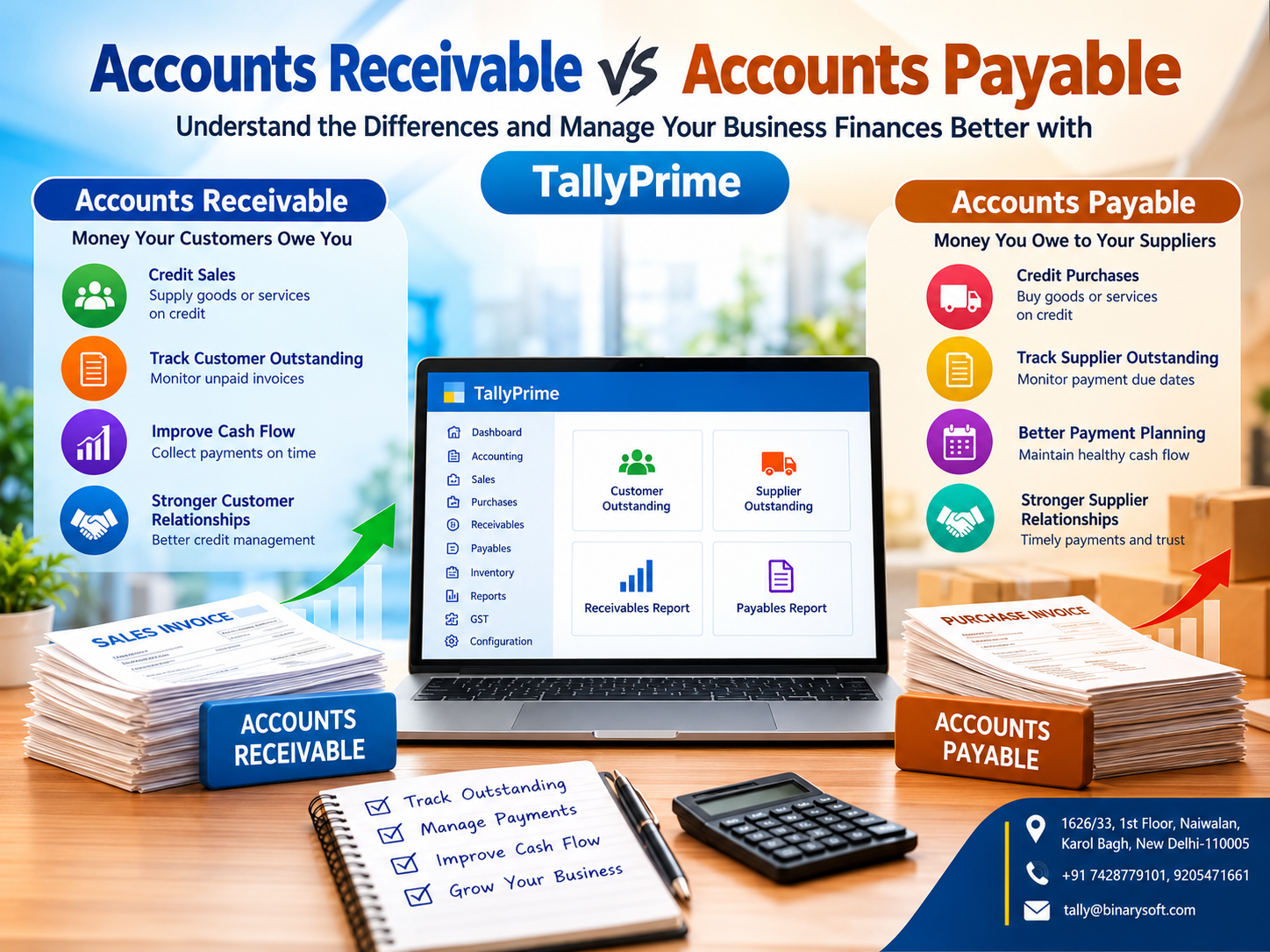
Accounts receivable represents the money customers owe a business for goods or services supplied on credit. Accounts payable represents the money a business owes suppliers for goods or services purchased on credit.
Although these accounting concepts appear simple, they play a major role in determining a company's financial stability.
Poor receivables management can result in delayed collections, increased outstanding balances and working capital shortages.
Similarly, ineffective payables management may lead to missed payment deadlines, supplier disputes, late-payment charges and disrupted business relationships.
Modern accounting solutions such as TallyPrime help businesses manage these activities through organized ledgers, bill-wise tracking, outstanding reports, credit management and financial reporting.
By maintaining accurate receivables and payables records, businesses can improve cash flow visibility, strengthen financial planning and make better operational decisions.
In this comprehensive guide, we will explore the differences between accounts receivable and accounts payable, their importance, practical examples, common challenges and how TallyPrime simplifies their management.
1. What Are Accounts Receivable?
Accounts receivable refers to the amount of money customers owe a business for products or services already supplied on credit.
When a business sells goods or provides services without receiving immediate payment, the outstanding amount is recorded as accounts receivable.
Accounts receivable is generally classified as a current asset because the business expects to collect the amount within its normal operating cycle or within twelve months.
Example of Accounts Receivable
Suppose a wholesale distributor sells electrical products worth ₹1,00,000 to a retailer on 30-day credit.
The distributor delivers the products immediately, but the customer will pay after 30 days.
Until payment is received, ₹1,00,000 remains outstanding as accounts receivable.
The accounting entry is:
| Account | Debit | Credit |
|---|
| Customer Account |
₹1,00,000 |
|
| Sales Account |
|
₹1,00,000 |
For simplicity, this example excludes GST.
When the customer makes the payment:
| Account | Debit | Credit |
|---|
| Bank Account |
₹1,00,000 |
|
| Customer Account |
|
₹1,00,000 |
The outstanding receivable is cleared.
Why Accounts Receivable Matters
Accounts receivable helps businesses understand how much money they expect to collect from customers.
Effective receivables management supports:
-
Timely customer payment collection.
-
Better working capital management.
-
Reduced overdue invoices.
-
Improved cash flow planning.
-
Stronger customer credit control.
-
More accurate financial reporting.
A business with high sales but poor receivables collection may struggle to meet everyday financial obligations.
Therefore, monitoring receivables is essential for maintaining financial stability.
2. What Are Accounts Payable?
Accounts payable refers to the money a business owes suppliers or vendors for goods or services purchased on credit.
When a company receives products or services but does not immediately pay the supplier, the outstanding amount becomes accounts payable.
Accounts payable is generally classified as a current liability because the business is expected to settle the obligation within its normal operating cycle or within twelve months.
Example of Accounts Payable
Suppose a manufacturing company purchases raw materials worth ₹75,000 from a supplier on 45-day credit.
The company receives the materials immediately but agrees to pay the supplier later.
The accounting entry is:
| Account | Debit | Credit |
|---|
| Purchase Account |
₹75,000 |
|
| Supplier Account |
|
₹75,000 |
When the company pays the supplier:
| Account | Debit | Credit |
|---|
| Supplier Account |
₹75,000 |
|
| Bank Account |
|
₹75,000 |
The supplier's outstanding balance is reduced.
Why Accounts Payable Matters
Accounts payable helps businesses monitor upcoming financial obligations.
Proper payables management supports:
-
Timely supplier payments.
-
Better cash flow planning.
-
Strong supplier relationships.
-
Avoidance of unnecessary late-payment charges.
-
Accurate liability reporting.
-
Better purchasing and working capital decisions.
Businesses must maintain a balance between preserving cash and meeting agreed payment obligations.
3. Accounts Receivable vs Accounts Payable: Key Differences
Although both accounts receivable and accounts payable involve credit transactions, they represent opposite sides of a business's financial activities.
| Basis | Accounts Receivable | Accounts Payable |
|---|
| Meaning |
Money customers owe the business |
Money the business owes suppliers |
| Accounting Classification |
Asset |
Liability |
| Transaction Type |
Credit sales |
Credit purchases |
| Financial Impact |
Expected future cash inflow |
Expected future cash outflow |
| Balance Sheet Position |
Generally current assets |
Generally current liabilities |
| Related Party |
Customers or debtors |
Suppliers or creditors |
| Main Objective |
Collect outstanding payments |
Settle outstanding obligations |
| Cash Flow Importance |
Supports incoming cash |
Determines outgoing cash |
| Common Risk |
Delayed or uncollectible payments |
Missed payment deadlines |
| Accounting Entry |
Debit customer account |
Credit supplier account |
| Management Focus |
Credit control and collections |
Payment planning and supplier management |
| TallyPrime Reports |
Receivables and customer outstanding |
Payables and supplier outstanding |
Understanding these differences helps business owners evaluate their financial position more accurately.
4. A Real-Life Business Story: When Strong Sales Failed to Protect a Growing Business
Rajiv owned a successful automobile spare parts distribution business in Delhi.
For nearly fifteen years, he had worked hard to build relationships with retailers, workshops and vehicle service centers.
His company supplied products to more than fifty regular customers.
Business was growing steadily.
Every month, sales increased, new customers placed orders and suppliers offered attractive purchasing opportunities.
However, Rajiv faced a problem that he could not understand.
Despite increasing sales, his bank account frequently had insufficient funds to cover supplier payments.
His employees regularly reminded him about outstanding invoices.
Suppliers began calling for overdue payments, and some warned that future deliveries might be delayed.
One evening, Rajiv reviewed his monthly sales report.
The numbers looked impressive.
Yet his accountant explained that a large portion of those sales remained unpaid.
Several customers had exceeded their agreed credit periods.
At the same time, supplier invoices were approaching their payment deadlines.
Rajiv realized that sales revenue and available cash were two very different things.
The business was profitable on paper, but its working capital was trapped in outstanding customer payments.
He decided to reorganize his accounting process using TallyPrime.
His team began maintaining customer-wise outstanding records, reviewing overdue invoices and monitoring supplier payment schedules.
They also introduced a weekly receivables review and a structured collection follow-up process.
Over time, the business gained clearer visibility into customer balances and supplier obligations.
Rajiv could identify which customers required follow-up and which supplier payments needed immediate attention.
The biggest improvement was not simply better accounting.
It was the confidence of understanding where the company's money was and when it was expected to arrive.
The lesson was simple: A business does not survive on sales alone. It survives by managing the movement of money.
This is an illustrative story created to explain the importance of receivables and payables management.
5. Why Accounts Receivable and Accounts Payable Are Important for Cash Flow
Cash flow represents the movement of money into and out of a business.
Accounts receivable and accounts payable directly influence the timing of these movements.
Accounts Receivable and Cash Inflows
When customers pay outstanding invoices, the business receives cash.
If customers delay payments, the company may struggle to meet operational expenses even when sales are strong.
Accounts Payable and Cash Outflows
Supplier payments represent important business cash outflows.
Paying suppliers too early may unnecessarily reduce available working capital.
However, delaying payments beyond agreed terms can damage supplier relationships and create additional costs.
Maintaining a Healthy Balance
Businesses should monitor both receivables and payables to maintain financial stability.
For example:
| Financial Particulars | Amount |
|---|
| Total Accounts Receivable |
₹8,00,000 |
| Total Accounts Payable |
₹5,00,000 |
| Difference |
₹3,00,000 |
Although receivables exceed payables by ₹3,00,000, this does not mean the business has ₹3,00,000 available in cash.
The actual cash position depends on collection dates, supplier payment deadlines, operating expenses and other financial commitments.
Therefore, businesses must consider payment timing rather than simply comparing outstanding balances.
6. How TallyPrime Simplifies Accounts Receivable Management
Managing customer outstanding payments manually can become difficult when businesses handle numerous credit transactions.
TallyPrime provides accounting features that help organize customer balances and monitor receivables.
6.1 Customer Ledger Management
Businesses can maintain separate ledgers for customers.
These ledgers record sales invoices, receipts, debit notes, credit notes and other relevant transactions.
This helps accountants review individual customer balances.
6.2 Bill-Wise Outstanding Tracking
TallyPrime supports bill-wise accounting.
Businesses can associate credit transactions with specific invoices and track outstanding amounts against those bills.
This makes it easier to identify unpaid and partially paid invoices.
6.3 Customer Credit Periods
Businesses can configure applicable credit periods for customers.
This helps establish expected payment dates and monitor overdue amounts.
6.4 Receivables Reports
TallyPrime provides receivables reports that help businesses review outstanding customer balances.
These reports support customer payment follow-ups and credit management.
6.5 Ageing Analysis
Ageing reports help classify outstanding amounts according to how long they have remained unpaid.
For example:
| Outstanding Period | Amount |
|---|
| 0–30 Days |
₹2,50,000 |
| 31–60 Days |
₹1,50,000 |
| 61–90 Days |
₹75,000 |
| Above 90 Days |
₹25,000 |
| Total |
₹5,00,000 |
This analysis helps businesses prioritize overdue payment collection.
6.6 Receipt Recording
When customers make payments, accountants can record receipt vouchers and allocate payments against relevant outstanding invoices.
This helps maintain updated customer balances.
6.7 Better Credit Management
By reviewing receivables regularly, businesses can identify customers with repeated payment delays.
Management can use this information to review credit limits, payment terms and future sales decisions.
7. How TallyPrime Simplifies Accounts Payable Management
Managing supplier payments is equally important for maintaining business continuity.
Businesses must ensure that suppliers receive payments according to agreed credit terms while maintaining sufficient working capital for daily operations.
TallyPrime provides accounting features that help businesses organize supplier transactions and monitor outstanding liabilities.
7.1 Supplier Ledger Management
Businesses can create separate ledgers for suppliers and vendors.
Each supplier ledger records relevant transactions, including credit purchases, payments, debit notes and credit notes.
This provides a clear record of the amount payable to each supplier.
7.2 Bill-Wise Payables Tracking
TallyPrime supports bill-wise accounting for supplier transactions.
Businesses can track outstanding purchase invoices and monitor payments against individual bills.
This helps reduce confusion when a supplier has multiple unpaid invoices.
7.3 Payment Due Date Monitoring
Supplier invoices may have different payment terms.
For example, one supplier may allow 15 days of credit, while another may provide 45 days.
TallyPrime helps businesses review outstanding bills and their due dates based on the information recorded.
7.4 Payables Reports
TallyPrime provides payables reports that help accountants identify outstanding supplier balances.
Management can use these reports to plan payments according to business priorities and available cash.
7.5 Payment Recording
When a business makes a supplier payment, the transaction can be recorded through an appropriate payment voucher.
The payment can be allocated against the relevant outstanding bill.
This helps maintain accurate supplier balances.
7.6 Supplier Reconciliation
Businesses should periodically compare their accounting records with supplier statements.
This helps identify missing invoices, incorrect entries, unrecorded payments and other discrepancies.
7.7 Improved Payment Planning
By reviewing upcoming supplier obligations, businesses can prepare payment schedules.
This supports financial planning and reduces the risk of unexpected cash shortages.
8. Practical Example: Managing Receivables and Payables in a Trading Business
Consider a wholesale electronics business that purchases products from manufacturers and sells them to retailers.
During one month, the following transactions occur.
| Transaction | Amount |
|---|
| Goods Purchased on Credit |
₹4,00,000 |
| Goods Sold on Credit |
₹6,00,000 |
| Customer Payments Received |
₹3,50,000 |
| Supplier Payments Made |
₹2,50,000 |
For simplicity, assume there are no opening outstanding balances, returns, discounts or GST adjustments.
Calculating Accounts Receivable
Total credit sales: ₹6,00,000
Less customer payments received: ₹3,50,000
Closing Accounts Receivable = ₹2,50,000
Calculating Accounts Payable
Total credit purchases: ₹4,00,000
Less supplier payments made: ₹2,50,000
Closing Accounts Payable = ₹1,50,000
Financial Summary
| Particulars | Amount |
|---|
| Closing Accounts Receivable |
₹2,50,000 |
| Closing Accounts Payable |
₹1,50,000 |
| Receivables Less Payables |
₹1,00,000 |
The business expects to receive ₹2,50,000 from customers and must pay ₹1,50,000 to suppliers.
However, the difference of ₹1,00,000 is not necessarily the company's profit or available cash.
Profitability depends on the cost of goods sold and other expenses, while liquidity depends on actual cash receipts and payments.
Using TallyPrime, the business can review these outstanding balances through its accounting reports.
9. Case Study 1: How a Wholesale Distributor Improved Customer Payment Collection
Business Background
A medium-sized wholesale distribution company supplied electrical equipment to retailers across several cities.
The business offered credit facilities to regular customers.
As sales increased, managing customer outstanding payments became increasingly difficult.
Challenges
The company experienced several accounting problems.
Customer payments were recorded in spreadsheets, and invoice-wise outstanding balances were not always updated promptly.
Some customers had multiple unpaid invoices, making it difficult to identify which payments related to specific transactions.
The finance team also struggled to identify overdue balances.
As a result, payment follow-ups were inconsistent.
Solution Using TallyPrime
The company introduced a structured receivables management process using TallyPrime.
Customer ledgers were organized systematically.
Bill-wise accounting was enabled for applicable transactions.
The finance team began reviewing customer outstanding reports every week.
Invoices were monitored according to their due dates.
Customer payments were allocated against relevant bills.
Business Results
The new process improved visibility into outstanding customer balances.
The finance team could identify overdue invoices more easily and prioritize collection activities.
Management gained a clearer understanding of expected customer payments.
This supported more reliable working capital planning.
Key Learning
Effective accounts receivable management helps businesses convert credit sales into actual cash more consistently.
This is an illustrative case study, not a documented customer implementation.
10. Case Study 2: How a Manufacturing Business Improved Supplier Payment Management
Business Background
A manufacturing company produced packaging materials for food processing businesses.
The organization purchased raw materials from several suppliers.
Each supplier offered different payment terms.
Challenges
The company faced difficulties tracking supplier invoices and payment deadlines.
Some payments were made earlier than necessary, reducing available working capital.
Other invoices were paid late because their due dates were overlooked.
The finance team also spent considerable time verifying supplier statements.
Solution Using TallyPrime
The company reorganized its supplier accounting process.
Supplier ledgers were maintained separately.
Purchase invoices were recorded using appropriate voucher types.
Bill-wise outstanding tracking was used to monitor unpaid invoices.
The finance team reviewed payables reports regularly.
Payment schedules were prepared according to supplier terms and available funds.
Business Results
The company gained better visibility into upcoming payment obligations.
The accounting team could identify supplier invoices approaching their due dates.
Management was able to plan payments more systematically.
The process also supported improved supplier reconciliation.
Key Learning
Organized accounts payable management helps businesses maintain supplier relationships while protecting working capital.
This is an illustrative case study intended to demonstrate potential benefits.
11. Common Challenges in Accounts Receivable Management
Businesses frequently experience difficulties collecting customer payments.
Delayed Customer Payments
Customers may fail to pay invoices within agreed credit periods.
Repeated delays can create working capital shortages.
Inaccurate Customer Records
Incorrect invoice entries or payment allocations may result in disputed outstanding balances.
Excessive Credit Sales
Offering excessive credit without evaluating customers' payment capacity can increase financial risk.
Poor Follow-Up Procedures
Businesses that do not monitor overdue invoices may experience longer collection periods.
Bad Debts
Some customer balances may become uncollectible.
Businesses should evaluate recoverability and recognize appropriate impairment or bad debt adjustments according to applicable accounting requirements.
How to Improve Receivables Management
Businesses should establish clear credit policies, maintain accurate customer records, review outstanding reports and follow up on overdue invoices regularly.
TallyPrime supports these activities through customer ledgers, bill-wise accounting and receivables reporting.
12. Common Challenges in Accounts Payable Management
Accounts payable management also involves several operational risks.
Missed Payment Deadlines
Late supplier payments may result in penalties, interest charges or disrupted supply arrangements.
Duplicate Invoice Recording
Recording the same supplier invoice more than once can create incorrect liabilities and increase the risk of duplicate payments.
Incorrect Supplier Balances
Missing purchase invoices, unrecorded credit notes or incorrect payment allocations may cause reconciliation differences.
Poor Cash Flow Planning
Businesses may struggle to meet supplier obligations if payments are not planned according to expected cash inflows.
Lack of Approval Controls
Unverified purchase invoices or unauthorized payments can expose businesses to financial losses.
How to Improve Payables Management
Businesses should verify supplier invoices, maintain accurate records, establish payment approval procedures and review upcoming obligations regularly.
TallyPrime can support these processes through accounting records and outstanding reports.
13. Important Financial Ratios for Receivables and Payables
Financial ratios help businesses evaluate collection efficiency and payment management.
Accounts Receivable Turnover Ratio
The accounts receivable turnover ratio measures how efficiently a business collects credit sales.
Formula:
Accounts Receivable Turnover = Net Credit Sales ÷ Average Accounts Receivable
Suppose a business has annual net credit sales of ₹60,00,000 and average accounts receivable of ₹10,00,000.
Accounts Receivable Turnover = 60,00,000 ÷ 10,00,000
Receivables Turnover = 6 Times
This means the business turns over its average receivables approximately six times annually.
Days Sales Outstanding (DSO)
DSO estimates the average number of days required to collect customer payments.
Formula:
DSO = (Average Accounts Receivable ÷ Net Credit Sales) × Number of Days
Using the previous example and a 365-day year:
DSO = (10,00,000 ÷ 60,00,000) × 365
DSO = Approximately 61 Days
A lower DSO generally indicates faster collection, although appropriate collection periods vary by industry and credit terms.
Accounts Payable Turnover Ratio
This ratio measures how frequently a business pays its suppliers.
Formula:
Accounts Payable Turnover = Net Credit Purchases ÷ Average Accounts Payable
For example:
Annual net credit purchases: ₹36,00,000
Average accounts payable: ₹6,00,000
Accounts Payable Turnover = 36,00,000 ÷ 6,00,000
Payables Turnover = 6 Times
Days Payable Outstanding (DPO)
DPO estimates the average time a business takes to pay suppliers.
Formula:
DPO = (Average Accounts Payable ÷ Net Credit Purchases) × Number of Days
DPO = (6,00,000 ÷ 36,00,000) × 365
DPO = Approximately 61 Days
Businesses should compare these ratios with their credit agreements, operating cycle and industry practices.
The figures used here are illustrative.
14. Best Practices for Managing Accounts Receivable and Accounts Payable
Businesses can improve financial control by following a structured approach.
Maintain accurate accounting records. Record sales, purchases, receipts and payments promptly.
Establish clear credit policies. Define customer credit periods and payment conditions.
Review outstanding invoices. Monitor customer and supplier balances regularly.
Use bill-wise accounting. Track transactions against individual invoices.
Reconcile accounts periodically. Compare ledger balances with customer and supplier statements.
Prepare cash flow forecasts. Estimate future cash receipts and payment obligations.
Follow up on overdue invoices. Establish consistent customer collection procedures.
Schedule supplier payments. Plan payments according to agreed terms and available funds.
Review financial reports. Use accounting information to identify unusual balances and financial risks.
Protect accounting data. Implement appropriate access controls, backup procedures and transaction verification practices.
These practices can help businesses improve working capital management and financial stability.
15. Traditional Receivables and Payables Management vs TallyPrime
| Business Activity | Traditional Manual Process | Using TallyPrime |
|---|
| Customer Ledger Management |
Manual registers or spreadsheets |
Organized customer ledgers |
| Supplier Ledger Management |
Separate manual records |
Supplier-wise accounting |
| Invoice Tracking |
Manual invoice lists |
Bill-wise outstanding tracking |
| Customer Outstanding Reports |
Spreadsheet calculations |
Receivables reports |
| Supplier Outstanding Reports |
Manual compilation |
Payables reports |
| Credit Period Monitoring |
Manual due-date tracking |
Credit-period-based outstanding information |
| Payment Allocation |
Manual reconciliation |
Bill-wise payment allocation |
| Financial Reporting |
Separate report preparation |
Integrated accounting reports |
| Bank Reconciliation |
Manual statement comparison |
Bank reconciliation features |
| Cash Flow Analysis |
Spreadsheet-based analysis |
Financial and cash flow reports |
TallyPrime helps reduce repetitive accounting activities.
However, businesses must still maintain accurate data, verify transactions and establish appropriate financial controls.
16. How Better Receivables and Payables Management Supports Business Growth
Efficient receivables and payables management can improve several aspects of business performance.
Stronger Working Capital
Timely customer collections improve the availability of funds for daily operations.
Better Supplier Relationships
Making payments according to agreed terms helps maintain supplier confidence.
Improved Financial Planning
Accurate outstanding reports help businesses anticipate future cash requirements.
Reduced Financial Risk
Monitoring overdue receivables helps identify potential collection problems.
Greater Operational Stability
Reliable payment planning reduces the risk of disruptions caused by unexpected cash shortages.
Better Business Decisions
Management can use receivables, payables and cash flow information to evaluate purchasing decisions, credit policies and expansion opportunities.
By managing both sides of the credit cycle, businesses can develop a stronger financial foundation.
17. How Binarysoft Technologies Helps Businesses Manage Receivables and Payables with TallyPrime
Managing customer payments and supplier obligations requires accurate accounting records and appropriate software configuration.
Binarysoft Technologies, an Authorized Tally Partner, helps businesses explore TallyPrime solutions according to their accounting and operational requirements.
Businesses can seek assistance with the following areas.
TallyPrime Accounting Setup
Configuring company information, accounting ledgers and relevant voucher settings.
Customer and Supplier Ledger Management
Organizing customer and supplier accounts for systematic transaction recording.
Bill-Wise Accounting
Understanding how to track outstanding invoices and allocate receipts or payments against individual bills.
Receivables and Payables Reporting
Learning how to access customer outstanding, supplier outstanding and related accounting reports.
GST Accounting
Configuring applicable GST-related accounting settings and workflows.
Financial Reporting
Reviewing Profit & Loss A/c, Balance Sheet, Cash Flow and other relevant reports.
TallyPrime Cloud and Remote Access
Exploring suitable hosted accounting arrangements for businesses requiring remote access.
Backup and Data Management
Understanding appropriate data backup and accounting information protection practices.
A properly configured accounting system can help businesses maintain financial discipline and improve operational efficiency.
18. Conclusion: Balance Customer Collections and Supplier Payments for Financial Success
Accounts receivable and accounts payable are two essential components of business accounting.
Accounts receivable represents money that customers owe a business, while accounts payable represents money that the business owes suppliers.
Although these concepts are different, both directly influence working capital, liquidity and financial stability.
A business with increasing sales may still face financial difficulties if customer payments are delayed.
Similarly, poor supplier payment management can damage relationships and disrupt operations.
Therefore, businesses must monitor both receivables and payables carefully.
TallyPrime simplifies these activities through customer and supplier ledgers, bill-wise accounting, outstanding reports, payment allocation and financial reporting.
These features help businesses maintain organized accounting records and gain better visibility into financial obligations.
However, effective financial management also requires clear credit policies, regular reconciliation, accurate data entry and disciplined payment planning.
Ultimately, successful businesses do not simply focus on generating revenue.
They focus on collecting money efficiently, managing obligations responsibly and maintaining sufficient cash to support sustainable growth.
Better receivables and payables management creates stronger cash flow, healthier supplier relationships and greater confidence in business decisions.
Powered by Binarysoft Technologies
Authorized Tally Partner
Location:
1626/33, 1st Floor, Naiwalan, Karol Bagh, New Delhi – 110005, INDIA
Contact Us:
+91 7428779101, 9205471661
Email Us:
tally@binarysoft.com
Business Hours:
10:00 AM – 6:00 PM, Monday to Friday
Frequently Asked Questions
Can TallyPrime be used for managing receivables and payables remotely?
Businesses may use suitable remote-access or hosted TallyPrime arrangements, subject to licensing, infrastructure and security requirements.
Can small businesses benefit from receivables and payables management?
Yes. Even small businesses need accurate customer and supplier records to maintain cash flow and avoid unnecessary financial pressure.
How can businesses improve accounts payable management?
Businesses can maintain accurate supplier records, verify invoices, reconcile balances and schedule payments according to agreed terms.
How can businesses reduce overdue receivables?
Businesses can establish clear credit terms, monitor outstanding reports, follow up on overdue invoices and review customer credit limits.
CA. Yuvan Rajagopal specializes in accounting advisory, statutory compliance, and financial consulting. He writes extensively on business automation, inventory management, and accounting best practices.