Call CA Tally HelpDesk
+91 9205471661,
7428779101
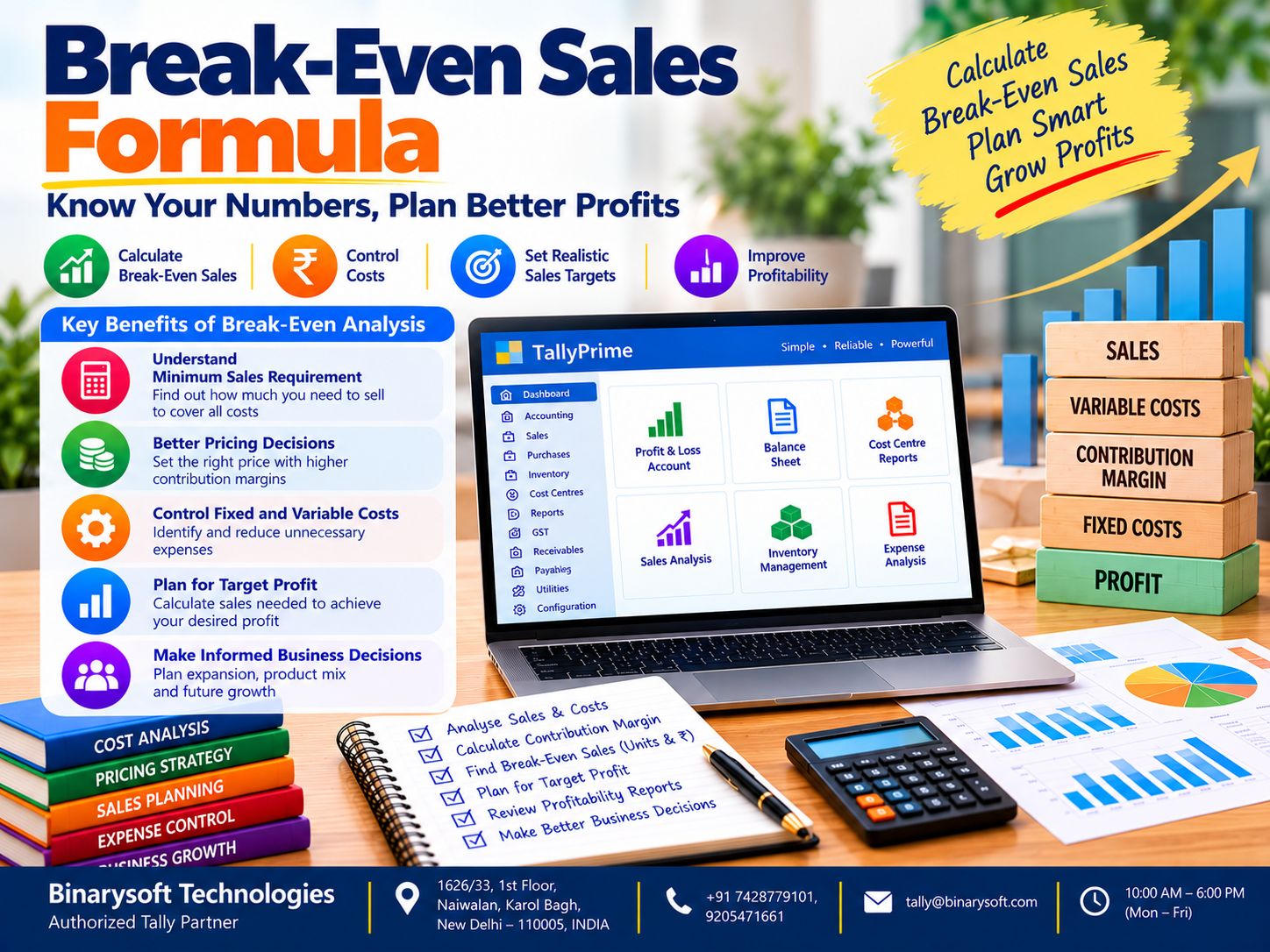
Introduction: Why Every Business Owner Should Know Their Break-Even Sales
Every business owner dreams of increasing sales, earning consistent profits and building a financially secure future.
However, higher sales do not always guarantee higher profits.
A shop may attract hundreds of customers but still struggle to cover rent, salaries and operating expenses.
Similarly, a manufacturing company may receive large orders while earning very little after paying production costs.
This creates an important question:
How much must a business sell before it starts earning a profit?
The answer lies in the break-even sales formula.
Break-even sales represent the minimum revenue required to cover all relevant fixed and variable costs within a defined period.
At this level, the business earns neither an operating profit nor an operating loss under the assumptions used.
Understanding break-even sales helps businesses establish realistic sales targets, evaluate pricing decisions and control expenses.
Accounting software such as TallyPrime can support this process by organizing sales, purchases, inventory and expense records.
This guide explains break-even sales formulas, practical calculations, common mistakes, two illustrative case studies and how TallyPrime supports financial planning.
1. What Are Break-Even Sales?
Break-even sales are the level of sales at which total revenue equals total relevant costs.
At the break-even point:
Total Sales Revenue = Total Fixed Costs + Total Variable Costs
The business has generated sufficient contribution to cover its fixed costs.
Sales below this level generally result in an operating loss.
Sales above this level generally contribute toward operating profit, assuming selling prices, costs and other conditions remain unchanged.
Simple Example
Suppose a business has monthly fixed expenses of ₹60,000.
It sells products for ₹200 each, with a variable cost of ₹120 per product.
Each product contributes ₹80 toward covering fixed expenses and generating profit.
The business must sell 750 products to recover its fixed costs.
This provides a measurable sales target.
2. An Emotional Story: The Shopkeeper Who Worked Every Day but Earned Nothing
For eleven years, Ramesh operated a stationery shop in Delhi.
His father had started the business, and Ramesh hoped to expand it for the next generation.
Every morning, he opened the shop before most nearby businesses.
He spent long hours serving customers, arranging inventory and negotiating with suppliers.
During the examination season, sales increased significantly.
Ramesh believed the business was performing well.
However, at the end of each month, very little money remained.
Rent, electricity, employee salaries and purchasing expenses consumed almost everything.
One evening, his daughter asked whether he could afford to enroll her in a professional course.
Ramesh wanted to say yes immediately.
But he was uncertain about the shop's financial position.
He realized that although he knew his daily sales, he had never calculated the minimum sales required to cover expenses.
His accountant introduced him to break-even analysis.
Together, they separated fixed expenses from variable product costs.
They calculated the contribution earned from each product category and estimated the monthly break-even sales level.
The result surprised Ramesh.
Some products generated substantial revenue but contributed very little toward fixed expenses.
Other products had stronger contribution margins.
He began monitoring product costs, reducing unnecessary expenses and reviewing pricing decisions.
Using organized accounting and inventory information from TallyPrime, he could examine sales and purchasing patterns more consistently.
The changes did not produce overnight success.
However, they gave him something he had previously lacked: financial clarity.
A few months later, Ramesh could explain his monthly sales targets and expected operating profit with greater confidence.
He also began saving systematically for his daughter's education.
For Ramesh, break-even analysis was not simply a mathematical formula. It was a way to understand whether years of hard work were creating a financially secure future.
This is an illustrative story created to explain the practical importance of break-even sales.
3. Understanding Fixed Costs and Variable Costs
Before calculating break-even sales, businesses must classify relevant expenses.
Fixed Costs
Fixed costs generally remain unchanged within a relevant activity range and period.
Examples include office rent, fixed administrative salaries, insurance and depreciation.
Suppose a shop pays ₹25,000 monthly rent.
The rent may remain ₹25,000 whether the shop sells 500 or 1,000 products.
However, fixed costs can change when business capacity or operating arrangements change.
Variable Costs
Variable costs change with production or sales activity.
Examples include raw materials, packaging, sales commissions and certain transportation expenses.
Suppose producing one product requires ₹150 of variable expenditure.
Producing 100 products would involve approximately ₹15,000 in variable costs, assuming constant unit costs.
Mixed Costs
Some expenses contain fixed and variable components.
For example, electricity charges may include a fixed connection charge and usage-based charges.
Such expenses should be separated appropriately for more reliable break-even calculations.
4. What Is the Break-Even Sales Formula?
Break-even sales can be calculated in units or monetary value.
Formula 1: Break-Even Sales in Units
Break-Even Sales (Units) = Total Fixed Costs ÷ Contribution per Unit
Where:
Contribution per Unit = Selling Price per Unit − Variable Cost per Unit
Formula 2: Break-Even Sales in Rupees
Break-Even Sales (₹) = Total Fixed Costs ÷ Contribution Margin Ratio
Where:
Contribution Margin Ratio = Contribution per Unit ÷ Selling Price per Unit
The ratio should be expressed as a decimal when used in the calculation.
These formulas assume a positive contribution margin and a consistent cost-volume relationship.
5. How to Calculate Break-Even Sales in Units
Consider a business manufacturing notebooks.
| Particulars | Amount |
|---|
| Selling Price per Notebook |
₹100 |
| Variable Cost per Notebook |
₹60 |
| Monthly Fixed Costs |
₹50,000 |
Step 1: Calculate Contribution
Contribution per Notebook:
₹100 − ₹60 = ₹40
Step 2: Calculate Break-Even Quantity
Break-Even Units:
₹50,000 ÷ ₹40 = 1,250 notebooks
The business must sell 1,250 notebooks during the month to cover the modeled costs.
Step 3: Interpret the Result
At 1,250 notebooks:
Sales Revenue = ₹1,25,000
Variable Costs = ₹75,000
Contribution = ₹50,000
Fixed Costs = ₹50,000
Operating Profit = ₹0
Sales beyond this quantity generally contribute toward profit if the underlying assumptions remain valid.
6. How to Calculate Break-Even Sales in Rupees
Using the same notebook example:
Selling Price = ₹100
Variable Cost = ₹60
Contribution = ₹40
Step 1: Calculate Contribution Margin Ratio
₹40 ÷ ₹100 = 0.40 or 40%
Step 2: Calculate Break-Even Revenue
₹50,000 ÷ 0.40 = ₹1,25,000
Therefore, the business requires monthly sales revenue of ₹1,25,000 to break even.
The rupee-based method is particularly useful when management focuses on revenue targets rather than production quantities.
7. What Is Contribution Margin?
Contribution margin represents the amount remaining after variable costs are deducted from sales revenue.
It is available to cover fixed expenses and generate operating profit.
Contribution Formula
Contribution = Sales Revenue − Variable Costs
Example
A product sells for ₹500.
Its variable cost is ₹300.
Contribution per Unit = ₹200
Contribution Margin Ratio = ₹200 ÷ ₹500 = 40%
A higher contribution margin generally reduces the sales required to cover fixed expenses, assuming other conditions remain unchanged.
Businesses should review contribution alongside customer demand, competition and product quality.
8. Break-Even Sales vs Break-Even Point
The terms are closely related but may be expressed differently.
| Basis | Break-Even Sales | Break-Even Point |
|---|
| Meaning |
Sales needed to cover costs |
Activity level where revenue equals costs |
| Measurement |
Usually revenue |
Units or revenue |
| Purpose |
Establish sales targets |
Evaluate operating viability |
| Example |
₹5 lakh sales |
2,000 units or ₹5 lakh |
| Business Application |
Revenue planning |
Pricing and cost-volume-profit analysis |
Both concepts help management understand the minimum activity required to avoid an operating loss.
9. How to Calculate Sales Required for a Target Profit
Break-even analysis can also help businesses determine sales targets for desired profits.
Target Profit Formula
Required Units = (Fixed Costs + Target Operating Profit) ÷ Contribution per Unit
Example
Fixed Costs = ₹80,000
Selling Price = ₹250
Variable Cost = ₹150
Contribution = ₹100
Target Operating Profit = ₹40,000
Required Units:
(₹80,000 + ₹40,000) ÷ ₹100
= 1,200 units
Required Revenue:
1,200 × ₹250 = ₹3,00,000
This calculation provides a target based on operating profit before any separately excluded financing costs or taxes.
10. What Is Margin of Safety?
Margin of safety measures how much actual or expected sales exceed break-even sales.
It indicates the extent to which sales can decline before the business reaches the break-even level.
Formula
Margin of Safety = Actual Sales − Break-Even Sales
Margin of Safety Percentage = Margin of Safety ÷ Actual Sales × 100
Example
Actual Monthly Sales = ₹5,00,000
Break-Even Sales = ₹3,50,000
Margin of Safety = ₹1,50,000
Margin of Safety Percentage:
₹1,50,000 ÷ ₹5,00,000 × 100
= 30%
A 30% margin of safety indicates that sales could decline by approximately 30% before reaching break-even, assuming the modeled costs and sales mix remain unchanged.
11. Why Break-Even Analysis Is Important for Businesses
Better Pricing Decisions
Businesses can evaluate whether selling prices provide sufficient contribution.
Realistic Sales Targets
Management can establish measurable revenue and quantity targets.
Expense Control
Break-even analysis highlights the impact of fixed and variable costs.
Investment Planning
Businesses can estimate additional sales required after expanding operations.
Product Profitability
Contribution analysis helps identify products with stronger financial potential.
Financial Risk Management
Margin of safety provides information about exposure to declining sales.
Improved Budgeting
Break-even calculations support operating budgets and profit planning.
12. How TallyPrime Helps with Break-Even Analysis
TallyPrime provides accounting and inventory information that supports break-even calculations.
Sales Reporting
Businesses can review historical sales quantities, values and product-wise transactions.
Expense Management
Separate expense ledgers help management identify relevant fixed and variable costs.
Purchase Accounting
Purchase records support analysis of raw material and product acquisition costs.
Inventory Management
Stock records provide information about quantities and inventory valuations.
Profit & Loss Reporting
Financial reports help management understand overall income and expenses.
Cost-Centre Accounting
Cost centres can help businesses analyze costs associated with departments or activities.
Financial Data Export
Businesses can use relevant accounting data in spreadsheets or financial models to calculate break-even sales.
TallyPrime supports the underlying accounting analysis; businesses may need separate calculations to classify mixed costs, determine contribution margins and model break-even scenarios.
13. Step-by-Step: Calculating Break-Even Sales Using TallyPrime Data
Step 1: Review sales reports. Identify selling prices, quantities and revenue.
Step 2: Examine expense ledgers. Collect rent, salaries, utilities and other operating costs.
Step 3: Classify expenses. Separate fixed, variable and mixed costs using appropriate assumptions.
Step 4: Review inventory and purchase data. Estimate variable material or product costs.
Step 5: Calculate contribution. Deduct variable cost per unit from selling price.
Step 6: Determine total fixed costs. Use the same reporting period as the sales analysis.
Step 7: Calculate break-even sales. Apply the appropriate unit-based or revenue-based formula.
Step 8: Prepare target-profit scenarios. Estimate the sales needed for desired operating profit.
Step 9: Compare actual sales. Calculate the margin of safety.
Step 10: Review regularly. Update calculations when prices, expenses or product mix change.
This process helps management connect accounting records with practical business planning.
14. Case Study 1: Manufacturing Business Improves Profit Planning
Business Background
A small manufacturer produced household storage containers.
The business had increasing sales but struggled to achieve consistent operating profits.
Challenge
Management had not calculated the contribution earned from each container.
Solution
The finance team reviewed material purchases, production expenses and sales records.
Relevant data was organized through TallyPrime and used in a separate break-even calculation.
Illustrative Calculation
Monthly Fixed Costs = ₹1,20,000
Selling Price per Container = ₹400
Variable Cost per Container = ₹250
Contribution per Container = ₹150
Break-Even Units:
₹1,20,000 ÷ ₹150 = 800 containers
Management discovered that monthly sales below 800 containers would not cover the modeled fixed expenses.
The company used this information to review pricing, production targets and material costs.
Key Learning
Knowing the break-even quantity helps manufacturers establish realistic production and sales targets.
This is an illustrative case study, not a documented customer implementation.
15. Case Study 2: Retail Business Evaluates a New Store
Business Background
A retailer planned to open a second outlet.
Management expected higher revenue but was concerned about additional rent and salaries.
Challenge
The business needed to estimate the sales required to support the new location.
Solution
The finance team prepared a break-even model using projected fixed costs and the expected contribution margin.
Historical sales and expense records from TallyPrime supported the assumptions.
Illustrative Calculation
Monthly Fixed Costs = ₹2,00,000
Expected Contribution Margin Ratio = 35%
Break-Even Sales:
₹2,00,000 ÷ 0.35
= Approximately ₹5,71,429
Management concluded that the outlet would need approximately ₹5.72 lakh in monthly revenue to cover the modeled operating costs.
The team compared this requirement with realistic customer demand before proceeding.
Key Learning
Break-even analysis helps businesses evaluate expansion decisions before committing to additional fixed expenses.
This is an illustrative case study intended to demonstrate potential business benefits.
16. How Changes in Costs Affect Break-Even Sales
Break-even sales are sensitive to cost changes.
Increase in Fixed Costs
Higher rent or administrative salaries increase the break-even point.
Increase in Variable Costs
Higher raw material or packaging costs reduce contribution per unit.
Increase in Selling Price
A higher selling price can improve contribution, provided demand remains sufficient.
Reduction in Operating Costs
Reducing unnecessary expenditure can lower the break-even requirement.
Changes in Product Mix
Selling more low-margin products may increase the overall revenue required to break even.
Businesses should calculate alternative scenarios before making significant pricing or investment decisions.
17. Break-Even Analysis for Multiple Products
Businesses selling several products must consider different contribution margins.
For example:
| Product | Selling Price | Variable Cost | Contribution |
|---|
| Product A |
₹200 |
₹120 |
₹80 |
| Product B |
₹500 |
₹350 |
₹150 |
| Product C |
₹1,000 |
₹700 |
₹300 |
Each product contributes a different amount toward fixed expenses.
A combined break-even calculation requires a weighted contribution margin based on the expected sales mix.
If the sales mix changes significantly, the combined break-even point may also change.
For multi-product businesses, contribution margin ratios weighted by expected revenue shares can support revenue-based break-even calculations.
18. Common Mistakes in Break-Even Calculations
Incorrect Cost Classification
Treating variable expenses as fixed costs can distort the calculation.
Ignoring Mixed Costs
Electricity and other semi-variable expenses may require separation.
Using Unrealistic Selling Prices
Discounts and market competition can reduce actual selling prices.
Ignoring Product Mix
Different products may have significantly different contribution margins.
Using Outdated Costs
Material price changes can make previous calculations unreliable.
Confusing Profit with Cash Flow
Break-even analysis measures modeled operating profitability, not cash availability.
Ignoring Capacity Constraints
A calculated break-even quantity may exceed available production capacity.
Treating the Result as Guaranteed
Break-even analysis is a planning model, not a guarantee of future financial performance.
19. Limitations of Break-Even Analysis
Break-even analysis is useful but depends on simplifying assumptions.
It commonly assumes that selling prices and variable costs per unit remain constant within the relevant range.
It also assumes fixed costs remain unchanged over the period analyzed.
Real businesses may experience volume discounts, production inefficiencies, seasonal demand and changing product mixes.
The basic model also does not automatically account for financing arrangements, taxes, working capital requirements or cash collection delays.
Therefore, businesses should combine break-even calculations with cash flow forecasts, market analysis and broader financial planning.
20. Best Practices for Improving Break-Even Performance
Monitor contribution margins. Identify products generating stronger contributions.
Review fixed expenses. Avoid unnecessary long-term commitments.
Control variable costs. Improve purchasing and production efficiency.
Evaluate pricing carefully. Consider customer demand and competition.
Reduce avoidable wastage. Monitor materials and inventory movement.
Prepare realistic budgets. Use reliable historical and projected information.
Track margin of safety. Understand exposure to declining sales.
Review product mix. Balance demand, profitability and operational capacity.
Update calculations regularly. Recalculate when important costs change.
Use accurate accounting records. Maintain reliable sales, expense and inventory information.
These practices help businesses improve financial discipline and profitability planning.
21. How Binarysoft Technologies Helps Businesses Use TallyPrime
Binarysoft Technologies, an Authorized Tally Partner, helps businesses explore TallyPrime solutions for accounting, inventory and financial management.
Accounting Setup
Assistance with company configuration, ledgers and voucher recording.
Sales Management
Guidance on recording and reviewing sales transactions.
Expense Tracking
Understanding relevant expense ledgers and financial reports.
Inventory Management
Exploring stock records, purchases and inventory valuation features.
Cost-Centre Accounting
Using cost centres for suitable departmental or activity-wise analysis.
Profitability Reporting
Understanding Profit & Loss and relevant sales reports.
Financial Data Management
Preparing accounting information for additional analysis and business planning.
TallyPrime Cloud
Exploring suitable hosted arrangements for authorized remote accounting access.
Organized accounting information provides a useful foundation for contribution analysis, break-even calculations and financial decision-making.
22. Conclusion: Break-Even Sales Turn Business Goals into Measurable Targets
Break-even sales analysis helps businesses understand the minimum revenue required to cover operating costs.
It provides valuable information for pricing, budgeting, production planning and business expansion.
By separating fixed and variable costs, businesses can calculate contribution margins and determine the sales volume needed to avoid operating losses.
The margin of safety helps management understand how much sales can decline before reaching the break-even point.
For manufacturers, this information supports production targets.
For retailers, it helps evaluate store profitability.
For service businesses, it can support pricing and capacity planning.
TallyPrime contributes by providing organized sales, expense, purchase and inventory records that support financial analysis.
However, accurate break-even calculations still require appropriate cost classification, realistic assumptions and regular management review.
Ultimately, successful business management involves more than increasing revenue.
It requires understanding how sales translate into profit.
When business owners know their break-even sales, they can plan with greater confidence, control expenses more effectively and pursue sustainable growth.
Powered by Binarysoft Technologies
Authorized Tally Partner
Location: 1626/33, 1st Floor, Naiwalan, Karol Bagh, New Delhi – 110005, INDIA
Contact Us: +91 7428779101, 9205471661
Email Us: tally@binarysoft.com
Business Hours: 10:00 AM – 6:00 PM, Monday to Friday
Frequently Asked Questions
How often should break-even sales be recalculated?
Businesses should update calculations whenever significant costs, prices or sales mix assumptions change.
Can businesses calculate break-even for multiple products?
Yes. Multi-product calculations generally require a weighted contribution margin based on expected sales mix.
How can Binarysoft Technologies help businesses?
Binarysoft Technologies can assist businesses with TallyPrime accounting, inventory, reporting, configuration and suitable cloud hosting arrangements.
Is break-even analysis the same as cash flow analysis?
No. Break-even analysis focuses on modeled profitability, while cash flow analysis examines cash receipts and payments.
CA. Aaryan Kanodia focuses on GST reporting, bookkeeping systems, and financial process improvement. He works with businesses to simplify routine accounting activities and maintain records suitable for compliance and internal review.