Call CA Tally HelpDesk
+91 9205471661,
7428779101
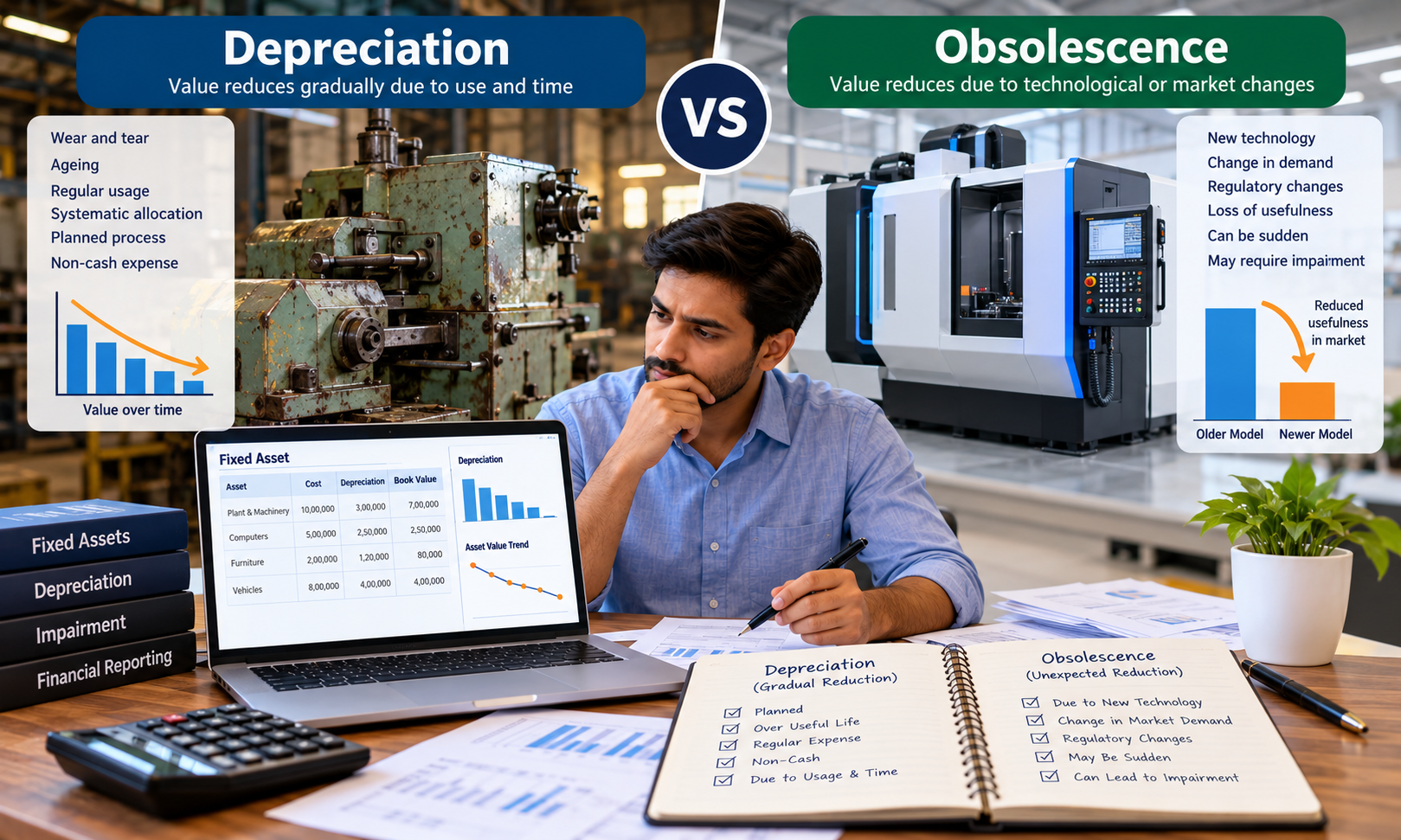
Introduction: Why Depreciation and Obsolescence Matter for Businesses in 2026
In 2026, Indian businesses are investing in machinery, computers, vehicles, automation systems and digital infrastructure to improve productivity and remain competitive. However, purchasing an asset is only the beginning of its financial journey. Equipment gradually loses its economic value through usage, ageing and the passage of time, while rapid technological developments can make even recently purchased assets unsuitable for modern business requirements. This creates an important accounting challenge: understanding the difference between depreciation and obsolescence. Depreciation systematically allocates an asset's depreciable cost over its useful life, while obsolescence refers to a decline in usefulness caused by technological, commercial, functional or regulatory changes. Confusing these concepts can result in inaccurate asset valuations, misleading profits and poor replacement decisions. With structured accounting practices and software such as TallyPrime, businesses can record depreciation, maintain fixed asset accounts, recognize necessary adjustments and improve financial reporting. Understanding both concepts helps organizations protect investments and make better long-term financial decisions.
A Business Owner's Story: The Machine That Still Worked but Could No Longer Compete
Rakesh owned a printing and packaging business in Delhi.
After years of hard work, he had invested ₹12 lakh in a printing machine that helped his company handle large customer orders.
The machine worked reliably, and Rakesh expected it to remain useful for several more years.
However, the printing industry was changing.
Competitors began adopting newer digital equipment capable of producing customized packaging faster and with lower setup costs.
Customers increasingly demanded shorter delivery times and smaller production batches.
Rakesh's machine was still operational, but it was becoming commercially inefficient.
One afternoon, an important customer moved a large order to another supplier because Rakesh could not meet the revised delivery requirements.
The loss affected him deeply. He remembered the financial sacrifices he had made to purchase the machine.
His accountant explained that the machine had two separate accounting considerations.
First, its cost was being allocated through regular depreciation.
Second, changing technology and customer requirements had reduced its economic usefulness sooner than expected.
Rakesh reviewed the machine's remaining value, expected future cash flows and replacement options.
He then began planning equipment investments more carefully and maintaining systematic fixed asset records.
He realized that an asset does not need to stop working before it stops being valuable to a business.
This is an illustrative story created for educational purposes.
1. What Is Depreciation in Accounting?
Depreciation is the systematic allocation of the depreciable amount of a tangible fixed asset over its estimated useful life.
Businesses purchase fixed assets such as machinery, furniture, vehicles, computers and equipment to support operations over several accounting periods.
Instead of charging the entire depreciable cost to one period, depreciation distributes that cost across the periods benefiting from the asset.
Depreciation is generally a non-cash accounting expense because the cash outflow normally occurs when the asset is purchased.
Example of Depreciation
Suppose a manufacturing company purchases machinery for ₹10,00,000.
The estimated useful life is five years, and the expected residual value is ₹1,00,000.
Using the straight-line method:
\[ \text{Annual Depreciation}=\frac{\text{Cost}-\text{Residual Value}}{\text{Useful Life}} \]
\[ =\frac{₹10,00,000-₹1,00,000}{5} \]
Annual depreciation
₹1,80,000
Based on straight-line depreciation over five years
The business records ₹1,80,000 as annual depreciation, assuming no changes in estimates or impairment.
This reduces accounting profit and the carrying amount of the asset over time.
2. What Is Obsolescence in Accounting?
Obsolescence occurs when an asset loses economic usefulness because of changes in technology, market conditions, business requirements or regulations.
An obsolete asset may still be physically functional but no longer suitable or economically beneficial for its intended purpose.
For example, a business may own an older computer system that operates correctly but cannot support modern software or security requirements.
Similarly, manufacturing equipment may become commercially outdated when newer machines deliver substantially higher output at lower operating costs.
Obsolescence is not necessarily the same as physical deterioration.
It can arise suddenly and may require management to reassess an asset's useful life, residual value or recoverable amount.
Obsolescence does not automatically require an immediate full write-off. The appropriate accounting treatment depends on the asset's remaining economic benefits and applicable accounting standards.
3. Types of Obsolescence in Business Accounting
Technological Obsolescence
Technological obsolescence occurs when newer technology reduces the usefulness or competitiveness of existing equipment.
Examples include outdated computers, older manufacturing machines and legacy software systems.
Functional Obsolescence
Functional obsolescence arises when an asset no longer meets the operational requirements of a business.
For example, a warehouse handling system may become unsuitable after the business significantly expands its storage capacity.
Economic or Commercial Obsolescence
This occurs when external market conditions reduce an asset's ability to generate economic benefits.
A production machine designed for a product experiencing declining demand may become commercially obsolete.
Regulatory Obsolescence
Changes in safety standards, environmental regulations or industry requirements can make existing equipment unsuitable or prohibit its continued use.
Businesses must evaluate whether upgrades, modifications or replacements are necessary.
4. Difference Between Depreciation and Obsolescence
|
Basis
|
Depreciation
|
Obsolescence
|
|---|
|
Meaning
|
Systematic allocation of asset cost
|
Loss of economic usefulness
|
|
Main causes
|
Use, ageing and consumption of benefits
|
Technology, market, functional or regulatory changes
|
|
Nature
|
Planned accounting process
|
Economic or operational condition
|
|
Timing
|
Recognized over useful life
|
Can arise unexpectedly
|
|
Calculation
|
Based on depreciation method
|
Requires assessment of economic impact
|
|
Accounting treatment
|
Depreciation expense
|
May lead to revised estimates, impairment or disposal
|
|
Predictability
|
Generally more predictable
|
Often difficult to forecast
|
|
Financial impact
|
Gradual expense recognition
|
Potential accelerated depreciation or impairment loss
|
|
Asset condition
|
May remain fully operational
|
May still be physically functional
|
|
Business response
|
Routine accounting review
|
Reassessment, upgrading, replacement or disposal
|
The key distinction is that depreciation is an accounting allocation process, whereas obsolescence is a condition affecting an asset's usefulness.
Both concepts can apply to the same asset.
5. Can an Asset Become Obsolete Before It Is Fully Depreciated?
Yes. An asset can become obsolete long before the end of its originally estimated useful life.
Consider a company that purchases computer equipment for ₹5,00,000 and expects to use it for five years.
After two years, the equipment may become unsuitable because newly required applications are incompatible with its hardware.
The company must then evaluate whether the remaining carrying amount can be recovered through continued use or disposal.
If the asset's recoverable amount is below its carrying amount, an impairment loss may need to be recognized under the applicable accounting framework.
Management may also need to revise the remaining useful life or depreciation estimates.
6. Methods of Calculating Depreciation
Straight-Line Method
The straight-line method allocates an equal depreciation amount over the asset's useful life, assuming unchanged estimates.
It is commonly used when economic benefits are expected to be consumed relatively evenly.
Written-Down Value Method
Under the written-down value method, depreciation is calculated by applying a rate to the asset's opening carrying amount.
For example, machinery with an opening value of ₹5,00,000 and an illustrative depreciation rate of 20% would have first-year depreciation of ₹1,00,000.
The following year's depreciation would be calculated on the reduced carrying amount, subject to relevant adjustments.
Units of Production Method
This method allocates depreciation according to actual usage or production output.
It can be suitable for assets whose consumption is closely related to operating activity.
The selected method should reflect the expected pattern of consumption of the asset's economic benefits and comply with applicable accounting requirements.
7. Practical Example: Depreciation vs Obsolescence
Suppose a company purchases equipment for ₹8,00,000 with an estimated useful life of eight years and no residual value.
Annual straight-line depreciation is ₹1,00,000.
After three years, accumulated depreciation equals ₹3,00,000.
The asset's carrying amount is therefore ₹5,00,000.
However, a technological development significantly reduces the equipment's usefulness, and its recoverable amount is assessed at ₹2,00,000.
Carrying amount
₹5,00,000
Recoverable amount
₹2,00,000
Asset Value Before and After Impairment
₹3,00,000
The company may need to recognize an impairment loss of ₹3,00,000, subject to applicable accounting standards.
This example demonstrates that scheduled depreciation and an unexpected decline in recoverable value are different accounting considerations.
8. Accounting Treatment of Depreciation and Obsolescence
Depreciation Journal Entry
Depreciation is generally recorded by debiting depreciation expense and crediting accumulated depreciation or the relevant fixed asset account, depending on the accounting system used.
For annual depreciation of ₹1,00,000:
|
Particulars
|
Debit
|
Credit
|
|---|
|
Depreciation Expense A/c
|
₹1,00,000
|
—
|
|
Accumulated Depreciation A/c
|
—
|
₹1,00,000
|
Impairment Due to Obsolescence
When an impairment assessment establishes that an asset's carrying amount exceeds its recoverable amount, an impairment loss may be recorded.
|
Particulars
|
Debit
|
Credit
|
|---|
|
Impairment Loss A/c
|
₹3,00,000
|
—
|
|
Accumulated Impairment A/c
|
—
|
₹3,00,000
|
The impairment example assumes the ₹3,00,000 loss calculated earlier.
Indian businesses should apply the appropriate accounting standards, including AS 28 or Ind AS 36 where applicable. Depreciation estimates and asset disposals must also be treated according to the relevant framework.
9. How TallyPrime Helps Manage Depreciation and Obsolescence
TallyPrime supports fixed asset accounting through ledgers, journal vouchers and financial reports.
Fixed Asset Ledger Management
Businesses can create separate fixed asset ledgers for machinery, computers, furniture, vehicles and office equipment.
These ledgers help organize acquisition costs, depreciation adjustments and asset disposals.
Depreciation Journal Entries
TallyPrime allows users to record depreciation through journal vouchers. Depreciation can be recorded periodically according to the company's accounting policies.
Monitoring Asset Values
Fixed asset balances appear in the Balance Sheet, helping management review the carrying amounts reflected in accounting records.
Recording Impairment and Write-Offs
When an asset becomes obsolete, the accounting team can record an appropriate impairment adjustment or disposal entry through relevant vouchers.
The amount must be determined through an appropriate accounting assessment rather than assumed automatically.
Financial Reporting
TallyPrime helps businesses review the impact of depreciation and impairment adjustments on expenses, profits and asset balances.
Important: TallyPrime does not automatically determine an asset's depreciation rate, technological obsolescence or recoverable amount. These require appropriate calculations, assessments and accounting entries.
10. Step-by-Step: Recording Depreciation in TallyPrime
Step 1: Create the Fixed Asset Ledger
Open TallyPrime and select the relevant company.
Create a ledger such as Plant and Machinery under the Fixed Assets group.
Step 2: Create a Depreciation Ledger
Create a ledger named Depreciation under Indirect Expenses.
Step 3: Calculate Depreciation
Determine the depreciation amount using the appropriate accounting method and applicable financial reporting requirements.
Step 4: Open the Journal Voucher
Navigate to:
Alt+G (Go To) → Create Voucher → F7 (Journal)
Step 5: Enter the Depreciation Adjustment
Debit the Depreciation ledger and credit the appropriate fixed asset ledger, following TallyPrime's direct-credit workflow.
For example:
Depreciation A/c Dr. ₹50,000
To Machinery A/c ₹50,000
Step 6: Save the Voucher
Press Ctrl+A to save the entry.
Step 7: Review Financial Statements
Open the Profit and Loss Statement and Balance Sheet to verify the accounting impact.
For obsolescence-related impairment, create suitable impairment accounts and record the approved adjustment using the correct accounting treatment. Avoid crediting the asset twice where accumulated depreciation or impairment has already been accounted for.
11. Case Study 1: Manufacturing Company Faces Technological Obsolescence
Illustrative case study: A manufacturing company evaluates an ageing production machine.
A manufacturing company in Faridabad purchased production equipment for ₹15 lakh.
The equipment was expected to remain useful for ten years.
After four years, competitors began using more efficient automated machines.
Although the existing equipment remained operational, its production costs were becoming uncompetitive.
The Challenge
The company needed to determine whether continuing with the existing machine was financially sensible.
The Solution
Management reviewed the machine's operating costs, remaining useful life and recoverable amount.
The accounting team examined accumulated depreciation and considered whether an impairment adjustment was necessary.
TallyPrime was used to maintain the asset ledger and record the resulting accounting adjustments.
Illustrative Results
|
Particulars
|
Amount
|
|---|
|
Original machine cost
|
₹15,00,000
|
|
Accumulated depreciation
|
₹6,00,000
|
|
Carrying amount
|
₹9,00,000
|
|
Assessed recoverable amount
|
₹5,00,000
|
|
Impairment loss
|
₹4,00,000
|
The company recognized the financial impact of technological obsolescence and used the assessment to support its replacement decision.
Key takeaway: Regular depreciation alone may not adequately reflect a significant decline in an asset's recoverable value.
12. Case Study 2: IT Services Company Reviews Outdated Computers
Illustrative case study: A professional services company improves its computer replacement planning.
An IT services company in Gurugram maintained several desktop computers purchased for development and administrative work.
The computers were originally expected to remain useful for five years.
However, newer software applications required more powerful processors and updated security capabilities.
The Challenge
Employees experienced slower performance, and some computers could no longer support essential applications.
The equipment was physically functional but increasingly unsuitable for business operations.
The Solution
Management reviewed the computer assets individually, assessed their remaining economic usefulness and developed a phased replacement plan.
The accounting team maintained depreciation records and recorded necessary adjustments in TallyPrime.
Illustrative Results
|
Particulars
|
Amount
|
|---|
|
Original equipment cost
|
₹6,00,000
|
|
Accumulated depreciation
|
₹2,40,000
|
|
Carrying amount
|
₹3,60,000
|
|
Assessed recoverable amount
|
₹1,20,000
|
|
Impairment loss
|
₹2,40,000
|
The business obtained a clearer view of the financial impact of outdated technology and planned future equipment purchases more systematically.
Key takeaway: Technological obsolescence can affect computers and digital equipment even when they remain operational.
13. Why Depreciation and Obsolescence Matter for Financial Statements
Depreciation and obsolescence affect the Profit and Loss Statement and Balance Sheet.
Depreciation is recognized systematically over an asset's useful life, while impairment losses may arise when an asset's recoverable amount falls below its carrying amount.
Both can reduce reported profit, but neither necessarily involves an immediate cash payment when the accounting adjustment is recorded.
Accurate asset accounting helps businesses avoid overstating asset values and profitability.
It also supports better capital expenditure planning, equipment replacement decisions and financial reporting.
14. Depreciation and Obsolescence Under Indian Taxation
Financial accounting depreciation and income tax depreciation are not necessarily calculated using the same methods or rates.
For income tax purposes, depreciation is generally governed by Section 32 of the Income-tax Act, 1961, subject to applicable provisions and the relevant assessment year.
Tax depreciation commonly follows the block-of-assets system.
Obsolescence does not automatically create a separate tax deduction equal to an accounting impairment loss.
The tax treatment of discarded, sold or demolished assets depends on the applicable statutory provisions and circumstances.
Businesses should consult their chartered accountant before claiming deductions or making significant asset write-offs.
15. Best Practices for Managing Fixed Assets
Businesses should maintain an updated fixed asset register containing acquisition dates, purchase costs, locations, useful lives and depreciation details.
Management should periodically review whether equipment remains suitable for current operational requirements.
Technology-intensive businesses may need more frequent reviews because equipment and software requirements can change rapidly.
Significant impairment assessments should be supported by appropriate evidence, such as valuation reports, operating forecasts or disposal estimates.
TallyPrime can help maintain the related accounting records, while separate asset registers and management reviews can support detailed asset-level decisions.
Conclusion
Depreciation and obsolescence are important but distinct concepts in business accounting.
Depreciation systematically allocates the cost of fixed assets over their useful lives, while obsolescence reflects a decline in economic usefulness caused by technological, commercial, functional or regulatory changes.
An asset can become obsolete before it is fully depreciated, making regular asset reviews essential.
For manufacturers, distributors, retailers and service providers, understanding both concepts helps improve asset valuation, financial reporting and investment planning.
TallyPrime supports fixed asset accounting through ledgers, depreciation journal entries, impairment adjustments and financial statements.
By combining accurate accounting records with regular assessments of asset usefulness, businesses can make more informed decisions and strengthen long-term financial management.
Powered by Binarysoft Technologies
Authorized Tally Partner
Location: 1626/33, 1st Floor, Naiwalan, Karol Bagh, New Delhi – 110005, INDIA
Contact us: +91 7428779101, 9205471661
Email us: tally@binarysoft.com
Business Hours: 10:00 AM – 6:00 PM, Monday to Friday
Website: tallyatcloud.com
Frequently Asked Questions
How can businesses reduce losses caused by obsolescence?
Businesses can review technology requirements regularly, maintain asset registers, evaluate replacement plans and assess the economic usefulness of equipment before making major investment decisions.
Which accounting standards address asset impairment in India?
AS 28 and Ind AS 36 address impairment of assets under their respective applicable financial reporting frameworks.
What happens when an asset becomes obsolete?
Management should reassess the asset's useful life, recoverable amount and future economic benefits. Depending on the circumstances, impairment, revised depreciation or disposal may be appropriate.
How is depreciation calculated?
Depreciation can be calculated using methods such as straight-line, written-down value or units of production, depending on the applicable accounting policies.
CA. Harshit Gaurwaadi is a practicing Chartered Accountant with hands-on experience in accounting systems, GST compliance, and MSME advisory. He regularly works with small and mid-sized businesses to streamline inventory, billing, and statutory processes using modern accounting software. His articles focus on practical, ground-level challenges faced by Indian traders and professionals.