Call CA Tally HelpDesk
+91 9205471661,
7428779101
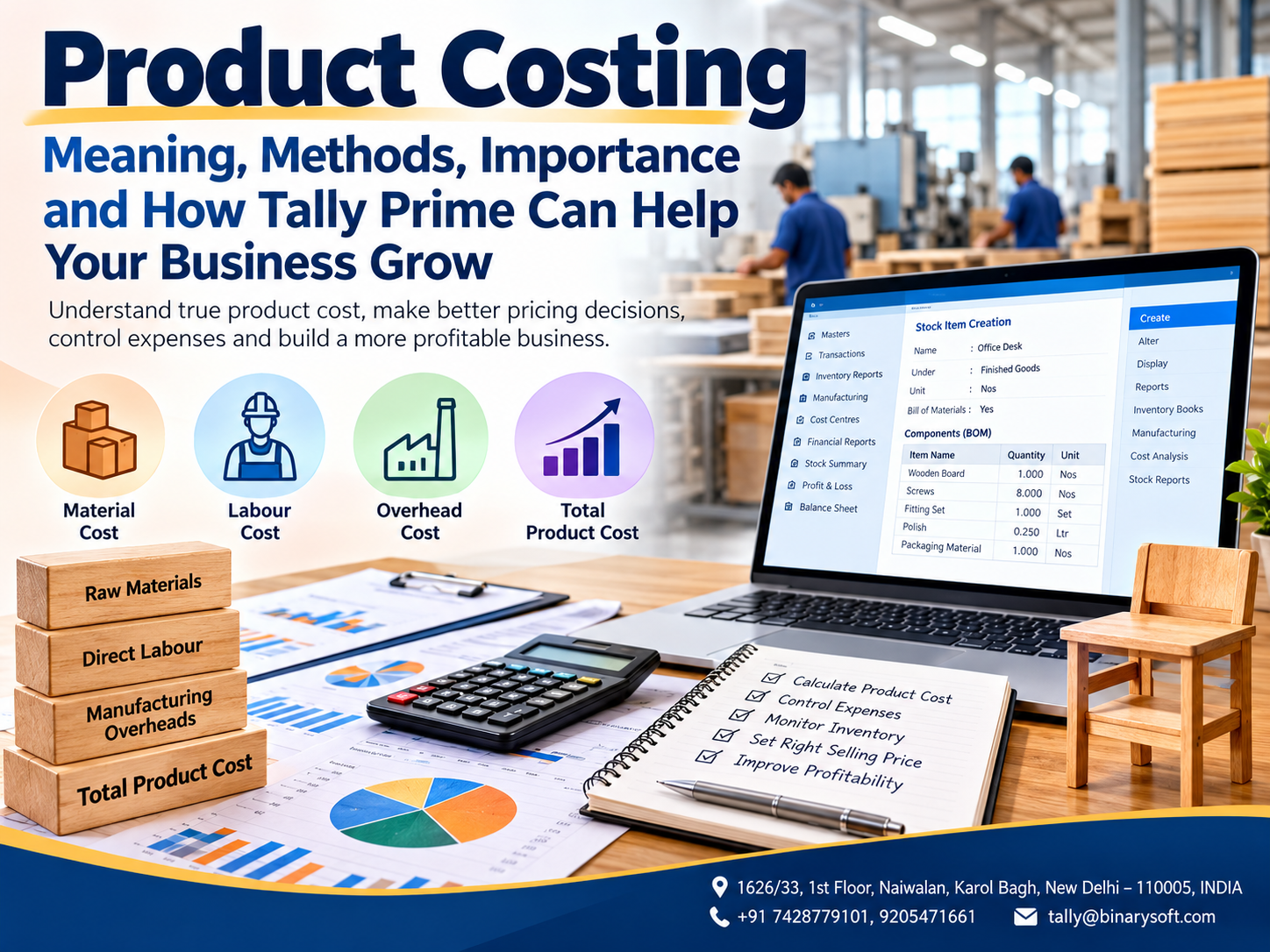
Introduction: Why Understanding Product Costs Is Essential for Business Success
Every successful business depends on one important financial principle: understanding how much it costs to produce or purchase a product before deciding its selling price.
Whether a business manufactures furniture, produces garments, assembles electronic equipment or distributes consumer goods, accurate product costing plays a crucial role in determining profitability.
Many businesses focus primarily on increasing sales without carefully examining the expenses involved in delivering their products. Unfortunately, higher sales do not always translate into higher profits.
A company may generate impressive revenue but still struggle financially because of rising raw material prices, inefficient production processes, excessive wastage or inaccurate cost calculations.
Product costing helps businesses identify these hidden expenses and make informed financial decisions.
By calculating direct materials, labour expenses and manufacturing overheads, businesses can understand their actual production costs and establish sustainable pricing strategies.
Modern accounting solutions such as Tally Prime make this process more manageable by connecting inventory records, manufacturing transactions, accounting information and financial reports.
This guide explains product costing, its importance, major costing methods, practical calculations and how Tally Prime can help businesses strengthen cost management and profitability.
A Business Owner's Story: When Increasing Sales Failed to Increase Profits
Rajesh owned a small furniture manufacturing business in Delhi.
For nearly fifteen years, he had worked tirelessly to build his company. His workshop manufactured office desks, wooden cabinets and customised furniture for local businesses.
As customer orders increased, Rajesh believed his business was becoming more successful.
He employed additional workers, purchased new machinery and expanded his production capacity.
However, something unexpected happened.
Despite increasing sales, the company's bank balance continued to decline.
Monthly expenses became difficult to manage. Supplier payments were delayed, and employee salaries sometimes required personal financial support.
One evening, Rajesh sat in his workshop reviewing invoices and production records.
His daughter, who had recently completed her accounting studies, asked him a simple question:
"Papa, do you know exactly how much it costs to manufacture one office desk?"
Rajesh confidently replied that each desk cost approximately ₹3,500.
But after examining the records, they discovered several overlooked expenses.
The calculation excluded electricity, machinery maintenance, packaging materials, production wastage and certain labour expenses.
The actual manufacturing cost was approximately ₹4,250.
Rajesh had been selling some desks for ₹4,400, believing he was earning a healthy profit.
In reality, his margin was extremely small before considering additional administrative and selling expenses.
That discovery changed his approach to business management.
He started maintaining detailed inventory records, monitoring manufacturing expenses and reviewing product profitability regularly.
With improved cost visibility and disciplined financial reporting, he gradually adjusted selling prices, reduced wastage and improved purchasing decisions.
His experience demonstrates an important lesson:
A business cannot consistently protect its profits unless it understands the actual cost of its products.
What Is Product Costing?
Product costing is the process of identifying, calculating and allocating expenses associated with manufacturing or acquiring a product.
It helps businesses determine the total cost incurred in bringing a product to its finished or saleable condition.
For manufacturing businesses, product costing generally includes three major components:
-
Direct material costs
-
Direct labour costs
-
Manufacturing overheads
These expenses collectively determine the manufacturing cost of a product.
Product Costing Formula
Total Manufacturing Cost = Direct Materials + Direct Labour + Manufacturing Overheads
The average manufacturing cost per unit can be calculated as:
Cost Per Unit = Total Manufacturing Cost ÷ Total Units Produced
For example, suppose a company manufactures 1,000 products during a particular period.
Its manufacturing expenses are:
| Cost Component | Amount |
|---|
| Direct Materials |
₹2,50,000 |
| Direct Labour |
₹1,20,000 |
| Manufacturing Overheads |
₹80,000 |
| Total Manufacturing Cost |
₹4,50,000 |
| Units Produced |
1,000 |
| Manufacturing Cost Per Unit |
₹450 |
The average manufacturing cost of each product is ₹450.
This information helps management evaluate selling prices, production efficiency and potential profit margins.
However, businesses must also consider selling, distribution and administrative expenses when assessing overall profitability.
Major Components of Product Costing
1. Direct Material Costs
Direct materials are the raw materials that become part of the finished product.
Examples include wood used in furniture manufacturing, fabric used in garment production and metal components used in machinery.
Material costs may include purchase prices and directly attributable expenses required to bring materials into usable condition.
Accurate material costing helps businesses identify expensive inputs, control wastage and improve procurement decisions.
2. Direct Labour Costs
Direct labour includes wages and related employment costs attributable to workers directly involved in manufacturing products.
For example, wages paid to carpenters assembling furniture or technicians operating production machinery may form part of direct labour costs.
Monitoring labour expenses helps businesses evaluate productivity and identify opportunities for operational improvement.
3. Manufacturing Overheads
Manufacturing overheads represent production-related expenses that cannot be directly traced to individual products without allocation.
Common examples include factory electricity, machinery depreciation, equipment maintenance, factory rent and production supervision.
These expenses must be allocated using reasonable and consistent methods.
Ignoring manufacturing overheads can significantly underestimate actual production costs.
Different Methods of Product Costing
Businesses use different costing methods depending on their industry, production structure and operational requirements.
1. Job Costing
Job costing calculates expenses separately for individual customer orders, projects or production jobs.
It is suitable for businesses manufacturing customised products.
Examples include furniture manufacturers, printing businesses, fabrication workshops and customised equipment producers.
Each job receives its own cost calculation based on materials, labour and applicable overheads.
Business benefit: Management can identify the profitability of individual customer orders and improve future quotations.
2. Process Costing
Process costing is used when businesses manufacture large quantities of similar products through continuous production processes.
Examples include chemical manufacturing, food processing, cement production and textile manufacturing.
Production expenses are accumulated for a process or department and allocated across the output produced.
Business benefit: Companies can monitor process efficiency and calculate average production costs.
3. Batch Costing
Batch costing calculates the total production cost of a specific batch of products.
It is commonly used in pharmaceutical manufacturing, bakeries, garment production and packaged food businesses.
For example, a bakery producing 2,000 packets of biscuits can calculate the expenses incurred for that production batch.
The batch cost is then divided by the number of usable units produced.
Business benefit: Businesses can compare production batches and identify variations in material consumption or operational efficiency.
4. Standard Costing
Standard costing establishes predetermined costs for materials, labour and overheads.
Actual expenses are compared against these standards to identify differences.
For example, if the standard material cost is ₹200 per product but actual consumption costs ₹225, management can investigate the ₹25 difference.
Business benefit: Standard costing supports budgeting, operational control and cost variance analysis.
5. Activity-Based Costing
Activity-based costing allocates overhead expenses according to the activities responsible for generating those costs.
Activities may include machine setup, quality inspection, material handling and production scheduling.
This method can provide more detailed cost information when products consume different levels of resources.
Business benefit: Companies can identify expensive operational activities and make better pricing decisions.
6. Absorption Costing
Absorption costing includes direct materials, direct labour and allocated variable and fixed manufacturing overheads in product costs.
It is widely used for inventory valuation and financial reporting where applicable accounting standards require this treatment.
Business benefit: It provides a comprehensive view of manufacturing costs and supports inventory valuation.
7. Marginal Costing
Marginal costing focuses on variable costs associated with production.
Fixed manufacturing costs are generally treated as period expenses for internal decision-making purposes.
It is useful for evaluating contribution margins, special orders and short-term pricing decisions.
Business benefit: Management can understand how changes in production volume affect contribution and operating results.
Why Product Costing Is Important for Businesses
Accurate Selling Price Determination
Product costing helps businesses establish selling prices that reflect production expenses and desired profit margins.
Without reliable cost information, businesses may unintentionally sell products at unsustainable prices.
Better Profitability Analysis
Accurate costing allows management to identify profitable and less profitable products.
Businesses can then focus on products that contribute positively to financial performance.
Improved Inventory Management
Product costing supports inventory valuation and helps businesses understand the value of raw materials, work-in-progress and finished goods.
Reduced Production Wastage
Regular cost analysis helps identify excessive material consumption, inefficient processes and unnecessary production expenses.
Effective Budget Planning
Historical production costs provide useful information for preparing budgets and forecasting future expenses.
Stronger Financial Decision-Making
Reliable cost information supports decisions involving outsourcing, production expansion, supplier selection and product pricing.
Case Study 1: Furniture Manufacturer Improves Profitability Through Better Cost Tracking
Illustrative business scenario
A medium-sized furniture manufacturer in Delhi produced office chairs, desks and storage cabinets.
The company relied on approximate material estimates when calculating selling prices.
Management noticed that certain products generated strong sales but contributed relatively little profit.
After reviewing production expenses, the company identified three major problems.
First, wood and hardware consumption frequently exceeded estimates.
Second, production overheads were not consistently allocated to individual product categories.
Third, damaged materials were not properly monitored.
The company introduced structured material tracking, manufacturing records and cost-centre reporting.
Tally Prime was used to maintain inventory records, record material purchases, document manufacturing consumption and analyse relevant expenses.
Within several months, management gained better visibility into material usage and production-related expenditure.
It became easier to compare estimated costs with actual expenses and investigate unusual variations.
The company revised selected selling prices and introduced stronger controls over material wastage.
Key lesson: Accurate cost records can reveal profitability problems that sales reports alone cannot identify.
Case Study 2: Garment Manufacturer Uses Cost Analysis to Improve Production Planning
Illustrative business scenario
A garment manufacturing business in Jaipur produced shirts, trousers and uniforms for wholesale customers.
The company frequently received bulk orders with different fabric requirements and production schedules.
Although order volumes were increasing, management struggled to understand which product categories generated the highest margins.
The business introduced batch-wise production monitoring and improved inventory classification.
Fabric purchases, accessories and production-related expenses were recorded more systematically.
Using Tally Prime, the accounting team maintained stock information, purchase transactions and financial reports.
The company also established a separate internal costing worksheet for allocating labour and overhead expenses to production batches.
This combination helped management compare product costs across different orders.
The business identified opportunities to reduce fabric wastage, improve supplier negotiations and revise quotations for customised orders.
Key lesson: Combining reliable accounting records with appropriate costing calculations improves production planning and pricing decisions.
How Tally Prime Helps Businesses Manage Product Costing
Tally Prime provides integrated accounting and inventory management capabilities that can support product costing and cost-control activities.
Although specialised costing calculations may require additional configuration, reports or external worksheets, Tally Prime provides important financial and inventory information needed for effective analysis.
1. Raw Material Inventory Management
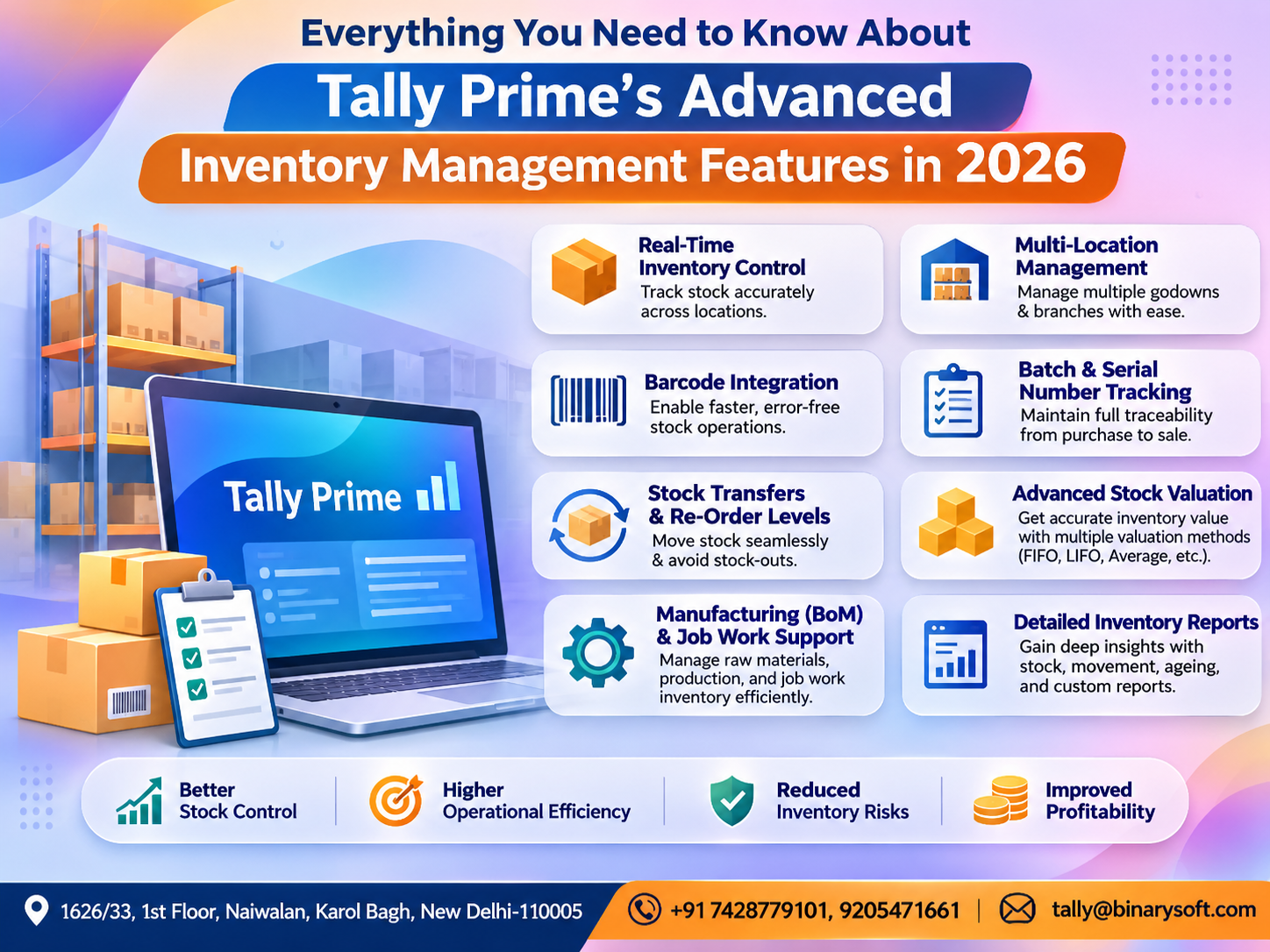
Businesses can create stock items for raw materials, components and finished goods.
Stock groups, categories, units of measurement and godowns can help organise inventory information.
This allows businesses to monitor material availability and maintain more structured inventory records.
2. Manufacturing Journal
Tally Prime supports manufacturing-related stock journal transactions.
Businesses can record the consumption of raw materials and the production of finished goods.
Where applicable, manufacturing details can be maintained using bills of materials.
This helps connect material consumption with finished-product quantities.
3. Bill of Materials Management
A Bill of Materials, commonly called BOM, defines the components and quantities required to manufacture a product.
For example, manufacturing one office desk may require wooden boards, screws, fittings and packaging materials.
Maintaining a BOM helps businesses standardise material requirements and estimate production inputs.
4. Cost Centres and Cost Categories
Cost centres help businesses allocate relevant income and expenses to departments, projects or operational activities.
For example, a manufacturer may maintain separate cost centres for production departments or specific projects.
This enables management to review expenses associated with different business activities.
The level of product-wise costing detail depends on how transactions and cost allocations are configured.
5. Purchase and Expense Tracking
Tally Prime enables businesses to record supplier invoices, purchase transactions and operating expenses.
Accurate accounting records help management monitor material procurement costs and analyse changes in expenditure.
6. Inventory Valuation
Inventory valuation reports help businesses understand stock values using the supported valuation methods and configured inventory records.
This information is useful for financial reporting, stock management and cost analysis.
7. Financial Reporting
Businesses can review accounting reports such as profit and loss statements, balance sheets and relevant inventory reports.
These reports help management understand overall financial performance and identify areas requiring further cost investigation.
8. Better Cost Visibility
When inventory and accounting transactions are maintained consistently, businesses gain a clearer understanding of material purchases, stock movement and operating expenses.
This creates a stronger foundation for cost analysis and management decisions.
Practical Steps to Manage Product Costing in Tally Prime
Businesses can establish a structured costing workflow using the following approach.
Step 1: Create Stock Items
Create separate stock items for raw materials, components and finished goods.
Assign appropriate units of measurement and inventory classifications.
Step 2: Configure Inventory Features
Enable the inventory features required for manufacturing, stock tracking and godown management.
Step 3: Define Bills of Materials
Create a BOM for applicable manufactured products.
Specify the quantities of raw materials required to produce each finished item.
Step 4: Record Material Purchases
Enter purchase vouchers accurately, including relevant material costs and applicable accounting details.
Step 5: Record Manufacturing Transactions
Use manufacturing or stock journal entries to record material consumption and finished goods production.
Step 6: Allocate Relevant Expenses
Use cost centres or other suitable accounting classifications to monitor labour and manufacturing-related expenses.
Step 7: Calculate Product Costs
Combine material consumption values with appropriately allocated labour and overhead expenses.
For detailed job-wise or activity-based costing, additional calculations or customised reporting may be required.
Step 8: Review Reports Regularly
Analyse inventory records, production transactions, expense ledgers and profitability reports.
Investigate unusual cost increases and update pricing decisions when necessary.
Common Product Costing Mistakes Businesses Should Avoid
Even experienced businesses sometimes make costing mistakes that reduce profitability.
One common mistake is excluding indirect manufacturing expenses from production costs.
Another is relying on outdated material prices when preparing quotations.
Businesses may also underestimate wastage, ignore production losses or allocate overheads inconsistently.
Inaccurate inventory records can create further problems because reported stock values may not reflect actual material consumption.
To improve costing accuracy, businesses should maintain reliable accounting records, review inventory regularly and document their costing assumptions.
Periodic comparisons between estimated and actual production costs can reveal opportunities for improvement.
Product Costing and Business Growth
Product costing is not simply an accounting exercise.
It is a strategic management process that influences pricing, purchasing, production planning and profitability.
Businesses that understand their cost structures can respond more confidently to changing market conditions.
When raw material prices increase, accurate costing helps management evaluate whether selling prices need adjustment.
When competition intensifies, cost analysis helps identify opportunities to improve efficiency without compromising product quality.
When businesses introduce new products, costing information supports realistic pricing and investment decisions.
Combining disciplined costing practices with accounting and inventory tools such as Tally Prime can strengthen operational visibility and financial control.
Conclusion
Product costing is essential for businesses that want to maintain competitive prices, control production expenses and achieve sustainable profitability.
By understanding direct material costs, labour expenses and manufacturing overheads, businesses can calculate production costs more accurately and make informed decisions.
Different costing methods, including job costing, process costing, batch costing and activity-based costing, provide useful approaches for different manufacturing environments.
Tally Prime supports product costing activities through inventory management, manufacturing transactions, bills of materials, cost-centre accounting and financial reporting.
However, businesses should select appropriate costing methods and use additional calculations where detailed overhead allocation or specialised cost analysis is required.
The ultimate objective of product costing is not merely to calculate expenses but to transform cost information into better business decisions.
With accurate records, regular analysis and effective financial management, businesses can reduce unnecessary expenditure, improve pricing strategies and build stronger long-term profitability.
Powered by Binarysoft Technologies
Authorized Tally Partner
Location: 1626/33, 1st Floor, Naiwalan, Karol Bagh, New Delhi – 110005, INDIA
Contact Us: +91 7428779101, 9205471661
Email: tally@binarysoft.com
Business Hours: 10:00 AM – 6:00 PM, Monday to Friday
Frequently Asked Questions
What is the role of a Bill of Materials in product costing?
A Bill of Materials identifies the raw materials and quantities required to manufacture a product. It helps standardise material requirements and supports production cost calculations.
Is product costing useful for small businesses?
Yes. Small businesses benefit from product costing because it helps them understand expenses, prevent underpricing, manage inventory and improve financial stability.
How does product costing improve profitability?
Accurate product costing helps identify unnecessary expenses, reduce wastage, improve pricing decisions and focus resources on profitable products.
What is the difference between product costing and pricing?
Product costing determines the expenses associated with producing or acquiring a product, while pricing establishes the amount charged to customers. Pricing also considers demand, competition, taxes and desired profit margins.
CA. Ronav Maheshwari works with small and mid-sized businesses on accounting processes, GST compliance, and financial reporting. His focus is on simplifying routine accounting workflows and helping business owners maintain accurate and audit-ready records.