Call CA Tally HelpDesk
+91 9205471661,
7428779101
Introduction: Why Knowing Your Product Cost Can Change Your Business
Every business owner wants to increase sales, reduce expenses and earn higher profits. However, many businesses overlook one important question: How much does it actually cost to produce one unit of a product?
A company may generate impressive revenue but still struggle financially because its production costs are higher than expected.
Raw material price fluctuations, labour expenses, electricity bills, packaging costs and operational inefficiencies can gradually reduce profitability.
This is where unit costing becomes an essential business management tool.
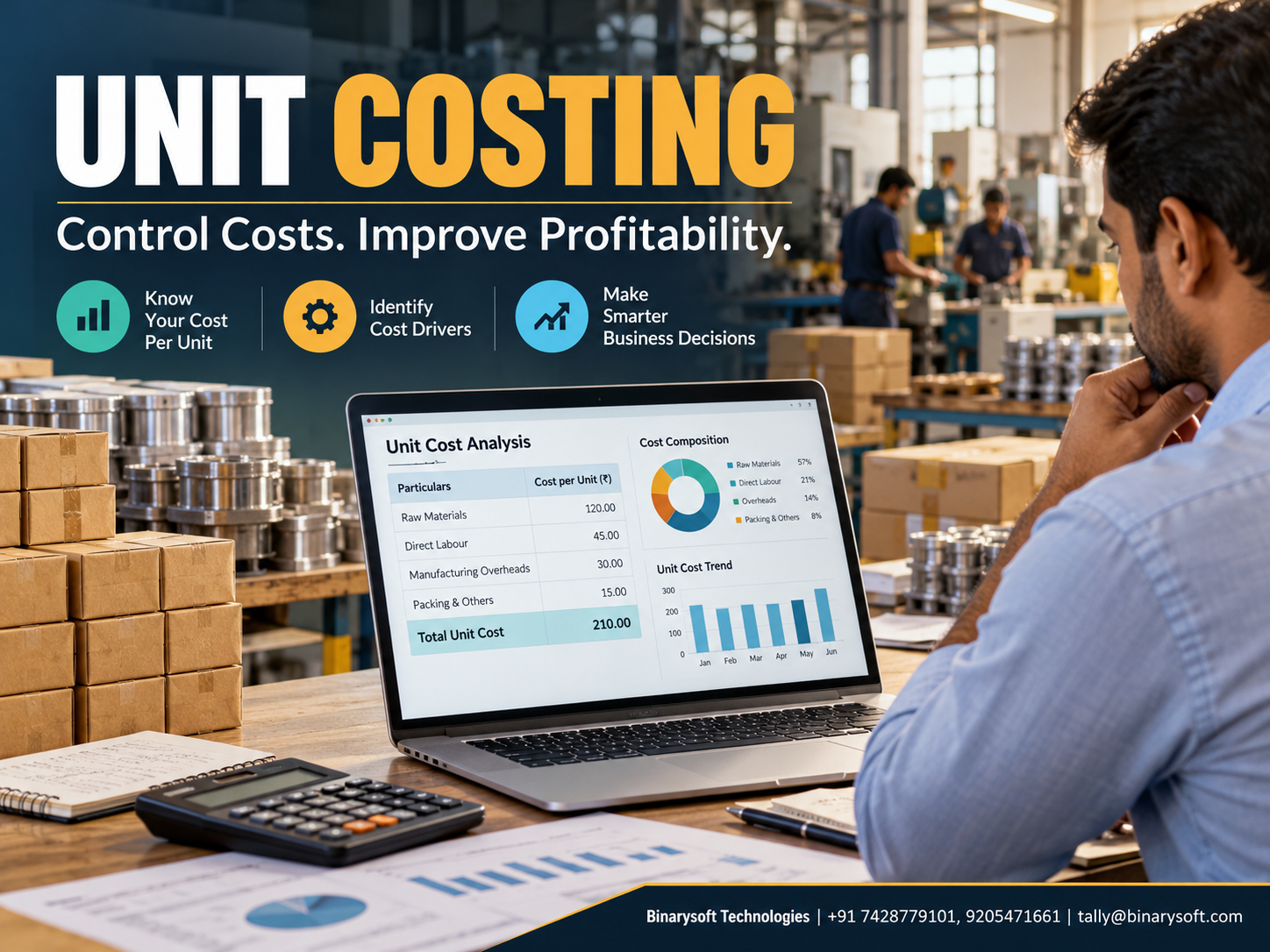
Unit costing helps businesses determine the cost of manufacturing one product or delivering one measurable unit of service. It provides valuable insights into pricing, expense management, inventory control and profit planning.
With accounting software such as TallyPrime, businesses can organize financial records, track inventory transactions, allocate expenses and generate reports that support accurate cost calculations.
Understanding unit costing is not simply about calculating numbers. It is about making informed decisions that protect business growth.
A Business Owner's Story: When Rising Sales Failed to Bring Happiness
Rajesh operated a small furniture manufacturing business in Delhi.
For several years, his business had been growing steadily. Customer orders were increasing, his workshop was busy and employees were working overtime.
From the outside, everything appeared successful.
However, Rajesh noticed something troubling.
Despite increasing sales, his bank balance was shrinking.
He struggled to pay suppliers on time and frequently worried about meeting monthly salary commitments.
One evening, while reviewing business expenses, he realized that he had never calculated the actual production cost of each furniture item.
He had been setting selling prices primarily by observing competitors.
When he examined material consumption, labour expenses, transportation charges and manufacturing overheads, he discovered that some products were generating extremely low margins.
Certain customized products were even being sold below their total production cost.
Rajesh introduced unit-wise cost analysis and began maintaining more organized accounting and inventory records.
Over time, he identified material wastage, revised pricing and improved purchasing decisions.
The most meaningful change was not simply financial.
He could finally plan supplier payments and employee salaries with greater confidence.
His experience illustrates an important business lesson:
Higher sales do not automatically mean higher profits. Understanding costs is equally important.
What Is Unit Costing?
Unit costing is a cost accounting method used to calculate the total expenditure incurred in producing one unit of a product or service.
It is particularly suitable for businesses producing similar or standardized products.
Examples include:
-
Cement manufacturing
-
Food processing
-
Textile production
-
Furniture manufacturing
-
Packaging businesses
-
Automobile component manufacturing
-
Consumer goods production
-
Printing and stationery manufacturing
Unit costing considers direct expenses and an appropriate allocation of indirect expenses.
The resulting figure helps businesses evaluate operational efficiency and determine profitable selling prices.
Unit Costing Formula
Cost Per Unit = Total Production Cost ÷ Number of Units Produced
Total production cost generally includes:
Direct Materials + Direct Labour + Manufacturing Overheads
For example, consider a company manufacturing 5,000 products every month.
| Cost Component | Monthly Expense |
|---|
| Raw Materials |
₹4,00,000 |
| Direct Labour |
₹1,50,000 |
| Factory Electricity |
₹40,000 |
| Factory Rent |
₹60,000 |
| Other Manufacturing Overheads |
₹50,000 |
| Total Production Cost |
₹7,00,000 |
Total units produced: 5,000
Cost per unit:
₹7,00,000 ÷ 5,000 = ₹140
If the company sells each product for ₹200, the difference is ₹60 per unit before considering applicable selling, administrative, financing and other non-manufacturing expenses.
This calculation helps management understand the relationship between production costs and selling prices.
Important Components of Unit Costing
Accurate unit costing requires businesses to identify and classify expenses properly.
1. Direct Material Cost
Direct materials are the raw materials used to manufacture a product.
For a furniture manufacturer, these may include wood, plywood, screws, adhesives and finishing materials.
Tracking material consumption helps identify excessive usage, wastage and purchasing inefficiencies.
2. Direct Labour Cost
Direct labour includes wages paid to employees directly involved in manufacturing.
For example, machine operators, carpenters, production workers and assembly employees.
Monitoring labour productivity helps businesses understand whether production resources are being utilized efficiently.
3. Manufacturing Overheads
Manufacturing overheads are production-related expenses that cannot be directly attributed to a particular unit without allocation.
These may include factory rent, electricity, equipment maintenance, depreciation and factory supervision.
Businesses should use a reasonable and consistent method for allocating these costs.
4. Administrative and Selling Expenses
Office expenses, marketing costs, sales commissions and distribution charges may also influence pricing decisions.
However, these expenses should generally be distinguished from manufacturing costs when calculating inventory production cost.
A business may calculate a separate full cost per unit for internal profitability analysis by allocating relevant administrative and selling expenses.
Types of Costs Businesses Should Understand
Unit costing becomes more useful when businesses understand different cost behaviours.
Fixed Costs: Expenses that remain relatively stable within a relevant operating range, such as factory rent and certain salaried staff costs.
Variable Costs: Expenses that generally change with production volume, such as raw materials and certain packaging costs.
Semi-Variable Costs: Expenses containing fixed and variable elements, such as some electricity and maintenance charges.
Direct Costs: Expenses that can be traced to a particular product or production activity.
Indirect Costs: Expenses that must be allocated across products, departments or production units.
Understanding these classifications helps businesses estimate costs at different production levels.
How Unit Costing Helps Businesses Control Expenses
Improve Product Pricing
Businesses can determine selling prices using more reliable cost information instead of relying entirely on competitor pricing.
Reduce Material Wastage
Regular cost analysis helps identify excessive raw material consumption, production defects and avoidable losses.
Strengthen Profit Margins
Understanding unit costs allows businesses to identify products with insufficient margins and take corrective action.
Improve Budget Planning
Historical cost information supports more realistic production budgets and expense forecasts.
Evaluate Production Efficiency
Comparing unit costs across different periods helps identify changes in productivity and manufacturing performance.
Support Business Expansion
Before increasing production capacity, businesses can estimate additional costs and evaluate whether expansion is financially practical.
Step-by-Step Process for Calculating Unit Cost
Step 1: Select the Product
Identify the product or service for which unit cost needs to be calculated.
Step 2: Determine the Accounting Period
Choose a suitable period, such as a month, quarter or production cycle.
Step 3: Calculate Direct Material Consumption
Determine the value of materials actually consumed during production rather than simply using total purchases.
Step 4: Identify Direct Labour Expenses
Include wages directly attributable to the production process.
Step 5: Calculate Manufacturing Overheads
Identify relevant factory expenses and allocate them using a suitable basis.
Step 6: Determine Production Quantity
Calculate the number of completed units produced during the selected period.
Step 7: Calculate Cost Per Unit
Divide the total applicable production cost by completed units, adjusting for work-in-progress and other relevant production accounting factors where necessary.
Step 8: Review and Compare
Compare actual unit costs with previous periods, budgets and target costs.
This process helps businesses identify cost fluctuations and opportunities for improvement.
Case Study 1: How a Garment Manufacturer Reduced Production Costs
Illustrative business example
A garment manufacturing company in Noida produced approximately 10,000 shirts every month.
Management noticed that manufacturing expenses were increasing even though production volume remained stable.
The company introduced systematic unit costing.
Initial Cost Analysis
| Expense | Monthly Cost |
|---|
| Fabric and Accessories |
₹12,00,000 |
| Labour |
₹4,00,000 |
| Factory Overheads |
₹3,00,000 |
| Total Cost |
₹19,00,000 |
Initial unit cost:
₹19,00,000 ÷ 10,000 = ₹190
The company identified excessive fabric wastage and inefficient production scheduling.
After improving material planning and production processes, monthly manufacturing costs decreased to ₹17,50,000.
Revised unit cost:
₹17,50,000 ÷ 10,000 = ₹175
Result:
The company reduced its manufacturing cost by ₹15 per shirt, representing approximately 7.9% savings.
At the same production volume, this meant potential monthly savings of ₹1,50,000.
The example demonstrates how identifying small inefficiencies can generate meaningful financial improvements.
Case Study 2: A Food Processing Business Improved Pricing Decisions
Illustrative business example
A packaged food manufacturer produced 20,000 snack packets every month.
The company initially focused primarily on ingredient and packaging expenses when deciding selling prices.
However, additional costs such as electricity, production labour and factory maintenance were not being fully considered.
After implementing unit costing, management calculated the following:
| Expense Category | Monthly Cost |
|---|
| Ingredients |
₹3,00,000 |
| Packaging Materials |
₹1,00,000 |
| Production Labour |
₹1,20,000 |
| Manufacturing Overheads |
₹80,000 |
| Total Manufacturing Cost |
₹6,00,000 |
Cost per packet:
₹6,00,000 ÷ 20,000 = ₹30
The company discovered that its manufacturing cost was higher than previously estimated.
Management reviewed packaging procurement, adjusted production scheduling and reassessed product pricing.
The business gained clearer visibility into its costs and was better positioned to make sustainable pricing decisions.
How TallyPrime Helps Businesses Manage Unit Costing
TallyPrime provides accounting, inventory management and reporting capabilities that can support unit costing calculations.
Although unit costing may require additional calculations or customized reporting depending on business requirements, accurate transaction records provide a strong foundation.
1. Track Raw Material Purchases
Businesses can record raw material purchases with item details, quantities and values.
This helps maintain organized procurement information and monitor material prices.
2. Monitor Inventory Movements
Stock items, stock groups, units of measurement and inventory vouchers help businesses track material movements.
Manufacturers can use stock journal entries to record production-related material consumption and finished goods quantities.
3. Record Manufacturing Transactions
Businesses can configure appropriate inventory and manufacturing workflows to record raw material consumption and finished goods production.
Bills of Materials can help define standard material requirements for products.
4. Organize Production Expenses
Separate accounting ledgers can be maintained for direct labour, electricity, maintenance and other manufacturing expenses.
This supports more accurate expense classification.
5. Use Cost Centres
Cost centres can help businesses allocate relevant expenses to departments, projects or production activities.
Proper configuration allows management to analyze costs across different operational areas.
6. Generate Financial Reports
TallyPrime provides reports such as Profit & Loss, Stock Summary and ledger statements.
These reports help businesses review expenses, inventory values and financial performance.
7. Compare Cost Trends
By reviewing reports for different periods, businesses can identify changes in material prices, labour expenses and manufacturing overheads.
This information supports periodic unit cost calculations.
8. Improve Inventory Planning
Inventory reports help businesses monitor stock availability and reduce the risk of excessive purchasing or stock shortages.
Better inventory planning can support improved cost control and working capital management.
Practical Example: Unit Costing with TallyPrime
Consider a manufacturer producing 2,000 wooden chairs.
The business records the following expenses:
| Expense | Amount |
|---|
| Wood and Other Materials |
₹3,00,000 |
| Direct Labour |
₹1,00,000 |
| Factory Overheads |
₹80,000 |
| Total Manufacturing Cost |
₹4,80,000 |
Cost per chair:
₹4,80,000 ÷ 2,000 = ₹240
The business can record material purchases, production transactions and relevant expenses in TallyPrime.
Using accounting and inventory reports, management can gather the information needed to calculate manufacturing cost per chair.
If the selling price is ₹350, the difference between selling price and manufacturing cost is ₹110 per chair, before other expenses.
This information supports pricing decisions and profitability analysis.
Best Practices for Effective Unit Costing
Businesses should adopt a consistent approach to cost monitoring.
Maintain accurate material consumption records and regularly reconcile inventory.
Separate direct production costs from administrative and selling expenses.
Review production wastage and investigate unusual cost increases.
Use consistent overhead allocation methods.
Compare actual costs against planned or standard costs.
Monitor production quantities and consider capacity utilization when interpreting fixed overhead costs.
Review unit costs periodically rather than relying on outdated calculations.
Most importantly, use cost information to support practical management decisions.
Common Unit Costing Mistakes to Avoid
One common mistake is calculating unit cost using total purchases instead of actual material consumption.
Another is ignoring manufacturing overheads.
Businesses may also underestimate production costs by failing to account for damaged products, rework or unfinished production.
Using inconsistent allocation methods can make period-to-period comparisons misleading.
Similarly, dividing all expenses by total units sold instead of the appropriate production quantity may produce inaccurate manufacturing cost figures.
Maintaining accurate records and applying consistent accounting principles helps reduce these errors.
Unit Costing and Long-Term Business Growth
Unit costing supports more than short-term expense reduction.
It helps businesses understand which products consume the most resources, where operational inefficiencies occur and how production decisions influence profitability.
As businesses expand, the importance of accurate cost information increases.
Manufacturers may introduce new product lines, purchase additional machinery or expand production facilities.
Reliable unit cost information helps management evaluate these decisions more confidently.
When supported by organized accounting and inventory records in TallyPrime, unit costing can become part of a broader financial management strategy.
Conclusion
Unit costing is an important cost control technique for businesses seeking stronger financial performance.
By calculating the actual cost of producing each unit, businesses can improve pricing decisions, reduce unnecessary expenditure, identify inefficiencies and protect profit margins.
Whether operating a small manufacturing workshop or a growing production company, understanding unit costs provides valuable financial clarity.
TallyPrime supports this process through organized accounting, inventory tracking, expense classification and business reporting.
Successful businesses do not focus only on how much they sell. They also understand how much each sale costs them.
With consistent cost monitoring and informed decisions, businesses can build a stronger foundation for sustainable profitability.
Powered by Binarysoft Technologies
Authorized Tally Partner
Location: 1626/33, 1st Floor, Naiwalan, Karol Bagh, New Delhi – 110005, INDIA
Contact Us: +91 7428779101, 9205471661
Email: tally@binarysoft.com
Business Hours: 10:00 AM – 6:00 PM, Monday to Friday
Frequently Asked Questions
How can Binarysoft Technologies help businesses using TallyPrime?
Binarysoft Technologies, an Authorized Tally Partner, can assist businesses with TallyPrime implementation, accounting configuration, inventory management workflows and reporting requirements to support better financial control.
How frequently should unit costing be reviewed?
Businesses should review unit costs periodically, often monthly or after significant changes in material prices, labour expenses or production processes.
Can small businesses use unit costing?
Yes. Small manufacturers and growing businesses can use unit costing to understand product expenses and improve financial decision-making.
How does unit costing improve profitability?
It helps businesses identify unnecessary expenditure, reduce material wastage, improve operational efficiency and establish more informed pricing strategies.
CA. Yuvan Rajagopal specializes in accounting advisory, statutory compliance, and financial consulting. He writes extensively on business automation, inventory management, and accounting best practices.