Call CA Tally HelpDesk
+91 9205471661,
7428779101
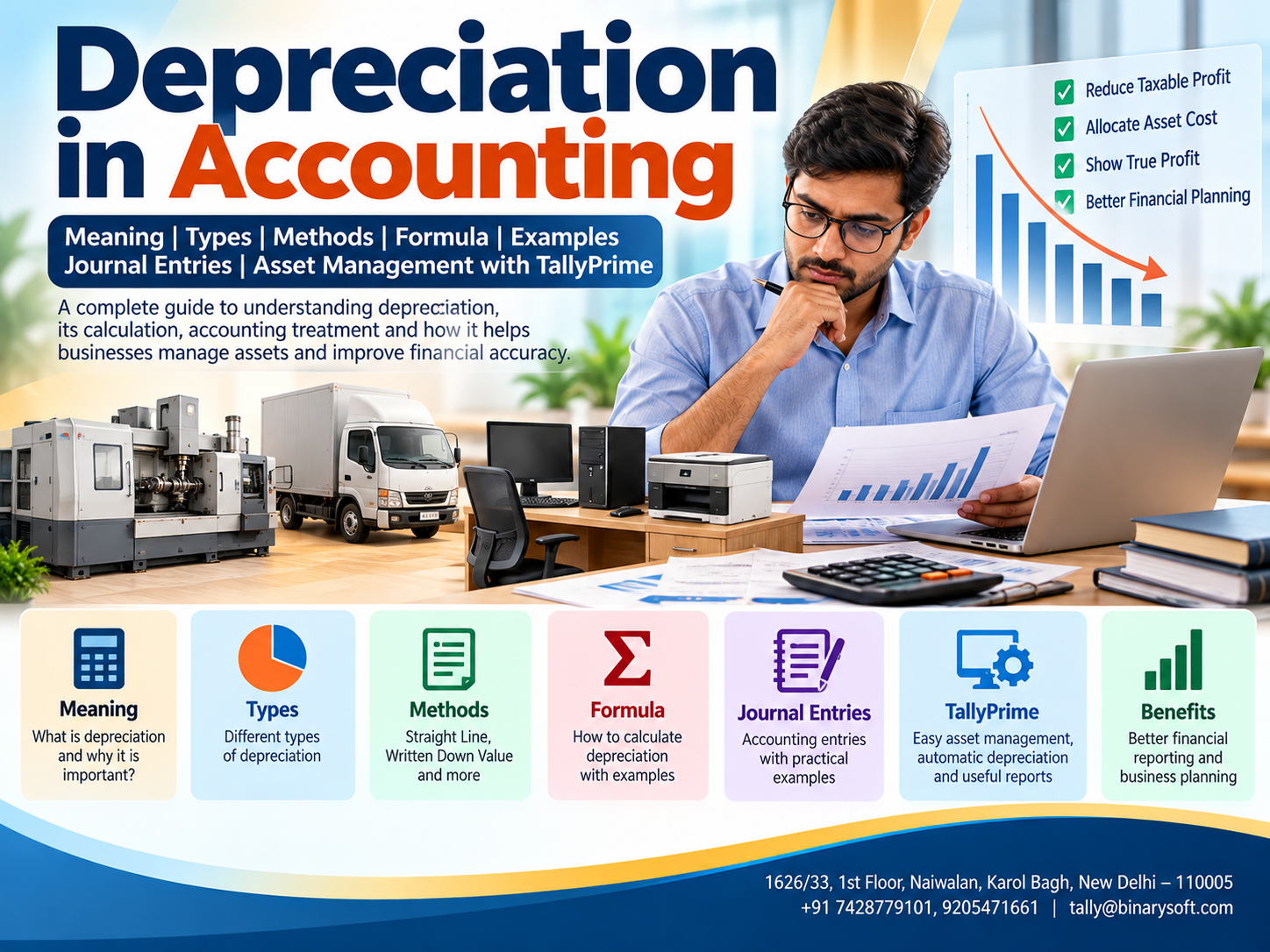
Introduction: Why Depreciation Matters More for Businesses in 2026
In 2026, Indian businesses continue investing in computers, machinery, vehicles, office equipment and technology to improve productivity and remain competitive. However, purchasing an asset is only the beginning of its financial journey. As equipment is used, its economic benefits are consumed over time, making depreciation an essential part of accurate accounting. Many small and medium-sized businesses focus on the original purchase price without fully understanding how depreciation affects profitability, asset valuation, taxation and future replacement planning. Incorrect depreciation calculations can distort financial statements, complicate tax computations and lead to poor investment decisions. By understanding depreciation methods and maintaining proper fixed asset records, businesses can improve financial transparency and plan capital expenditure more effectively. Accounting software such as TallyPrime supports this process through asset ledgers, accounting vouchers and financial reporting, helping organizations maintain better control over their long-term investments.
1. What Is Depreciation in Accounting?
Depreciation is the systematic allocation of the depreciable amount of a tangible fixed asset over its estimated useful life.
When a business purchases equipment, machinery, furniture or vehicles, the asset generally provides economic benefits over several accounting periods.
Instead of recognizing the entire asset cost as an expense immediately, depreciation allocates the relevant cost across the periods benefiting from its use.
For example, suppose a business purchases office equipment for ₹1,20,000 and expects to use it for five years.
If the estimated residual value is ₹20,000, the depreciable amount is:
₹1,20,000 − ₹20,000 = ₹1,00,000
Under the straight-line method, annual depreciation would be:
₹1,00,000 ÷ 5 = ₹20,000 per year
This systematic allocation helps present a more meaningful picture of the business's financial performance.
Depreciation is an accounting expense, but recording it does not itself involve an immediate cash payment.
2. Why Is Depreciation Important for Businesses?
Depreciation plays an important role in financial reporting, asset management and business planning.
Accurate profit calculation
Depreciation recognizes the cost of using fixed assets during an accounting period.
Without depreciation, reported profits may be overstated because the consumption of asset benefits would not be reflected appropriately.
Better asset valuation
Depreciation reduces the carrying amount of an asset in accounting records.
However, the resulting carrying amount is not necessarily equal to its market value.
Improved financial planning
Businesses can use depreciation schedules alongside maintenance records and asset condition assessments to plan future equipment replacement.
Tax considerations
Depreciation may affect taxable income, although tax depreciation follows the applicable tax legislation and may differ from accounting depreciation.
More reliable financial statements
Correct depreciation accounting improves the reliability of the Statement of Profit and Loss and Balance Sheet.
3. Which Assets Are Subject to Depreciation?
Depreciation generally applies to tangible assets that have a finite useful life.
Common examples include:
-
Plant and machinery
-
Office computers and laptops
-
Furniture and fixtures
-
Motor vehicles
-
Manufacturing equipment
-
Printers and office equipment
-
Buildings, where applicable
-
Electrical installations
-
Other depreciable tangible fixed assets
Land normally is not depreciated because it generally has an unlimited useful life, although certain land-related improvements may be depreciable.
Intangible assets, such as certain software rights or patents, are generally subject to amortization rather than depreciation.
Natural resource assets may involve depletion accounting.
The appropriate treatment depends on the asset and applicable accounting framework.
4. Major Types and Methods of Depreciation
Different depreciation methods allocate asset costs differently.
The selected method should reflect the expected pattern in which the asset's future economic benefits are consumed.
4.1 Straight-Line Method (SLM)
The straight-line method allocates an equal amount of depreciation to each accounting period over an asset's useful life, assuming estimates remain unchanged.
Formula:
\[ \text{Annual Depreciation}=\frac{\text{Cost}-\text{Residual Value}}{\text{Useful Life}} \]
Example:
A company purchases office furniture for ₹2,00,000.
Estimated residual value: ₹20,000
Useful life: 6 years
Annual depreciation:
(₹2,00,000 − ₹20,000) ÷ 6 = ₹30,000
The company recognizes ₹30,000 as depreciation expense annually.
This method is commonly suitable for assets whose benefits are consumed relatively evenly over time.
4.2 Written Down Value Method (WDV)
The written-down value method, also called the reducing balance method, calculates depreciation using a fixed percentage of the asset's opening carrying amount.
Depreciation is generally higher during the earlier years and decreases over time.
Formula:
\[ \text{Depreciation}=\text{Opening WDV}\times\text{Depreciation Rate} \]
Example:
Asset cost: ₹5,00,000
Depreciation rate: 20%
|
Year
|
Opening WDV
|
Depreciation
|
Closing WDV
|
|---|
|
1
|
₹5,00,000
|
₹1,00,000
|
₹4,00,000
|
|
2
|
₹4,00,000
|
₹80,000
|
₹3,20,000
|
|
3
|
₹3,20,000
|
₹64,000
|
₹2,56,000
|
|
4
|
₹2,56,000
|
₹51,200
|
₹2,04,800
|
The depreciation amount decreases because the calculation uses the reducing carrying amount.
4.3 Units of Production Method
Under this method, depreciation is calculated based on actual production or usage.
It can be suitable for machinery whose economic benefits are consumed according to operating activity.
Formula:
\[ \text{Depreciation per Unit}=\frac{\text{Cost}-\text{Residual Value}}{\text{Estimated Total Units}} \]
Suppose machinery costs ₹10,00,000, has an estimated residual value of ₹1,00,000 and is expected to produce 90,000 units.
Depreciation per unit:
₹9,00,000 ÷ 90,000 = ₹10
If 12,000 units are produced during the year:
12,000 × ₹10 = ₹1,20,000 depreciation.
4.4 Sum-of-the-Years'-Digits Method
This is an accelerated depreciation method that allocates higher depreciation in earlier years.
For an asset with a useful life of five years, the sum of the years' digits is:
5 + 4 + 3 + 2 + 1 = 15
The first year's depreciation is calculated using 5/15 of the depreciable amount.
The second year uses 4/15, and so on.
This method may be appropriate when the asset's economic benefits are consumed more heavily during its earlier years.
5. Difference Between Straight-Line and Written Down Value Methods
|
Particulars
|
Straight-Line Method
|
Written Down Value Method
|
|---|
|
Depreciation amount
|
Generally constant
|
Generally decreases
|
|
Calculation basis
|
Depreciable amount and useful life
|
Opening carrying amount
|
|
Early-year expense
|
Even allocation
|
Higher allocation
|
|
Complexity
|
Relatively simple
|
Requires yearly recalculation
|
|
Typical suitability
|
Even consumption of benefits
|
Faster consumption in early years
|
Neither method is universally better.
The accounting method should reflect the expected pattern of economic benefit consumption and applicable reporting requirements.
6. How to Calculate Depreciation: Practical Example
Consider a trading company purchasing the following assets:
|
Asset
|
Purchase cost
|
Annual depreciation
|
|---|
|
Computers
|
₹3,00,000
|
₹60,000
|
|
Office furniture
|
₹2,00,000
|
₹20,000
|
|
Delivery vehicle
|
₹8,00,000
|
₹1,60,000
|
|
Office equipment
|
₹1,50,000
|
₹30,000
|
|
Total
|
₹14,50,000
|
₹2,70,000
|
The annual depreciation figures are illustrative and assume the relevant depreciation calculations have already been determined.
Total annual depreciation:
₹60,000 + ₹20,000 + ₹1,60,000 + ₹30,000 = ₹2,70,000
This amount may be recognized in the relevant expense classifications in the financial statements.
The actual depreciation must be calculated using the appropriate useful lives, residual values, methods and dates when assets become available for use.
7. Depreciation Journal Entries in Accounting
Depreciation is generally recorded at the end of the relevant accounting period, although businesses may recognize it monthly or at other appropriate intervals.
Entry for depreciation expense
Suppose annual depreciation on machinery is ₹50,000.
|
Particulars
|
Debit
|
Credit
|
|---|
|
Depreciation Expense A/c Dr.
|
₹50,000
|
|
|
To Accumulated Depreciation – Machinery A/c
|
|
₹50,000
|
Narration: Being depreciation charged on machinery for the accounting period.
The accumulated depreciation account is a contra-asset account.
It reduces the net carrying amount of the related asset without directly reducing its historical cost ledger.
Transfer to Profit and Loss Account
Where manual closing entries are used:
|
Particulars
|
Debit
|
Credit
|
|---|
|
Profit and Loss A/c Dr.
|
₹50,000
|
|
|
To Depreciation Expense A/c
|
|
₹50,000
|
In accounting software, Profit and Loss reporting generally reflects the relevant expense ledger balance without requiring a separate manual closing journal for every expense.
8. How Depreciation Affects Financial Statements
Depreciation influences both profitability and the carrying amount of fixed assets.
Impact on the Profit and Loss Account
Depreciation is recognized as an expense, reducing reported profit.
Suppose a business earns ₹12,00,000 before depreciation and tax.
If annual depreciation is ₹2,00,000:
Profit before tax = ₹12,00,000 − ₹2,00,000
Profit before tax = ₹10,00,000
Impact on the Balance Sheet
Fixed assets are generally presented at their carrying amounts, determined by deducting accumulated depreciation and applicable impairment losses from the relevant asset cost or revalued amount.
For example:
|
Particulars
|
Amount
|
|---|
|
Machinery cost
|
₹10,00,000
|
|
Less: Accumulated depreciation
|
₹2,00,000
|
|
Net carrying amount
|
₹8,00,000
|
Impact on Cash Flow
Depreciation is a non-cash expense.
Under the indirect method of preparing cash flows from operating activities, depreciation is generally added back to profit when reconciling profit to operating cash flow.
This adjustment does not mean depreciation generates cash.
It simply reverses a non-cash expense already included in profit.
9. How to Record and Manage Depreciation in TallyPrime
TallyPrime helps businesses maintain fixed asset accounts, record depreciation through accounting vouchers and review financial statements.
A business should first determine its depreciation amounts using an appropriate fixed asset schedule, accounting policy and applicable standards.
Step 1: Create a fixed asset ledger
Open TallyPrime and select the relevant company.
Navigate to the ledger creation screen and create a ledger such as Office Computers, under the Fixed Assets group.
Save the ledger with the appropriate details.
Step 2: Record the purchase of the asset
Suppose a business purchases a computer for ₹60,000, excluding any applicable tax.
Record the purchase through an appropriate accounting voucher, debiting the fixed asset ledger and crediting the supplier or bank account.
Step 3: Create a depreciation expense ledger
Create a ledger named Depreciation Expense under the appropriate expense group, generally Indirect Expenses.
Where accumulated depreciation is maintained separately, create a suitable contra-asset ledger and ensure it is classified correctly for financial reporting.
Step 4: Record the depreciation journal
Suppose annual depreciation is calculated at ₹12,000.
Pass the journal entry:
Depreciation Expense A/c Dr. ₹12,000
To Accumulated Depreciation – Computers A/c ₹12,000
This recognizes depreciation without changing the original purchase cost recorded in the computer asset ledger.
Step 5: Review financial statements
Open the Profit and Loss Account to review depreciation expenses.
Examine the Balance Sheet to verify the presentation of fixed assets and accumulated depreciation.
Businesses can also export relevant accounting reports for additional analysis.
Important: Standard TallyPrime accounting vouchers support depreciation entries, but automatic calculation of depreciation for every asset should not be assumed. Detailed depreciation schedules, useful-life calculations and asset-wise automation may require external schedules, additional configurations or compatible extensions.
10. Depreciation Under Indian Accounting and Tax Rules
Businesses in India should distinguish between depreciation for financial reporting and depreciation for income-tax purposes.
Depreciation under the Companies Act
Companies preparing financial statements under applicable Indian corporate accounting requirements must consider the relevant accounting standards and Schedule II of the Companies Act, 2013, where applicable.
Depreciation calculations may involve estimated useful life, residual value and the expected consumption pattern of the asset's benefits.
Depreciation under the Income-tax Act
Tax depreciation is generally governed by the applicable income-tax provisions.
For many business assets, depreciation is calculated using prescribed rates and block-of-assets principles.
Tax treatment may differ from book depreciation because of differences in rates, calculation methods, eligibility and other statutory requirements.
For example, an asset's depreciation expense in financial accounts may not equal the depreciation deduction permitted for tax computation.
Businesses should therefore maintain appropriate records for both accounting and taxation.
The applicable rules, rates and transitional provisions should be verified for the relevant assessment year before finalizing tax computations.
11. An Emotional Story: When an Unexpected Machine Failure Threatened a Family Business
Amit managed a small packaging business that his father had established nearly twenty years earlier.
The business employed twelve workers and supplied packaging materials to several local traders.
For years, Amit concentrated on sales, raw materials and employee payments.
He rarely reviewed the financial condition of his machinery.
One morning, an important production machine stopped working.
The repair technician explained that several components were badly worn and replacement might be more economical than repeated repairs.
Amit suddenly faced a difficult decision.
Customer orders were pending, employees depended on regular work and purchasing a replacement machine required significant investment.
He realized that although the business had recorded machinery purchases, it had never maintained a proper replacement plan based on asset age, depreciation and condition.
With help from his accountant, Amit introduced a fixed asset register, depreciation schedules and periodic equipment reviews.
He also started setting aside funds for future capital expenditure.
The experience changed his understanding of business finance.
Depreciation was no longer merely an accounting entry. It became one part of a broader system for understanding how business assets were being consumed and when replacement investment might be necessary.
This is a fictional illustrative story based on common business challenges.
12. Case Study 1: Depreciation Management for a Manufacturing Business
Business background
Consider a hypothetical manufacturing company operating in Delhi NCR.
The company owns production machinery, computers, office furniture and delivery equipment.
The challenge
The company maintained fixed asset purchase records but lacked a consistent asset-wise depreciation schedule.
This made year-end calculations time-consuming and increased the risk of inconsistent expense recognition.
The solution
The accountant created separate fixed asset ledgers in TallyPrime and maintained a supporting depreciation schedule.
The business recorded periodic depreciation adjustments through journal vouchers and reconciled the balances with its financial statements.
Illustrative results
|
Particulars
|
Amount
|
|---|
|
Total depreciable asset cost
|
₹25,00,000
|
|
Accumulated depreciation at beginning of year
|
₹4,00,000
|
|
Current-year depreciation
|
₹3,00,000
|
|
Accumulated depreciation at year-end
|
₹7,00,000
|
|
Closing net carrying amount
|
₹18,00,000
|
The business gained a clearer picture of its asset carrying amounts and annual depreciation expenses.
It could also use the depreciation schedule alongside maintenance information to support future machinery investment planning.
13. Case Study 2: Fixed Asset Accounting for a Professional Services Company
Business background
A hypothetical consulting company operates offices in Delhi, Gurugram and Noida.
Its assets include computers, printers, furniture and networking equipment.
The challenge
Asset purchases were recorded by different employees, creating inconsistencies in ledger naming and depreciation calculations.
Management also found it difficult to identify the carrying amount of equipment at individual locations.
The solution using TallyPrime
The company standardized fixed asset ledger classifications and introduced an asset register containing purchase dates, locations, costs, useful lives and depreciation methods.
Depreciation calculations were reviewed and posted using journal vouchers.
Relevant location information was maintained in supporting asset records.
Illustrative outcome
|
Asset category
|
Cost
|
Accumulated depreciation
|
Carrying amount
|
|---|
|
Computers
|
₹8,00,000
|
₹3,00,000
|
₹5,00,000
|
|
Furniture
|
₹4,00,000
|
₹1,00,000
|
₹3,00,000
|
|
Office equipment
|
₹3,00,000
|
₹1,20,000
|
₹1,80,000
|
|
Total
|
₹15,00,000
|
₹5,20,000
|
₹9,80,000
|
The company improved the consistency of its fixed asset records and reduced manual reconciliation difficulties.
Both case studies are hypothetical examples, not verified customer outcomes.
14. Common Mistakes in Depreciation Accounting
Businesses should avoid several common errors when recording depreciation.
Incorrect useful-life estimates: An unrealistic useful life may lead to inappropriate depreciation expenses.
Ignoring residual value: Where material and required by the applicable framework, residual value should be considered when determining the depreciable amount.
Wrong depreciation method: The selected method should reflect the asset's expected pattern of economic benefit consumption.
Confusing tax and book depreciation: Accounting depreciation and tax depreciation can differ significantly.
Incorrect capitalization: Routine repair expenses should not automatically be added to fixed asset cost. Capitalization depends on the applicable recognition criteria.
Failure to review estimates: Useful lives, residual values and depreciation methods should be reviewed as required by the relevant accounting framework.
Missing asset disposal entries: When an asset is sold or retired, the business should account for the disposal, accumulated depreciation and any resulting gain or loss.
15. Best Practices for Depreciation and Fixed Asset Management
Businesses can improve fixed asset accounting by maintaining a detailed asset register and adopting consistent depreciation policies.
Each asset record should contain its description, acquisition date, cost, location, useful life, residual value and depreciation method.
Accountants should also maintain supporting purchase documents and periodically reconcile the asset register with the general ledger.
Depreciation should begin when the asset is available for use, subject to the applicable accounting framework, rather than simply when payment is made.
Businesses should periodically verify the physical existence and condition of important assets.
Management should also distinguish depreciation accounting from cash planning.
Depreciation is a non-cash expense and does not automatically create a fund for asset replacement. A separate capital expenditure or replacement budget is necessary.
TallyPrime can support this process through structured fixed asset ledgers, journal entries and financial reports.
16. How Depreciation Supports Long-Term Business Growth
Depreciation helps businesses understand the cost of using assets over time.
When combined with asset maintenance records, utilization reports and cash flow forecasts, depreciation information can support better investment decisions.
A manufacturing business may use asset records to evaluate whether older machinery should be repaired or replaced.
A service company may use depreciation schedules to plan computer upgrades.
A trading business may assess delivery vehicle replacement requirements based on age, condition, operating costs and expected future use.
Depreciation alone does not determine the best replacement date or market value of an asset.
However, accurate depreciation accounting provides a useful foundation for financial reporting and long-term capital planning.
Conclusion
Depreciation is an important accounting process that systematically allocates the depreciable cost of fixed assets over their useful lives.
Understanding depreciation methods, formulas, journal entries and financial statement effects helps businesses maintain more reliable accounting records.
Straight-line, written-down value and usage-based methods offer different approaches to allocating asset costs, depending on the nature of the asset and applicable accounting requirements.
TallyPrime supports depreciation accounting through fixed asset ledgers, journal vouchers and financial reporting.
By maintaining accurate asset registers, applying suitable depreciation policies and reviewing fixed asset records regularly, businesses can improve financial transparency, support compliance and make better long-term investment decisions.
Powered by Binarysoft Technologies Authorized Tally Partner
Location: 1626/33, 1st Floor, Naiwalan, Karol Bagh, New Delhi – 110005, INDIA
Contact us: +91 7428779101, 9205471661
Email us: tally@binarysoft.com
Business Hours: 10:00 AM – 6:00 PM, Monday to Friday
Frequently Asked Questions
What is the difference between depreciation and amortization?
Depreciation generally applies to tangible fixed assets, while amortization generally applies to intangible assets with finite useful lives.
Can depreciation be recorded in TallyPrime?
Yes. Businesses can create depreciation expense ledgers and record calculated depreciation amounts using appropriate journal vouchers.
Does TallyPrime automatically calculate depreciation for every fixed asset?
Standard accounting features support recording depreciation, but detailed automatic depreciation calculation may require additional tools, configurations or extensions.
Can depreciation be calculated monthly?
Yes. Depreciation can be allocated to monthly accounting periods using an appropriate and consistent calculation approach.
CA. T.R Venkat is a Chartered Accountant with extensive experience in accounting systems, GST compliance, and MSME advisory. He has worked closely with Indian traders and businesses on inventory control and accounting process improvement. His writing draws from real operational challenges faced by growing enterprises.