Call CA Tally HelpDesk
+91 9205471661,
7428779101
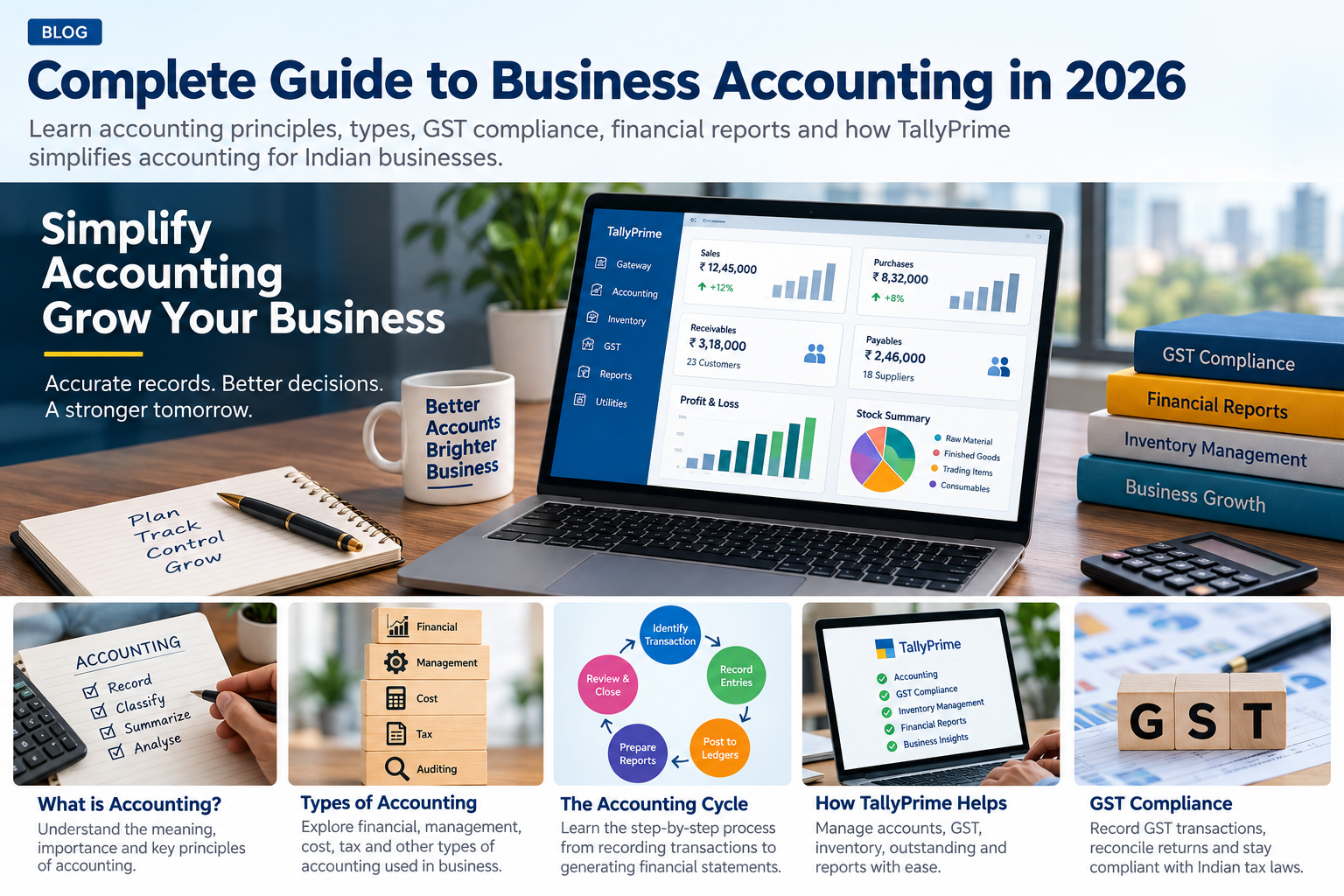
Introduction: Why Smarter Accounting Matters More Than Ever in 2026
In 2026, running a successful business in India requires more than generating sales and maintaining customer relationships. Rising operating expenses, GST compliance responsibilities, delayed customer payments and increasing transaction volumes are putting significant pressure on business owners. Even profitable businesses can experience financial difficulties when accounting records are incomplete, expenses remain unnoticed or cash flow is poorly managed.
Traditional bookkeeping methods, scattered Excel files and manual invoice tracking often make it difficult to understand the actual financial position of a business. A single missed entry can create reconciliation problems, while inaccurate inventory records may affect purchasing decisions.
Modern accounting systems help businesses move from reactive bookkeeping to informed financial management. With TallyPrime, organisations can maintain structured accounting records, manage GST transactions, monitor outstanding payments, track inventory and generate meaningful financial reports. The result is better financial visibility, stronger operational control and greater confidence when making important business decisions.
1. What Is Accounting in Business?
Accounting is the systematic process of identifying, recording, classifying, summarising and analysing financial transactions. It helps organisations understand how money enters and leaves the business and how those transactions affect profitability, assets and liabilities.
Every business transaction has a financial impact. Purchasing goods, paying employee salaries, receiving customer payments, obtaining loans and purchasing equipment must be recorded appropriately.
The main objectives of accounting include:
-
Maintaining accurate financial records.
-
Measuring business profitability.
-
Tracking income and expenditure.
-
Monitoring assets and liabilities.
-
Supporting tax compliance.
-
Evaluating financial performance.
-
Helping management make informed decisions.
For example, a wholesale trader may generate sales of ₹25 lakh during a month. However, sales alone do not establish profitability. The business must consider purchase costs, transportation, employee salaries, rent, interest and other expenses before determining its financial results.
Accounting brings these figures together into a meaningful financial picture.
2. Why Accounting Is Essential for Every Business
Accounting is not simply a statutory or taxation requirement. It is an important management function that supports long-term business stability.
Understanding profitability
Financial records help business owners determine whether their operations are generating sufficient profit after accounting for direct and indirect expenses.
Controlling expenditure
Regular expense monitoring identifies unnecessary spending, recurring charges and opportunities to improve operational efficiency.
Managing cash flow
Businesses need sufficient funds to pay suppliers, employees, lenders and statutory dues. Accounting helps identify upcoming financial obligations and expected customer collections.
Supporting compliance
Accurate books provide the foundation for GST reporting, income-tax calculations, financial audits and other applicable regulatory requirements.
Improving business decisions
Reliable accounting information supports decisions about expansion, pricing, borrowing, investments and inventory purchasing.
A business that understands its financial position is better prepared to respond to unexpected challenges.
3. Fundamental Accounting Principles Every Business Owner Should Understand
Accounting principles establish a consistent framework for recording and presenting financial information.
Business entity concept
The business and its owner are treated as separate accounting entities. Personal expenditure should not be incorrectly recorded as business expenditure.
Going concern concept
Financial statements are generally prepared on the assumption that the business will continue operating for the foreseeable future, unless circumstances indicate otherwise.
Accrual concept
Income and expenses are recognised when earned or incurred, rather than solely when cash is received or paid, subject to the applicable accounting framework.
Consistency principle
Businesses should apply accounting policies consistently across reporting periods, with changes appropriately justified and disclosed.
Matching principle
Expenses should be recognised in the appropriate period alongside related revenue, where applicable.
Prudence principle
Accounting estimates should reflect uncertainty without deliberately overstating income or assets or understating expenses and liabilities.
Understanding these concepts improves the reliability and comparability of financial statements.
4. Different Types of Accounting Used in Business
Different accounting disciplines serve different organisational requirements.
|
Accounting type
|
Primary purpose
|
|---|
|
Financial Accounting
|
Preparation of financial statements
|
|
Management Accounting
|
Internal planning and decision-making
|
|
Cost Accounting
|
Analysis of product and operational costs
|
|
Tax Accounting
|
Tax calculations and compliance
|
|
Auditing
|
Examination of financial information
|
|
Forensic Accounting
|
Investigation of financial irregularities
|
Financial accounting focuses primarily on historical transactions and external reporting.
Management accounting helps business owners interpret performance and prepare operational plans.
Cost accounting is especially valuable for manufacturers seeking to understand material, labour and production costs.
Tax accounting supports the calculation and reporting of applicable taxes.
An integrated accounting system can provide much of the underlying transaction information required across these disciplines.
5. The Accounting Cycle: From Transaction to Financial Statement
The accounting cycle represents the sequence of activities involved in preparing reliable financial information.
Step 1: Identify transactions. Collect invoices, receipts, payment confirmations, debit notes, credit notes and other supporting documents.
Step 2: Record entries. Enter transactions using appropriate accounting vouchers.
Step 3: Post to ledgers. Classify transactions under relevant accounts such as sales, purchases, cash, bank, expenses, debtors and creditors.
Step 4: Review balances. Prepare and examine the trial balance to identify potential recording errors.
Step 5: Record adjustments. Account for depreciation, outstanding expenses, prepaid expenses and other necessary adjustments.
Step 6: Prepare statements. Generate the Profit & Loss Account, Balance Sheet and other relevant reports.
Step 7: Review and close. Verify financial information and complete period-end procedures.
TallyPrime helps organise these activities through integrated vouchers, ledgers and financial reports.
6. Understanding Debit, Credit and Double-Entry Accounting
Double-entry accounting requires every transaction to have equal debit and credit effects.
The fundamental accounting equation is:
\[ \text{Assets}=\text{Liabilities}+\text{Equity} \]
Consider a business purchasing office furniture worth ₹50,000 through its bank account, excluding any tax considerations.
|
Account
|
Debit
|
Credit
|
|---|
|
Furniture Account
|
₹50,000
|
—
|
|
Bank Account
|
—
|
₹50,000
|
|
Total
|
₹50,000
|
₹50,000
|
Furniture increases as an asset, while the bank balance decreases.
Similarly, when goods are sold on credit, the relevant sales account is credited and the customer account is debited, with applicable GST and inventory treatment recorded separately.
Correct debit and credit classification is essential for maintaining balanced books.
7. Important Financial Statements Every Business Should Review
Three financial reports are particularly important for business owners.
Profit & Loss Account
The Profit & Loss Account measures income, expenditure and profitability over a specified period.
It helps management identify rising expenses, changing margins and overall financial performance.
Balance Sheet
The Balance Sheet presents assets, liabilities and equity at a particular date.
It helps assess financial stability, borrowing levels, investments and working capital.
Cash Flow Statement
A Cash Flow Statement explains cash movements through operating, investing and financing activities.
A profitable business may still experience cash shortages when customers delay payments or excessive funds remain invested in inventory.
TallyPrime provides financial reports that can help management examine these important areas.
8. How TallyPrime Helps Businesses Simplify Accounting
TallyPrime is an integrated business management and accounting application designed to support financial recordkeeping and related operational processes.
Accounting voucher management
Businesses can record sales, purchases, receipts, payments, journal entries, contra transactions, debit notes and credit notes.
Ledger management
Separate ledgers help organise customers, suppliers, banks, expenses, income and statutory liabilities.
GST accounting
Businesses can maintain GST-related transaction details, generate relevant reports and use supported connected GST capabilities, depending on the release and configuration.
Inventory integration
Stock records can be linked with purchase and sales transactions, helping businesses monitor inventory quantities and valuations.
Outstanding management
Bill-wise accounting helps track receivables, payables and pending settlements.
Financial reporting
Business owners can review financial statements, ledger balances, cash and bank information, and other management reports.
These capabilities reduce fragmented recordkeeping and improve access to accounting information.
9. Practical Steps to Start Accounting in TallyPrime
A business adopting TallyPrime can follow a structured implementation process.
Step 1: Create a company. Enter the business name, financial year, books beginning date and other required details.
Step 2: Configure features. Enable relevant accounting, inventory, taxation and bill-wise management options.
Step 3: Create ledgers. Establish customer, supplier, bank, expense, sales and purchase accounts under appropriate groups.
Step 4: Configure GST. Enter applicable registration details and tax classifications, ensuring that the setup reflects the business's actual compliance requirements.
Step 5: Record opening balances. Enter verified balances for cash, banks, debtors, creditors, assets and liabilities.
Step 6: Record daily transactions. Use the appropriate vouchers for purchases, sales, payments and receipts.
Step 7: Reconcile and review. Check bank balances, outstanding bills, inventory records and accounting reports regularly.
Step 8: Maintain backups. Establish a secure backup and recovery procedure and periodically verify that backups can be restored.
A carefully configured accounting system produces more dependable results than software installed without proper data preparation.
10. GST Accounting and Compliance Management
GST compliance is an important part of accounting for registered Indian businesses.
Businesses must maintain appropriate records of taxable supplies, purchases, input tax credit, tax liabilities and adjustments.
Common GST accounting activities include:
-
Recording GST-compliant purchase and sales transactions.
-
Maintaining applicable CGST, SGST, IGST and cess details.
-
Monitoring input tax credit eligibility.
-
Reviewing GSTR-1-related sales information.
-
Reconciling eligible purchase information with GSTR-2B.
-
Identifying transaction mismatches.
-
Preparing information required for applicable GST returns.
TallyPrime supports GST reporting and reconciliation workflows. Available online filing, download and connected services depend on the software release, configuration and statutory portal availability.
Businesses should still review transactions, tax classifications and eligibility conditions before filing returns.
11. Inventory Accounting and Its Impact on Profitability
Inventory represents a significant investment for retailers, wholesalers, distributors and manufacturers.
Inaccurate inventory records may cause unnecessary purchases, shortages, incorrect valuations and misleading profit calculations.
TallyPrime helps businesses maintain stock items, stock groups, units of measurement, godowns and relevant inventory reports.
Depending on configuration, businesses can also use batch-wise tracking and other inventory management features.
For example, an electrical goods distributor may stock hundreds of switches, wires and accessories.
Integrated accounting and inventory records help the distributor understand which products are moving quickly, which products remain unsold and how much working capital is invested in stock.
This information supports better purchasing and pricing decisions.
12. Emotional Story: The Business Owner Who Had Sales but No Peace of Mind
The following is an illustrative story.
Rajesh operated a small electrical trading business in Delhi. His shop was busy, customers trusted him and monthly sales appeared encouraging.
Yet every evening, after closing the shutters, Rajesh remained at his desk surrounded by invoices, notebooks and handwritten payment reminders.
His biggest concern was not finding customers. It was understanding where the money had gone.
Some customers had not paid for months. Several supplier invoices were approaching their due dates. Inventory was increasing, but his bank balance remained low.
One evening, his daughter asked why he was still working when everyone else had gone home.
Rajesh had no simple answer.
He eventually decided to organise his accounting records using TallyPrime. Customer balances were reviewed, outstanding invoices were tracked and inventory reports were examined.
The process required effort, particularly while correcting old records. But gradually, Rajesh began making decisions based on verified figures instead of assumptions.
He could identify overdue customers, plan supplier payments and avoid purchasing unnecessary stock.
The most meaningful change was not a particular report.
It was the confidence to close his shop on time, return home and know that his business finances were under better control.
The lesson: Good accounting does more than measure profit. It reduces uncertainty and gives business owners greater confidence in their decisions.
13. Case Study One: Wholesale Trading Business Improves Receivable Management
Illustrative case study using hypothetical business figures.
Business background
A wholesale stationery distributor in Karol Bagh handled approximately 400 monthly sales invoices and supplied goods to retailers across Delhi.
The business relied on spreadsheets and handwritten payment records.
Challenges
Customer balances were difficult to verify, invoice-wise outstanding amounts were not consistently maintained and supplier payments were frequently planned without a complete view of receivables.
Solution using TallyPrime
The business implemented structured customer ledgers, bill-wise accounting and regular outstanding reviews.
Sales invoices and customer receipts were recorded against their respective references. Management also introduced a weekly collection review.
Illustrative results
|
Performance indicator
|
Before
|
After
|
|---|
|
Overdue receivables
|
₹12 lakh
|
₹7.5 lakh
|
|
Monthly reconciliation effort
|
20 hours
|
8 hours
|
|
Unmatched customer receipts
|
35
|
6
|
These figures illustrate a possible improvement scenario, not verified customer results or guaranteed software outcomes.
Key learning
Accounting software becomes more valuable when businesses combine accurate data entry with disciplined collection procedures.
TallyPrime provides the information needed to support those procedures.
14. Case Study Two: Manufacturing Business Gains Better Cost Visibility
Illustrative case study using hypothetical figures.
Business background
A small packaging manufacturer in the Delhi NCR region produced cartons for local businesses.
The manufacturer maintained separate spreadsheets for raw materials, production expenses and accounting.
Challenges
Management struggled to identify material consumption accurately. Purchase decisions were sometimes made without reviewing available stock.
Cost information was also difficult to consolidate.
Solution using TallyPrime
The manufacturer introduced stock item masters, godown records, purchase and sales accounting, and relevant inventory reports.
Where appropriate, manufacturing-related inventory entries were configured to reflect material movement and finished goods production.
Illustrative results
|
Indicator
|
Before
|
After
|
|---|
|
Monthly inventory discrepancies
|
₹80,000
|
₹25,000
|
|
Inventory reporting time
|
2 days
|
4 hours
|
|
Excess raw material holdings
|
₹9 lakh
|
₹6.8 lakh
|
Actual outcomes depend on implementation quality, physical stock controls and operational discipline.
Key learning
Integrated accounting and inventory information can help manufacturers identify inefficiencies and make more informed production decisions.
15. Cloud Accounting and Remote Financial Access
As businesses expand across branches and locations, access to accounting information becomes increasingly important.
TallyPrime can be deployed through suitable hosted or remote-access arrangements, subject to licensing, infrastructure and service-provider requirements.
A properly designed cloud-hosted environment may offer:
-
Remote access to authorised users.
-
Centralised accounting data.
-
Support for distributed accounting teams.
-
Managed infrastructure and backup arrangements.
-
Improved continuity when local office hardware is unavailable.
However, cloud hosting does not automatically guarantee security or uninterrupted availability.
Businesses should evaluate access controls, encryption, backup frequency, recovery procedures, service-level commitments and overall hosting costs.
A reliable hosting arrangement should complement strong accounting practices rather than replace them.
16. Common Accounting Mistakes Businesses Should Avoid
Even advanced accounting software cannot compensate for consistently inaccurate records.
Common mistakes include recording personal expenditure as business expenditure, selecting incorrect ledgers, ignoring outstanding balances, failing to reconcile bank transactions and using inappropriate GST classifications.
Other problems arise when opening balances are entered without verification or inventory quantities are not checked against physical stock.
Businesses should establish a monthly review procedure covering cash and bank balances, receivables, payables, inventory, expenses and statutory liabilities.
Supporting documents should be retained in accordance with applicable legal requirements.
Access to sensitive financial information should also be restricted according to employee responsibilities.
Regular reviews help identify errors before they become larger financial problems.
17. Best Practices for Effective Business Accounting in 2026
Businesses can strengthen accounting accuracy by adopting several practical habits.
Record transactions promptly. Delayed entries increase the risk of missing documents and incorrect balances.
Reconcile bank accounts regularly. Compare accounting records with bank statements and investigate differences.
Review outstanding invoices. Identify overdue customers and plan collections systematically.
Monitor inventory movement. Compare recorded stock with physical quantities at appropriate intervals.
Review expenses by category. Identify unusual increases and assess whether spending supports business objectives.
Protect financial data. Maintain appropriate user permissions, backups and recovery procedures.
Use management reports. Review profitability, working capital and other financial indicators rather than relying only on sales figures.
TallyPrime can support these practices through structured accounting records and relevant reports.
18. The Future of Accounting: Automation, Connectivity and Better Decisions
Accounting is gradually moving beyond transaction recording towards connected financial management.
Businesses increasingly expect accounting applications to support faster reconciliation, electronic document exchange, GST-related workflows and timely financial reporting.
Automation can reduce repetitive activity, but human review remains essential for accounting judgments, tax eligibility, unusual transactions and financial controls.
The most successful businesses will be those that combine appropriate technology with disciplined financial processes.
TallyPrime offers an integrated foundation for accounting, inventory, statutory reporting and business analysis.
For growing enterprises, the objective should not simply be to maintain digital books. It should be to convert reliable financial information into better operational and strategic decisions.
Conclusion: Build a Stronger Business with Accurate Accounting and TallyPrime
Accounting is the foundation of financial discipline, business transparency and sustainable growth.
From recording daily transactions to monitoring cash flow, managing GST information and preparing financial statements, accurate accounting enables business owners to understand their true financial position.
TallyPrime helps bring accounting, inventory and financial reporting into a structured environment, reducing dependence on disconnected records.
Whether a business operates in retail, wholesale, manufacturing or professional services, a properly implemented accounting system can support improved accuracy, stronger financial control and more confident decision-making.
For businesses planning to implement, upgrade or host TallyPrime, professional assistance with configuration, data migration, training and ongoing support can help establish reliable accounting processes.
Powered by Binarysoft Technologies
Authorized Tally Partner
Location: 1626/33, 1st Floor, Naiwalan, Karol Bagh, New Delhi – 110005, INDIA
Contact us: +91 7428779101, 9205471661
Email us: tally@binarysoft.com
Business Hours: 10:00 AM – 6:00 PM, Monday to Friday
Website: tallyatcloud.com
Frequently Asked Questions
What is accounting and why is it important?
Accounting is the process of recording, classifying and analysing financial transactions. It helps businesses measure profitability, manage cash flow, maintain financial records and meet applicable compliance obligations.
What are the main types of accounting?
The major types include financial accounting, management accounting, cost accounting, tax accounting, auditing and forensic accounting. Each serves a different financial or operational purpose.
How does TallyPrime help small businesses?
TallyPrime helps small businesses manage sales, purchases, payments, receipts, customer balances, GST information, inventory and financial reports through an integrated accounting system.
Can TallyPrime be used for GST accounting?
Yes. TallyPrime supports GST-related transaction recording, tax reports and reconciliation workflows. Specific connected GST features depend on the software release and configuration.
What is the difference between bookkeeping and accounting?
Bookkeeping primarily involves recording and organising financial transactions. Accounting also includes analysing, interpreting and reporting financial information to support business decisions.
CA. Vishal Mehta is a Chartered Accountant specializing in accounting compliance, GST advisory, and business process optimization. He has assisted businesses in transitioning to structured accounting and inventory systems. His articles focus on accuracy, compliance, and sustainable business growth.