Call CA Tally HelpDesk
+91 9205471661,
7428779101
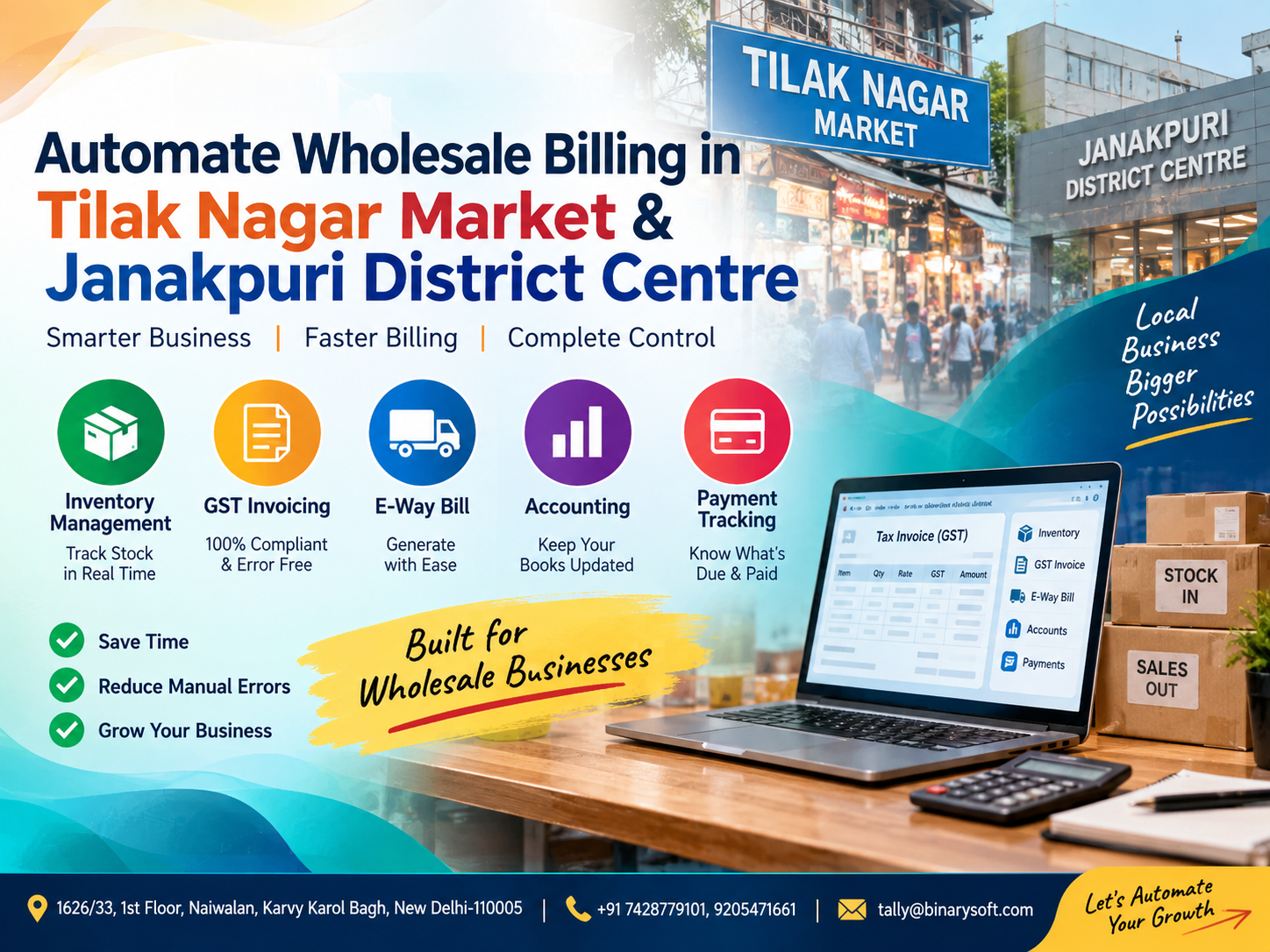
What Changed in 2026? Wholesale Businesses Need Faster, Connected Billing
In 2026, wholesale businesses in Tilak Nagar Market and Janakpuri District Centre are operating in an environment where speed, stock accuracy and GST compliance have become increasingly important. Managing hundreds of products, multiple customer accounts, credit sales, GST invoices, E-Way Bills and outstanding payments through disconnected spreadsheets or manual registers can create costly delays and mistakes. A single incorrect stock entry or missed receivable can affect margins and cash flow. The biggest change for wholesalers is the growing need to connect billing, inventory, accounting and compliance instead of treating them as separate jobs. With automated wholesale billing software, businesses can generate invoices faster, update inventory automatically, maintain customer ledgers, monitor outstanding payments and simplify GST-related records from one integrated system. For growing wholesalers, automation is no longer simply about saving a few minutes—it can provide better control over the entire business.
Wholesale Trade Is Changing in West Delhi
Tilak Nagar and Janakpuri are important commercial areas of West Delhi, serving retailers, distributors, traders, service businesses and consumers across nearby locations.
Wholesale businesses operating in and around these markets may handle dozens or even hundreds of transactions every day. The challenge becomes greater when the same business manages multiple product categories, different GST rates, cash and credit customers, purchase orders, supplier payments and large inventories.
Traditional billing methods can become difficult to manage as transaction volumes increase.
A wholesaler may need to know:
Which products are currently available?
Which products are running low?
How much money is outstanding from a particular customer?
Which invoices are overdue?
What was today's sales value?
How much GST has been recorded?
Which supplier payments are pending?
What is the current stock value?
Which items are selling quickly?
Which customers have crossed their credit limits?
When these answers are spread across registers, Excel files, handwritten notes and different applications, decision-making becomes slower.
Integrated wholesale billing and accounting software brings this information together.
A Story from the Wholesale Counter: When One Missing Entry Changes the Entire Day
Imagine a wholesale trader operating near Tilak Nagar.
It is Monday morning and the shop is already crowded. Retailers are calling for quotations, customers are waiting for invoices and suppliers are asking about pending payments.
A regular customer urgently requests a large quantity of a fast-moving product.
The register shows enough stock.
The order is confirmed.
But when the warehouse team checks the shelves, the required quantity isn't available.
Several units had been dispatched on Saturday evening, but the stock register had not been updated.
The customer has already promised delivery to his own buyers.
Suddenly, what looked like a small stock-entry mistake becomes an uncomfortable conversation.
The owner calls the warehouse. The accountant checks old invoices. Staff search through WhatsApp messages and handwritten dispatch notes.
The customer waits.
The wholesaler feels the pressure—not because the business lacks customers, but because the information isn't moving as quickly as the business.
Now imagine the same transaction with integrated billing and inventory management.
Every sales invoice automatically reduces stock. Purchase entries increase inventory. Current quantities are visible before the order is confirmed.
The owner doesn't have to guess.
That confidence is one of the biggest benefits of business automation.
Why Wholesale Billing Needs More Than Simple Invoice Software
Basic billing software may create invoices, but wholesale businesses usually require much more.
A complete wholesale business management system should connect:
Billing
Inventory management
GST invoicing
Purchase management
Accounting
Customer ledgers
Supplier ledgers
Receivables
Payables
Payment tracking
E-Way Bill-related processes
GST-related records
Sales analysis
Stock reporting
Financial reports
When these functions work together, every transaction can update the relevant business records automatically.
For example, when a sales transaction is recorded correctly, it can simultaneously affect sales, customer outstanding balances, inventory quantities, GST-related records and accounting ledgers.
This reduces repetitive data entry.
1. Faster Wholesale Billing for Busy Counters
Speed matters at a wholesale counter.
Customers often purchase multiple products in different quantities, and invoices may contain many line items.
Manually entering calculations increases the possibility of mistakes.
A structured billing system can help businesses maintain product masters, customer details, tax information, rates and transaction records so invoices can be prepared more efficiently.
Depending on the software configuration and business requirements, wholesalers can manage information such as:
Product name
Item code
HSN/SAC information
Quantity
Unit of measurement
Rate
Discount
Taxable value
GST rate
CGST
SGST
IGST
Invoice total
Customer details
Payment terms
This can significantly reduce repetitive work during invoice preparation.
2. Real-Time Inventory Management
Inventory is often one of the largest investments for a wholesale business.
Poor inventory visibility can lock money into slow-moving products while popular products repeatedly go out of stock.
Integrated inventory management helps businesses understand what they actually have available.
When purchases and sales are properly recorded, stock quantities can be updated along with transactions.
Businesses can monitor:
Opening stock
Purchases
Sales
Sales returns
Purchase returns
Stock transfers
Closing stock
Item-wise movement
Stock valuation
Godown or location-wise inventory, where configured
This provides management with a clearer picture of inventory movement.
Avoid Overstocking
Buying too much stock can create unnecessary working-capital pressure.
Products may remain unsold for months while money stays blocked.
Better inventory reports allow wholesalers to identify slower-moving items before placing additional orders.
Avoid Stock-Out Situations
Running out of a popular product can mean losing an immediate sale and potentially losing a customer.
Stock monitoring helps purchasing teams identify products that require replenishment.
3. GST Invoicing for Wholesale Businesses
GST compliance is an essential part of wholesale billing.
Invoices need accurate information, particularly when businesses handle products with different tax classifications and GST rates.
Maintaining properly configured customer, product and tax masters can reduce repetitive manual calculations.
A GST-ready accounting environment can assist businesses in recording:
GSTIN
HSN/SAC
Taxable value
CGST
SGST
IGST
Applicable GST rates
Interstate and intrastate transactions
Credit notes
Debit notes
Sales returns
Purchase returns
Accurate source data is particularly important because errors at the billing stage can create additional reconciliation work later.
4. E-Way Bill Management for Goods Movement
Wholesalers frequently dispatch goods across Delhi and to customers in other states.
Where E-Way Bill requirements apply, businesses need accurate invoice and transportation information.
Re-entering the same information across different processes consumes time and increases the possibility of errors.
A properly integrated business workflow can make it easier to prepare and manage the transaction information required for applicable E-Way Bill processes.
Businesses should maintain accurate details such as:
Invoice number
Invoice date
Customer GSTIN
Dispatch information
Delivery location
HSN details
Taxable amount
Tax details
Transporter information
Vehicle details, where applicable
Distance and other required transportation particulars
The exact compliance requirement depends on the transaction and prevailing GST/E-Way Bill rules, so businesses should verify applicability for each relevant movement of goods.
5. Integrated Accounting
Billing should not end when the invoice is printed.
Every sale affects accounting.
When billing and accounting are disconnected, accountants may need to enter the same transaction again.
This creates duplicate work.
Integrated accounting can help ensure that properly recorded transactions flow into the relevant accounts and ledgers.
Businesses can maintain records relating to:
Sales
Purchases
Cash
Bank
Customers
Suppliers
Expenses
Taxes
Receivables
Payables
Credit notes
Debit notes
Journal entries
A connected accounting system gives business owners a clearer financial picture.
6. Customer Outstanding and Payment Tracking
Credit sales are common in wholesale markets.
A retailer may purchase today and pay after an agreed credit period.
When there are only ten customers, outstanding balances may be manageable manually.
When there are hundreds, manual tracking becomes risky.
Businesses need to know who owes money, how much is due and how long an invoice has remained unpaid.
An accounting system can help provide customer-wise outstanding information.
For example:
Customer A – ₹85,000 outstanding
Customer B – ₹1,25,000 outstanding
Customer C – ₹42,500 outstanding
Instead of searching through old invoices and registers, the accounts team can review receivables from the accounting records.
Ageing Analysis
Outstanding reports become even more useful when receivables are categorized according to their age.
Businesses may analyze dues across periods such as:
0–30 days
31–60 days
61–90 days
Above 90 days
This helps owners prioritize collections.
7. Supplier Payment Tracking
Wholesalers don't only need to collect money.
They also need to pay suppliers on time.
Missing supplier payments can affect credit limits, purchase terms and future supplies.
Proper accounting records help businesses track supplier balances and payable obligations.
This provides better visibility into upcoming cash requirements.
8. Purchase Management
Wholesale profitability depends heavily on purchasing.
Buying the right quantity at the right rate directly affects margins.
Purchase records should therefore be integrated with inventory and accounting.
When goods are purchased and properly entered, the system can update stock and supplier accounts accordingly.
Management can subsequently analyze purchasing patterns, supplier balances and inventory levels.
9. Manage Multiple Price Levels
Wholesale businesses may not sell every item at one fixed price.
Different customers may receive different rates based on quantity, relationship, category or commercial terms.
For example, a product may have separate rates for retail customers, dealers, distributors or bulk buyers.
Depending on the accounting or ERP software being used, price lists or rate structures can help standardize these arrangements.
This reduces dependence on staff memory.
10. Better Control Over Discounts
Discount errors directly affect profit.
A salesperson may accidentally provide an incorrect discount or apply the wrong rate.
Structured billing processes make it easier to maintain consistent pricing and review discounts provided to customers.
Owners can then identify unusually high discounts or transactions requiring attention.
11. Sales Return and Purchase Return Management
Returns are part of wholesale trading.
Customers may return damaged, incorrect or excess goods.
Similarly, businesses may return defective stock to suppliers.
If returns are not recorded correctly, inventory and accounting balances can become inaccurate.
A connected system helps businesses record returns while maintaining the corresponding financial and stock impact.
12. Know Which Products Actually Make Money
High sales don't automatically mean high profit.
One product may generate significant turnover but very little margin.
Another may sell fewer units while producing better profitability.
Business reports can help owners compare product movement and commercial performance.
This enables better purchasing and pricing decisions.
13. Faster Customer Service
Customers remember speed.
If a retailer calls and asks:
"What was my last purchase rate?"
"What is my outstanding balance?"
"Can you resend my previous invoice?"
"How much stock do you have?"
"When was my last payment?"
The business should ideally be able to retrieve the required information quickly.
Digital records reduce dependence on physical files and individual employees' memory.
14. Reduce Manual Data Entry
Consider a transaction being manually recorded in several places:
First in the invoice.
Then in the stock register.
Then in the customer ledger.
Then in an Excel outstanding sheet.
Then again for accounting or compliance work.
Every duplicate entry consumes employee time and creates another opportunity for error.
Integrated software aims to record the transaction once and use that information across relevant functions.
15. Better Cash-Flow Visibility
A profitable business can still experience cash-flow problems.
Suppose a wholesaler sells ₹20 lakh in a month but ₹12 lakh remains unpaid by customers.
The sales figure looks strong.
The bank balance may tell a very different story.
Outstanding and payable reports help owners understand the relationship between sales, collections and upcoming obligations.
That information can support better purchasing and payment decisions.
16. Reports That Help Owners Make Decisions
Good accounting software shouldn't only store transactions.
It should help convert transactions into useful business information.
Depending on the software and configuration, management may review reports such as:
Sales Register
Purchase Register
Stock Summary
Outstanding Receivables
Outstanding Payables
Cash Book
Bank Book
Day Book
Ledger Reports
Profit & Loss Account
Balance Sheet
GST-related reports
Item-wise sales
Customer-wise sales
Stock movement reports
These reports help transform everyday billing into management information.
Why TallyPrime Is Relevant for Wholesale Businesses
TallyPrime is widely used by Indian businesses for accounting, invoicing, inventory and GST-related business processes.
For wholesalers, the key advantage of an integrated accounting environment is that billing doesn't need to operate as an isolated activity.
Sales, purchases, inventory, accounting, customer balances and business reports can work together.
A correctly configured TallyPrime environment can support businesses in areas such as:
GST invoicing
Accounting
Inventory management
Receivables and payables
Banking-related accounting processes
Sales and purchase records
Business reports
GST-related workflows
E-Invoice and E-Way Bill-related capabilities, subject to applicable requirements and configuration
The appropriate setup depends on the nature, scale and workflow of the business.
TallyPrime for Tilak Nagar Wholesale Businesses
Tilak Nagar businesses can use integrated accounting and inventory systems to manage growing transaction volumes without depending heavily on manual registers.
This can be especially useful for businesses dealing in categories such as garments, electrical goods, electronics, hardware, household goods, auto-related products, food products, accessories and general merchandise.
The specific software configuration should be based on the actual workflow rather than simply installing software with default settings.
TallyPrime for Janakpuri District Centre Businesses
Janakpuri District Centre and surrounding commercial areas include businesses with varied accounting, trading and service requirements.
Businesses managing B2B transactions may particularly benefit from stronger control over customer accounts, inventory, GST records, receivables and financial reporting.
As transaction volume grows, owners need faster access to business information without waiting for multiple spreadsheets to be reconciled.
Moving from Manual Billing to Automated Business Management
Software implementation should be planned carefully.
The first stage is understanding the current business process.
Identify how the business currently handles:
Sales
Purchases
Inventory
Customer credit
Supplier payments
GST
Returns
Discounts
Banking
Reporting
Next, identify where repetitive work and errors occur.
The business can then configure its accounting and billing environment according to actual operational requirements.
Master data should be reviewed carefully, including product names, units, GST details, customer information, supplier information and opening balances.
Finally, staff should be trained on the correct workflow.
Software alone cannot solve poor data-entry practices.
Accurate processes and proper implementation are equally important.
Why Data Accuracy Matters
Automation can process information quickly, but the quality of reports depends on the quality of the underlying entries.
Incorrect product masters, tax rates, opening balances or customer details can affect subsequent reports.
Businesses should therefore periodically review:
Stock records
Customer balances
Supplier balances
Bank reconciliation
Tax information
Product masters
GST details
Outstanding invoices
User access and backup practices
Good software combined with disciplined accounting processes provides much stronger control than either one alone.
Wholesale Business Automation Is About Control, Not Just Speed
The biggest misconception about billing automation is that its only purpose is faster invoice printing.
Speed is useful, but control is more valuable.
A connected system helps an owner understand:
What was sold?
What remains in stock?
Who has not paid?
Which suppliers need payment?
How much money is available?
What are the current liabilities?
Which products are moving?
Where is working capital blocked?
What is the financial position of the business?
These questions directly influence everyday business decisions.
Grow Without Losing Visibility
Growth creates complexity.
A wholesaler may start with one counter, a few customers and a manageable number of products.
Over time, the business may expand to hundreds of customers, thousands of inventory items, multiple employees and significantly larger transaction volumes.
The methods that worked at the beginning may no longer be adequate.
This is why automation becomes particularly important during growth.
The goal is to increase transaction capacity without losing financial and inventory visibility.
From Billing Counter to Business Intelligence
Every invoice contains valuable information.
Every purchase tells you something about demand.
Every outstanding invoice says something about cash flow.
Every stock movement indicates customer behaviour.
When business records are properly maintained, this information can support smarter decisions.
Owners can move from asking:
"How much did we sell?"
to asking:
"Which products generated those sales, which customers bought them, how much money has actually been collected and what stock should we purchase next?"
That is the difference between basic billing and business management.
Why Choose Binarysoft Technologies?
Binarysoft Technologies helps businesses implement and use Tally solutions according to their operational requirements.
As an Authorized Tally Partner, Binarysoft Technologies can assist businesses looking to improve areas such as accounting, GST billing, inventory management and business process efficiency using Tally solutions.
For wholesalers in Tilak Nagar Market, Janakpuri District Centre and other parts of Delhi NCR, the objective should be to create a practical system that employees can use consistently every day.
The right implementation can help reduce repetitive work, improve visibility and provide business owners with more reliable information for decision-making.
Conclusion
Wholesale businesses in Tilak Nagar Market and Janakpuri District Centre operate in an increasingly fast-moving environment where customers expect quick billing, accurate stock information and reliable service.
Managing billing, inventory, GST records, E-Way Bill-related information, accounting and payment tracking through separate manual systems can create unnecessary complexity.
An integrated wholesale billing and accounting solution can bring these processes together.
The real value of automation isn't simply generating invoices faster. It is knowing what you have sold, what remains in stock, who owes you money, what you owe suppliers and how the business is performing financially.
For wholesalers planning to grow in 2026 and beyond, better information can mean better decisions.
Powered by Binarysoft Technologies
Authorized Tally Partner
Location: 1626/33, 1st Floor, Naiwalan, Karol Bagh, New Delhi – 110005, INDIA
Contact us: +91 7428779101, 9205471661
Email us: tally@binarysoft.com
Working Hours: 10:00 AM – 6:00 PM, Mon–Fri
Frequently Asked Questions
What is wholesale billing software?
Wholesale billing software helps businesses create invoices and manage transaction records. More comprehensive solutions can integrate billing with inventory, accounting, customer outstanding balances, purchases, GST-related records and business reporting.
Can TallyPrime be used for wholesale businesses?
Yes. TallyPrime can be used for accounting, invoicing, inventory management, receivables, payables, GST-related processes and other business requirements. The exact functionality available depends on the edition, configuration and applicable services.
CA. Mayankh Singhaal is a Chartered Accountant experienced in accounting systems, statutory audits, and compliance advisory. He has worked with businesses across different sectors to improve reporting accuracy and inventory tracking. His writing focuses on structured growth and compliance-ready operations.