Call CA Tally HelpDesk
+91 9205471661,
7428779101
What Changed in 2026 for Manufacturing Businesses?
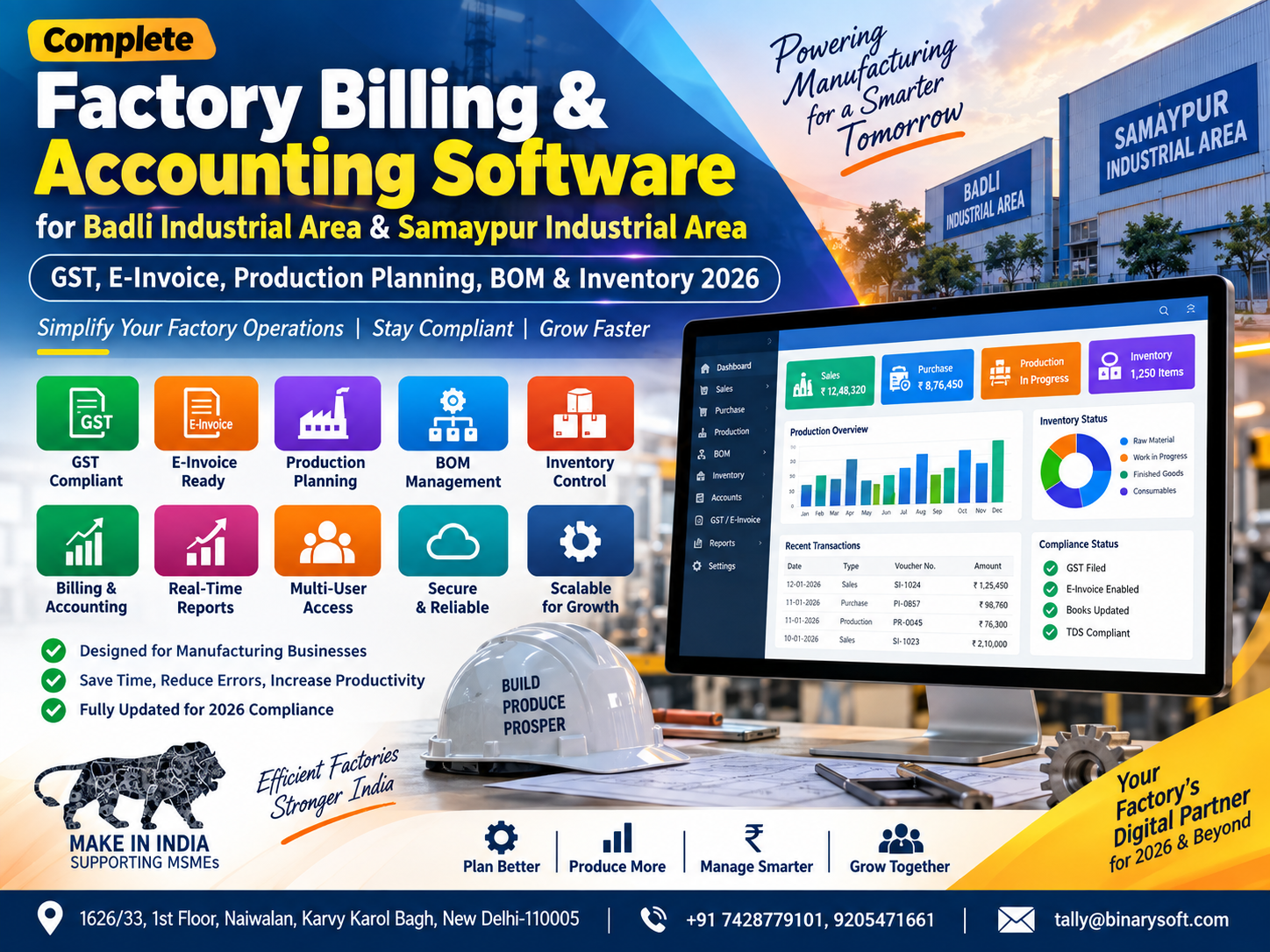
In 2026, factories operating in Badli Industrial Area and Samaypur Industrial Area are under increasing pressure to manage production, inventory, GST billing, e-invoicing, purchases, receivables and accounting without delays or duplicate data entry. As order volumes increase and customers expect faster dispatches, relying on separate spreadsheets, manual stock registers and disconnected billing systems can make everyday factory operations difficult to control. A single wrong stock figure can delay production, while an incorrect invoice or missing material entry can affect accounting and compliance. This is why manufacturers are increasingly looking for integrated factory billing and accounting software that connects raw materials, Bill of Materials (BOM), production planning, finished goods, GST invoices and financial accounts. With the right business software, factory owners can get better visibility over material consumption, production costs, stock availability, pending payments and profitability—helping them make faster decisions and run a more controlled manufacturing operation.
Manufacturing Is No Longer Just About Production
For a factory owner, manufacturing a good product is only one part of running the business successfully.
Every production order creates several connected activities. Raw materials need to be purchased, received and recorded. Materials are issued for production. Finished goods must be accounted for. Wastage and by-products may need tracking. Customer orders have to be dispatched on time. GST invoices and, where applicable, e-invoices and e-way bills must be generated correctly.
At the same time, management needs answers to basic but critical questions:
How much raw material is currently available?
Which finished products are ready for dispatch?
What material needs to be purchased?
How much material was consumed during production?
What is the approximate production cost?
Which customers have outstanding balances?
Which suppliers need to be paid?
What is today's sales value?
What is the GST liability?
Which products are generating better margins?
When these answers are spread across registers, Excel files and different software applications, management loses valuable time.
A complete factory billing and accounting solution can bring these processes together.
Why Factories in Badli Industrial Area Need Better Business Software
Badli Industrial Area is home to businesses involved in manufacturing, processing, fabrication, trading, packaging and various industrial activities.
Many growing factories begin with relatively simple accounting requirements. But as the number of customers, suppliers, products and transactions increases, business operations become more complicated.
Imagine a factory handling hundreds of raw-material items and dozens of finished products.
A single finished item might require five, ten or even twenty different components.
If production increases unexpectedly, management needs to know whether sufficient components are available before accepting a large delivery commitment.
Without proper inventory and BOM management, the production team may discover shortages only after manufacturing has started.
That can result in delayed production, emergency purchases and missed customer commitments.
Integrated factory management software can significantly improve this situation.
Factory Billing Software for Samaypur Industrial Area
Manufacturing businesses operating in and around Samaypur Industrial Area can face similar operational challenges.
Production teams focus on manufacturing.
Stores teams manage materials.
Sales teams process customer orders.
Purchase teams communicate with suppliers.
Accounts teams handle invoices, GST, collections and payments.
When every department maintains separate information, discrepancies can occur.
For example, the stores department may report 500 units of a component, while the spreadsheet maintained by accounts shows 650.
Which figure should management trust?
An integrated inventory and accounting system creates a centralized flow of information.
Purchase transactions increase inventory.
Production consumption reduces raw-material inventory.
Manufacturing entries increase finished-goods inventory.
Sales invoices reduce finished-goods stock.
Accounting entries are simultaneously reflected in the books.
This reduces unnecessary duplication.
A Factory Owner's Story: When One Missing Component Stopped an Entire Order
Consider a fictional manufacturer named Rajiv running a small manufacturing unit in the Badli-Samaypur industrial belt.
His factory had been growing steadily.
One Monday morning, Rajiv received an urgent order from an important customer. The customer needed the goods before the weekend.
His spreadsheet showed enough material, so Rajiv confidently accepted the order.
Production started the next morning.
Then the production supervisor called him.
One critical component was almost finished.
The spreadsheet showed 1,200 units.
The physical stock was only around 300.
Some previous production consumption had never been updated correctly.
Rajiv immediately contacted suppliers. The required material was available, but only at a higher rate for urgent delivery.
The production schedule slipped.
Workers waited.
Dispatch was delayed.
And Rajiv had to call his customer personally and explain why the promised delivery date could not be maintained.
For him, the biggest problem wasn't simply the additional material cost.
It was the uncomfortable feeling of telling a long-standing customer, "We thought the material was available."
That evening, Rajiv realized something important.
A growing factory cannot make tomorrow's production decisions using yesterday's stock information.
After moving toward an integrated inventory, production and accounting process, his objective was simple: before accepting an order, the business should know what is available, what is required and what must be purchased.
That visibility can be one of the biggest advantages of modern factory management software.
One Software System for the Complete Manufacturing Cycle
A well-configured manufacturing accounting solution can connect the complete operational cycle:
Purchase → Raw Material → Production Planning → Material Consumption → Manufacturing → Finished Goods → Sales → GST Invoice → E-Invoice/E-Way Bill → Payment Collection → Accounting → Reporting
Instead of maintaining multiple disconnected records, businesses can create a structured workflow.
1. GST Billing for Manufacturing Businesses
GST billing is a fundamental requirement for factories selling goods to registered and unregistered customers.
A properly configured accounting system can help businesses maintain customer GST details, HSN/SAC information, tax rates, place of supply and invoice-level tax calculations.
Depending on the transaction, businesses may need to handle:
CGST and SGST
IGST
B2B invoices
B2C transactions
Credit notes
Debit notes
Sales returns
Purchase returns
Interstate sales
Intrastate sales
Different GST rates
A centralized system reduces repeated manual calculations and helps keep accounting data connected with invoices.
2. E-Invoice Management
For businesses covered by applicable GST e-invoicing requirements, invoice processing becomes another important part of the dispatch workflow.
Instead of preparing an invoice in one system and repeatedly entering the same information elsewhere, compatible accounting software can streamline e-invoice-related processes.
Depending on the software, configuration and applicable compliance requirements, businesses can manage invoice information needed for generating the Invoice Reference Number and QR-code-related details.
This becomes particularly useful for factories generating a large number of B2B invoices.
A faster invoicing workflow can also mean faster dispatch.
3. E-Way Bill Management
Factories frequently dispatch goods to customers located across Delhi NCR and other states.
Where e-way bill requirements apply, transport and invoice information must be properly managed.
An integrated workflow can help businesses maintain important details such as transporter information, vehicle details, invoice value and goods information.
This can reduce repetitive work between billing and dispatch teams.
4. Bill of Materials (BOM) Management
BOM management is one of the most important capabilities for manufacturing businesses.
A Bill of Materials defines the raw materials or components required to manufacture a finished product.
For example:
Finished Product: Industrial Control Box
Production Quantity: 1 Unit
Required materials may include:
Metal enclosure
Switch
Cable
Connector
PCB
Fasteners
Packaging material
Instead of calculating these requirements manually for every production batch, the BOM provides a predefined material structure.
If the factory needs to manufacture 500 units, management can estimate the corresponding material requirement.
This helps connect sales demand with procurement and production.
5. Raw Material Inventory Management
Raw-material shortages can stop production.
Excess inventory creates another problem—it blocks working capital.
Factory inventory software should therefore help management understand:
Opening stock
Purchases
Material received
Material issued for production
Consumption
Returns
Adjustments
Closing stock
Reorder requirements
The objective is not simply maintaining a stock quantity.
The objective is knowing whether the available inventory is sufficient to meet upcoming production requirements.
6. Finished Goods Inventory
Once production is completed, finished products need to be transferred into available inventory.
Management should be able to see how many units were manufactured, how many were sold, how many are reserved for customer orders and how many remain available.
This information is particularly important when sales teams make delivery commitments.
Accurate finished-goods inventory can help prevent situations where two salespeople promise the same available stock to different customers.
7. Production Planning
Production planning connects demand with available resources.
A factory may have multiple pending orders with different promised delivery dates.
Instead of deciding production only through phone calls and handwritten notes, businesses can create a more structured production process.
Planning can consider:
Pending sales orders
Required production quantity
Available finished stock
Raw-material availability
BOM requirements
Purchase requirements
Production priorities
Expected dispatch dates
Better production visibility allows factory owners to identify potential shortages before they become emergencies.
8. Manufacturing Entries
Manufacturing entries help convert raw-material inventory into finished-goods inventory within the accounting and inventory system.
Suppose a factory manufactures 100 units of Product A.
The system can record consumption of the required raw materials and corresponding production of the finished product.
This provides much better inventory visibility than manually adjusting stock at the end of the month.
9. Wastage and Scrap Tracking
Manufacturing does not always convert 100 percent of raw material into finished goods.
There may be:
Production wastage
Scrap
Rejected components
Damaged materials
By-products
Process loss
These items can affect the true economics of production.
If wastage is consistently higher than expected, management should know.
Proper recording helps businesses compare standard consumption with actual consumption and investigate abnormal differences.
10. Purchase Management
Manufacturing depends heavily on reliable procurement.
Factory software can help organize supplier transactions from purchase requirements through invoice accounting.
Businesses can maintain supplier-wise information, purchase rates, outstanding balances and material receipts.
Historical purchase information can also help management compare rates before placing new orders.
11. Supplier Outstanding Management
Factories frequently purchase materials on credit.
Without proper outstanding tracking, accounts teams can struggle to determine which bills are due and which payments have already been adjusted.
Bill-wise accounting can provide better visibility into supplier balances and pending bills.
This can help businesses plan working capital and maintain better supplier relationships.
12. Customer Outstanding and Receivables
Sales are important, but cash collection keeps operations moving.
A factory may report strong monthly sales while simultaneously facing a cash shortage because customers have not paid on time.
Receivable management helps businesses monitor customer balances, pending invoices and ageing.
Management can identify overdue accounts and prioritize collection follow-ups.
13. Sales Order Management
Customer orders can serve as the starting point for production planning.
A sales order can capture:
Customer
Product
Quantity
Rate
Delivery date
Commercial terms
Pending quantity
Once orders are systematically recorded, businesses gain clearer visibility into future production and dispatch commitments.
14. Purchase Order Management
Purchase orders help create greater control over procurement.
Instead of depending entirely on verbal instructions, the purchase team can record supplier, material, quantity, agreed rate and delivery expectations.
When materials arrive, businesses can compare actual receipt against the order.
This improves procurement discipline.
15. Batch-Wise Inventory
Some manufacturing businesses need batch-level tracking.
Batch management can be useful when businesses need to identify which production or purchase batch particular goods came from.
Depending on the industry, businesses may also need manufacturing dates, expiry dates or other batch-related information.
16. Godown and Location-Wise Stock
A factory may maintain inventory across multiple physical locations:
Raw-material store
Production floor
Finished-goods warehouse
Dispatch area
External godown
Branch warehouse
Location-wise inventory allows management to see not only how much stock exists, but where it exists.
This can substantially improve material control.
Accounting Integrated with Factory Operations
One of the major advantages of an integrated system is that factory operations and financial accounting do not remain completely separate.
Sales affect customer balances.
Purchases affect supplier balances.
Receipts reduce customer outstanding.
Payments reduce supplier outstanding.
Expenses affect profitability.
Inventory transactions affect stock records.
This allows owners and accounts teams to review the financial position using the same underlying business data.
Financial Reports for Better Decisions
Management may require reports such as:
Profit & Loss Account
Balance Sheet
Trial Balance
Cash Book
Bank Book
Ledger reports
Receivables
Payables
Stock Summary
Sales Register
Purchase Register
GST-related reports
Item-wise sales
Customer-wise sales
Supplier-wise purchases
These reports turn day-to-day entries into information that management can use.
Production Cost Visibility
A factory owner should know more than the selling price of a product.
Understanding production cost is essential for pricing and profitability.
Depending on the business process and system configuration, production cost analysis may include raw-material cost, direct expenses and other manufacturing-related allocations.
Consider a product selling for ₹1,000.
If management assumes its production cost is ₹700, it may appear to generate a healthy margin.
But if material prices increase and the actual production cost moves closer to ₹850, the profitability changes substantially.
Without current cost information, businesses may continue selling products at outdated prices.
BOM Helps Control Production Cost
A properly maintained BOM provides a standard reference for expected material consumption.
Management can compare expected consumption against actual consumption.
If actual consumption is consistently higher, possible causes could include:
Wastage
Production inefficiency
Incorrect BOM quantities
Material quality problems
Unrecorded stock movement
Pilferage
Process variation
Identifying these differences can lead to meaningful cost savings.
Inventory Control: Avoid Both Shortage and Overstocking
Inventory management has two opposite risks.
Too little inventory can stop production.
Too much inventory can lock up working capital.
For example, if a factory keeps ₹20 lakh worth of unnecessary material, that money cannot easily be used for salaries, supplier payments, machinery maintenance or expansion.
Software-assisted stock management can help identify slow-moving items, fast-moving materials and potential reorder requirements.
Better information leads to better purchasing decisions.
Real-Time Business Visibility
Factory owners cannot always remain physically present in the production unit.
Management reporting can provide visibility into important business information such as sales, purchases, stock, receivables, payables and cash/bank positions.
The exact availability of remote or real-time access depends on the software setup, hosting environment, permissions and infrastructure selected by the business.
For organizations that need secure remote working, appropriate cloud or remote-access solutions can be considered.
TallyPrime for Manufacturing and Factory Accounting
TallyPrime can be configured for many accounting, inventory, GST and manufacturing-related business requirements.
For suitable businesses, it can help manage:
GST accounting
Sales and purchase transactions
Inventory
Stock groups and stock items
Godowns
Batch-related inventory
Bill of Materials
Manufacturing journals
Sales orders
Purchase orders
Receivables and payables
Cost centres
Banking
Financial statements
Business reports
The appropriate configuration depends on the manufacturing process and reporting requirements of each business.
A factory with five finished products may require a very different setup from a manufacturer maintaining thousands of stock items and multiple production stages.
Why Proper Implementation Matters
Purchasing accounting software is only the first step.
Configuration is equally important.
Stock groups must be planned correctly.
Units of measurement need to be defined.
GST details should be configured appropriately.
Opening balances need verification.
BOMs need accurate quantities.
Godowns and inventory locations should reflect the actual business.
User permissions should match responsibilities.
Reports should be tested against management expectations.
Poor configuration can result in good software producing confusing reports.
This is why implementation, training and ongoing support matter.
Factory Software Setup for Badli Industrial Area
Manufacturers in Badli Industrial Area can consider an implementation based on their actual workflow.
For example:
Customer Order
↓
Production Requirement
↓
BOM Material Requirement
↓
Raw-Material Availability Check
↓
Purchase Requirement
↓
Material Receipt
↓
Production / Manufacturing Entry
↓
Finished Goods
↓
Dispatch
↓
GST Invoice
↓
E-Invoice / E-Way Bill, where applicable
↓
Customer Outstanding
↓
Payment Receipt
↓
Accounting & MIS Reports
This creates a more structured operational flow.
Factory Software Setup for Samaypur Industrial Area
Factories in Samaypur Industrial Area can similarly integrate accounting with inventory and manufacturing.
The objective should be simple:
Enter information at the correct point and use it throughout the business process.
When a purchase is recorded, inventory and supplier accounts should reflect it.
When raw material is consumed, inventory should reflect it.
When finished goods are produced, finished inventory should update.
When goods are sold, stock and customer accounts should reflect the transaction.
This minimizes duplicate work and gives management more dependable information.
Industries That Can Benefit
A properly configured factory accounting and inventory solution may be useful for businesses involved in:
Electrical components
Electronics
Plastic products
Packaging materials
Metal fabrication
Auto components
Machinery parts
Furniture manufacturing
Garments and textiles
Printing and packaging
Food processing
Engineering products
Hardware products
Industrial equipment
Consumer products
Assembly operations
Job work
The exact solution should always be designed around the manufacturing process rather than forcing every factory into the same workflow.
From Excel Sheets to an Integrated Manufacturing System
Excel remains useful for many business activities.
The problem arises when critical factory processes depend on multiple independent spreadsheets.
One file tracks purchases.
Another tracks raw materials.
Another maintains production.
Another tracks finished stock.
Another contains customer outstanding.
Accounting is maintained somewhere else.
Every time information moves manually between these files, there is an opportunity for delay or error.
An integrated system can create one more consistent source of operational and financial information.
Better Control for Factory Owners in 2026
Modern factory management is increasingly data-driven.
Owners need to know what is happening without waiting until month-end accounts are completed.
A well-structured system can help management answer:
What did we sell today?
What did we manufacture?
Which orders are pending?
Which materials are running low?
Which customers owe us money?
What supplier payments are coming due?
What is the current stock position?
Which items are selling faster?
Where is working capital getting blocked?
These are operational questions that affect daily decisions.
Reduce Manual Errors and Duplicate Entry
Manual data handling can create avoidable mistakes.
An invoice amount may be entered incorrectly.
A purchase may be entered in accounts but not in the stock sheet.
Production consumption may not be updated.
A customer receipt may remain unadjusted.
An old BOM may continue to be used after the manufacturing process changes.
A centralized workflow reduces the number of places where the same information needs to be entered.
Less duplicate entry generally means fewer opportunities for mismatch.
Improve Coordination Between Departments
Manufacturing businesses depend on coordination.
Sales needs information from production.
Production depends on stores.
Stores depends on purchase.
Purchase depends on finance.
Finance depends on collections.
Management depends on everyone.
When these teams operate with disconnected information, delays can multiply.
An integrated system provides a common data foundation for decision-making.
Business Growth Without Losing Control
A factory can often manage manually when transaction volumes are small.
Problems become visible during growth.
Ten daily invoices become fifty.
Twenty stock items become two hundred.
Two suppliers become fifty.
One production line becomes multiple lines.
A few customers become hundreds.
Processes that worked at a smaller scale can become bottlenecks.
The right accounting and inventory infrastructure helps businesses scale without proportionately increasing administrative complexity.
Choosing Factory Billing & Accounting Software in 2026
Before selecting a solution, manufacturing businesses should evaluate their actual requirements.
Consider:
Number of users
Number of stock items
Raw-material structure
Finished products
BOM complexity
Production stages
Godowns
GST requirements
E-invoicing requirements
E-way bill requirements
Sales order process
Purchase order process
Customer outstanding
Supplier outstanding
Management reports
Remote-access requirements
Backup and data-security needs
Support and training requirements
The best system is not necessarily the one with the longest feature list.
It is the one that fits the factory's actual workflow.
Binarysoft Technologies – Tally Solutions for Manufacturing Businesses
Binarysoft Technologies provides Tally-related solutions and support for businesses looking to improve accounting, inventory, GST and operational management.
For manufacturing businesses in Badli Industrial Area, Samaypur Industrial Area and other parts of Delhi NCR, the implementation can be planned according to business requirements such as inventory structure, BOM, manufacturing entries, godown management, sales/purchase processes and accounting reports.
The goal is to create a practical system that employees can use consistently while giving management useful information.
Why Local Support Matters
Software problems do not always happen at convenient times.
A business may need assistance with configuration, inventory setup, GST-related workflows, data management, reports, user training or operational changes.
Working with an experienced Tally partner can help businesses receive guidance not only during software purchase but also during implementation and subsequent usage.
For a manufacturing business, this is particularly important because accounting and inventory structures can become more complex as the business expands.
Conclusion
Factories in Badli Industrial Area and Samaypur Industrial Area are operating in an environment where production speed alone is not enough. Businesses also need better control over raw materials, finished goods, customer orders, supplier payments, GST billing, e-invoicing, inventory and financial reporting.
A complete factory billing and accounting system can connect these activities into a more structured workflow.
From BOM and production planning to manufacturing entries, GST invoices, stock control, receivables and financial reports, integrated business software can reduce duplicate work and provide management with better operational visibility.
For manufacturers planning to modernize their accounting and inventory processes in 2026, the priority should be to build a system around the actual factory workflow.
Better data can mean better production planning.
Better inventory control can mean fewer shortages.
Better accounting visibility can mean stronger financial decisions.
And ultimately, better control can help a manufacturing business grow with greater confidence.
Powered by Binarysoft Technologies
Authorized Tally Partner
Location: 1626/33, 1st Floor, Naiwalan, Karol Bagh, New Delhi – 110005, INDIA
Contact us: +91 7428779101, 9205471661
Email us: tally@binarysoft.com
Business Hours: 10:00 AM – 6:00 PM, Mon–Fri
Frequently Asked Questions
What is factory billing and accounting software?
Factory billing and accounting software combines sales billing, purchases, inventory, accounting and manufacturing-related processes within a structured business system. Depending on the solution, it can also support BOM, production entries, godown management, GST and other operational requirements.
Can TallyPrime be used for manufacturing businesses?
Yes. TallyPrime provides accounting and inventory capabilities that can be configured for many manufacturing businesses, including stock items, godowns, BOM, manufacturing journals, sales, purchases, receivables, payables and GST-related processes.
CA. Lakshy Vermaa advises small and mid-sized businesses on accounting discipline, tax compliance, and process improvement. With exposure to retail and trading environments, he writes practical articles aimed at helping business owners gain better financial visibility and control.