Call CA Tally HelpDesk
+91 9205471661,
7428779101
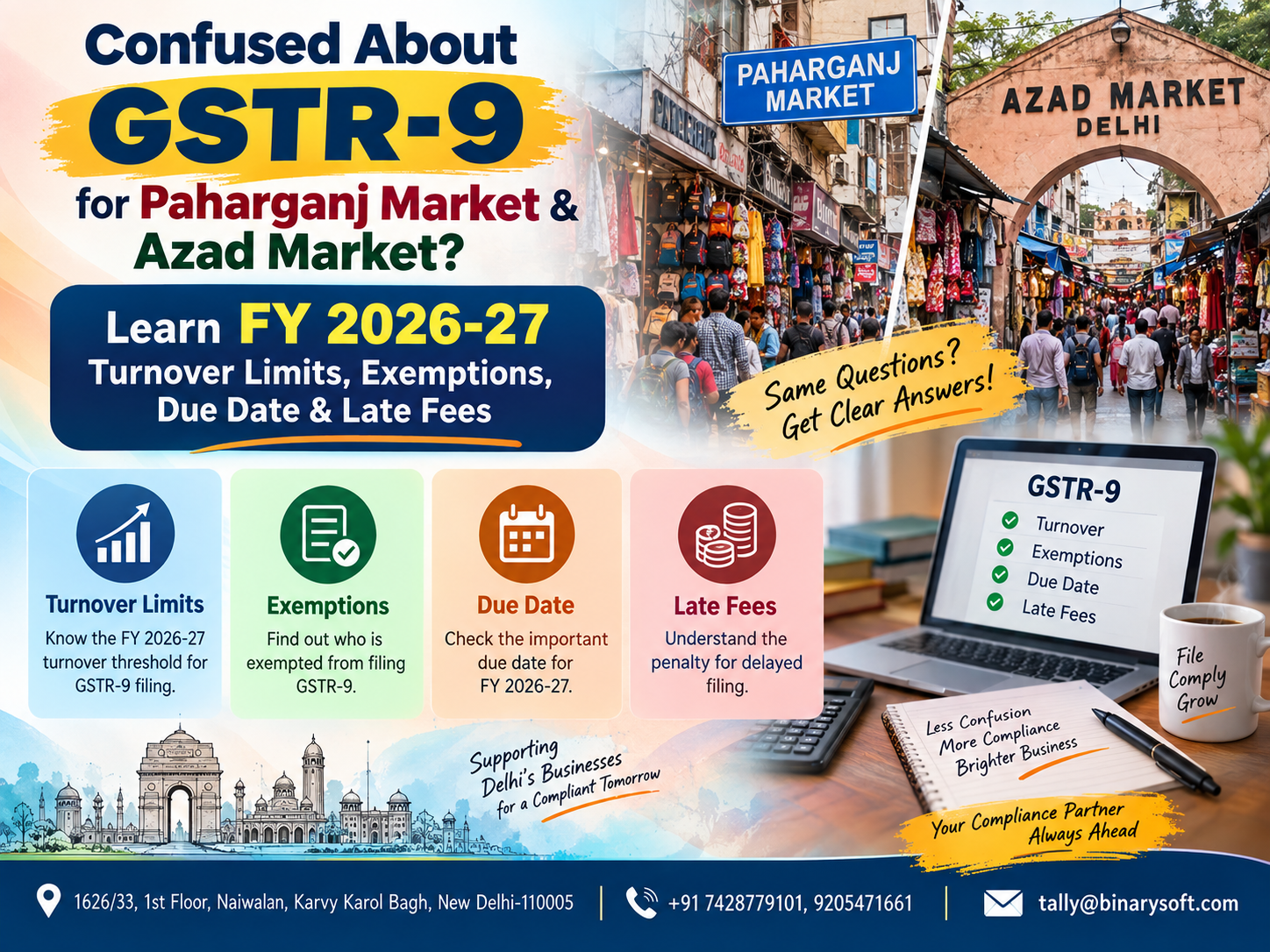
What Changed Now? Why GSTR-9 Deserves Attention in 2026
In 2026, GST compliance is becoming increasingly data-driven, and businesses in busy trading areas such as Paharganj Market and Azad Market cannot afford to treat the annual return as a last-minute exercise. GSTR-9 brings an entire financial year's GST information together, making mismatches between sales, tax paid, input tax credit and accounting records much easier to identify. The pressure increases when monthly or quarterly returns, books of accounts and GST records do not agree. For FY 2026-27, businesses should therefore start reconciliation during the year rather than waiting until the annual filing period. Under the current framework, GSTR-9 is generally filed by eligible regular taxpayers, while specified categories are excluded and turnover-based relief may apply through government notifications. The benefit of preparing early is straightforward: cleaner books, fewer year-end surprises, better reconciliation and enough time to correct eligible discrepancies before statutory deadlines close.
Why GSTR-9 Matters for Paharganj Market and Azad Market Businesses
Paharganj and Azad Market are active commercial areas of Delhi where retailers, wholesalers, distributors, traders and service businesses can process substantial numbers of transactions.
A typical business may deal with:
Daily sales invoices
Purchase invoices
GST collections
Input Tax Credit
Credit notes
Debit notes
Sales returns
Purchase returns
Cash transactions
Bank payments
UPI receipts
Supplier outstanding balances
Customer outstanding balances
Interstate transactions
During the year, these transactions ultimately contribute to GST compliance records.
This is why annual GST compliance should not begin on the day you decide to file GSTR-9.
It should begin with accurate accounting throughout the financial year.
What Is GSTR-9?
GSTR-9 is the annual return prescribed under the GST framework for applicable registered taxpayers.
It provides consolidated information relating to supplies, taxes, Input Tax Credit and other relevant particulars for a financial year.
In simple terms, monthly or quarterly GST compliance tells the government what happened during individual tax periods, while GSTR-9 provides an annual view of relevant GST information.
This makes reconciliation particularly important.
Businesses should not assume that GSTR-9 is simply a matter of adding twelve months of figures together.
FY 2026-27 Means Which Period?
FY 2026-27 covers:
1 April 2026 to 31 March 2027.
Businesses operating in Paharganj Market, Azad Market or anywhere else in India should therefore maintain clean GST and accounting records throughout this period.
Under the existing Rule 80 framework, an annual return is ordinarily due by 31 December following the end of the relevant financial year.
Accordingly, the normal statutory timeline for FY 2026-27 would fall on:
31 December 2027
This should be treated as the current-rule position. Businesses should check subsequent CBIC/GST notifications before filing because deadlines, exemptions or procedural requirements can be amended or extended.
Understanding the GSTR-9 Turnover Limit
One of the most common questions among traders is:
"My turnover is small. Do I still have to file GSTR-9?"
The answer depends on the applicable law and any exemption notification issued for the relevant financial year.
Section 44 permits the government, on the GST Council's recommendations, to exempt specified classes of registered persons from filing the annual return.
Therefore, businesses should not blindly assume that a turnover exemption applicable to one financial year will automatically remain unchanged forever.
For FY 2026-27, taxpayers should verify the notification applicable to that specific year before deciding that GSTR-9 is not required.
The Common ₹2 Crore Question
Businesses frequently hear about a ₹2 crore threshold in relation to GSTR-9.
Turnover-based exemptions have historically provided relief to smaller taxpayers for specified financial years.
However, the important point for a business owner is this:
Do not decide applicability merely because someone says, "Below ₹2 crore, GSTR-9 is never required."
The exemption needs to be checked for the relevant financial year.
Since FY 2026-27 has not yet ended as of September 2026, businesses should verify the final notification position applicable to FY 2026-27 before the filing season.
This is particularly important for SEO readers finding this article months later, because GST notifications can change after publication.
What Is GSTR-9C?
GSTR-9 and GSTR-9C are related, but they are not the same form.
Under the current Rule 80 framework, a registered person whose aggregate turnover during a financial year exceeds ₹5 crore is generally required to furnish a self-certified reconciliation statement in Form GSTR-9C along with the annual return, subject to applicable exclusions and future amendments.
GSTR-9C is designed to reconcile information reported in the annual return with the relevant financial information.
Businesses crossing this level should therefore pay particular attention to reconciliation well before the annual filing deadline.
A Story from a Busy Delhi Market: The December Surprise
Imagine a wholesale trader operating from a crowded market in Delhi.
Throughout the year, business was strong.
Invoices were generated every day. Suppliers were paid. Customers placed repeat orders. GST returns were also filed regularly.
The owner assumed everything was fine.
Then December arrived.
His accountant began preparing the annual GST reconciliation.
A problem appeared.
Sales recorded in the accounting books did not perfectly match the figures reported through GST returns.
Then another difference appeared in Input Tax Credit.
A few credit notes had been accounted for differently.
The owner looked at his accountant and asked:
"We filed GST throughout the year. Why are we finding all these differences now?"
The accountant's answer was simple:
"Because filing a return and reconciling an entire financial year are different jobs."
For the next several days, the team opened old invoices, checked ledgers, compared GST reports and traced entries one by one.
The shop remained busy, but the owner was mentally somewhere else.
He worried about whether an old mistake would turn into a larger compliance problem.
The following year, he changed one process.
Every month, his accountant reconciled the major GST figures instead of waiting until December.
The difference was enormous.
Year-end compliance stopped feeling like an emergency.
That is the real lesson of GSTR-9: annual compliance becomes easier when accounting discipline begins in April, not December.
Who Is Generally Covered by GSTR-9?
Under Section 44 and Rule 80, the annual return framework applies to registered persons subject to statutory exclusions and any exemptions notified by the government.
Businesses should evaluate their exact registration category and turnover before filing.
The legislation specifically provides exclusions for certain categories, including:
Input Service Distributors
Persons required to deduct tax under Section 51
Persons required to collect tax under Section 52
Casual taxable persons
Non-resident taxable persons
There are also provisions concerning specified government departments and local authorities whose accounts are subject to the prescribed audit framework.
Always evaluate applicability according to the law and notifications relevant to the particular financial year.
GSTR-9 Is Not the Same as GSTR-1
This causes confusion for many new business owners.
GSTR-1 primarily contains details relating to outward supplies for the relevant return period.
GSTR-9 is an annual return.
It consolidates and reports annual GST information across multiple areas rather than functioning as another monthly sales return.
Therefore:
GSTR-1 is not GSTR-9.
GSTR-3B is not GSTR-9.
GSTR-9C is not GSTR-9.
Each has a different purpose within the GST compliance framework.
Why Turnover Calculation Needs Attention
A business owner may look at sales in one shop and conclude that turnover is below a particular threshold.
GST applicability calculations can require a broader view.
Where a taxpayer operates under the same PAN through multiple registrations or business locations, aggregate turnover concepts need to be considered appropriately.
For example, a business might have operations in Delhi and another state.
The owner should not automatically evaluate a statutory aggregate-turnover threshold using only one shop's local sales figure.
Businesses with multiple GST registrations should get the turnover calculation reviewed carefully.
What Information Should Be Reconciled Before GSTR-9?
Preparation should start with the books of accounts and GST records.
Businesses should review important areas such as:
Turnover as per books
Turnover reported in GST returns
Taxable supplies
Exempt supplies
Zero-rated supplies, where applicable
Tax liability
Tax paid
Input Tax Credit claimed
Input Tax Credit reversals
Credit notes
Debit notes
Amendments
HSN-related information where applicable
Previous-period adjustments permitted under GST rules
The objective is to understand why differences exist rather than simply forcing figures to match.
Sales Reconciliation
For a retailer or wholesaler in Paharganj or Azad Market, sales volume can be significant.
A strong reconciliation process should compare accounting sales with GST reporting.
Differences may arise because of:
Missed invoices
Duplicate entries
Incorrect dates
Credit notes
Sales returns
Amendments
Wrong GST classification
Incorrect tax rates
Timing differences
Finding these problems earlier gives the accounting team more time to investigate them.
Input Tax Credit Reconciliation
Input Tax Credit is another critical area.
Businesses should review ITC recorded in their books against relevant GST data and determine whether the credit claimed satisfies applicable conditions.
Do not assume that every GST amount appearing on a purchase invoice is automatically eligible ITC.
Eligibility depends on the GST law and the circumstances of the transaction.
Businesses should review questionable credits with their GST professional before annual filing.
Credit Notes and Debit Notes
Retail and wholesale businesses frequently issue or receive credit and debit notes.
For example, goods may be:
Returned
Damaged
Short supplied
Overcharged
Discounted after sale
Repriced
If these adjustments are not correctly recorded, turnover and GST figures may differ.
A proper accounting system makes it easier to trace such transactions during reconciliation.
Why Correct GST Masters Matter
A surprisingly large number of reporting problems begin with incorrect master configuration.
For example:
Wrong GSTIN
Incorrect HSN/SAC
Wrong tax rate
Incorrect party registration type
Incorrect state
Wrong place-of-supply treatment
Incorrect ledger configuration
One incorrect master can affect dozens or hundreds of transactions.
This is why businesses should periodically review their GST masters rather than checking them only when a problem occurs.
GSTR-9 Due Date for FY 2026-27
Under the current statutory framework, GSTR-9 is required to be furnished on or before 31 December following the end of the relevant financial year.
FY 2026-27 ends on 31 March 2027.
Therefore, under the current framework, the normal due date would be:
31 December 2027
However, GST deadlines can be modified or extended through government notifications.
Businesses should therefore verify the official due date applicable at the time of filing.
What Happens If GSTR-9 Is Filed Late?
Late filing can result in a late fee under Section 47 of the CGST Act and corresponding State/UT GST provisions.
The late-fee framework has been rationalised for specified turnover categories through notifications.
For smaller eligible taxpayers, reduced per-day late fees and lower maximum caps have applied under the revised framework, while larger taxpayers can face the statutory rate.
Because FY 2026-27 filing will occur in the future, businesses should verify the exact late-fee notification applicable when the return becomes due rather than relying on an outdated article or social-media post.
Current Late-Fee Structure: An Important Reference Point
Under the rationalised framework applicable from specified earlier financial years, the total CGST plus SGST late-fee structure has generally operated as follows:
For aggregate turnover up to ₹5 crore: ₹50 per day in total, subject to the applicable reduced maximum cap.
For turnover above ₹5 crore and up to ₹20 crore: ₹100 per day in total, subject to the applicable reduced maximum cap.
For taxpayers outside the reduced-fee categories, the statutory framework can result in a higher late fee.
These figures should be treated as the current framework to understand the system, not as a guarantee that no notification will change the treatment for FY 2026-27.
Why GSTR-9C Should Not Be Ignored
Businesses above the applicable GSTR-9C turnover threshold need to pay special attention to the reconciliation statement.
A significant clarification issued by CBIC in 2025 addressed late fees where GSTR-9C is required.
The clarification explains that when GSTR-9C is required, the annual return is not considered complete merely because GSTR-9 has been filed.
The complete annual return includes GSTR-9 together with GSTR-9C where GSTR-9C is applicable.
This makes timely preparation of reconciliation information particularly important for larger businesses.
Can GSTR-9 Be Treated Like a Routine Return?
It should not be.
Annual return preparation provides an opportunity to look at the financial year as one complete compliance period.
Monthly returns can appear correct individually while annual reconciliation still reveals differences.
That is why businesses should examine the relationship between:
Books of accounts
Sales records
Purchase records
GSTR-1
GSTR-3B
Input Tax Credit information
Tax payments
Annual return information
Why Paharganj Businesses Should Start Early
Paharganj businesses can deal with rapid inventory movement and frequent customer transactions.
When transaction volumes are high, even a small percentage of incorrect entries can create a large reconciliation workload.
Consider a business processing thousands of invoices.
If only a small number contain incorrect GST classifications, finding those transactions at year-end can consume substantial time.
Regular review makes the process manageable.
Why Azad Market Traders Need Structured Accounting
Wholesale businesses often have a different challenge.
A wholesaler may deal with:
Large invoices
Multiple suppliers
Bulk quantities
Credit transactions
Customer outstanding balances
Purchase returns
Trade discounts
Interstate supplies
These transactions can affect accounting and GST reporting in different ways.
Structured accounting allows the business to trace each transaction from invoice to ledger to GST report.
Using TallyPrime for GST Accounting
TallyPrime can help businesses maintain GST-related accounting and transaction information when configured appropriately.
Businesses can use accounting and GST features to maintain:
Sales transactions
Purchase transactions
GST ledgers
Party ledgers
Credit notes
Debit notes
Inventory records
Tax-related information
GST reports
The quality of the output, however, depends heavily on the accuracy of the underlying data.
Software cannot automatically correct every accounting decision.
Correct configuration, accurate entries and regular review remain essential.
Don't Wait Until December
One of the biggest mistakes businesses make is thinking:
"We will check everything when GSTR-9 becomes due."
By then, employees may have changed.
Old invoices may be difficult to locate.
Suppliers may not respond quickly.
Accounting adjustments may require investigation.
The person who entered a transaction may no longer remember why it was recorded in a particular way.
Monthly or quarterly reconciliation reduces this pressure.
A Better FY 2026-27 Compliance Routine
Businesses can create a simple year-round process.
During the year, regularly reconcile sales, purchases and GST information.
Review Input Tax Credit.
Check GSTIN and party masters.
Review credit and debit notes.
Check unusual transactions.
Investigate differences rather than carrying them forward indefinitely.
Before annual return preparation begins, conduct a detailed year-end reconciliation.
This transforms GSTR-9 from a December crisis into a controlled compliance process.
Maintain Digital Records Properly
Businesses should maintain proper supporting documentation for transactions.
This can include applicable:
Tax invoices
Purchase invoices
Credit notes
Debit notes
Payment records
E-invoice records
E-way bill records
Bank records
Accounting ledgers
Relevant agreements or supporting documents
Good documentation makes reconciliation and future verification much easier.
Do Not File Without Reviewing the Data
Annual returns deserve careful review.
Before submission, taxpayers should ensure that relevant figures have been checked against books and GST records.
A business should understand significant differences rather than assuming auto-populated information is automatically correct for every purpose.
This is especially important because annual GST compliance involves information accumulated over an entire financial year.
How Binarysoft Technologies Can Help
Binarysoft Technologies, an Authorized Tally Partner, helps businesses implement and use TallyPrime for accounting, inventory and GST-related business processes.
For retailers, wholesalers and other businesses in Paharganj Market, Azad Market and across Delhi NCR, a properly configured accounting system can make year-round GST data management significantly more organised.
Businesses can focus on maintaining accurate transactions throughout the year so that GST reconciliation does not become an avoidable last-minute exercise.
Support requirements may include TallyPrime implementation, GST configuration, accounting setup, inventory configuration, user training and related business-process assistance.
GSTR-9 Readiness Is Really About Better Accounting
There is an important business lesson hidden inside annual GST compliance.
A company with clean accounting records generally finds annual reconciliation easier.
A company with incomplete invoices, incorrect GST masters, unrecorded credit notes and unreconciled transactions can struggle regardless of which software it uses.
Therefore, the best GSTR-9 strategy is not simply:
"File before the due date."
A better strategy is:
"Keep the accounts ready throughout the year."
That change in mindset can save considerable time when annual compliance begins.
Conclusion
For businesses in Paharganj Market and Azad Market, GSTR-9 should be viewed as an annual reconciliation exercise rather than just another GST form.
FY 2026-27 runs from 1 April 2026 to 31 March 2027, and under the current Rule 80 framework, the normal annual-return deadline would be 31 December 2027. However, businesses should verify the final government notifications applicable to FY 2026-27 before relying on any turnover exemption, filing requirement or late-fee concession.
The most effective preparation starts now.
Keep sales and purchase records accurate. Reconcile GST returns with books regularly. Review Input Tax Credit. Correct master-data problems. Track credit and debit notes. Investigate differences when they occur.
For a busy retailer or wholesaler, this discipline does more than simplify GSTR-9.
It creates cleaner accounts, better visibility and greater confidence in the financial information used to run the business.
Frequently Asked Questions
What is GSTR-9?
GSTR-9 is the annual GST return prescribed for applicable registered taxpayers. It contains consolidated information relating to supplies, taxes, Input Tax Credit and other prescribed details for the financial year.
What period does FY 2026-27 cover?
FY 2026-27 runs from 1 April 2026 to 31 March 2027.
CA. Arvindh Khetwaani is a Chartered Accountant with experience in financial reporting, compliance management, and accounting software implementation. He has assisted businesses in adopting structured inventory and billing practices, and his articles focus on accuracy, controls, and sustainable business growth.