Call CA Tally HelpDesk
+91 9205471661,
7428779101
What Changed in 2026? Delhi Retailers Are Moving Beyond Simple Billing
In 2026, running a retail store in busy commercial areas such as Nehru Place and Janakpuri is no longer only about generating bills quickly. Customers expect faster checkout, digital payment options, accurate GST invoices and instant information about product availability. At the same time, retailers are under pressure to control inventory, reduce billing mistakes, track thousands of products and understand daily profits without spending hours checking registers and spreadsheets. Recent months have therefore pushed many businesses toward integrated barcode billing and POS software that connects sales, inventory, GST invoicing and business reporting in one system. A barcode scan can identify an item, fetch its price, calculate applicable taxes, update stock and complete the sale within seconds. For retailers handling high customer volumes, the benefit is significant: shorter queues, better stock visibility, fewer manual errors and greater control over everyday business operations.
Why Barcode Billing Software Has Become Important for Nehru Place & Janakpuri Businesses
Nehru Place and Janakpuri represent two important commercial environments in Delhi. Nehru Place is widely associated with computers, electronics, accessories, IT products and related businesses, while Janakpuri has a broad retail ecosystem serving customers across multiple product categories.
The common challenge is speed.
When a customer reaches the billing counter, the retailer cannot afford to spend several minutes manually searching for an item, checking its price, calculating tax and entering product information.
A modern barcode billing system simplifies the process.
The cashier scans the barcode, the software identifies the product, retrieves its selling price and tax information, adds it to the invoice and adjusts the available stock after the transaction.
This transforms the billing counter from a manual data-entry point into an integrated retail management system.
For growing retailers, the advantage extends far beyond faster billing. The same software can help owners understand:
Which products are selling quickly?
Which items have low stock?
Which products have remained unsold for months?
What was today's total sale?
How much GST was collected?
Which customers have outstanding balances?
Which suppliers need to be paid?
Which category generates better revenue?
What is the current inventory position?
Instead of collecting information from different registers and spreadsheets, business owners can access important operational information from one system.
What Is Barcode Billing Software?
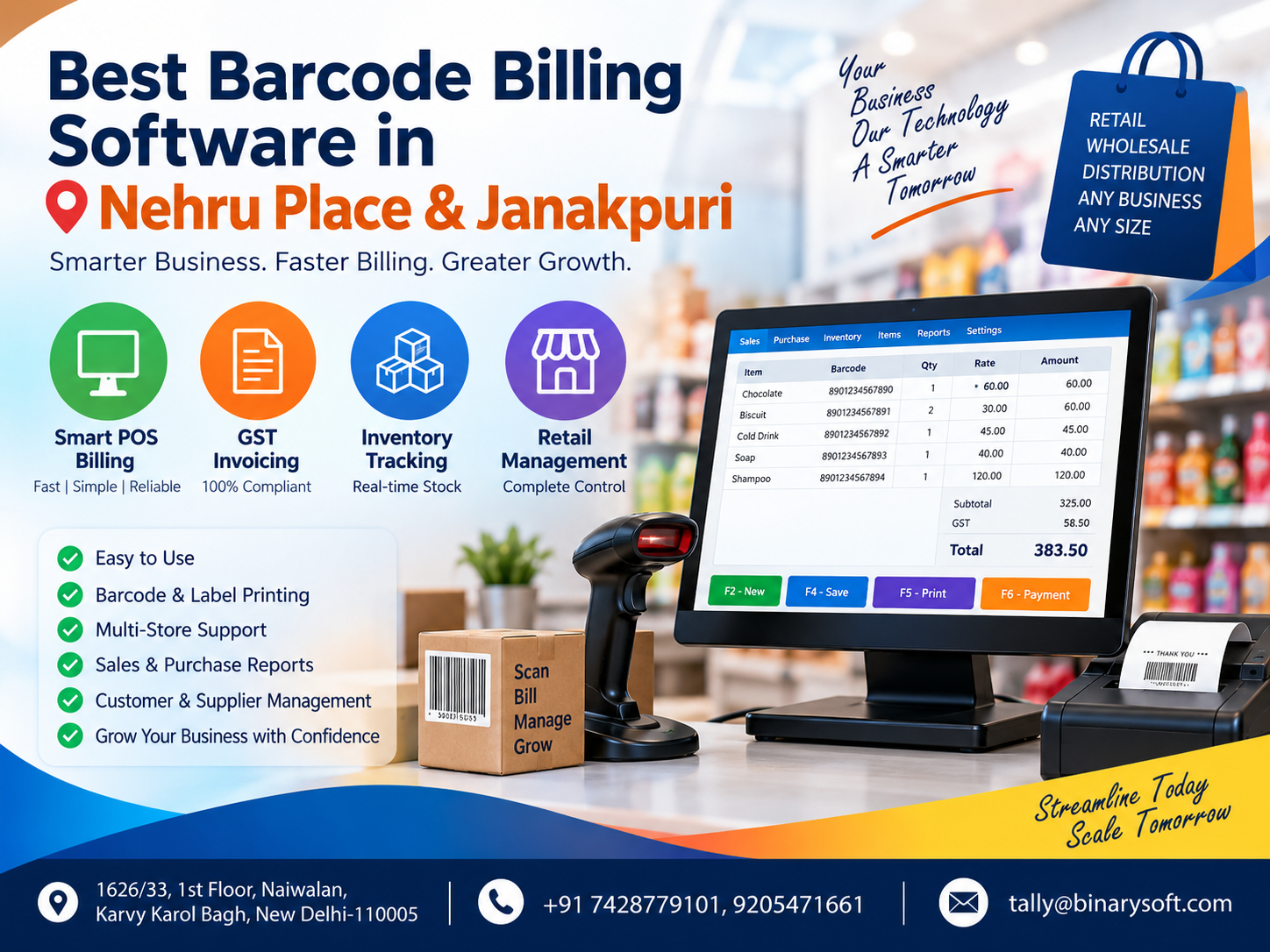
Barcode billing software is a retail billing and inventory management solution that uses product barcodes to identify items during purchase, sale and stock-related transactions.
Every product can be assigned or linked with a barcode containing a unique identification reference.
When the barcode is scanned at the billing counter, the software can automatically retrieve information such as:
Product name
Item code
Selling price
GST rate
Quantity
Discount
Batch details, where applicable
Available inventory
Product category
Brand
Unit of measurement
The cashier does not have to manually type every item description.
For a store processing hundreds of transactions every day, even a few seconds saved per product can create a substantial improvement in checkout efficiency.
From Barcode Scan to Final Invoice: How the Process Works
A well-configured retail billing workflow can be remarkably simple.
First, products are created in the inventory database with their item codes, prices, tax classifications and other required details.
Barcodes are then assigned to products. Businesses selling products without manufacturer barcodes may generate and print their own barcode labels depending on their operational requirements and software configuration.
At the billing counter, the cashier scans the product.
The software retrieves the corresponding product information.
The required quantity, discounts or other transaction details can then be applied.
The system calculates the invoice value and applicable taxes based on configured information.
The customer completes the payment.
The invoice is generated.
Inventory is updated based on the transaction.
This creates a connected workflow where billing and stock management happen together.
The Story of a Busy Retail Counter: When One Missing Product Changed the Owner's Thinking
Imagine a retailer in Nehru Place during a busy weekend.
Customers are standing near the counter, staff members are searching shelves and several invoices are being prepared simultaneously.
One customer asks for a specific computer accessory.
The register indicates that five pieces should still be available.
The salesperson searches the shelf.
Nothing.
Another employee checks the storeroom.
Nothing there either.
After several minutes, the customer says, "It's okay, I'll buy it somewhere else."
He walks out.
The owner watches a confirmed sale disappear because his stock records did not match physical inventory.
Later that evening, he discovers another problem. A popular accessory that was selling quickly had almost finished, but nobody had noticed that stock had reached the reorder level.
Two completely different problems had produced the same result: lost sales.
That experience changed his perspective.
He didn't simply need faster billing. He needed better visibility.
After implementing barcode-based billing and systematic inventory tracking, each sale began reducing stock records immediately. Product movement became easier to monitor, low-stock items could be identified sooner and counter staff spent less time manually searching for prices and product codes.
For the owner, the biggest change was not the barcode scanner.
It was confidence.
He could finally make purchasing and stock decisions using organized business data instead of assumptions.
Key Features to Look for in Barcode Billing Software in 2026
Choosing retail software should not be based only on whether it can print an invoice. A growing business needs a solution that can support its broader operations.
1. Fast POS Billing
POS billing should allow staff to create invoices quickly during peak customer hours.
The system should support efficient item selection, barcode scanning, quantities, applicable discounts, taxes and payment information.
A streamlined billing interface is especially useful for stores where customers purchase multiple products in a single transaction.
2. Barcode Scanning
Barcode scanning reduces repetitive manual item entry.
The cashier scans the item and the software retrieves the corresponding product information.
This can improve both speed and accuracy, particularly for businesses maintaining hundreds or thousands of SKUs.
3. Barcode Label Generation
Some retailers receive products without suitable manufacturer barcodes.
Depending on the software and configuration, businesses may create internal product codes and print barcode labels for inventory identification and billing.
This can be useful for garments, accessories, spare parts, gift items and many other retail categories.
4. GST Invoicing
GST billing is an important requirement for GST-registered retailers.
A properly configured billing system can maintain tax-related information and generate GST invoices using the business and transaction data entered into the system.
Businesses should ensure that GSTIN, HSN/SAC information where applicable, tax rates, customer details and other relevant records are configured correctly.
Software can simplify calculations and record-keeping, but businesses remain responsible for ensuring their tax configuration and transactions comply with applicable requirements.
5. Real-Time Inventory Tracking
One of the strongest benefits of integrated billing software is automatic inventory movement.
Suppose the store has 50 units of a particular keyboard.
Five are sold.
The inventory record can reflect the reduction based on the recorded transaction.
This helps the business maintain better visibility into current stock instead of waiting for manual stock calculations at the end of the week or month.
Why Inventory Accuracy Matters More Than Ever
Retail profit can remain trapped inside inventory.
A store may have substantial stock but still face cash-flow pressure if much of that inventory is not selling.
This is why retailers should distinguish between:
Fast-moving stock
Slow-moving stock
Non-moving stock
Low-stock products
Out-of-stock products
High-value inventory
Frequently reordered items
Category-wise inventory
Brand-wise stock
Accurate inventory information can help owners determine what to reorder, what to reduce and where working capital is being used.
Barcode Billing for Computer & Electronics Businesses in Nehru Place
Nehru Place businesses can have particularly demanding inventory requirements because technology retailers may maintain numerous products with similar descriptions but different specifications.
Consider a computer accessories store selling:
Keyboards
Mouse devices
Monitors
Storage devices
Cables
Adapters
Routers
Headphones
Printers
Cartridges
Computer components
Networking accessories
USB devices
Laptop accessories
Two products may look almost identical while having different models, capacities or prices.
Manual selection increases the possibility of choosing the wrong product during billing.
Barcode-based product identification can reduce this risk when the inventory database has been configured correctly.
Serial Number Tracking for Electronics Businesses
Some electronics businesses may also need to maintain serial-number-level information.
For example, a retailer may sell multiple units of the same product model but need to identify the specific unit supplied to a customer.
Depending on the business software and implementation, serial-number tracking can support:
Product identification
Sales records
Purchase records
Warranty references
Replacement handling
Customer support
Stock verification
For electronics retailers, this can provide an additional level of inventory control beyond simple quantity tracking.
Smart Retail Management for Janakpuri Stores
Janakpuri retailers may operate across many categories, including apparel, footwear, cosmetics, electronics, accessories, stationery, household goods and general retail.
The challenges vary, but the underlying requirement is similar: business information needs to move faster than the products themselves.
A modern retail system can connect billing with inventory, customer information, purchases and reports.
Instead of asking staff members for approximate figures, the owner can review recorded data directly.
Manage Multiple Product Variants
Retail inventory becomes complicated when a single product exists in several variants.
A clothing retailer, for example, may sell one shirt design in:
Small
Medium
Large
Extra Large
Different colours
Different patterns
Different prices
Similarly, an electronics retailer may sell the same product family with different storage capacities or specifications.
Proper item and variant management makes it easier to identify exactly what is available.
Low-Stock and Reorder Management
Running out of a fast-selling product can directly affect revenue.
Inventory software can help businesses identify items approaching their predefined reorder levels.
This gives the purchasing team an opportunity to replenish important stock before shelves become empty.
The objective is not simply to maintain more inventory.
It is to maintain the right inventory.
Overstock ties up working capital.
Understock creates lost sales.
Better information helps retailers find a more practical balance.
Purchase Management
Retail management begins before the product reaches the sales counter.
Businesses need to record purchases from suppliers accurately so inventory levels and payable information remain organized.
Purchase management can help maintain information such as:
Supplier details
Purchase invoices
Product quantities
Purchase rates
Taxes
Outstanding payments
Stock received
Purchase returns
This creates continuity between procurement, inventory and sales.
Sales Return and Purchase Return Management
Returns are an unavoidable part of many retail businesses.
Customers may return products, suppliers may accept defective goods and quantities may need adjustment.
When returns are properly recorded in the system, inventory records can be updated accordingly.
Without systematic return management, the physical stock and software stock may gradually become different.
Customer Management
Retailers increasingly want to understand who their customers are and how they purchase.
Depending on the solution and business requirements, customer records may include:
Customer name
Mobile number
GSTIN for applicable B2B transactions
Address
Purchase history
Outstanding balance
Credit information
Transaction details
For businesses serving repeat customers, organized records can improve service and follow-up.
Supplier Management
Good inventory management is closely connected with supplier management.
Retailers need to know which supplier provides which products, current outstanding amounts, purchase history and pending transactions.
Maintaining organized supplier records can make procurement and payment planning easier.
Cash, Card, UPI and Other Payment Records
Indian retail customers increasingly use multiple payment methods.
A billing system should allow the business to appropriately record the payment modes it supports, such as cash, card, UPI or other configured methods.
This can make end-of-day reconciliation easier.
For example, the owner can compare recorded sales with the corresponding payment information instead of manually reconstructing every transaction.
Daily Sales Reports
One of the most useful questions for a retailer is also one of the simplest:
"How much did we sell today?"
Modern software can provide sales reports based on recorded transactions.
Owners can analyse performance by:
Day
Week
Month
Product
Category
Customer
Salesperson
Location, where supported
Other configured dimensions
The exact reporting capabilities depend on the chosen software and implementation.
Identify Your Best-Selling Products
Retailers often assume they know their best products.
Data can reveal something different.
A high-value item may generate substantial revenue but sell infrequently.
Another inexpensive product may sell hundreds of units and generate consistent margins.
Product-wise sales analysis can help retailers understand actual movement patterns.
This information can guide purchasing, merchandising and promotional decisions.
Detect Slow-Moving Inventory Before It Becomes Dead Stock
Imagine purchasing 100 units of a product because it appeared promising.
Three months later, 75 remain unsold.
Without reporting, the retailer may continue ordering similar products.
With stock-ageing and movement analysis, depending on software capabilities, slow-moving products can become easier to identify.
Management can then consider appropriate actions such as reviewing reorder quantities, changing product placement, adjusting promotions or discontinuing future purchases.
Multi-User Retail Operations
As a business grows, several employees may need access to billing and inventory functions.
The owner may want cashiers to create bills while restricting access to sensitive reports or administrative settings.
User-based access controls can help define what different employees are allowed to access.
This can improve operational control while allowing staff to perform their assigned work.
Multi-Location Inventory Management
Retailers operating more than one shop, branch, warehouse or godown have another challenge.
Where exactly is the stock?
For example:
Nehru Place Store: 20 units
Janakpuri Store: 8 units
Warehouse: 100 units
A multi-location inventory system can help businesses maintain location-wise stock information when properly configured.
This is useful when products need to be transferred between branches or warehouses.
Stock Transfers Between Locations
Suppose the Nehru Place outlet is running short of a popular item while the Janakpuri location has excess inventory.
Instead of immediately purchasing additional stock, management may decide to transfer units between locations.
Recording stock transfers systematically helps maintain location-wise inventory accuracy.
Physical Stock Verification
Even with software, retailers should periodically verify physical stock.
Products can be damaged, misplaced or incorrectly recorded.
A physical stock count allows the business to compare actual quantities with system quantities.
Significant differences should be investigated.
Barcode-based processes can make stock identification and verification more systematic.
Reduce Human Error at the Billing Counter
Manual billing creates multiple opportunities for mistakes.
An employee can:
Enter the wrong product
Type the wrong quantity
Select an incorrect rate
Forget a discount rule
Choose an incorrect tax configuration
Miss recording an item
Barcode scanning removes some repetitive manual steps.
However, the system is only as accurate as the data configured inside it. Product masters, tax rates, prices and barcodes should therefore be maintained carefully.
Retail Management Is More Than Billing
Many businesses initially search for "billing software."
What they actually need is business visibility.
A retail management solution can potentially connect:
POS billing
Barcode management
Inventory
Purchases
Sales
GST-related records
Customer accounts
Supplier accounts
Payments
Returns
Stock transfers
Business reports
Accounting integration
This integrated approach can reduce dependence on disconnected registers, spreadsheets and manual calculations.
TallyPrime and Retail Business Management
TallyPrime is widely used by Indian businesses for accounting, inventory and GST-related business processes.
For retailers, the exact solution can be designed according to operational requirements and may involve TallyPrime together with appropriate billing, barcode, POS or business-process configurations and integrations.
Businesses should evaluate requirements such as:
Number of billing counters
Number of users
Product volume
Barcode requirements
Inventory locations
GST invoicing requirements
Accounting workflow
Reports required by management
Data access requirements
Backup requirements
Existing software or data migration
A requirement assessment before implementation can prevent businesses from purchasing a solution that does not match their workflow.
Why Retailers Should Avoid Choosing Software Only on Price
The cheapest software is not always the least expensive solution.
Suppose a retailer saves a few thousand rupees when purchasing software but later discovers that the system cannot handle the required inventory structure, reporting or billing workflow.
The business may then spend additional money on migration, retraining and another implementation.
Software should therefore be evaluated on overall suitability rather than purchase price alone.
Consider:
Ease of use
Billing speed
Inventory capabilities
Barcode support
GST requirements
Reporting
Scalability
Data backup
User controls
Implementation support
Training
Customization or integration requirements
Long-term support
Benefits of Barcode Billing Software for Small Retailers
Barcode systems are not only for supermarkets or large retail chains.
A smaller shop can also benefit.
Consider a retailer with 500 products.
Remembering every item's exact selling price, stock level and tax configuration is difficult.
Barcode-based billing provides a structured way to identify products.
As the product range grows, the benefit becomes even greater.
A business can introduce systematic inventory practices before operational complexity becomes difficult to manage.
Benefits for Large Retailers
Larger retailers may have thousands of SKUs and multiple employees processing transactions.
At this scale, manual systems become increasingly difficult to maintain.
Integrated retail software can support faster transaction processing, inventory monitoring, user controls, purchasing and management reporting.
The objective is to give management a consistent view of operations.
Preparing Your Store for Barcode Billing
A successful implementation begins with clean data.
Before moving to a new system, businesses should review:
Product names
Product codes
Categories
Units
Opening stock
Purchase rates
Selling prices
GST configuration
HSN/SAC information where applicable
Supplier information
Customer balances
Existing outstanding transactions
Duplicate product records
Barcode assignments
Good master data is essential because inaccurate information will produce inaccurate reports.
Staff Training Is Equally Important
Even powerful software can fail if employees do not know how to use it correctly.
Cashiers should understand billing.
Store staff should understand stock-related processes.
Purchase staff should know how purchases are recorded.
Management should understand reports.
Administrators should understand backups and access controls.
Proper training helps ensure that the system becomes part of everyday operations instead of remaining an unused technology investment.
Backup and Business Continuity
Retail data is valuable.
It can contain years of sales, purchases, inventory and accounting information.
Businesses should establish an appropriate backup strategy based on their system architecture.
The objective is straightforward: a hardware problem, accidental deletion or other failure should not permanently destroy essential business records.
Backup procedures should also be tested periodically rather than simply assumed to work.
Cloud and Remote Access Requirements
Some business owners want to review operations while away from their stores.
Depending on the selected setup, cloud-hosted or remote-access arrangements may provide greater flexibility.
Before implementing remote access, businesses should evaluate security, user permissions, connectivity, backups, licensing and the suitability of the proposed architecture.
How Barcode Billing Can Improve the Customer Experience
Technology inside a retail store should ultimately make purchasing easier for customers.
Faster billing can mean shorter queues.
Accurate product identification can reduce disputes.
Clear invoices can improve transparency.
Accessible transaction records can help with appropriate after-sales queries.
When checkout is smooth, customers notice the difference even if they never think about the software running behind the counter.
Retail Business Intelligence: Turning Transactions Into Decisions
Every invoice contains information.
Over hundreds or thousands of invoices, that information becomes business intelligence.
Retailers can analyse questions such as:
What sells most on weekends?
Which categories perform better during festive periods?
Which products are frequently purchased together?
Which items are losing momentum?
Which suppliers account for substantial purchases?
Which inventory is absorbing working capital?
Which periods produce the strongest sales?
The quality and availability of these insights depend on the software and the accuracy of recorded data, but the underlying principle is important.
A billing system should not merely store yesterday's transactions.
It should help management make better decisions tomorrow.
Barcode Billing Software for Different Business Types
A properly selected retail solution may be suitable for businesses such as:
Computer shops
Electronics retailers
Mobile accessory stores
Garment shops
Footwear stores
Gift shops
Stationery businesses
Hardware stores
Electrical shops
Home appliance stores
General retail outlets
Distributors and wholesalers with retail counters
Supermarkets and departmental stores
Auto parts retailers
IT accessory businesses
The ideal configuration will differ between industries.
A garment retailer may prioritize size and colour variants, while an electronics retailer may care more about serial numbers and warranty-related records.
Why 2026 Is a Good Time to Modernize Retail Operations
Retail competition increasingly depends on execution.
Customers can compare products quickly and move between stores easily.
This means retailers need stronger control over availability, pricing, service and transaction speed.
A business that does not know what is in stock can lose a sale.
A business that cannot process customers quickly can create unnecessary queues.
A business that cannot identify slow-moving inventory may continue locking money into products that are not selling.
Modern retail software cannot solve every business challenge.
But it can provide something fundamental: timely, structured information.
That information can help owners make decisions with greater confidence.
Choosing Barcode Billing Software in Nehru Place & Janakpuri
Before finalizing a solution, prepare a list of your actual operational requirements.
Do you have one store or multiple locations?
How many billing counters do you operate?
How many users need access?
How many products do you maintain?
Do your products already have barcodes?
Do you need to print barcode labels?
Do you need batch or serial-number tracking?
Do you maintain customer credit?
Do you need supplier outstanding reports?
Do you require GST invoicing?
Do you need accounting integration?
Do you require branch-wise inventory?
What management reports are important?
Do you need remote access?
Answering these questions helps identify a solution that fits the business rather than forcing the business to fit unsuitable software.
Implementation Support from Binarysoft Technologies
Binarysoft Technologies works with businesses looking to improve billing, accounting, inventory and Tally-related operations.
As an Authorized Tally Partner, the focus can include understanding existing processes, identifying requirements and helping businesses implement an appropriate Tally-based solution and related configurations according to their operational needs.
For a retailer in Nehru Place or Janakpuri, this may involve evaluating areas such as barcode billing, POS workflow, inventory management, GST invoicing, accounting, reports, user requirements and related business processes.
Requirements can vary significantly between businesses, so implementation should be planned around the retailer's actual operations.
Build a Smarter Retail Counter in 2026
The traditional billing counter was designed to collect money and issue a receipt.
The modern retail counter can do much more.
Every barcode scan can contribute to a transaction record.
Every transaction can update inventory.
Every inventory movement can contribute to management reports.
And those reports can help owners decide what to purchase, what to promote, what to stop ordering and where to focus working capital.
That is the real value of modern retail management technology.
It connects the activity happening at the counter with the decisions happening in the owner's office.
Powered by Binarysoft Technologies
Authorized Tally Partner
Location: 1626/33, 1st Floor, Naiwalan, Karol Bagh, New Delhi – 110005, INDIA
Contact us: +91 7428779101, 9205471661
Email us: tally@binarysoft.com
Business Hours: 10:00 AM – 6:00 PM, Mon–Fri
Conclusion
For retailers in Nehru Place and Janakpuri, barcode billing software in 2026 is increasingly about much more than printing invoices. The real opportunity is to connect POS billing, GST invoicing, barcode scanning, inventory tracking, purchasing, customer and supplier records, accounting and management reporting into a more organized workflow.
Whether you operate a computer accessories store in Nehru Place, a fashion outlet in Janakpuri or another retail business in Delhi, better inventory visibility can help reduce uncertainty at the counter and improve decision-making behind the scenes.
The right solution should match your current business requirements while leaving room for future growth.
Binarysoft Technologies, an Authorized Tally Partner, can help businesses evaluate Tally-based billing, inventory, accounting and retail management requirements and identify an appropriate implementation for their operations.
Frequently Asked Questions
What is the best barcode billing software for retailers in Nehru Place and Janakpuri?
The best solution depends on the business type, number of products, billing counters, users, inventory locations, GST requirements and reporting needs. Retailers should evaluate the complete workflow rather than selecting software only on price.
What is barcode billing software?
Barcode billing software identifies products through barcodes and retrieves their configured details during billing. It can reduce manual item entry and, when integrated with inventory, update stock based on recorded transactions.
CA. Harshit Gaurwaadi is a practicing Chartered Accountant with hands-on experience in accounting systems, GST compliance, and MSME advisory. He regularly works with small and mid-sized businesses to streamline inventory, billing, and statutory processes using modern accounting software. His articles focus on practical, ground-level challenges faced by Indian traders and professionals.