Call CA Tally HelpDesk
+91 9205471661,
7428779101
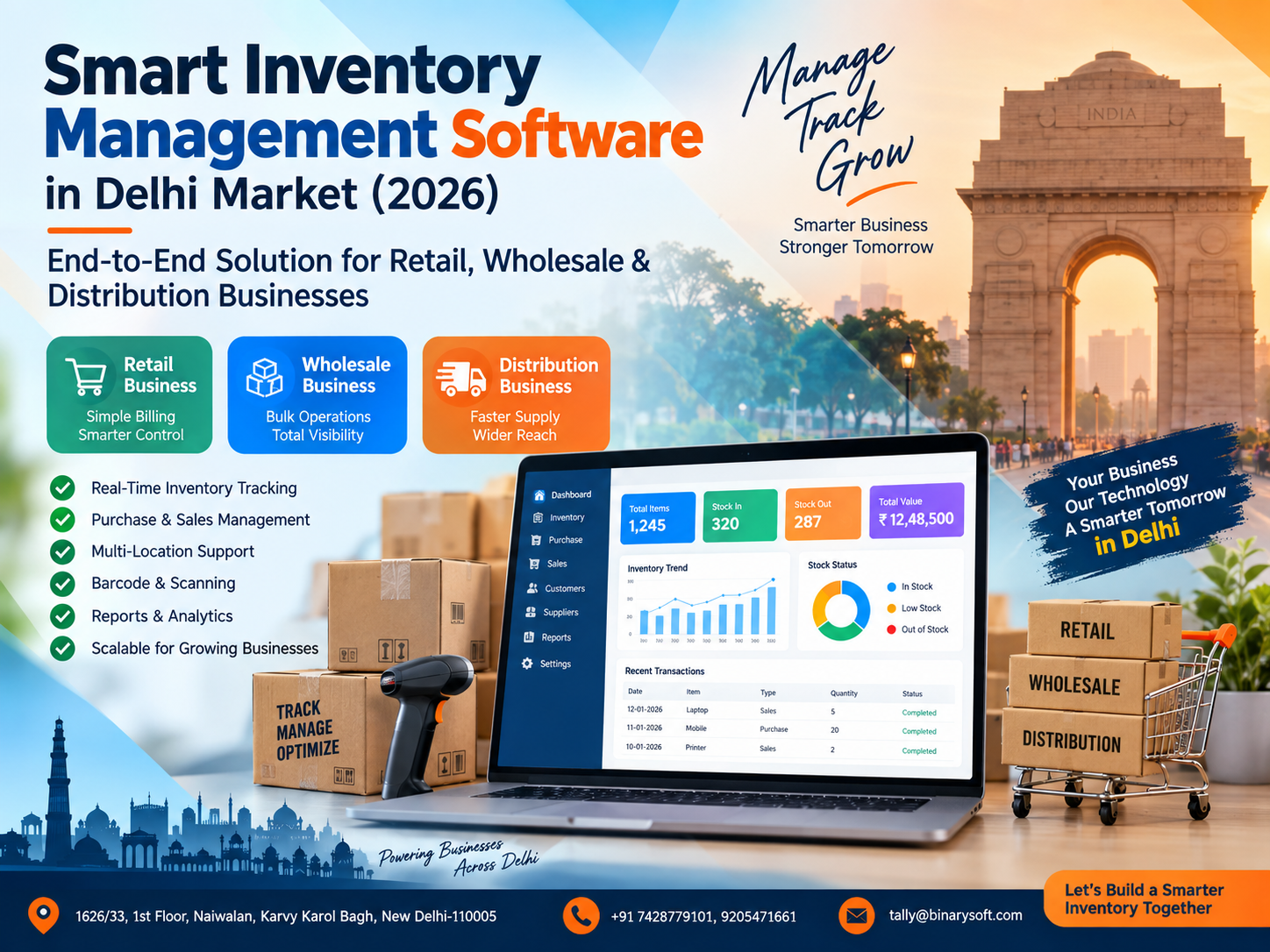
What Changed in 2026? Delhi Businesses Can No Longer Afford to Manage Inventory Blindly
In 2026, inventory management in Delhi has moved far beyond simply recording purchases, sales and closing stock. Retailers, wholesalers and distributors are dealing with faster product movement, tighter margins, multiple sales channels, GST compliance, customer demand for immediate billing and growing pressure to know exactly what is available at every location. A stock mismatch that once meant a few hours of checking registers can now result in delayed orders, lost customers, blocked working capital and incorrect purchasing decisions. This is why businesses across Karol Bagh, Chandni Chowk, Nehru Place, Lajpat Nagar, Gandhi Nagar, Sadar Bazaar, Janakpuri, Rajouri Garden and other commercial markets are increasingly looking at smart inventory management software. The benefit is practical: one integrated system can connect billing, purchases, stock, warehouses, accounting and business reports, helping owners make faster decisions with better visibility and less dependence on manual records.
Why Smart Inventory Management Software Has Become Essential in Delhi
Delhi is one of India's most active trading and commercial centres. From a small retailer operating a single counter to a wholesaler managing hundreds of dealers, inventory is often one of the largest investments of a business.
Every item sitting in a warehouse represents money.
Every item sold without being properly recorded creates a stock difference.
Every product purchased unnecessarily blocks working capital.
Every fast-moving item that goes out of stock can result in a lost sale.
For businesses dealing with hundreds or thousands of SKUs, manual stock registers and disconnected spreadsheets can quickly become difficult to manage.
Smart inventory management software provides a structured way to record, track, analyse and control inventory throughout the business cycle.
Instead of treating inventory as an isolated function, modern software can connect stock management with purchases, sales, billing, GST invoicing, accounting, receivables, payables, warehouses and management reporting.
This creates an end-to-end business management environment.
A Delhi Business Owner's Story: When Sales Were Growing but Profits Were Disappearing
Consider the example of a fictional wholesale distributor operating in Delhi.
For years, the owner managed his business through a combination of handwritten notes, Excel sheets and information received from warehouse staff over the phone. Business was growing steadily. Orders were coming from retailers across Delhi-NCR, and monthly sales appeared healthy.
But there was a problem.
The owner constantly felt short of cash.
One afternoon, an important retailer called asking for immediate delivery of a fast-moving product. According to the spreadsheet, 120 units were available.
The warehouse team checked the racks.
Only 38 units could actually be found.
The customer could not wait and placed the remaining order with another supplier.
That evening, the owner and his staff spent hours checking purchase bills, sales invoices, damaged-stock records and old spreadsheets. They discovered that the problem was bigger than one missing product.
Some items had been sold but not properly updated.
Some stock had been transferred without correct entries.
Several slow-moving products had been purchased repeatedly.
A few high-demand products were regularly running out.
The business was generating sales, but inventory decisions were being made without reliable information.
After moving to an integrated inventory and accounting system, the owner began reviewing stock levels, reorder requirements, outstanding receivables, purchase history and product movement from one system.
The biggest change was not simply faster billing.
It was confidence.
When a customer asked, "Is the stock available?", the team could give a much more reliable answer without searching through registers and multiple spreadsheets.
For a growing Delhi business, that visibility can be extremely valuable.
What Is Smart Inventory Management Software?
Smart inventory management software is a business solution designed to record and monitor the movement of goods from purchase to final sale.
Depending on the software and configuration, it can help businesses manage:
- Opening and closing stock
- Purchase entries
- Sales transactions
- Stock inward and outward
- Multiple godowns or warehouses
- Stock transfers
- Product categories
- Units of measurement
- Batch-wise inventory
- Serial-number tracking
- Barcode-based billing
- Reorder levels
- Minimum and maximum stock
- Expiry information
- Damaged or returned goods
- Supplier information
- Customer information
- Purchase and sales returns
- GST invoicing
- Receivables and payables
- Product profitability
- Inventory valuation
- Business reports
For Delhi retailers, wholesalers and distributors, the objective is simple: know what stock is available, where it is located, how quickly it is selling and what needs attention.
Why Delhi Markets Need Better Inventory Control in 2026
Delhi's business environment is highly competitive.
Customers have many alternatives, distributors work with large product catalogues, and wholesalers often deal with fluctuating demand.
Businesses in markets such as Chandni Chowk and Sadar Bazaar may handle high transaction volumes. Electronics businesses in Nehru Place can have extensive model and serial-number requirements. Garment businesses in Gandhi Nagar may need size, colour and design-wise stock control. Auto-parts businesses around Kashmere Gate and Karol Bagh may handle thousands of individual product codes.
The inventory challenge is different in every industry, but the underlying requirement remains the same:
Accurate information must be available when a business decision is made.
A modern inventory system can reduce the information gap between the billing counter, warehouse, purchasing team, accounts department and business owner.
End-to-End Inventory Management: From Purchase to Final Sale
A major advantage of an integrated inventory solution is the ability to manage the complete inventory lifecycle.
1. Purchase Planning
Inventory control begins before goods enter the warehouse.
Businesses need to understand:
What should be purchased?
How much should be purchased?
Which supplier should receive the order?
What was the previous purchase price?
Which products are selling quickly?
Which products are already overstocked?
Software-generated reports can support these decisions using historical transaction and stock data.
Better purchasing can help reduce both shortages and unnecessary stock accumulation.
2. Goods Receipt and Stock Inward
When goods arrive from suppliers, the inventory needs to be recorded accurately.
The system can capture details such as:
Supplier name
Item name
Quantity
Rate
Batch
Serial number
Godown
Purchase invoice
Applicable taxes
Discounts
Additional costs
Accurate inward entries create the foundation for reliable stock reports.
3. Warehouse and Godown Management
A business may maintain inventory at a shop, warehouse, branch or multiple godowns.
Without location-wise tracking, total stock may appear sufficient even when the required product is not available at the location where it is needed.
Multi-location inventory management allows businesses to understand stock availability at each defined location.
4. Sales and Billing
When an invoice is generated, the corresponding stock movement can be recorded in the system.
This connects billing directly with inventory.
Businesses can therefore avoid maintaining one record for sales and another independent record for stock.
5. Sales Returns
Returned products require proper handling.
Depending on their condition, they may need to be:
Returned to available inventory
Marked as damaged
Sent back to the supplier
Transferred to another location
Recorded separately for further inspection
A structured process helps prevent returned stock from creating inventory mismatches.
6. Purchase Returns
When products are returned to a supplier, inventory records should reflect the outward movement.
Integrated software helps maintain the relationship between stock and accounting entries.
7. Stock Adjustment
Physical stock and system stock may occasionally differ due to breakage, damage, incorrect entries or operational issues.
Stock adjustments allow authorised users to bring system records in line with verified physical quantities while maintaining an audit trail according to the capabilities and controls of the selected software.
Real-Time Stock Visibility for Faster Business Decisions
One of the biggest advantages of inventory software is faster access to stock information.
Imagine a wholesale customer calls and asks for:
500 units of Product A
250 units of Product B
100 units of Product C
The salesperson should not have to call the warehouse for every item.
A properly maintained inventory system can show the recorded available quantity immediately.
This can improve order processing and customer service.
For business owners, visibility also makes it easier to identify products requiring action.
Low-Stock and Reorder Management
Running out of a fast-moving item can mean losing a customer.
At the same time, purchasing too much stock can lock money into inventory.
Reorder management helps businesses find a balance.
Businesses can define appropriate reorder levels based on their operational requirements.
When stock approaches a predetermined threshold, reports can help the purchasing team identify what may need replenishment.
This is especially useful for distributors and retailers handling large product catalogues.
Fast-Moving and Slow-Moving Inventory Analysis
Not every product deserves the same amount of working capital.
Some items may sell every day.
Others may remain in stock for weeks or months.
Smart inventory reporting can help management classify stock based on movement.
Fast-Moving Products
These are products with regular or high sales.
Businesses may want to maintain adequate quantities of these items to minimise missed sales opportunities.
Slow-Moving Products
These products sell less frequently.
Excessive purchasing can increase carrying costs and block capital.
Non-Moving Products
Products with little or no movement over an extended period need management attention.
Businesses may consider reducing future purchases, offering appropriate promotions or taking other commercial decisions based on their circumstances.
Barcode Billing and Inventory Management
Barcode-based operations can be particularly useful for retail businesses.
Instead of manually typing an item name or code, staff can scan the barcode where the configured software and hardware support the workflow.
This can make billing faster and reduce manual item-selection errors.
Barcode systems can be useful for:
Supermarkets
Garment stores
Footwear retailers
Electronics stores
Stationery shops
Cosmetic stores
Department stores
Pharmacies, subject to relevant requirements
Hardware businesses
Auto-parts stores
A barcode-enabled inventory environment can connect item identification with billing and stock movement.
Batch-Wise Inventory Management
Certain industries need inventory tracking beyond a basic product name and quantity.
For example, businesses dealing with packaged goods, food products, medicines or other batch-sensitive products may need to maintain batch information.
Depending on software capabilities, batch-wise inventory can help track:
Batch number
Quantity
Purchase details
Manufacturing-related information
Expiry-related information
Selling price
This can provide better control where multiple batches of the same product are stored simultaneously.
Serial Number Tracking
Electronics, IT hardware, appliances and similar products may require serial-number-wise identification.
A laptop retailer, for example, may have ten units of the same model, but each unit can have a different serial number.
Serial-number tracking can help businesses connect individual units with purchases, sales and warranty-related references where supported by the configured system.
For technology-focused markets such as Nehru Place, this can be an important inventory-management requirement.
Size, Colour and Variant-Wise Stock
Garment, footwear and fashion businesses face another challenge.
A single design may exist in:
Multiple sizes
Multiple colours
Different styles
Different patterns
Different price ranges
Knowing that "100 shirts" are available is not enough.
The business needs to know how many units are available in each required variant.
Proper item classification and inventory configuration can make variant-level stock easier to monitor.
Multi-Godown Inventory Management
Many growing Delhi businesses no longer operate from one physical location.
A company may have:
One retail outlet
One warehouse
One office
Another storage location
A branch elsewhere in Delhi-NCR
Multi-godown inventory management helps businesses maintain location-wise stock records.
This can answer questions such as:
How much stock is available at the main warehouse?
What is available at the retail counter?
Which branch has excess stock?
Can stock be transferred instead of purchasing more?
This visibility can improve inventory utilisation.
Stock Transfer Management
When stock moves from one godown to another, the movement should be recorded properly.
Otherwise, one location may show excess stock while another shows a shortage.
A structured stock-transfer process helps businesses maintain better location-wise records.
This becomes increasingly important as a company expands to multiple branches or warehouses.
GST Billing and Inventory Integration
Inventory management should not operate separately from billing and accounting.
For GST-registered businesses, invoices and transaction records may include information such as:
GSTIN
HSN/SAC, where applicable
Taxable value
CGST
SGST
IGST
Discounts
Invoice value
An integrated accounting and inventory solution can reduce duplicate data entry by connecting relevant transactions with stock and accounts.
Businesses should configure their software according to their applicable GST requirements and consult their tax professional where necessary.
Inventory Management with TallyPrime
For businesses already using or considering Tally, TallyPrime can provide accounting, inventory, invoicing and business-management capabilities within an integrated environment.
Depending on business requirements and configuration, inventory features can be used to organise stock items, stock groups, units, godowns, batches and related transactions.
For many businesses, the benefit of an integrated environment is that inventory and financial information are not treated as completely separate systems.
A sale affects stock as well as accounts.
A purchase affects inventory as well as supplier balances.
This gives management a broader view of business operations.
Retail Inventory Management Software in Delhi
Retail businesses need speed.
Customers standing at a billing counter expect invoices to be generated quickly.
At the same time, the business owner needs control over stock.
A suitable retail inventory system can help with:
Fast billing
Product-wise stock
Barcode workflows
Sales returns
Purchase management
Stock valuation
Low-stock monitoring
Customer records
GST invoicing
Sales analysis
Retail inventory software can be suitable for businesses operating in Karol Bagh, Rajouri Garden, Janakpuri, Lajpat Nagar, Connaught Place and other retail hubs.
Wholesale Inventory Management Software in Delhi
Wholesale businesses face different operational pressures.
They often deal with:
Large order quantities
Dealer pricing
Multiple suppliers
High-volume purchases
Credit sales
Outstanding receivables
Bulk inventory
Frequent stock transfers
An integrated system can help wholesalers connect inventory with customer and supplier transactions.
This allows management to review both product movement and financial information.
Distributor Inventory Management Software
Distribution businesses need control over both inventory and movement.
A distributor may supply hundreds of retailers while handling multiple brands and product categories.
Important requirements can include:
Product-wise inventory
Dealer-wise sales
Area-wise reporting
Purchase management
Sales orders
Receivables
Returns
Godown stock
Fast-moving items
Slow-moving stock
Outstanding payments
Better visibility helps distributors understand what is moving through the supply chain and where working capital is being used.
Inventory Management for FMCG Businesses
FMCG businesses typically operate with high transaction frequency and large product ranges.
They may need to track:
Brand
Category
SKU
Pack size
Batch
Expiry information
MRP
Purchase rate
Selling rate
Stock quantity
For an FMCG distributor, even a small percentage of excess inventory across hundreds of products can represent substantial blocked capital.
Better inventory reporting helps purchasing teams focus on actual movement instead of relying entirely on estimates.
Inventory Software for Manufacturing Businesses
Manufacturers require more than basic buy-and-sell inventory.
They may need to manage:
Raw materials
Work-in-progress
Finished goods
Components
Consumption
Production quantities
Bill of Materials
Wastage
Godowns
The exact requirements vary significantly by manufacturing process, so software configuration should be based on the actual production workflow.
Inventory Reports Every Business Owner Should Review
Installing software alone does not improve inventory control.
Management must use the reports.
Important reports can include:
Stock summary
Item-wise movement
Godown-wise stock
Purchase report
Sales report
Stock ageing
Fast-moving items
Slow-moving items
Reorder status
Inventory valuation
Outstanding receivables
Outstanding payables
Product profitability
Regular review turns transaction data into useful business information.
How Inventory Software Can Improve Cash Flow
Inventory and cash flow are closely connected.
Suppose a business has ₹50 lakh invested in stock.
If ₹12 lakh of that inventory consists of products with very low movement, a significant amount of working capital is effectively tied up.
At the same time, the company might be borrowing money or delaying supplier payments because available cash is limited.
Inventory reports can help identify this imbalance.
Better purchasing decisions can reduce unnecessary stock accumulation and potentially free working capital for other business requirements.
Reduce Overstocking
Overstocking can appear harmless because the products are physically present in the warehouse.
But inventory has a financial cost.
Excess stock can create:
Blocked working capital
Storage requirements
Risk of damage
Risk of obsolescence
Expiry exposure for applicable products
Reduced purchasing flexibility
Stock movement reports can help businesses make purchasing decisions based on historical data and current inventory.
Reduce Stock-Out Situations
The opposite problem is understocking.
When a popular item is unavailable, customers may not wait.
They can simply purchase from a competitor.
For Delhi businesses operating in highly competitive markets, repeated stock-outs can affect both revenue and customer relationships.
Reorder-level monitoring and fast-moving inventory analysis can help reduce this risk.
Improve Customer Service
Inventory management may look like a back-office function, but customers experience its impact directly.
When inventory information is accurate, staff can respond faster to questions such as:
Is this item available?
How many units can you supply?
Can you dispatch today?
Is the required model available?
Which branch has this product?
Reliable answers improve the customer's buying experience.
Better Supplier Negotiations
Historical purchase information can also support supplier negotiations.
Businesses can review:
Previous purchase rates
Purchase quantities
Supplier history
Item-wise purchase trends
Pending supplier balances
This can provide useful information before negotiating prices, quantities or commercial terms.
Role-Based Access and Better Internal Control
As businesses grow, not every employee should necessarily have access to every type of information.
Depending on software capabilities, organisations can establish user roles and access permissions.
For example:
Billing staff may handle invoices.
Warehouse staff may handle inventory movements.
Accounts staff may manage financial transactions.
Management may review consolidated reports.
Appropriate controls can help create a more organised operational structure.
From Spreadsheet Dependency to an Integrated System
Spreadsheets remain useful for many analytical tasks, but inventory operations become difficult when multiple people maintain different files.
Typical problems include:
Duplicate entries
Different versions of the same file
Accidental deletion
Formula errors
Delayed updates
No consistent transaction workflow
As transaction volume increases, businesses often benefit from moving core inventory operations into a structured business system.
Cloud and Remote Business Access
Business owners increasingly need access to business information while travelling, working from another office or managing multiple locations.
Depending on the selected solution and deployment arrangement, remote or cloud-based access can make business information available beyond the primary office.
Businesses should evaluate security, backups, user permissions, internet dependency and the exact capabilities of the chosen deployment before implementation.
Data Backup Is Part of Inventory Management
Inventory information is business-critical data.
A hardware failure or accidental deletion can create serious operational disruption.
Businesses should establish a reliable backup policy appropriate to their software and infrastructure.
This may include scheduled backups, multiple backup locations and periodic verification that backups can actually be restored.
How to Choose Inventory Management Software in Delhi
The best inventory solution is not necessarily the system with the longest feature list.
It should match the actual workflow of the business.
Before choosing software, ask:
How many products do we maintain?
Do we need barcode billing?
Do we maintain batches?
Do we require serial-number tracking?
How many warehouses do we have?
Do we need GST invoicing?
Do we need integrated accounting?
Do we require multi-user access?
Do we need remote access?
How many invoices are generated daily?
Do we need size or colour variants?
Do we manufacture products?
Do we require BOM management?
Which reports does management need?
Who will use the software?
These questions help define the actual implementation requirements.
Implementation Matters as Much as Software Selection
Buying software is only the beginning.
The system must be configured correctly.
An inventory implementation may involve:
Creating stock groups
Creating stock items
Defining units
Configuring godowns
Entering opening stock
Configuring tax information
Creating customer and supplier ledgers
Setting user access
Setting up invoice formats
Configuring barcode requirements
Training staff
Establishing backup procedures
Poor configuration can reduce the benefits of even capable software.
Employee Training Is Critical
A system is only useful when staff use it correctly.
If warehouse staff move products without entries or billing staff select incorrect items, stock reports will eventually become unreliable.
Training should therefore cover not only how to operate the software but also why accurate entries matter.
When employees understand that every purchase, sale, return and transfer affects inventory visibility, compliance and management decisions, adoption can improve.
Why Businesses Across Delhi Are Moving Toward Integrated Management
The shift toward integrated software is not simply about digitisation.
It is about reducing the gap between what is happening in the business and what the owner knows about the business.
A retailer wants to know what is selling.
A wholesaler wants to know which items need replenishment.
A distributor wants to know what is available for dispatch.
An accountant wants correct transaction records.
A business owner wants to know where money is blocked.
Integrated inventory management brings these requirements closer together.
Smart Inventory Management Software for Major Delhi Business Markets
Inventory solutions can support businesses across a wide range of Delhi commercial locations, including:
Karol Bagh
Chandni Chowk
Sadar Bazaar
Nehru Place
Gandhi Nagar Market
Lajpat Nagar
Rajouri Garden
Janakpuri
Connaught Place
Janpath
Kashmere Gate
Bhagirath Palace
Lajpat Rai Market
Kamla Nagar
Punjabi Bagh
Paschim Vihar
Uttam Nagar
Shahdara
Laxmi Nagar
Preet Vihar
Okhla
Nangloi
Najafgarh
The appropriate configuration depends more on the business model, transaction volume and inventory complexity than on the location itself.
Industries That Can Benefit from Inventory Management Software
A properly configured inventory system can be useful across many sectors, including:
Retail shops
Wholesalers
Distributors
FMCG businesses
Garment businesses
Electronics dealers
Computer and IT hardware sellers
Auto-parts businesses
Mobile-accessory businesses
Electrical traders
Hardware suppliers
Footwear businesses
Cosmetic retailers
Stationery suppliers
Manufacturing units
Pharmaceutical and medical-product businesses, subject to applicable regulatory requirements
Supermarkets
Departmental stores
Industrial suppliers
Inventory Management Is Ultimately About Business Control
The real value of inventory software is not the number of screens, reports or features available.
It is the ability to answer important business questions quickly.
What do we have?
Where is it?
What is selling?
What is not selling?
What should we purchase?
What should we stop purchasing?
How much money is invested in stock?
Which products require immediate attention?
Which customers owe us money?
Which suppliers need to be paid?
When these answers become easier to access, business owners can spend less time searching for information and more time acting on it.
Why Choose Binarysoft Technologies for Inventory and Tally Solutions in Delhi?
Binarysoft Technologies helps businesses evaluate and implement accounting, billing and inventory-management solutions based on their operational requirements.
As an Authorized Tally Partner, Binarysoft Technologies can assist businesses looking to implement Tally solutions for accounting, GST billing, inventory management and related business processes.
The objective should not simply be to install software.
The objective should be to build a practical system that employees can use consistently and management can rely on for business information.
Businesses planning to move from manual inventory records, disconnected spreadsheets or an existing accounting setup can first evaluate their current workflow and identify the areas that need better control.
Powered by Binarysoft Technologies
Authorized Tally Partner
Location: 1626/33, 1st Floor, Naiwalan, Karol Bagh, New Delhi – 110005, INDIA
Contact us: +91 7428779101, 9205471661
Email us: tally@binarysoft.com
Business Hours: 10:00 AM – 6:00 PM, Monday to Friday
Conclusion
In 2026, inventory management is becoming a central part of business control for Delhi's retailers, wholesalers and distributors. Increasing product variety, faster customer expectations, multi-location operations, GST-related processes and pressure on working capital make it difficult to depend entirely on manual registers or disconnected spreadsheets.
Smart inventory management software can bring purchasing, sales, billing, stock movement, godowns, accounting and management reporting into a more organised environment.
For a retailer, this can mean faster billing and better stock visibility. For a wholesaler, it can mean stronger control over bulk purchases and customer orders. For a distributor, it can mean better visibility across products, dealers and warehouses. For management, the biggest benefit is access to information that supports faster and more informed decisions.
Inventory is money stored on shelves and in warehouses. Managing it intelligently can help a business protect working capital, serve customers better and build a stronger foundation for sustainable growth.
Frequently Asked Questions
What is smart inventory management software?
Smart inventory management software is a system used to record and monitor purchases, sales, stock quantities, stock transfers, warehouses, returns and other inventory-related transactions. Depending on the solution, it may also integrate billing, GST, accounting and business reports.
Which inventory management software is suitable for Delhi businesses?
The right solution depends on the type of business, number of products, transaction volume, warehouses, users, billing requirements and accounting needs. Businesses should evaluate their workflow before selecting a solution.
CA. Reyansh Kulkarni has expertise in GST advisory, accounting compliance, and financial planning. He frequently contributes articles on digital accounting, inventory management, and modern financial practices for businesses.