Call CA Tally HelpDesk
+91 9205471661,
7428779101
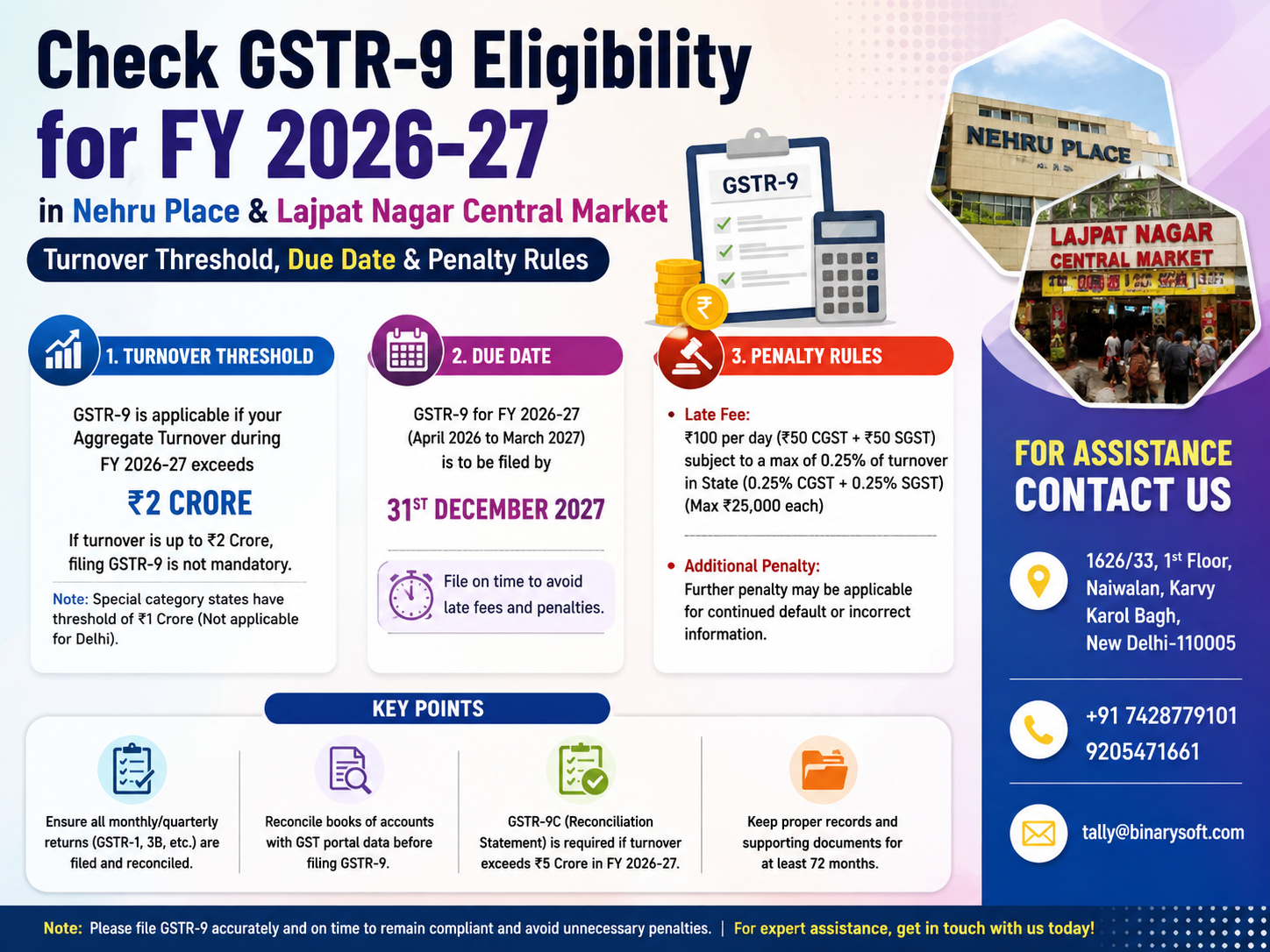
Businesses operating in Nehru Place and Lajpat Nagar Central Market, Delhi, should start treating annual GST reconciliation as a year-round process rather than a December compliance exercise. In 2026, GST reporting is increasingly data-driven: sales reported in GSTR-1, tax paid through GSTR-3B, Input Tax Credit, e-invoices, HSN details and accounting records can all expose inconsistencies during annual reconciliation. For FY 2026-27, the financial year will close on 31 March 2027, and businesses that fall within the applicable GSTR-9 filing requirements will need to prepare their annual return after year-end. The normal statutory due date under Section 44 is 31 December following the financial year, which would mean 31 December 2027, unless the government later extends or changes it. The real advantage of preparing early is simple: fewer year-end surprises, cleaner GST records, easier ITC reconciliation and substantially lower risk of late fees or incorrect annual reporting.
Why GSTR-9 Matters for Businesses in Nehru Place and Lajpat Nagar
Nehru Place is one of Delhi’s major commercial hubs, especially for computers, electronics, IT products, software, accessories, repairs and business services. Lajpat Nagar Central Market, meanwhile, has a diverse mix of apparel, footwear, fashion, jewellery, home products, restaurants, wholesalers, retailers and service businesses.
For businesses operating in such high-volume markets, GST transactions can quickly become complicated.
A trader may issue hundreds or thousands of invoices every month. There can be B2B sales, B2C transactions, purchase returns, credit notes, debit notes, e-invoices, interstate purchases, interstate sales, Input Tax Credit claims and tax adjustments.
GSTR-9 provides an annual consolidated view of GST information for the financial year. The GST Portal describes GSTR-9 as an annual return containing information relating to purchases, sales, Input Tax Credit, refunds and demands, among other details.
This makes annual reconciliation particularly important for businesses where transaction volumes are high.
What Is GSTR-9?
GSTR-9 is the annual GST return applicable to eligible regular GST-registered taxpayers.
It consolidates important GST information for an entire financial year.
The return broadly brings together information relating to:
Sales and outward supplies
Taxable turnover
Exempt and non-GST supplies
Input Tax Credit
GST liability
Tax payments
Previous-year transactions reported subsequently, where applicable
HSN-wise information
Demand and refund information
Other annual GST disclosures
The GST Portal also uses information reported through GSTR-1 and GSTR-3B to generate system-computed information for GSTR-9.
However, businesses should not assume that auto-populated information automatically makes the annual return correct.
Accounting books and GST returns should still be reconciled carefully.
GSTR-9 Eligibility for FY 2026-27
This is the most important question for traders:
Do I need to file GSTR-9 for FY 2026-27?
The answer depends primarily on your GST registration category, aggregate turnover and the exemption applicable for the relevant financial year.
Recent rules have provided exemption from GSTR-9 filing for registered persons whose aggregate turnover does not exceed ₹2 crore, subject to the relevant notification and conditions.
Businesses should therefore check the notification applicable specifically to FY 2026-27 before treating the ₹2 crore figure as final for that year.
In practical terms, businesses should monitor three important turnover bands:
Aggregate Turnover Up to ₹2 Crore
Historically, eligible small taxpayers within the notified threshold have received exemption from mandatory GSTR-9 filing.
However, because FY 2026-27 is still in progress as of September 2026, businesses should verify the final government notification applicable to that financial year before deciding not to file.
Aggregate Turnover Above ₹2 Crore
If the applicable exemption continues on the same basis, regular taxpayers crossing ₹2 crore would generally need to prepare and file GSTR-9.
Aggregate Turnover Above ₹5 Crore
Businesses crossing the prescribed GSTR-9C threshold should also examine their obligation to furnish the self-certified reconciliation statement in Form GSTR-9C.
Current guidance identifies ₹5 crore as the relevant threshold for GSTR-9C.
What Does Aggregate Turnover Mean?
A common mistake is to check only the turnover of one shop, branch or GSTIN.
GST aggregate turnover has a wider meaning.
Businesses should not simply look at the sales figure appearing in one Delhi GST registration and conclude whether GSTR-9 applies.
Aggregate turnover is generally determined on a PAN-India basis for the same PAN, subject to GST law.
For example, imagine a business owner has operations in:
Nehru Place, Delhi
Noida, Uttar Pradesh
Gurugram, Haryana
Mumbai, Maharashtra
The business should not evaluate the GSTR-9 threshold merely by looking at its Delhi sales.
Its aggregate turnover across registrations under the same PAN becomes relevant when determining applicable turnover thresholds.
This is particularly important for wholesalers, distributors and multi-location businesses.
A Nehru Place Trader’s Year-End Wake-Up Call
Imagine a computer accessories distributor operating from Nehru Place.
Throughout the year, business is strong.
Orders arrive continuously. Laptops, networking products, storage devices and computer accessories move quickly. The accountant files monthly GST returns, management monitors sales and everyone assumes GST compliance is under control.
December arrives.
The accountant starts annual reconciliation.
Then the problems appear.
Sales according to the accounting software do not completely match GSTR-1.
Several credit notes were entered in the books but handled differently in GST returns.
Some purchase invoices appear in the accounting records but need to be reconciled with GST data.
A few invoices were amended in later months.
There are differences between the tax liability shown in books and GST returns.
Suddenly, what looked like a routine annual return becomes weeks of checking old invoices.
The business owner becomes anxious.
Not because the business did something intentionally wrong, but because twelve months of small differences have accumulated into one large reconciliation exercise.
The accountant finally says:
“We should have checked this every month.”
That sentence captures one of the biggest lessons of GSTR-9 compliance.
Annual GST reconciliation should not begin at the end of the year.
It should be built gradually throughout the year.
For a busy trader in Nehru Place or Lajpat Nagar, monthly reconciliation can turn December from a stressful investigation into a controlled compliance exercise.
Expected GSTR-9 Due Date for FY 2026-27
FY 2026-27 runs from:
1 April 2026 to 31 March 2027
Section 44 of the CGST Act provides for furnishing the annual return by 31 December following the end of the financial year.
Therefore, under the normal statutory timetable:
FY 2026-27 GSTR-9 Due Date: 31 December 2027
This date should be treated as the normal due date based on the current statutory framework.
However, taxpayers should always verify GST notifications and official announcements closer to the filing period because the government may extend or otherwise modify compliance timelines.
Do Not Wait Until December 2027
A December deadline does not mean reconciliation should start in December.
For FY 2026-27, a better compliance cycle would be:
April 2026 onward – Maintain clean GST accounting
Every month – Match sales with GSTR-1
Every month – Match liability with GSTR-3B
Regularly – Reconcile eligible Input Tax Credit
Quarterly – Review outstanding mismatches
March 2027 – Conduct financial-year closing review
April–June 2027 – Perform detailed annual GST reconciliation
Before December 2027 – Prepare, verify and file GSTR-9/GSTR-9C, where applicable
This approach provides enough time to investigate differences.
GSTR-9 Late Fee and Penalty Rules
Missing the applicable annual-return deadline can result in late fees.
The CGST Act provides for late fees where the annual return required under Section 44 is not furnished by the due date.
Late fees for GSTR-9 have also been rationalised according to turnover slabs from FY 2022-23 onwards.
The applicable structure includes both CGST and corresponding SGST components.
Turnover Up to ₹5 Crore
The combined late fee is generally:
₹50 per day
This represents:
₹25 CGST per day
₹25 SGST per day
The maximum is subject to the prescribed percentage-based cap.
Turnover Above ₹5 Crore and Up to ₹20 Crore
Combined late fee:
₹100 per day
This represents:
₹50 CGST per day
₹50 SGST per day
Again, the maximum is subject to the prescribed cap.
Turnover Above ₹20 Crore
The higher statutory late-fee structure can apply:
₹200 per day
comprising the CGST and SGST components, subject to the applicable turnover-based maximum.
The turnover-based rationalised late-fee structure for GSTR-9 from FY 2022-23 onwards is documented under Notification No. 07/2023-Central Tax.
Businesses should verify that this structure remains applicable when FY 2026-27 actually becomes due.
Why Delayed GSTR-9 Can Become Expensive
Consider a business that should file GSTR-9 but delays filing for several months.
The financial impact is not necessarily limited to a late fee.
The company may also face:
Compliance follow-ups
Difficulty finalising annual GST records
Unresolved ITC discrepancies
Unreconciled turnover
Questions during GST scrutiny
Additional tax liability
Interest exposure where tax was underpaid
Problems during audit or due diligence
More accounting and professional work
Therefore, filing on time is only one part of compliance.
Filing an accurate return is equally important.
GSTR-9 vs GSTR-9C: Understand the Difference
Businesses often use GSTR-9 and GSTR-9C interchangeably, but they are different compliance forms.
GSTR-9
GSTR-9 is the annual GST return.
It consolidates annual information regarding outward supplies, Input Tax Credit, tax payments and other GST details.
GSTR-9C
GSTR-9C is the annual reconciliation statement applicable to taxpayers crossing the prescribed turnover threshold.
Under the current framework, businesses exceeding the applicable ₹5 crore aggregate-turnover threshold should evaluate GSTR-9C applicability.
It is a self-certified reconciliation statement.
Businesses near the ₹5 crore mark should therefore pay special attention to turnover calculation.
GSTR-9C Late Fee Is Also Important
Businesses subject to GSTR-9C should not assume their annual-return responsibility ends after submitting GSTR-9.
CBIC clarified in Circular No. 246/03/2025-GST that the annual return under Section 44 is considered complete with both GSTR-9 and GSTR-9C where GSTR-9C is applicable.
GST Portal guidance for FY 2024-25 explains that late fee can continue in relation to delayed GSTR-9C filing when it is required.
This makes timely preparation of the reconciliation statement particularly important for larger businesses.
What Nehru Place Businesses Should Reconcile
Nehru Place businesses commonly deal with electronics, computers, peripherals, software, networking products and IT services.
A business should compare:
Accounting sales vs GSTR-1
GSTR-1 vs GSTR-3B
Books vs GST taxable turnover
B2B invoice records
B2C sales
Credit notes
Debit notes
Sales returns
Interstate supplies
E-invoices, wherever applicable
HSN classifications
GST rates
Output GST liability
Purchase records
Input Tax Credit
ITC reversals
Exempt supplies
Nil-rated supplies
Exports, if applicable
Refund information
Demand information
This reconciliation should ideally happen periodically.
What Lajpat Nagar Central Market Businesses Should Check
Retail and wholesale businesses in Lajpat Nagar may have another challenge: high transaction volume.
Apparel, footwear, fashion accessories, home furnishing and consumer-product businesses can generate significant numbers of invoices.
They should particularly monitor:
Daily sales totals
GST rate classification
Purchase invoices
Stock returns
Customer returns
Supplier credit notes
Discount adjustments
B2B invoices
B2C sales
E-commerce transactions, where applicable
Cash and digital sales
ITC availability
GST liability
A small classification error repeated across thousands of transactions can become a significant annual discrepancy.
GSTR-1 vs GSTR-3B vs Books: The Three-Way Check
One of the most useful year-end exercises is a three-way reconciliation.
Step 1: Accounting Books
Determine the actual taxable turnover recorded in the accounting system.
Step 2: GSTR-1
Check what outward supply information was reported to GST.
Step 3: GSTR-3B
Check the tax liability declared and discharged.
Ideally, all three should reconcile after legitimate adjustments are considered.
When they do not, identify the reason.
Never simply alter numbers to force a match without understanding the underlying transaction.
Input Tax Credit Needs Separate Attention
Input Tax Credit is another major area of annual reconciliation.
Businesses should review:
ITC recorded in books
ITC claimed in GSTR-3B
Available GST data
Eligible ITC
Ineligible ITC
ITC reversals
Blocked credits
Supplier-related discrepancies
Credit notes
Previous-period adjustments
If the business maintains thousands of purchase invoices, doing this only once at year-end can be difficult.
Monthly or quarterly ITC reconciliation is much safer.
Additional Liability Discovered During GSTR-9
What happens if reconciliation identifies GST liability that was not properly reported earlier?
The GST Portal's GSTR-9 filing guidance provides that additional liability declared through GSTR-9, where applicable, is required to be paid using Form GST DRC-03.
This is another reason businesses should perform reconciliation before filing the annual return.
Identifying a difference before submission allows time to understand its cause and take appropriate professional advice.
GSTR-9 Cannot Be Treated Like an Ordinary Monthly Return
Annual returns deserve additional caution.
The taxpayer is effectively consolidating the GST position for an entire financial year.
Businesses should therefore avoid:
Filing without reconciliation
Depending entirely on auto-populated figures
Ignoring credit notes
Ignoring debit notes
Ignoring ITC differences
Using only accounting turnover without checking GST returns
Checking only GSTR-1
Checking only GSTR-3B
Ignoring previous-year adjustments
Waiting until the final filing week
The objective should be accuracy, not merely submission.
How TallyPrime Can Support GST Record Management
For businesses using TallyPrime, maintaining organised accounting and GST records throughout the year can simplify annual reconciliation.
A properly maintained accounting system can help businesses monitor:
GST invoices
Sales
Purchases
Debit notes
Credit notes
GST ledgers
Input Tax Credit
Tax liability
HSN/SAC information
Party ledgers
Receivables
Payables
Inventory transactions
Financial reports
The key advantage is not simply software automation.
It is having structured accounting information available when annual GST reconciliation begins.
Why Correct GST Configuration Matters
Even powerful accounting software depends on correct configuration and accurate data entry.
Businesses should check:
GSTIN
State
Registration type
HSN/SAC
GST rates
Tax ledgers
Party GST details
Place of supply
Voucher configuration
Invoice numbering
Credit-note treatment
Debit-note treatment
Incorrect masters can create recurring errors.
For example, if a product is mapped to an incorrect GST rate at the beginning of the year, hundreds of subsequent invoices may inherit the same problem.
Regular master-data reviews therefore matter.
FY 2026-27 GSTR-9 Preparation Checklist
Before preparing the annual return, businesses should ensure that their GST accounting is substantially complete.
Check annual turnover.
Determine GSTR-9 eligibility under the notification applicable to FY 2026-27.
Determine whether GSTR-9C applies.
Reconcile books with GSTR-1.
Reconcile books with GSTR-3B.
Check outward taxable supplies.
Check exempt and nil-rated supplies.
Review B2B transactions.
Review B2C transactions.
Reconcile credit notes.
Reconcile debit notes.
Review Input Tax Credit.
Review ITC reversals.
Check tax payments.
Review HSN/SAC information.
Check interstate transactions.
Review e-invoices, where applicable.
Identify additional liabilities.
Verify annual GST reports before filing.
Special Warning for Businesses Near the ₹2 Crore Threshold
Suppose your turnover is approximately ₹1.95 crore.
Do not immediately assume that GSTR-9 will not apply.
First calculate aggregate turnover correctly.
There may be turnover under another GSTIN associated with the same PAN.
There may also be transactions that management did not initially consider when estimating aggregate turnover.
Therefore, businesses close to the threshold should calculate turnover formally rather than rely on approximate sales numbers.
Special Warning for Businesses Near ₹5 Crore
The same principle becomes even more important near the GSTR-9C threshold.
Suppose the business estimates annual turnover at ₹4.90 crore.
If final reconciliation takes aggregate turnover beyond ₹5 crore, additional annual compliance requirements may arise under the prevailing rules.
Businesses approaching this level should begin reviewing annual turnover well before the financial year closes.
Do Small Businesses Need to Ignore GSTR-9 Completely?
No.
Even when a business is exempt from filing because it falls within the applicable turnover exemption, annual GST reconciliation remains a good accounting practice.
A business can still compare:
Annual sales
GSTR-1
GSTR-3B
Input Tax Credit
Tax liability
Accounting books
Financial statements
Doing so can identify problems before they affect future periods.
An exemption from filing should not be interpreted as an exemption from maintaining accurate GST records.
Monthly Reconciliation Is Better Than Annual Firefighting
Imagine reconciling 100 transactions every month.
Now compare that with investigating 1,200 transactions at year-end.
The underlying work may be similar, but identifying errors is much easier when transactions are recent.
Staff remember what happened.
Invoices are readily available.
Customers and suppliers can be contacted.
Corrections can be investigated quickly.
Twelve months later, the same transaction may require searching emails, WhatsApp messages, purchase orders, payment records and old invoices.
That is why monthly reconciliation is valuable.
GST Compliance Strategy for FY 2026-27
Businesses in Nehru Place and Lajpat Nagar should consider a simple compliance strategy.
Maintain accurate data throughout the year.
Do not treat accounting as a backlog exercise.
Review GST monthly.
Compare accounting records with filed returns.
Review quarterly.
Investigate major ITC and turnover differences.
Perform year-end reconciliation.
After March 2027, prepare a detailed annual comparison.
Check eligibility.
Confirm the government notification applicable to FY 2026-27.
File before the deadline.
Avoid waiting until the final days of December 2027.
Important FY 2026-27 Compliance Note
As of September 2026, FY 2026-27 has not yet ended.
Therefore, businesses should be careful with articles or advertisements claiming that every threshold, exemption, procedural relaxation or filing utility for FY 2026-27 has already been finally settled.
The statutory framework provides the foundation, but GST notifications, portal functionality and compliance instructions can evolve before the return becomes due.
For this reason, the safest approach is:
Plan using the existing framework.
Maintain complete records.
Monitor CBIC/GST Portal announcements.
Verify the FY-specific exemption before filing.
Confirm the final deadline closer to the filing period.
This is particularly important when relying on the ₹2 crore exemption threshold.
Benefits of Preparing GSTR-9 Early
Early preparation gives businesses several practical advantages.
It helps identify tax differences sooner.
It improves ITC reconciliation.
It reduces year-end workload.
It improves accounting accuracy.
It gives management a clearer turnover picture.
It allows more time to resolve mismatches.
It reduces the risk of rushed filing.
It helps businesses determine GSTR-9C applicability early.
It makes financial-year closing smoother.
Most importantly, it turns annual GST compliance into a controlled process rather than an emergency.
GSTR-9 Support for Businesses in Nehru Place & Lajpat Nagar
Businesses looking to organise their GST accounting, inventory and financial records can use TallyPrime as part of their accounting and compliance workflow.
Binarysoft Technologies provides Tally-related solutions and support for businesses requiring assistance with accounting software implementation, configuration and business-process management.
Businesses can seek assistance relating to:
TallyPrime setup
GST configuration
Accounting implementation
Inventory management
GST reporting
Data management
Business reports
User configuration
Tally customisation requirements
Software support
The objective should be to keep accounting information organised throughout the financial year so that GST reconciliation becomes easier at year-end.
Conclusion
GSTR-9 eligibility for FY 2026-27 should not be checked only when December 2027 approaches. Businesses in Nehru Place and Lajpat Nagar Central Market should start monitoring their aggregate turnover, GST reconciliation and annual compliance position during the financial year itself.
Under the normal statutory framework, the annual return for FY 2026-27 would be due by 31 December 2027, unless the government notifies a different or extended date.
The ₹2 crore exemption threshold used under recent annual-return rules is an important benchmark, while businesses above the applicable ₹5 crore threshold should also examine GSTR-9C requirements. However, because FY 2026-27 is still underway, taxpayers should verify the notification specifically applicable to that year before making a final filing decision.
Whether you run an electronics distribution business in Nehru Place or a retail/wholesale operation in Lajpat Nagar, the principle remains the same:
Keep your GST data clean throughout the year, reconcile regularly and never leave twelve months of GST checking for the final week.
Powered by Binarysoft Technologies
Authorized Tally Partner
Location: 1626/33, 1st Floor, Naiwalan, Karol Bagh, New Delhi – 110005, INDIA
Contact us: +91 7428779101, 9205471661
Email us: tally@binarysoft.com
Support Hours: 10:00 AM – 6:00 PM, Mon–Fri
Frequently Asked Questions
What is GSTR-9?
GSTR-9 is the annual GST return for eligible regular GST taxpayers. It consolidates information relating to sales, purchases, Input Tax Credit, tax liability and other GST details for the financial year.
What is the GSTR-9 due date for FY 2026-27?
Under the normal rule in Section 44, the annual return is due by 31 December following the end of the financial year. Therefore, the normal due date for FY 2026-27 would be 31 December 2027, unless extended or otherwise changed by the government.
CA. Rishubh Talrejaa specializes in GST, business accounting, and compliance advisory for growing enterprises. With experience in handling real-time transactional data and audits, he writes practical insights on inventory control, taxation, and digital transformation for Indian businesses operating in competitive markets.