Call CA Tally HelpDesk
+91 9205471661,
7428779101
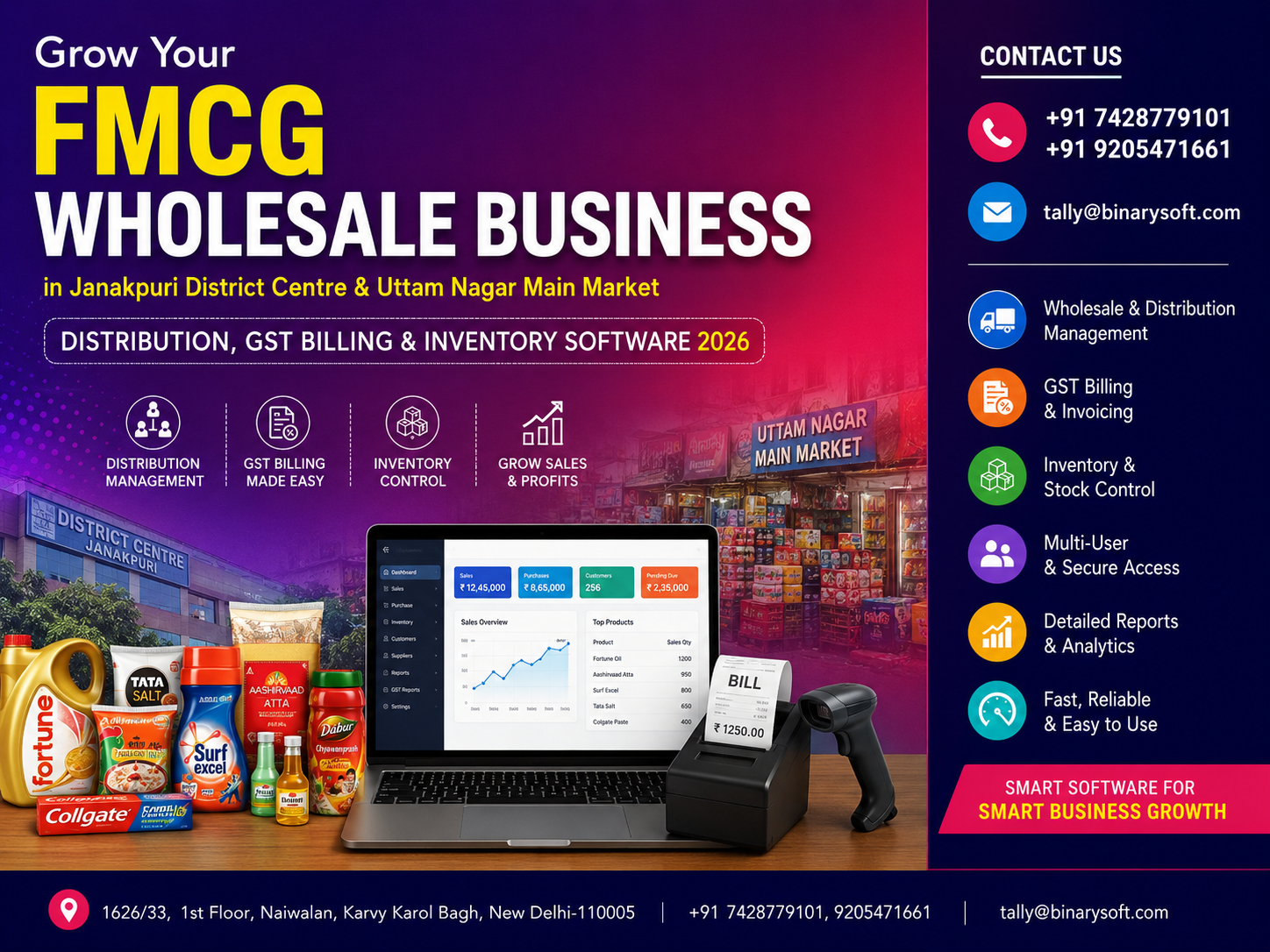
FMCG Wholesale Business in 2026: Faster Distribution, Tighter Margins and Smarter Inventory Are Now Essential
In 2026, running an FMCG wholesale business is becoming increasingly demanding as retailers expect faster deliveries, accurate GST invoices, dependable stock availability and competitive pricing at the same time. For wholesalers operating around Janakpuri District Centre and Uttam Nagar Main Market, even a small delay in identifying low stock, collecting outstanding payments or updating product rates can affect an entire day’s distribution schedule. With hundreds or thousands of fast-moving SKUs, multiple brands, different GST rates, schemes, batches and retailer accounts, manual processes can quickly become difficult to control. The opportunity, however, is equally significant. A well-implemented distribution, GST billing and inventory software system can connect sales, purchases, stock, receivables and accounting in one workflow. This gives FMCG wholesalers better visibility, faster billing and stronger control over working capital, helping them serve more retailers without allowing administrative work to grow at the same pace.
Why FMCG Wholesalers in Janakpuri and Uttam Nagar Need Better Business Management in 2026
The FMCG wholesale business operates differently from many other trading businesses.
A wholesaler may sell hundreds of products every day, including packaged foods, beverages, personal-care products, household products, cleaning supplies, grocery products and other everyday consumer goods.
Margins on individual products may be relatively small, while sales volumes can be substantial. That means operational efficiency becomes extremely important.
A small pricing error repeated across hundreds of invoices can affect profitability. Overstocking a slow-moving product can block working capital. Running out of a popular item can send a retailer to another distributor.
This is why wholesalers in busy commercial locations such as Janakpuri District Centre and Uttam Nagar Main Market increasingly need more than basic invoice-generation software.
They need a business management system capable of connecting:
Distribution management
GST billing
Purchase management
Inventory tracking
Batch-wise stock
Sales order processing
Outstanding receivables
Supplier payments
Accounting
Cash and bank management
Sales analysis
Profitability reports
Stock movement reports
Business dashboards
The objective is simple: know what is happening in the business without waiting until the end of the month.
The Everyday Challenge of FMCG Distribution
Imagine receiving orders from dozens of retailers during the morning.
One shop needs biscuits and beverages.
Another needs personal-care products.
A third retailer wants household cleaning products but only if the promotional scheme is available.
Meanwhile, your warehouse staff is preparing dispatches, your accountant is entering purchase bills, salespeople are collecting payments and another supplier has informed you about revised product pricing.
This is normal in FMCG distribution.
The problem begins when each activity is managed separately.
Orders may be recorded on paper or messaging applications.
Inventory may be checked manually.
Outstanding balances may be maintained in spreadsheets.
Billing happens on another system.
Purchase information is recorded later.
Management therefore receives fragmented information.
An integrated FMCG accounting and inventory solution can bring these processes together.
A Story from the Wholesale Counter: When Sales Were Growing but Cash Was Disappearing
Consider the example of a fictional FMCG wholesaler, Rajesh, operating in West Delhi.
His business looked successful from outside.
Every morning, retailers called with new orders. Delivery staff remained busy. The warehouse was filled with cartons from multiple brands, and monthly sales were steadily increasing.
Yet Rajesh had one persistent concern.
Despite higher sales, there never seemed to be enough free cash.
Every month he would ask his accountant the same question:
“If our sales are increasing, where is the money?”
The answer was not one big mistake.
It was dozens of small problems.
Some retailers had crossed their normal credit period. Certain products had been purchased in excess. A few slow-moving items occupied valuable warehouse space. Purchase rates had changed, but selling prices were not always reviewed quickly. Salespeople were accepting new orders without immediately knowing a customer's previous outstanding balance.
One evening, Rajesh stayed at the warehouse after everyone had left.
He looked at rows of cartons and realised that the problem was not lack of business.
The problem was lack of visibility.
He decided to bring billing, inventory, outstanding payments and accounting into a structured software-based workflow.
Within the following months, the biggest improvement was not simply faster invoicing.
It was clarity.
Before confirming a large order, his team could check stock.
Before extending additional credit, they could review outstanding balances.
Before purchasing more inventory, they could examine existing quantities and product movement.
Rajesh no longer had to depend entirely on memory to understand his business.
That change gave him something every growing wholesaler eventually needs: control.
What Is FMCG Distribution and Inventory Software?
FMCG distribution and inventory software is designed to help businesses manage the movement of products from suppliers and distributors to retailers while simultaneously recording the financial impact of every transaction.
Instead of treating billing, inventory and accounting as separate activities, an integrated system creates a connected workflow.
For example:
When goods are purchased, inventory increases.
When goods are sold, inventory decreases.
When a credit invoice is created, the customer’s outstanding balance changes.
When payment is received, the receivable is adjusted.
When purchase liabilities arise, supplier balances are updated.
This interconnected approach reduces repeated data entry and gives management a clearer picture of the business.
GST Billing Software for FMCG Wholesalers
GST invoicing is a fundamental part of wholesale business operations.
A proper billing system should help businesses maintain accurate product and tax information so that invoices can be prepared consistently.
Depending on the nature of transactions and the configuration required, businesses may need to manage information such as:
GSTIN details
HSN information
Taxable value
CGST
SGST
IGST
Discounts
Freight or additional charges
Credit notes
Debit notes
Sales returns
Purchase returns
The real advantage of integrated GST billing is that invoicing becomes part of the accounting process rather than an isolated activity.
Once a transaction is correctly recorded, the corresponding inventory and accounting records can also be updated.
This reduces duplication and can simplify subsequent reconciliation and reporting.
Businesses should ensure that their GST processes and software configuration follow the rules applicable to them and verify current statutory requirements with their tax professional.
Manage Hundreds or Thousands of FMCG Products
FMCG wholesalers typically handle a much larger number of SKUs than many traditional businesses.
A single brand may have multiple products.
Each product may have multiple:
Pack sizes
Variants
Flavours
Quantities
Product codes
Rates
Imagine managing beverages.
The same brand may offer different flavours and multiple pack sizes.
Now multiply this across snacks, personal-care products, cleaning supplies, packaged foods and household goods.
Manual stock management quickly becomes impractical.
A structured inventory system allows every item to be recorded and monitored systematically.
Know Your Actual Stock Before Accepting an Order
One of the most common problems in wholesale distribution occurs when an order is accepted but sufficient stock is not available.
The salesperson may believe that 100 units are available.
The warehouse may actually have only 60 saleable units.
The difference may be caused by recently dispatched stock, damaged goods, returns or transactions that were not updated on time.
Inventory software provides much better visibility into available quantities.
Before promising delivery, the team can check the current stock position.
That improves customer service and reduces last-minute dispatch problems.
Batch-Wise Inventory Management for FMCG Businesses
Many FMCG businesses deal with products where batches and expiry information are operationally important.
Batch-wise inventory management can help wholesalers identify stock according to its batch.
Depending on the product category and business requirements, this can help monitor:
Batch numbers
Manufacturing information
Expiry dates
Purchase rates
Selling rates
Quantities
Better batch visibility is particularly valuable when managing products with limited shelf lives.
It can help businesses plan stock movement more carefully and reduce the risk of products remaining unnoticed until they approach expiry.
Reduce Dead Stock and Slow-Moving Inventory
A warehouse full of products does not necessarily indicate a healthy business.
Inventory represents money.
If ₹5 lakh worth of products are sitting in the warehouse without sufficient demand, that capital cannot easily be used elsewhere.
The challenge becomes greater in FMCG because product movement differs dramatically.
Some products may sell every day.
Others may move once a week.
Some may stop moving because consumer preferences, retailer demand or supplier schemes change.
Inventory reports can help management identify:
Fast-moving products
Slow-moving products
Non-moving products
High-value inventory
Low-stock products
Excess stock
This information can improve purchasing decisions.
Avoid Stock-Outs of Your Best-Selling Products
Dead stock is one problem.
Stock-outs are another.
Suppose one of your highest-selling products runs out on Friday afternoon.
Your next supplier delivery is scheduled for Monday.
Retailers still need the product during the weekend.
If you cannot supply it, they may purchase it from another distributor.
Repeated stock-outs can gradually weaken retailer relationships.
Reorder-level monitoring can help businesses identify products that are approaching minimum inventory levels.
Instead of discovering the shortage after an order arrives, the purchasing team can take action earlier.
Better Purchase Planning
Purchasing more is not always better.
The goal is to purchase the right quantity at the right time.
FMCG wholesalers can use inventory and sales information to understand what is actually moving.
Before placing a purchase order, management can review:
Current stock
Recent sales
Pending orders
Historical movement
Supplier rates
Purchase requirements
This reduces decisions based purely on intuition.
Experience remains valuable, but experience becomes more powerful when supported by current data.
Manage Multiple Suppliers Efficiently
A wholesaler may purchase from manufacturers, super-stockists, distributors or other suppliers.
Different suppliers can have different:
Payment terms
Purchase rates
Schemes
Credit periods
Delivery schedules
Product categories
Maintaining supplier ledgers and purchase records systematically makes it easier to understand what the business owes and when payments are expected.
This can support better cash-flow planning and supplier relationships.
Retailer-Wise Outstanding Management
Credit is common in wholesale distribution.
A retailer may purchase today and pay later.
When this happens across dozens or hundreds of retailers, outstanding receivables can become difficult to monitor manually.
A structured accounting system can provide party-wise outstanding reports showing which customers owe money.
Management can review:
Customer balance
Pending invoices
Invoice dates
Overdue amounts
Payment history
This becomes particularly useful before approving additional credit sales.
Credit Control Can Protect Your Working Capital
High sales do not automatically mean strong cash flow.
A business can report substantial sales while simultaneously struggling to pay suppliers because customers have not paid on time.
For example, suppose a wholesaler records monthly credit sales of ₹40 lakh.
If ₹12 lakh remains outstanding beyond the expected collection cycle, the business may need additional working capital to purchase fresh stock.
That can create unnecessary financial pressure.
Regular outstanding monitoring helps management identify overdue accounts and prioritise collection efforts.
Salesperson-Wise Performance Tracking
FMCG distribution frequently involves salespeople visiting retailers and collecting orders.
Management may want to know:
Which salesperson generates the highest sales?
Which salesperson handles the largest number of customers?
What is the outstanding position of customers handled by each salesperson?
Which product categories perform well in different territories?
Software-based reporting can make salesperson performance easier to analyse.
The objective should not simply be to measure sales value.
Businesses should also consider collection discipline, product mix, profitability and customer retention.
Area-Wise and Retailer-Wise Sales Analysis
Janakpuri, Uttam Nagar and surrounding West Delhi markets can contain very different customer profiles.
Some retailers may focus heavily on grocery.
Others may sell cosmetics, personal care, packaged foods or household goods.
Sales analysis can help wholesalers understand which products perform well in particular customer segments or territories.
That knowledge can support more targeted distribution planning.
Product-Wise Profitability
Revenue alone can be misleading.
Suppose Product A generates ₹10 lakh in monthly sales while Product B generates ₹5 lakh.
At first glance, Product A appears more important.
But if Product A has a very small margin and requires heavy discounts while Product B generates significantly stronger margins, the profitability picture changes.
Product-wise reporting can help businesses analyse sales alongside cost and margin information.
This helps management focus on profitable growth rather than only higher turnover.
Manage Discounts and Trade Schemes More Carefully
FMCG distribution often involves promotional schemes and discounts.
These may vary according to supplier, product, quantity, customer or promotional period.
If such schemes are handled informally, mistakes can occur.
A salesperson may promise a discount that was available last month.
A retailer may claim a scheme that has already ended.
An accountant may need to verify previous transactions manually.
A structured system helps businesses maintain clearer records and improve consistency.
Sales Orders to Delivery and Billing
An efficient distribution process should ideally connect the major stages of a transaction.
Retailer Order
↓
Sales Order
↓
Stock Verification
↓
Warehouse Picking
↓
Dispatch
↓
GST Invoice
↓
Customer Outstanding
↓
Payment Collection
When these activities are disconnected, employees spend more time checking information between departments.
A connected workflow reduces that administrative effort.
Faster Billing During Peak Hours
Wholesale billing is often concentrated during specific hours.
Several retailers may place orders simultaneously while vehicles are waiting for dispatch.
Slow invoice preparation can delay the entire delivery schedule.
Properly configured billing software can improve invoice preparation by maintaining commonly used information such as:
Customer details
Product details
GST information
Rates
Units
Ledger accounts
Inventory records
Faster billing means the warehouse can move to picking, packing and dispatch sooner.
Barcode Support for Suitable FMCG Operations
Businesses that use barcode-based processes may integrate barcode information into their inventory workflow.
This can be particularly useful where large numbers of packaged products are handled.
Depending on the business setup, barcode functionality may help with:
Product identification
Billing
Inventory entry
Stock checking
Warehouse operations
The exact workflow should be designed around the size and structure of the wholesaler.
Sales Return Management
Returns are a normal part of distribution.
A retailer may return products because of:
Damage
Wrong product supplied
Excess quantity
Quality concerns
Near-expiry concerns
Commercial adjustment
If returns are not recorded properly, inventory and customer balances can become inaccurate.
An integrated system helps ensure that sales returns are reflected in both stock and accounts.
Purchase Return Management
Wholesalers may also need to return products to suppliers.
This can occur because of damaged stock, incorrect supply, quality issues or commercial arrangements.
Proper purchase-return records ensure that inventory and supplier balances remain aligned.
Track Damaged and Expired Inventory
FMCG wholesalers cannot treat every carton in the warehouse as saleable inventory.
Some stock may be:
Damaged
Expired
Near expiry
Returned
Under dispute
Reserved
Without appropriate classification and reporting, management may overestimate available stock.
Businesses should establish clear processes for identifying and accounting for such inventory.
Multi-Godown Inventory Management
Growing distributors may maintain inventory at more than one location.
For example:
Main warehouse
Secondary storage facility
Retail counter
Dispatch location
Software can help track stock location-wise so management understands where products are physically available.
This reduces unnecessary stock transfers and improves order planning.
Better Warehouse Decisions Through Reports
Warehouse efficiency is closely linked with inventory information.
Reports can help answer questions such as:
What needs to be reordered?
What has not sold recently?
Which products are occupying significant warehouse value?
Which products are moving fastest?
Which products need management attention?
Instead of counting everything manually before making every purchase decision, management can use structured reports as a starting point.
Accounting and Inventory Should Work Together
One of the biggest advantages of an integrated business system is that accounts and inventory are connected.
Consider a normal credit sale.
The transaction affects:
Sales revenue
GST accounting
Customer receivable
Inventory quantity
Cost and profitability information
When different systems are used for each area, reconciliation becomes more complicated.
Integrated accounting reduces the number of disconnected records that employees need to maintain.
Cash and Bank Management
FMCG businesses may receive payments through multiple channels.
Depending on the business, these can include:
Cash
Bank transfer
Cheque
UPI
Other banking modes
Accurate receipt recording is essential.
When payments are properly recorded against customer accounts, management gets a more reliable outstanding position.
Bank reconciliation also helps businesses compare accounting records with bank transactions and identify differences that require attention.
Why Daily Business Reports Matter
Waiting until month-end to understand the business can be risky.
FMCG moves quickly.
A product that is profitable today may face a price revision tomorrow.
A retailer who normally pays on time may suddenly accumulate outstanding invoices.
A high-demand product can go out of stock within days.
Management therefore benefits from frequently reviewing key information such as:
Daily sales
Purchases
Stock position
Receivables
Payables
Cash position
Bank position
Product movement
Profitability
The faster management sees a problem, the faster it can respond.
TallyPrime for FMCG Wholesale Business Management
TallyPrime can be configured to support many core accounting, inventory and GST-related requirements of trading and distribution businesses.
For FMCG wholesalers, the value comes from bringing important financial and inventory information into a structured system.
Depending on business requirements and configuration, TallyPrime can support areas such as:
Accounting
GST invoicing
Inventory management
Purchase management
Sales management
Receivables
Payables
Banking and reconciliation workflows
Godown-wise inventory
Batch-related inventory requirements
Financial reporting
Management information
The appropriate setup depends on the wholesaler’s operational requirements.
Why Proper TallyPrime Configuration Matters
Buying software is only one part of digital transformation.
Configuration matters just as much.
Consider two wholesalers using the same accounting software.
The first creates products without proper groups, inconsistent units and incomplete tax information.
The second creates a structured product hierarchy, maintains appropriate GST information, configures inventory systematically and trains employees on standard processes.
The second business is far more likely to obtain meaningful reports.
A good implementation should therefore begin by understanding the business process.
Suggested FMCG Inventory Structure
A wholesaler can organise inventory according to the nature of the business.
For example:
FMCG Products
Packaged Foods
Biscuits
Snacks
Breakfast Products
Beverages
Juices
Soft Drinks
Packaged Water
Personal Care
Soap
Shampoo
Hair Care
Oral Care
Household Care
Detergents
Floor Cleaners
Dishwashing Products
Other Categories
Within these categories, individual stock items and variants can be created.
A well-designed inventory structure makes reporting easier.
Customer Classification Can Improve Decision-Making
Retailers can also be classified logically.
For example:
Large Retailers
Medium Retailers
Small Retailers
Supermarkets
Convenience Stores
Institutional Customers
Businesses can additionally organise customers according to area or sales territory.
This makes customer-level and area-level analysis more meaningful.
Distributor Growth Requires Process Discipline
When an FMCG business is small, the owner may personally know:
Every retailer
Every outstanding amount
Every supplier
Every important product
Every stock shortage
But as the business grows, this becomes impossible.
Growth creates complexity.
More retailers mean more invoices.
More products mean more inventory.
More employees mean more coordination.
More credit sales mean more receivables.
More suppliers mean more payment commitments.
Software provides the structure required to manage that complexity.
From Owner-Dependent Business to System-Driven Business
Many wholesale businesses depend heavily on the owner.
Employees repeatedly ask:
“What rate should we use?”
“Should we give this customer credit?”
“Do we have this product?”
“When did this retailer last pay?”
“How much do we owe this supplier?”
The owner becomes the information centre for the entire business.
This creates a bottleneck.
A system-driven business keeps authorised information accessible to the people who need it.
The owner can then focus more on purchasing, supplier negotiation, customer relationships and growth.
Better Data Can Improve Supplier Negotiations
Imagine approaching a supplier and saying:
“We think this product sells well.”
Now compare that with:
“Our records show that we sold approximately this quantity during the previous period, our current inventory is at this level and our average movement has been consistent.”
The second conversation is stronger.
Reliable business data can help distributors negotiate with suppliers using evidence rather than memory.
Prepare for Seasonal FMCG Demand
FMCG demand can change during:
Festivals
Summer
Winter
Wedding seasons
School periods
Local events
Promotional campaigns
Historical sales reports can help businesses understand previous demand patterns.
Past performance cannot guarantee future demand, but it can provide useful context for purchase planning.
This can reduce both stock-outs and unnecessary overstocking.
Data Security and User Access
Not every employee should necessarily have unrestricted access to every part of the accounting system.
Businesses should establish roles according to responsibilities.
For example, a billing employee may need access to sales invoicing but may not need unrestricted access to sensitive financial reports.
Management should review user permissions, backups and internal controls as part of its software implementation.
Good software cannot compensate for weak internal processes.
Both technology and discipline are required.
Regular Data Backup Is Essential
Business data includes valuable information about:
Customers
Suppliers
Sales
Purchases
Inventory
Outstanding balances
Financial transactions
Loss of this data can disrupt operations.
Businesses should therefore maintain an appropriate backup strategy and periodically verify that backups can actually be restored.
A backup that has never been tested should not automatically be assumed to be reliable.
Questions an FMCG Wholesaler Should Be Able to Answer Quickly
A well-managed business should be able to answer important questions without spending hours collecting information.
How much did we sell today?
Which products are selling fastest?
Which products are running low?
Which stock has not moved?
Which retailers owe us money?
Which payments are overdue?
How much do we owe suppliers?
Which customer generates the most business?
Which product contributes strongly to sales?
What is our current stock value?
Which warehouse holds a particular product?
What are our current cash and bank positions?
If these questions require multiple registers, spreadsheets and phone calls, the business may benefit from a more integrated system.
Benefits for FMCG Wholesalers in Janakpuri District Centre
Businesses operating around Janakpuri District Centre can benefit from stronger digital processes because wholesale and retail operations require fast coordination.
A properly implemented business system can help improve:
Billing speed
Inventory visibility
Retailer account management
Outstanding monitoring
Purchase planning
Management reporting
GST record organisation
For growing businesses, these improvements can reduce administrative pressure while supporting higher transaction volumes.
Benefits for FMCG Wholesalers in Uttam Nagar Main Market
Uttam Nagar and nearby West Delhi markets serve a large and diverse retail customer base.
For distributors handling frequent retailer orders, efficiency becomes critical.
Integrated billing and inventory management can help businesses process transactions quickly while maintaining accurate records.
As the number of retailers and products increases, systematic inventory and accounting become increasingly important.
A Practical Digital Workflow for an FMCG Distributor
A typical technology-enabled workflow may look like this:
Retailer places order.
Sales team records the requirement.
Available stock is checked.
Credit status or outstanding balance is reviewed where required.
Order is confirmed.
Warehouse prepares products.
GST invoice is generated.
Goods are dispatched.
Inventory is updated.
Customer outstanding is updated for credit transactions.
Payment is subsequently recorded.
Management reviews sales, inventory and collection reports.
The important point is not simply automation.
It is continuity of information from order to payment.
Common Warning Signs That Your FMCG Business Needs Better Software
Your business may need improved inventory and accounting processes if:
You frequently discover stock shortages after accepting orders.
Your warehouse contains large quantities of slow-moving products.
Retailer outstanding balances are difficult to track.
Sales and inventory figures are maintained separately.
You depend heavily on spreadsheets for operational reporting.
Employees repeatedly ask the owner for basic transaction information.
GST invoice preparation requires unnecessary manual work.
Purchase decisions are made without checking current inventory.
Management cannot quickly identify profitable products.
Month-end reconciliation takes too long.
These issues often become more serious as turnover increases.
How to Select FMCG Billing and Inventory Software
Do not select software only because it can generate invoices.
Evaluate whether it can support the wider business process.
Consider:
GST invoicing requirements
Inventory management
Batch-related requirements
Godown management
Outstanding receivables
Supplier balances
Purchase and sales reporting
Accounting integration
Banking requirements
User access controls
Data backup
Management reports
Scalability
Implementation support
Employee training
The best solution is the one that fits your actual business workflow.
Implementation Should Start with a Business Process Review
Before implementing accounting or inventory software, map the existing workflow.
Understand:
How retailers place orders.
How stock is checked.
How prices are decided.
How discounts are approved.
How invoices are generated.
How dispatch is recorded.
How collections are tracked.
How purchases are planned.
How management reviews performance.
Once the workflow is understood, software can be configured around the business rather than forcing employees to work around poorly designed settings.
Employee Training Is as Important as Software
Even excellent software can produce poor results when employees are not properly trained.
Staff should understand:
How to create transactions correctly.
How to select the correct ledger.
How to select the correct stock item.
How to handle returns.
How to record payments.
How to correct errors using authorised procedures.
How to generate relevant reports.
Consistent data entry is essential because management decisions are only as reliable as the information recorded in the system.
Why 2026 Is the Right Time to Strengthen FMCG Business Automation
Competition in FMCG distribution is not limited to product pricing.
Retailers also judge distributors on:
Product availability
Delivery speed
Billing accuracy
Credit flexibility
Scheme communication
Service quality
Reliability
Technology can support each of these areas.
A distributor who knows the exact inventory position can commit to orders more confidently.
A business with clear outstanding reports can manage credit more carefully.
A wholesaler with product movement reports can purchase more intelligently.
And an owner with timely financial information can make decisions faster.
That is the real value of digital business management.
Grow Without Losing Financial Control
Growth creates excitement.
More customers.
More products.
More suppliers.
More invoices.
More deliveries.
But growth without control can also create problems.
More sales can create larger receivables.
More products can create excess inventory.
More employees can create inconsistent processes.
More suppliers can create complicated payment schedules.
The goal should therefore be controlled growth.
Integrated accounting and inventory software can provide the foundation for that growth.
From Billing Software to a Business Management System
FMCG wholesalers should stop thinking about software as merely a tool for printing invoices.
The greater opportunity is to use it as a business information system.
Your accounting data should tell you what happened financially.
Your inventory data should tell you what is happening operationally.
Your outstanding reports should tell you where cash is blocked.
Your sales reports should tell you what customers are buying.
Your stock reports should tell you what needs attention.
When these pieces work together, software becomes a management tool rather than just a billing machine.
Why Work with an Experienced Tally Partner?
Successful implementation requires more than installing software.
An experienced Tally Partner can help businesses understand their requirements and configure the solution appropriately.
Depending on the project scope, assistance may include:
TallyPrime implementation
Company configuration
GST configuration
Inventory setup
Stock group creation
Godown configuration
Batch-related setup
Invoice configuration
User training
Data migration assistance
Reporting requirements
Support and troubleshooting
The objective should be to create a practical system that employees can use consistently in everyday operations.
Binarysoft Technologies – Tally Solutions for FMCG Wholesalers
Binarysoft Technologies provides Tally-related solutions and support for businesses looking to strengthen accounting, GST billing, inventory and business management processes.
For an FMCG wholesaler, implementation should focus on practical business questions:
Can we find available stock quickly?
Can we identify retailer outstanding balances?
Can we understand what is selling?
Can we see which products need replenishment?
Can we track supplier liabilities?
Can management get meaningful reports without depending on multiple spreadsheets?
A carefully configured solution can help answer these questions and create a stronger foundation for expansion.
Conclusion
FMCG wholesale distribution in Janakpuri District Centre and Uttam Nagar Main Market is fundamentally a business of speed, volume, availability and financial discipline.
Winning more retailer orders is important, but profitable growth requires much more than higher sales.
Wholesalers need to control inventory, prevent unnecessary stock-outs, monitor slow-moving products, manage retailer credit, track supplier liabilities, maintain GST-related transaction records and understand where working capital is being used.
In 2026, relying heavily on disconnected registers, spreadsheets and memory can make these responsibilities increasingly difficult as transaction volumes grow.
A properly configured GST billing, accounting and inventory management system can create a connected flow from purchase and inventory to sales, dispatch, receivables and reporting.
For FMCG distributors planning their next stage of growth, the goal should not simply be to process more invoices.
The goal should be to build a business where every important decision is supported by reliable information.
Better information creates better purchasing.
Better purchasing creates healthier inventory.
Better credit control protects cash flow.
Better reporting supports faster decisions.
And together, these improvements can help build a stronger, more scalable FMCG wholesale business.
Frequently Asked Questions
Which software is suitable for FMCG wholesalers in Janakpuri and Uttam Nagar?
The right software depends on business size, number of products, billing volume, inventory structure, GST requirements and reporting needs. TallyPrime can be configured for many accounting, GST, inventory and reporting requirements of FMCG trading businesses.
Can TallyPrime be used for FMCG inventory management?
Yes. TallyPrime provides inventory management capabilities that can be configured according to the requirements of trading and distribution businesses.
CA. Lakshy Vermaa advises small and mid-sized businesses on accounting discipline, tax compliance, and process improvement. With exposure to retail and trading environments, he writes practical articles aimed at helping business owners gain better financial visibility and control.