Call CA Tally HelpDesk
+91 9205471661,
7428779101
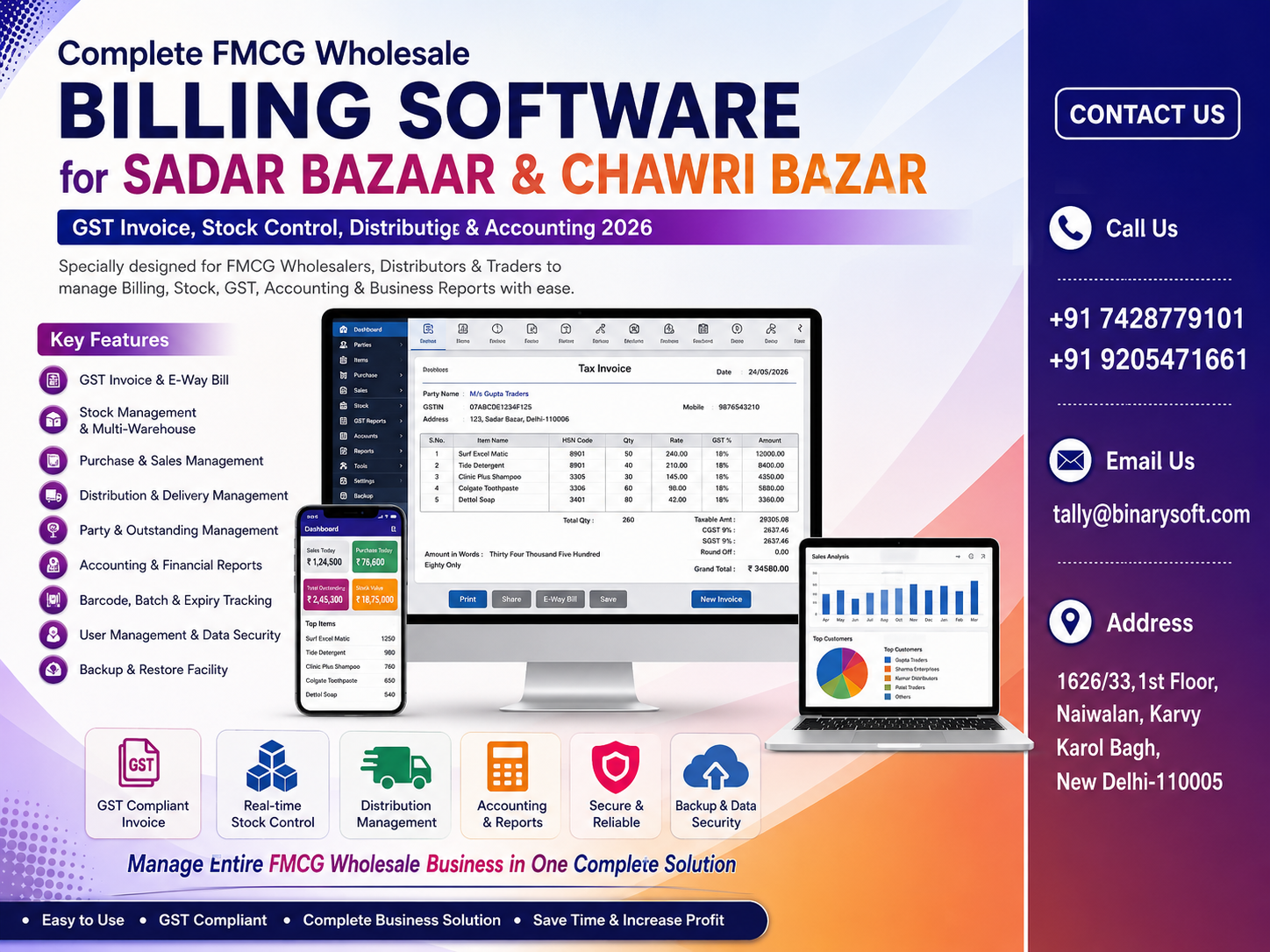
FMCG wholesalers are handling a business environment where billing speed, accurate stock visibility, GST-ready records and tighter control over outstanding payments matter more than ever. In high-volume trading locations such as Sadar Bazaar and Chawri Bazar, Delhi, even a small delay in invoicing or an incorrect stock figure can affect dozens of orders in a single day. Recent months have also increased the pressure on distributors to maintain cleaner digital records, track purchases and sales systematically, and respond quickly to retailers asking about stock, rates and pending supplies. This is why modern FMCG wholesale billing software is moving beyond basic invoice printing. A connected system for GST invoicing, inventory, distribution, accounting, receivables and business reporting can reduce repetitive work while giving owners a clearer picture of their operations. For growing wholesalers, the benefit is straightforward: faster billing, better stock control and more reliable information for everyday decisions.
Why FMCG Wholesalers in Sadar Bazaar and Chawri Bazar Need Better Software
FMCG wholesale is fundamentally different from many other trading businesses. A distributor may deal with hundreds or thousands of products across categories such as packaged foods, beverages, household products, personal care items, cleaning products and other fast-moving goods.
The challenge is not simply creating an invoice.
Businesses need to know what is available, what is moving quickly, which items require replenishment, what retailers owe, which suppliers need to be paid and whether the business is actually earning the expected margin.
In markets such as Sadar Bazaar, where wholesalers can process a high volume of transactions, manual registers and disconnected spreadsheets can become increasingly difficult to manage.
Chawri Bazar businesses face similar operational pressure. When orders, purchase records, inventory and accounts are maintained separately, management may spend valuable time reconciling information instead of focusing on customers and growth.
A complete FMCG billing and distribution solution brings these activities into a more organized workflow.
From Basic Billing to Complete FMCG Distribution Management
Traditional billing software primarily focused on creating invoices and maintaining basic accounts.
A modern FMCG wholesale operation requires much more.
The software should ideally connect:
- GST invoicing
- Sales management
- Purchase management
- Inventory tracking
- Distributor and retailer records
- Outstanding receivables
- Supplier payables
- Accounting
- Product-wise reports
- Customer-wise sales
- Stock movement
- Business profitability
When these functions work together, an invoice becomes more than a printed document.
Every sale can simultaneously update inventory, customer balances, sales records and accounting information.
This reduces duplicate data entry and makes reports more meaningful.
Fast GST Billing for Busy Wholesale Counters
Speed at the billing counter is critical for an FMCG wholesaler.
During peak business hours, retailers may be waiting for invoices while warehouse staff are preparing goods and salespeople are confirming additional orders.
Billing software can help users create structured GST invoices while maintaining item, customer and taxation information.
Depending on the business configuration and applicable compliance requirements, a well-implemented system can help maintain details such as:
HSN/SAC information, GST rates, taxable values, discounts, CGST, SGST, IGST, customer GSTIN and invoice values.
This creates a more consistent billing process and reduces reliance on manual calculations.
Businesses should still ensure that their tax configuration and compliance processes are reviewed according to applicable GST requirements.
Inventory Control: Know What You Actually Have
Inventory is one of the largest working-capital components in FMCG distribution.
Too much stock can block money.
Too little stock can result in lost orders.
The challenge becomes greater when the business handles multiple brands, categories, warehouses or storage locations.
Inventory management software can provide a structured view of:
- Opening stock
- Purchases
- Sales
- Stock transfers
- Current quantity
- Reorder requirements
- Fast-moving products
- Slow-moving products
- Item-wise movement
- Warehouse or godown stock
Instead of calling warehouse staff every time a customer asks whether an item is available, the billing team can check recorded inventory directly.
A Story from a Busy Wholesale Morning
Imagine an FMCG wholesaler operating near Sadar Bazaar.
For years, the owner had built the business through relationships. Retailers knew him personally. Suppliers trusted him. His staff could remember the prices of hundreds of products without checking a catalogue.
But growth created a new problem.
One Monday morning, several retailers arrived almost together. The billing desk was crowded. A salesperson confirmed an order for products that appeared to be available according to an old spreadsheet.
The warehouse team could not find enough quantity.
Meanwhile, another employee discovered that the same stock had already been committed to a different customer.
The owner stood between the counter and warehouse, answering calls while trying to decide which customer should receive the remaining goods.
The hardest part was not losing one order.
It was seeing a long-time customer leave disappointed.
That evening, the owner realized something important: his business had become too large to depend entirely on memory, registers and disconnected files.
After organizing billing, inventory and customer balances within a connected system, his mornings began differently. Staff could check recorded stock before confirming orders. Billing became more structured. Outstanding amounts were easier to review.
Technology did not replace the relationships that built his business.
It gave those relationships better operational support.
Distributor and Retailer Management
An FMCG wholesaler may serve hundreds of retailers.
Maintaining organized customer records becomes essential as the network expands.
Software can help maintain information such as customer names, GST details, billing information, transaction history, outstanding balances and sales patterns.
This makes it easier to answer everyday questions:
How much did this retailer purchase last month?
Which invoices remain unpaid?
What products does this customer regularly order?
What is the current outstanding amount?
When the information is available from organized records, sales and accounts teams can work more efficiently.
Purchase and Supplier Management
Distribution does not stop at sales.
Purchase planning has a direct impact on stock availability and cash flow.
A wholesaler needs visibility into purchases from manufacturers, super stockists or suppliers.
Purchase management can help maintain supplier invoices, purchase values, product quantities, taxes, payable balances and stock additions.
This creates a clearer connection between procurement and inventory.
For example, if a fast-moving item is repeatedly approaching minimum stock levels, management can use inventory and sales information to make more informed purchasing decisions.
Batch, Expiry and Product-Level Tracking
For businesses dealing in products where batch or expiry information is relevant, maintaining proper inventory records becomes even more important.
Depending on the software configuration and business requirements, batch-wise tracking can help businesses identify stock based on batch details and expiry dates.
This is especially useful for FMCG categories where shelf life matters.
Better visibility can help businesses prioritize older stock and reduce avoidable inventory losses.
Multiple Godown and Warehouse Management
Many growing wholesalers do not keep all inventory at one location.
A business may have a billing office in Sadar Bazaar while inventory is stored in one or more godowns elsewhere.
Without centralized records, the billing team may not know exactly which location has the required product.
Multi-location inventory management can help track stock separately for each godown while still providing consolidated business visibility.
This can improve stock allocation and internal transfers.
Outstanding Receivables: Sales Are Not the Same as Collections
High sales figures can look encouraging, but cash flow depends heavily on collections.
Wholesale businesses often extend credit to regular retailers.
If outstanding balances are not monitored carefully, working capital can become strained even when sales continue to grow.
Accounting and billing software can help provide customer-wise outstanding information and transaction history.
Management can identify overdue balances and plan collection follow-ups more systematically.
This is particularly valuable for businesses managing a large retailer network.
Supplier Payables and Cash-Flow Visibility
Customer collections are only one side of cash flow.
Wholesalers must also manage payments to suppliers.
A complete accounting system can provide visibility into amounts payable, amounts receivable and available financial information.
Rather than relying entirely on separate registers, owners can review structured records before planning payments.
Better information can support more disciplined working-capital management.
Accounting Integrated with Billing
One of the biggest advantages of integrated software is that billing and accounting do not need to operate as completely separate processes.
When properly configured, sales and purchase transactions can flow into accounting records.
This can support the maintenance of:
Sales accounts, purchase accounts, customer ledgers, supplier ledgers, cash and bank transactions, receivables, payables and financial reports.
Integrated accounting reduces repeated data entry and helps maintain consistency between operational transactions and financial records.
Sales Analysis for Better Decisions
Business owners often know their total sales.
But total sales alone cannot answer important questions.
Which products are selling fastest?
Which category produces more revenue?
Which retailer buys the most?
Which products have stopped moving?
Which month performed better?
Product-wise, customer-wise and period-wise reports can help turn transaction data into business information.
This is where modern FMCG distribution software becomes a management tool rather than simply a billing application.
Identify Fast-Moving and Slow-Moving Stock
FMCG businesses depend on inventory movement.
Fast-moving products need timely replenishment.
Slow-moving products require attention before they become dead stock.
Inventory reports can help management compare product movement and make better purchasing decisions.
Instead of ordering only based on instinct, businesses can use historical transaction data as an additional decision-making input.
Reduce Billing and Stock Errors
Manual operations introduce multiple opportunities for error.
An incorrect quantity can affect stock.
A wrong price can affect margins.
A missing invoice can affect customer balances.
Duplicate data entry can create mismatches between accounts and inventory.
Software does not eliminate every possible human mistake, but well-designed workflows can reduce repetitive calculations and provide more consistent transaction records.
Better Control Over Discounts and Pricing
Wholesale pricing can be complex.
Different retailers may receive different rates depending on quantity, relationship, scheme or commercial agreement.
Without systematic controls, pricing inconsistencies can reduce margins.
Depending on configuration, billing software can support organized price lists, discounts and customer-specific commercial terms.
This helps the billing team apply authorized pricing more consistently.
Business Reports at Your Fingertips
Owners should not have to wait until month-end to understand what is happening in the business.
Useful reports may include:
- Daily sales
- Monthly sales
- Purchase reports
- Stock summary
- Item movement
- Customer outstanding
- Supplier payable
- Customer ledger
- Supplier ledger
- GST-related transaction reports
- Profit and loss information
- Balance sheet
- Cash and bank information
The exact reports available depend on the software and implementation.
The objective is simple: give management quicker access to reliable business information.
Why FMCG Software Matters for Sadar Bazaar
Sadar Bazaar is known for intensive wholesale and trading activity.
Businesses operating in such an environment often compete on availability, price, service and speed.
When several retailers are waiting, the wholesaler who can check inventory quickly, prepare accurate bills and dispatch goods efficiently has an operational advantage.
A structured digital system can support that speed without sacrificing record keeping.
Why Chawri Bazar Businesses Can Benefit
Chawri Bazar has a long-established trading ecosystem where many businesses manage repeat customers, suppliers and high transaction volumes.
As these businesses expand their product lines and customer networks, maintaining visibility becomes more difficult.
Billing, inventory and accounting software can help owners modernize internal processes while continuing to operate according to their established business relationships.
Digital transformation does not necessarily mean changing the way customers are treated.
It means improving the systems behind that service.
Supporting Business Growth Without Losing Control
A small distributor may initially manage operations using a handful of employees and simple records.
As turnover grows, complexity grows with it.
More products mean more inventory.
More retailers mean more outstanding balances.
More suppliers mean more purchase transactions.
More employees mean greater need for structured access and accountability.
Software provides a framework that can scale more effectively than disconnected manual records.
Data Security, Backup and User Control
Business data includes sensitive information about customers, suppliers, pricing, inventory and accounts.
Therefore, security should be considered when selecting and implementing software.
Businesses should evaluate features such as user permissions, data backups, access controls and audit capabilities according to their operational requirements.
Regular backups are particularly important.
Software is valuable only when the underlying business data is appropriately protected and recoverable.
What to Look for in FMCG Wholesale Billing Software in 2026
Before choosing software, an FMCG distributor should evaluate whether the solution matches actual business workflows.
Important areas include GST billing, inventory, customer management, supplier management, accounting, reporting, stock locations and scalability.
The system should also be practical for employees who use it every day.
A feature-rich application that staff cannot operate comfortably may create more problems than it solves.
Implementation, training and support therefore matter alongside the software itself.
Tally Solutions for FMCG Wholesalers
For businesses already familiar with Tally-based accounting and business management, a properly configured Tally environment can support many billing, inventory and accounting requirements.
The appropriate setup depends on business size, transaction volume, number of users, inventory structure and reporting needs.
Professional implementation can help businesses configure masters, inventory structures, taxation, ledgers and workflows according to their requirements.
Binarysoft Technologies – Solutions for FMCG Distribution Businesses
Binarysoft Technologies works with businesses looking to improve billing, accounting, inventory and related business processes.
As an Authorized Tally Partner, Binarysoft Technologies can assist businesses in evaluating Tally solutions and implementing systems according to their operational requirements.
For FMCG wholesalers in Sadar Bazaar, Chawri Bazar and other Delhi trading locations, the objective is not merely to install software.
The objective is to build a practical workflow that employees can use every day.
Benefits of Moving to an Integrated FMCG System
A properly implemented solution can help an FMCG wholesale business achieve:
- Faster invoice processing
- Better inventory visibility
- More organized GST transaction records
- Improved customer account tracking
- Better supplier management
- Reduced duplicate data entry
- Easier outstanding monitoring
- Improved purchase planning
- Better business reporting
- More structured accounting
- Greater operational visibility
- Better scalability as the business grows
The actual benefits will depend on implementation quality, staff adoption and the processes followed by the business.
Powered by Binarysoft Technologies
Authorized Tally Partner
Location: 1626/33, 1st Floor, Naiwalan, Karol Bagh, New Delhi – 110005, INDIA
Contact Us: +91 7428779101, 9205471661
Email Us: tally@binarysoft.com
Business Hours: 10:00 AM – 6:00 PM, Mon–Fri
Conclusion
The FMCG wholesale market in 2026 demands speed, accuracy and visibility. For businesses operating in Sadar Bazaar and Chawri Bazar, relying entirely on manual records or disconnected billing and inventory systems can make growth increasingly difficult.
A complete FMCG wholesale billing solution can connect GST invoicing, stock control, purchases, distribution, customer management, supplier records and accounting within a more organized business process.
The biggest advantage is not simply faster invoice printing.
It is knowing what is happening across the business.
Owners can gain better visibility into stock, sales, purchases, receivables, payables and overall performance. Employees can spend less time searching through registers and spreadsheets, while management can use structured information to make more informed decisions.
For wholesalers planning to modernize operations in 2026, the right combination of software, configuration, training and ongoing support can provide a stronger foundation for sustainable growth.
Frequently Asked Questions
How do I choose the right FMCG billing solution?
Consider transaction volume, number of products, number of users, inventory locations, GST requirements, accounting needs, reporting requirements and future expansion before selecting a solution.
Can an existing FMCG business move from manual billing to software?
Yes. The migration should be planned carefully, particularly for opening stock, customer balances, supplier balances, product masters and accounting information.
CA. Lakshy Vermaa advises small and mid-sized businesses on accounting discipline, tax compliance, and process improvement. With exposure to retail and trading environments, he writes practical articles aimed at helping business owners gain better financial visibility and control.