Call CA Tally HelpDesk
+91 9205471661,
7428779101
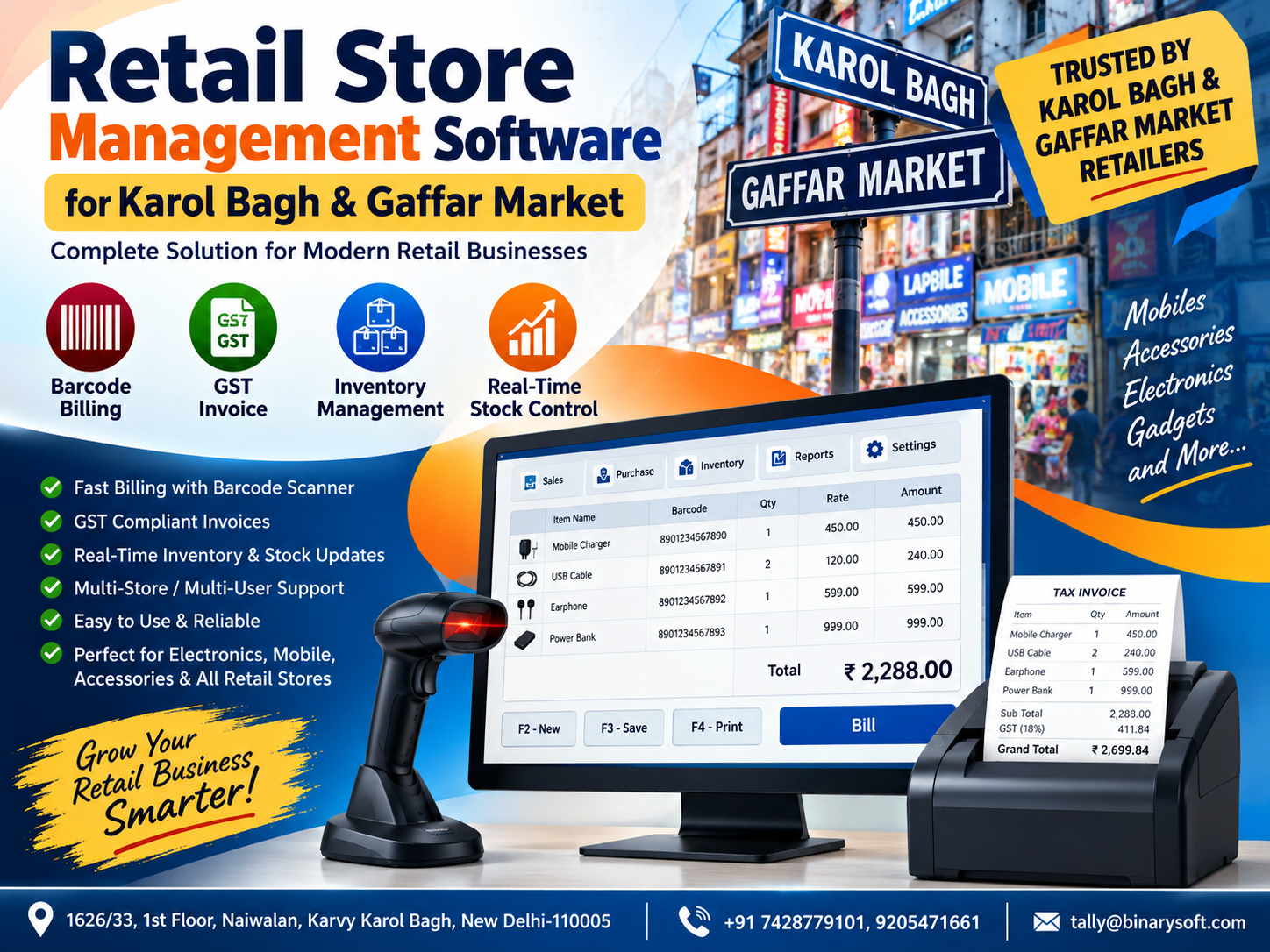
What Changed in 2026: Retailers Need Faster Billing and Better Stock Visibility
In 2026, retail businesses in Karol Bagh and Gaffar Market are facing a different kind of competitive pressure. Customers expect faster checkout, accurate GST invoices, instant product availability and fewer billing mistakes, while shop owners are managing thousands of SKUs, changing purchase prices, multiple suppliers and increasingly complex stock movements. Manual registers and disconnected billing tools can make it difficult to know what is actually available on the shelf, what is lying in the godown and what needs to be reordered. This is where modern retail store management software can make a measurable difference. By bringing barcode billing, GST invoicing, inventory tracking, accounting and real-time stock control into a connected system, retailers can reduce repetitive work and make faster decisions. For busy markets such as Karol Bagh and Gaffar Market, better technology is increasingly becoming an operational advantage rather than simply a billing convenience.
Why Retail Store Management Is Becoming More Important in 2026
Karol Bagh and Gaffar Market are among Delhi's active commercial destinations, with businesses dealing in electronics, mobile accessories, garments, footwear, automobile accessories, consumer products and numerous other categories.
The challenge for a growing retailer is no longer limited to generating a bill.
A modern store may need to manage hundreds or thousands of products, multiple variants, purchase transactions, suppliers, GST rates, customer balances, stock transfers, sales returns and daily cash or digital collections.
When these activities are maintained separately, even a successful shop can struggle with operational visibility.
A store owner may know that sales were good during the day but still be unable to answer immediately:
How much stock is currently available?
Which products sold the fastest?
Which items are running below minimum stock?
Which products have remained unsold for months?
What was today's actual sales value?
How much money is receivable from customers?
Which suppliers need to be paid?
What is the GST position of the business?
Modern retail store management software is designed to bring these answers together.
A Karol Bagh Retailer's Story: When a Busy Store Still Felt Out of Control
Imagine a retailer running a busy electronics and accessories store near Karol Bagh.
The shop had been growing steadily. Customers came throughout the day, employees handled billing and the godown was regularly receiving fresh stock.
From the outside, business looked excellent.
But every evening, the owner faced the same anxiety.
He could see sales happening, but he could not confidently tell which products were actually profitable. Staff sometimes spent several minutes checking whether a particular model or accessory was available. At other times, a customer was told that an item was out of stock, only for somebody to discover several units in the godown later.
During busy hours, handwritten product codes caused billing mistakes.
Then came the month-end stock check.
The owner and his employees stayed late into the night counting products and comparing quantities with registers and spreadsheets. Even after hours of work, the numbers did not completely match.
The problem wasn't lack of hard work.
The business had simply grown beyond the system being used to manage it.
After moving towards barcode-based billing and centralized inventory management, everyday operations became easier to track. Products could be identified quickly, stock movements became visible and management could review business information without waiting for a physical stock count.
For the owner, the biggest benefit wasn't simply faster billing.
It was confidence.
He could finally understand what was happening inside his business while it was happening.
That is the real purpose of modern retail management technology.
What Is Retail Store Management Software?
Retail store management software is a business solution that helps retailers manage important store operations from a structured system.
Depending on the software and configuration, it can support:
Barcode billing
GST invoicing
Inventory management
Purchase management
Sales management
Stock tracking
Item-wise reporting
Customer management
Supplier management
Accounting
Receivables and payables
Cash and bank transactions
Sales returns
Purchase returns
Business reports
Multiple godowns or locations
User-level controls
A good retail management system does more than replace a handwritten bill.
It creates an information system for the entire store.
Barcode Billing for Faster Retail Checkout
Speed matters in retail.
During weekends, festivals and peak shopping hours, a slow billing counter can create queues and frustration.
Barcode billing helps simplify product identification.
Instead of manually searching for an item and entering its details repeatedly, the salesperson can scan the product barcode. Where properly configured, the system can retrieve information such as product name, rate, applicable tax and other billing details.
The invoice can then be prepared much faster.
Benefits of Barcode Billing
Barcode-based billing can help retailers reduce manual product selection, improve billing speed and minimize product-code errors.
It can be particularly useful for stores carrying large numbers of similar products.
Consider a mobile accessories retailer.
The store may have dozens of chargers, cables, covers, earphones, adapters and screen protectors. Many products may look similar but have different models and selling prices.
Selecting the wrong product during billing can affect both the invoice and stock quantity.
A barcode-driven workflow makes product identification more systematic.
GST Invoice Management for Retail Businesses
GST invoicing is another important requirement for Indian retailers.
The billing system should allow businesses to maintain relevant tax information and generate invoices based on the nature of their transactions and applicable GST requirements.
Depending on business requirements, this can include details such as:
GSTIN
HSN/SAC information
Taxable value
CGST
SGST
IGST
Discounts
Invoice value
Customer details
Item descriptions
Properly configured accounting and billing software can reduce repetitive calculation work and help maintain more organized transaction records.
However, GST applicability and compliance requirements can vary according to the business and transaction. Businesses should verify applicable rules with their tax professional.
Real-Time Stock Control: Know What You Have Before the Customer Asks
One of the biggest advantages of integrated retail software is better inventory visibility.
When purchases, sales, returns and stock movements are recorded correctly, the system can provide an updated view of inventory.
Instead of repeatedly calling the godown or physically checking shelves, authorized users can review stock information from the system.
For example:
A customer asks for a particular mobile charger.
The salesperson searches the item.
The system shows available quantity.
The salesperson can respond more quickly.
This small improvement may be repeated hundreds of times every month.
The result can be faster customer service and better use of existing inventory.
Inventory Management for Karol Bagh Retail Stores
Karol Bagh retailers can deal with very diverse product categories.
Inventory management therefore needs to accommodate more than just basic quantity tracking.
Businesses may want to classify inventory by:
Product group
Brand
Category
Model
Size
Colour
Location
Godown
Batch, where relevant
Supplier
Price range
Tax category
A well-organized inventory structure makes reporting more useful.
For example, instead of only knowing that ₹10 lakh worth of stock is available, management may want to know which category represents that stock and how quickly it is moving.
That information is much more valuable for purchasing decisions.
Retail Software for Gaffar Market Businesses
Gaffar Market businesses frequently operate in fast-moving product environments where models and prices can change quickly.
Electronics and mobile-related retailers may carry many SKUs and variants.
A product that sells strongly today may be replaced by another model within months.
That makes inventory visibility particularly important.
Retail management software can help businesses analyze what is selling and what is not.
This can support better decisions around replenishment and slow-moving inventory.
Avoid Over-Stocking and Under-Stocking
Too much stock creates one problem.
Too little stock creates another.
Over-stock ties up working capital.
Under-stock can mean lost sales.
Imagine that a retailer has ₹5 lakh invested in products that customers rarely request while a popular item repeatedly goes out of stock.
The total inventory value may look healthy, but the inventory mix is inefficient.
A better inventory management system can help management review stock quantities, sales patterns and reorder requirements more systematically.
The goal isn't necessarily to keep more stock.
The goal is to keep the right stock.
Minimum Stock and Reorder Management
Retailers can establish stock-control processes around minimum quantities and reorder levels.
Suppose a particular product normally sells 50 units every week.
If the available quantity falls to 10 units and new stock takes several days to arrive, waiting until the product reaches zero could result in missed sales.
A structured reorder process allows the business to identify the requirement earlier.
This is especially useful for fast-moving products.
Sales and Purchase Management in One System
Retail operations involve both incoming and outgoing stock.
Purchases increase inventory.
Sales reduce inventory.
Sales returns may increase inventory.
Purchase returns may reduce inventory.
If each process is recorded in separate software or spreadsheets, reconciliation becomes difficult.
An integrated retail management solution connects these activities.
This gives management a clearer picture of product movement.
Supplier Management
A retailer may work with dozens of suppliers.
The business needs to understand what was purchased, from whom, at what rate and how much remains payable.
Proper accounting software can maintain supplier ledgers and purchase records so that management can review outstanding liabilities more systematically.
This can help improve supplier coordination and cash-flow planning.
Customer Management and Outstanding Tracking
Not every retail transaction is necessarily an immediate cash sale.
Some businesses also provide credit to regular customers, corporate buyers, dealers or other business customers.
When credit sales are involved, receivable tracking becomes important.
A connected accounting system can help maintain customer balances and transaction histories.
This reduces dependence on handwritten diaries and individual employee memory.
Multi-Godown Stock Management
Many Karol Bagh and Gaffar Market retailers operate from a shop while maintaining additional inventory in a godown.
This creates another challenge.
A product may not be physically available at the counter but may be available in the godown.
Without location-wise inventory records, employees can lose time searching.
A multi-location inventory structure can help maintain stock separately for different storage locations while providing management with a consolidated view where supported by the chosen solution.
Stock Transfer Management
When products move between the shop, godown or another business location, the movement should be recorded.
Otherwise, the total stock may be correct while location-level quantities become inaccurate.
Proper stock-transfer records improve inventory accountability.
Sales Return and Purchase Return Management
Returns are part of retail operations.
A customer may return or exchange an item.
A retailer may return damaged or incorrect stock to a supplier.
These transactions affect both inventory and financial records.
A structured software workflow helps ensure that returns are properly reflected instead of being handled informally.
Real-Time Business Reports for Better Decisions
Business software becomes more valuable when data is converted into actionable information.
Retailers may want to review reports covering areas such as:
Daily sales
Monthly sales
Item-wise sales
Category-wise sales
Stock summary
Low-stock items
Receivables
Payables
Purchases
Profitability
Cash and bank position
Outstanding balances
Business owners should not have to wait until the end of the month to understand basic operational performance.
Regular reporting can help management identify issues earlier.
Identify Fast-Moving Products
Some products may sell every day.
Others may move slowly.
Knowing the difference is essential for inventory planning.
Fast-moving products may require frequent replenishment.
Slow-moving products may require reduced purchasing, revised pricing, promotions or another business decision.
Retail software provides the underlying transaction information needed for such analysis.
Control Dead Stock
Dead stock silently consumes working capital.
Imagine 100 units of a product sitting in storage for several months.
The money invested in those units cannot easily be used to purchase products that are currently in demand.
Regular inventory reviews can help retailers identify slow-moving and non-moving products earlier.
Management can then decide how to handle them based on commercial considerations.
Better Control Over Discounts
Retail businesses often provide discounts.
But uncontrolled discounting can reduce margins.
With properly configured user permissions and reporting, management can establish more disciplined billing processes.
The owner can review sales and discount activity instead of relying solely on verbal information.
User-Level Security and Control
Retail businesses often have multiple employees handling different responsibilities.
Not everyone necessarily needs access to all business information.
Depending on the chosen software, access can be structured according to roles and responsibilities.
For example, billing staff may need transaction-related access while management requires broader reporting and accounting visibility.
This can improve operational control.
Accounting Integration for Retailers
Retail management is closely connected to accounting.
Every purchase, sale, receipt, payment, expense and return has a financial impact.
When billing and accounting processes are connected, businesses can reduce duplicate data entry and maintain more consistent records.
This is one reason solutions such as TallyPrime are widely considered by businesses that need accounting, inventory and GST-related capabilities in an integrated environment.
Why TallyPrime Can Be Considered for Retail Business Management
TallyPrime can support a variety of accounting and inventory requirements for businesses, depending on configuration and operational needs.
Retailers can use relevant features for areas including accounting, invoicing, inventory, GST-related records, receivables, payables and reporting.
The exact setup should be planned according to the retailer's workflow.
A small single-counter shop may need a different configuration from a retailer managing several users, thousands of products and multiple stock locations.
That is why implementation and configuration matter.
Buying software alone does not automatically improve business operations.
The software should reflect the actual workflow of the business.
Barcode and TallyPrime-Based Retail Workflows
Retail businesses looking for barcode-based workflows can structure their product masters and billing processes according to their requirements and compatible hardware/software setup.
The objective should be simple:
Scan or identify the correct item.
Generate the correct transaction.
Update the corresponding inventory records.
Maintain the accounting impact.
Provide management with useful reports.
When these steps work together, billing becomes part of a complete business-management process rather than an isolated activity.
Retail Management for Garment Stores
Garment retailers often face inventory complexity because a single design may be available in multiple sizes and colours.
A store may need to manage combinations such as:
Product: Shirt
Brand: ABC
Colour: Blue
Size: M
Size: L
Size: XL
Each variation represents inventory that needs accurate tracking.
Proper inventory classification can make these operations easier to manage.
Retail Management for Electronics Stores
Electronics retailers may need to manage many brands, models and accessories.
Product life cycles can also be relatively short.
This makes item-wise inventory information important.
Management can review what is selling and adjust future purchasing accordingly.
Retail Management for Footwear Stores
Footwear retailers may maintain the same design across multiple sizes and colours.
A salesperson needs to know whether the requested combination is available.
Structured inventory management can reduce unnecessary physical searches and improve customer service.
Retail Management for Auto Parts and Accessories
Karol Bagh has many businesses dealing with automobile parts and accessories.
These businesses may manage a large number of item codes.
Searching manually through thousands of parts can be inefficient.
A well-structured item master and inventory system can help employees identify products and available quantities more quickly.
Centralized Business Information
One major problem in traditional retail management is fragmented information.
Sales may be in one system.
Inventory may be in Excel.
Supplier balances may be in another file.
Customer dues may be written in a diary.
Bank transactions may be reviewed separately.
This creates unnecessary dependence on manual reconciliation.
Centralizing key business information can make daily operations easier to monitor.
How Better Stock Control Can Improve Cash Flow
Inventory is money stored in product form.
If ₹20 lakh is invested in inventory, management needs to know whether that stock is actually moving.
Suppose ₹6 lakh of that inventory remains unsold for an extended period.
That can create pressure on working capital even when the business appears well stocked.
Better inventory reports can help identify such patterns.
Management can then make more informed purchasing decisions.
Reduce Dependence on Memory
Many traditional retail stores operate successfully because experienced employees remember where products are kept, which customer has an outstanding balance and which supplier provides a particular item.
But this creates business dependency.
What happens when that employee is absent?
A structured software system turns important operational information into business data rather than personal memory.
That can make the organization more scalable.
Faster Customer Service
A customer may not care which software a retailer uses.
The customer cares about the experience.
Can the salesperson quickly confirm availability?
Can billing be completed without unnecessary delay?
Is the invoice accurate?
Can a return or exchange be handled systematically?
Technology becomes valuable when it improves these everyday interactions.
Festival and Peak-Season Retail Management
Retail activity can increase significantly during festivals and promotional periods.
High sales volumes put additional pressure on billing counters and inventory management.
A system that works adequately during a quiet weekday may become inefficient during peak demand.
Retailers should therefore design their billing and stock workflow for busy periods, not only average days.
Daily Store Closing and Management Review
At the end of the day, management should be able to review key information efficiently.
Depending on business setup, this may include sales, receipts, payments, outstanding amounts, inventory movements and other operational data.
A structured daily review can help owners detect unusual transactions and operational issues early.
Physical Stock Verification Still Matters
Real-time inventory software is valuable, but software stock is only as reliable as the transactions entered into the system.
Physical verification therefore remains important.
Businesses should periodically compare actual inventory with system quantities.
Differences can then be investigated and corrected according to proper accounting and internal-control procedures.
Technology improves control, but disciplined processes remain essential.
Why Software Implementation Matters
Retail software should not simply be installed and forgotten.
A successful implementation requires understanding the business.
Before configuring the system, retailers should consider:
How products are categorized.
How many billing users are required.
Whether barcodes are already available.
How purchases are entered.
Whether stock is stored at multiple locations.
How returns are handled.
Who can provide discounts.
Who can modify rates.
How customer credit is controlled.
Which reports management needs.
How data backup will be managed.
A carefully planned implementation provides much more value than a generic setup.
Choosing Retail Store Management Software in Karol Bagh & Gaffar Market
Retailers should evaluate software according to their actual business requirements rather than selecting a solution solely on the basis of price.
Important considerations include ease of use, billing speed, inventory requirements, accounting needs, GST-related processes, reporting, user controls, scalability, support and compatibility with the existing business workflow.
The right solution for a small shop may not be the same as the right solution for a high-volume retailer.
From Billing Software to Business Control
There is an important difference between billing software and business-management software.
Basic billing software answers:
"What did I sell?"
A stronger business system should help answer:
"What did I sell?"
"What is still in stock?"
"What should I purchase?"
"Who owes me money?"
"Whom do I need to pay?"
"Which products are performing?"
"Where is my working capital?"
"What is happening in my business right now?"
This is the transition retailers should consider in 2026.
Retail Digital Transformation in Karol Bagh and Gaffar Market
Digital transformation does not necessarily mean replacing every existing process overnight.
It can begin with basic improvements.
Start with structured product masters.
Introduce barcode-based product identification where appropriate.
Connect billing with inventory.
Maintain purchases systematically.
Track stock movements.
Review receivables and payables.
Use reports for purchasing decisions.
Train employees.
Verify stock periodically.
Small improvements made consistently can create significant operational benefits.
Why Real-Time Visibility Matters to the Store Owner
For many business owners, the most valuable benefit of retail management software is peace of mind.
When information is organized, the owner doesn't have to depend on constant phone calls to understand basic business activity.
Instead of asking:
"How much did we sell today?"
"Is this product available?"
"How much stock came yesterday?"
"Has this customer paid?"
"How much do we owe this supplier?"
Management can refer to properly maintained business records and reports.
That changes the owner's role from constantly chasing information to using information for decisions.
Grow Without Losing Control
Growth creates complexity.
More customers create more transactions.
More products create more inventory records.
More employees create more access requirements.
More suppliers create more payables.
More locations create more stock movements.
A business system should help the retailer handle this complexity without losing visibility.
The objective is not merely to automate today's workload.
It is to create a foundation capable of supporting tomorrow's business.
Powered by Binarysoft Technologies
Binarysoft Technologies provides Tally-related sales, implementation and support services for businesses looking to improve accounting, billing, GST and inventory management processes.
Retailers in Karol Bagh, Gaffar Market and other business locations can discuss their operational requirements before selecting an appropriate software configuration.
A requirement-based approach can help determine suitable options for billing, accounting, barcode workflows, inventory management, stock locations, reporting and other business processes.
Powered by Binarysoft Technologies
Authorized Tally Partner
Location: 1626/33, 1st Floor, Naiwalan, Karol Bagh, New Delhi – 110005, INDIA
Contact us: +91 7428779101, 9205471661
Email us: tally@binarysoft.com
Business Hours: 10:00 AM – 6:00 PM, Mon–Fri
Conclusion
Retail competition in Karol Bagh and Gaffar Market is increasingly about more than product selection and pricing. Speed, inventory availability, accurate billing and business visibility also influence how efficiently a store operates.
Barcode billing can make checkout faster. GST invoicing can make transaction records more structured. Integrated inventory management can provide better visibility into available stock. Accounting integration can help owners understand receivables, payables and financial activity. Reporting can turn everyday transactions into information that supports purchasing and management decisions.
Most importantly, real-time stock control can help a retailer move away from uncertainty.
Instead of discovering stock problems during month-end counting, management can monitor inventory continuously when transactions are maintained correctly.
For growing retail businesses, the objective of technology should not simply be to create invoices faster. It should help the owner understand the business better, serve customers more efficiently and grow without losing operational control.
Frequently Asked Questions
What is retail store management software?
Retail store management software helps businesses manage activities such as billing, inventory, purchases, sales, customer accounts, supplier accounts and business reporting through a structured system.
Is retail management software suitable for Karol Bagh shops?
Yes. The appropriate setup depends on the type and size of business. Retailers dealing in garments, electronics, mobile accessories, footwear, auto accessories and other products can benefit from structured billing and inventory management.
CA. Pankaj Bhadoria brings practical experience in GST, accounting, and business process consulting. He works closely with MSMEs to resolve compliance challenges and improve operational transparency. His articles aim to simplify complex regulations for everyday business use.