Call CA Tally HelpDesk
+91 9205471661,
7428779101
What Changed in 2026? Why Delhi Traders Should Start Preparing for GSTR-9 Early
In 2026, GST annual-return compliance is becoming increasingly data-driven, making year-end reconciliation more important for traders in Connaught Place and Palika Bazaar, New Delhi. The GST Portal now provides extensive system-computed information based on returns such as GSTR-1 and GSTR-3B, while differences entered by taxpayers can trigger visible warnings in relevant GSTR-9 fields. For businesses handling hundreds or thousands of invoices, waiting until the annual-return deadline to identify mismatches can create unnecessary pressure.
For FY 2026-27, businesses should not assume that an exemption threshold applicable to an earlier year will automatically remain unchanged. As of August 2026, traders should track the notification applicable specifically to FY 2026-27 before treating any turnover-based GSTR-9 exemption as final. What businesses can do now is prepare: reconcile sales, GST liability, input tax credit, HSN data and books throughout the year. That preparation can turn GSTR-9 from a December compliance rush into a controlled year-end process.
GSTR-9 Annual Return: Why It Matters for Connaught Place and Palika Bazaar Businesses
Connaught Place is one of Delhi's most prominent commercial districts, while Palika Bazaar has a large concentration of retail businesses dealing in products such as garments, accessories, electronics and consumer goods.
For GST-registered businesses operating in such high-transaction environments, annual reconciliation can become complicated.
Daily business may involve:
- B2B and B2C sales
- GST invoices
- Credit notes and debit notes
- Purchase returns
- Sales returns
- Input Tax Credit
- Multiple GST rates
- Cash and digital payments
- Interstate purchases
- Interstate sales
- E-commerce transactions
- HSN-wise sales reporting
- Vendor invoice reconciliation
GSTR-9 brings important information from the financial year together into an annual return.
The GST Portal describes Form GSTR-9 as an annual return filed once for each financial year by applicable registered regular taxpayers, including SEZ units and developers. It contains information relating to purchases, sales, input tax credit, refunds and demands, among other particulars.
That makes GSTR-9 more than another routine monthly return.
It is effectively an annual consolidation and review of the GST position reported during the year.
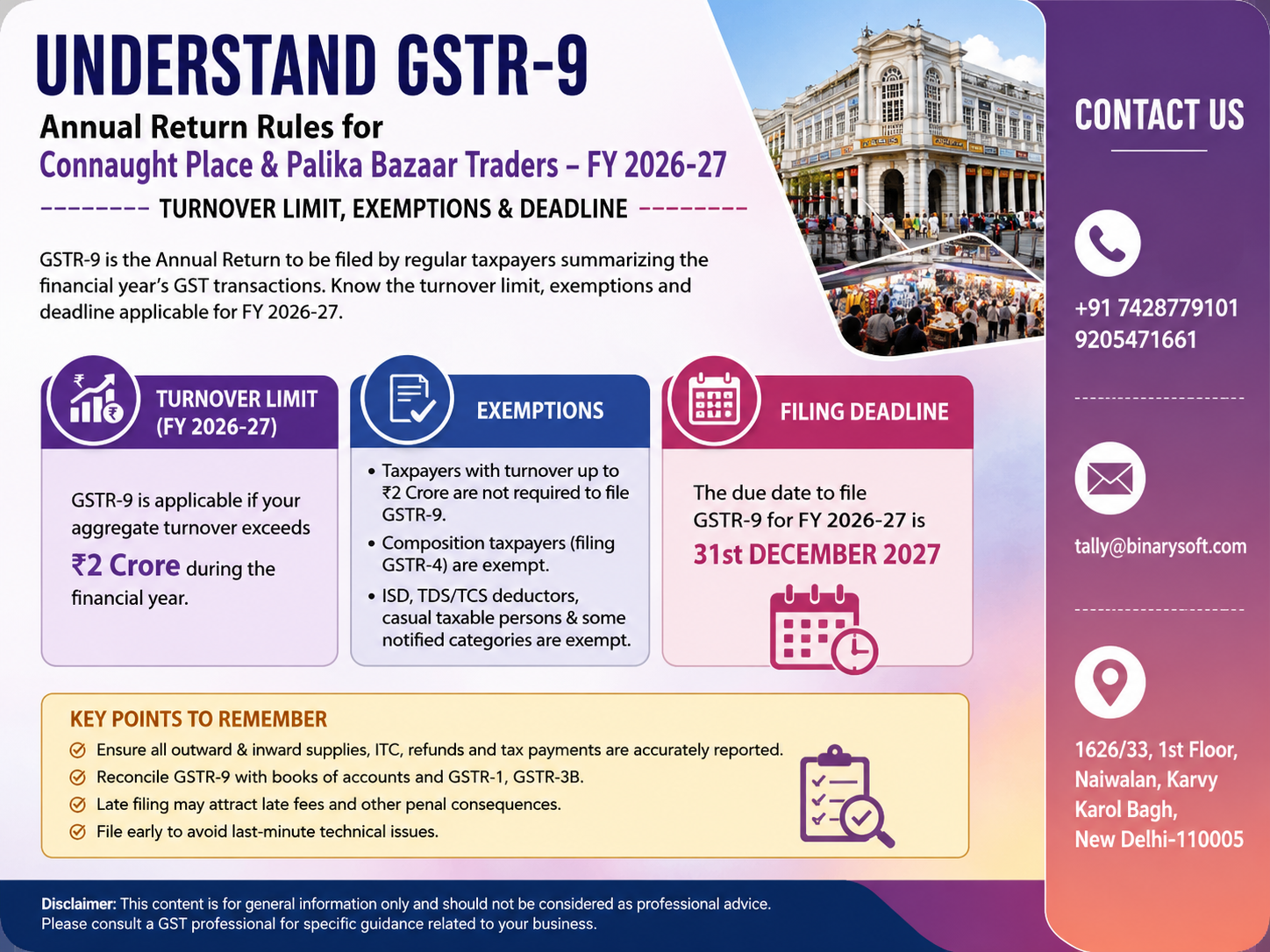
FY 2026-27: What Is the GSTR-9 Turnover Limit?
This is one of the most important questions for traders:
What is the GSTR-9 turnover limit for FY 2026-27?
A careful distinction is necessary.
Turnover-based relief from filing GSTR-9 has historically been provided through year-specific government notifications. Therefore, businesses should not simply copy the exemption applicable to an earlier financial year and assume that the same exemption has already been notified for FY 2026-27.
As of August 2026, businesses should verify the specific notification governing FY 2026-27 before relying on a turnover-based exemption.
This is especially important because FY 2026-27 itself will end on 31 March 2027, and the annual return will become relevant after the financial year closes.
Accordingly, businesses in Connaught Place, Palika Bazaar and elsewhere should treat any statement that the FY 2026-27 GSTR-9 exemption is definitively ₹2 crore as subject to the notification ultimately applicable to that financial year.
The safest strategy is simple:
Maintain GSTR-9-ready records during the year, even if your turnover may eventually qualify for an exemption.
GSTR-9 vs GSTR-9C: Do Not Confuse the Two Limits
Many traders confuse GSTR-9 with GSTR-9C.
They are related, but they are not the same compliance requirement.
GSTR-9 is the annual GST return.
GSTR-9C is a reconciliation statement applicable where the prescribed turnover condition is crossed.
Under the presently applicable Rule 80 framework explained by CBIC, taxpayers whose aggregate turnover during a financial year exceeds ₹5 crore are required to furnish a self-certified reconciliation statement in Form GSTR-9C along with the annual return.
Therefore, business owners should not say:
"My turnover is above ₹2 crore, so I automatically need GSTR-9C."
That is not the correct way to evaluate the current requirement.
The ₹5 crore threshold is particularly important when examining GSTR-9C under the current framework.
Always verify whether subsequent notifications or rule changes affect the financial year concerned.
Who Generally Falls Under GSTR-9?
Section 44 of the CGST Act establishes the annual-return requirement for registered persons, subject to specified exclusions and exemptions or relaxations notified under the law.
The statutory exclusions include certain categories such as:
- Input Service Distributor
- Persons paying tax under Section 51
- Persons collecting tax under Section 52
- Casual taxable persons
- Non-resident taxable persons
The applicable annual-return rules and any financial-year-specific exemption notification must therefore be read together.
For an ordinary GST-registered trader in Connaught Place or Palika Bazaar, the first questions should consequently be:
What was my aggregate turnover?
What type of GST registration did I have?
Was I a regular taxpayer during FY 2026-27?
Does a notification exempt my category or turnover level for that financial year?
Do I cross the separate GSTR-9C threshold?
These questions should be answered before deciding the annual-return compliance requirement.
What Does Aggregate Turnover Mean for GSTR-9?
One of the most common mistakes among business owners is to look only at the sales of a single shop or GST registration.
GST compliance may require looking at aggregate turnover, rather than simply one location's taxable sales.
For example, imagine a business owner operates:
- One retail outlet near Connaught Place
- Another outlet elsewhere in Delhi
- An online sales operation
- A wholesale division under the same PAN structure
It may be incorrect to examine only the turnover of the Connaught Place outlet when evaluating a turnover-linked GST requirement.
This is why business owners should obtain a consolidated turnover picture before making a filing decision.
A Connaught Place Trader's December Problem: A Story Many Businesses Will Recognize
Imagine a trader named Rajiv operating a growing consumer-goods business near Connaught Place.
Throughout the year, sales were strong.
His team generated invoices every day. Purchases came from suppliers in Delhi, Haryana, Uttar Pradesh, Maharashtra and Gujarat. GST returns were filed regularly, and because the monthly filings appeared complete, Rajiv assumed the annual return would be easy.
Then December arrived.
His accountant downloaded the annual data.
The sales figure in the books did not perfectly match the GST return summary.
A few credit notes had been accounted for differently.
Several vendor invoices required ITC verification.
Some HSN-wise information needed to be reviewed.
One transaction appeared in the books in March but had been reported differently in a subsequent GST period.
Suddenly, a compliance task Rajiv expected to complete in a few hours turned into days of reconciliation.
The real pressure was not merely the possibility of a late fee.
It was uncertainty.
Was the turnover correct?
Was the tax liability fully reported?
Was excess ITC claimed?
Were credit notes properly reflected?
Could the annual return be filed without creating a larger reconciliation problem?
The following year, Rajiv changed his approach.
Instead of waiting for December, his accountant reviewed the GST books every month.
By year-end, most mismatches had already been identified.
The lesson is particularly relevant for busy markets such as Connaught Place and Palika Bazaar:
GSTR-9 preparation should begin with accurate monthly accounting, not with a December deadline.
What Information Does GSTR-9 Bring Together?
GSTR-9 consolidates important GST information reported during the financial year.
Businesses should therefore review several major areas.
Outward Supplies
Review sales reported during the year, including relevant categories of:
- Taxable outward supplies
- Exempt supplies
- Nil-rated supplies
- Zero-rated supplies
- Interstate supplies
- B2B transactions
- B2C transactions
The objective is to determine whether turnover recorded in accounting books appropriately reconciles with GST returns.
Reconcile GSTR-1 with Accounting Books
For a trader, the first major reconciliation should normally be:
Sales Register vs GSTR-1
Check:
- Invoice numbers
- Invoice dates
- Taxable values
- GST rates
- CGST
- SGST
- IGST
- Credit notes
- Debit notes
- Amendments
- B2B invoices
- B2C sales
Even a small recurring error can become significant when multiplied across an entire financial year.
Reconcile GSTR-1 with GSTR-3B
The next important comparison is:
GSTR-1 vs GSTR-3B
Suppose invoices worth ₹15 lakh were disclosed in GSTR-1 for a particular tax period, but the corresponding taxable turnover reported through GSTR-3B does not align.
That difference should be investigated.
Do not simply alter annual-return figures to force a match.
Identify why the mismatch occurred.
Possible causes include:
- Return amendments
- Credit notes
- Timing differences
- Wrong tax period
- Incorrect taxable value
- Incorrect GST rate
- Interstate/intrastate classification errors
- Manual data-entry mistakes
Input Tax Credit Requires Equal Attention
Sales reconciliation is only half the annual-return exercise.
Purchase and ITC records require careful checking too.
Businesses should review:
Purchase Register vs ITC claimed
Important questions include:
- Is the vendor GSTIN correct?
- Is the invoice available?
- Was ITC actually eligible?
- Was ITC claimed in the appropriate period?
- Was any ineligible ITC reversed?
- Were purchase returns correctly adjusted?
- Are there vendor-related mismatches requiring review?
The GST Portal provides Table 8A document details and other system-generated information to assist taxpayers with annual-return preparation.
GST Portal Changes Make Reconciliation More Visible
From FY 2024-25 onward, the GST Portal's GSTR-9 workflow introduced updated screens and system-computed information.
The portal manual explains that GSTR-9 values are calculated using filed GSTR-1 and GSTR-3B information. Many fields are auto-populated but editable, while certain tables remain non-editable.
It also states that when taxpayers enter values differing from system-computed values in relevant areas, cells can be highlighted as a warning.
This reinforces an important principle for FY 2026-27 preparation:
Your accounting software, sales register and GST returns should be reconciled throughout the year.
HSN-Wise Reporting Is Important
Retail and wholesale businesses can deal with hundreds or thousands of products.
Examples in Palika Bazaar may include:
- Electronic accessories
- Computer accessories
- Mobile accessories
- Garments
- Footwear
- Bags
- Watches
- Consumer products
Managing correct HSN information throughout the year can therefore make annual compliance considerably easier.
The GST Portal's current GSTR-9 manual states that Table 17 deals with the HSN-wise summary of outward supplies. It also provides different HSN digit options depending on the taxpayer's preceding-year turnover, including a distinction at ₹5 crore.
Correct item masters and HSN configuration in accounting software can significantly reduce year-end manual work.
Can a NIL GSTR-9 Be Filed?
Yes, subject to the prescribed conditions.
According to the GST Portal guidance, a NIL GSTR-9 can be filed when the taxpayer, for the relevant financial year, has conditions such as:
- No outward supply
- No inward supply
- No other liability
- No ITC claimed
- No refund claimed
- No demand order
- No applicable late fee
These conditions are cumulative in the portal's NIL-return workflow.
Therefore, simply having no sales does not automatically mean a taxpayer can select NIL GSTR-9.
Other activities must also be checked.
What Is the GSTR-9 Due Date for FY 2026-27?
Under Section 44, the general statutory annual-return deadline is the 31st day of December following the end of the financial year, unless the deadline is extended under applicable law.
FY 2026-27 ends on:
31 March 2027
Accordingly, under the general rule, the GSTR-9 deadline would be:
31 December 2027
However, taxpayers should always check notifications and GST Portal updates closer to the filing period because the Government can provide extensions or other changes.
Do not treat an extension granted for an earlier financial year as automatically applicable to FY 2026-27.
What Happens If GSTR-9 Is Filed Late?
Late filing can result in late-fee liability under the applicable provisions.
The GST Portal's current filing workflow includes a Compute Liabilities function, through which late fee, if applicable, is calculated when an annual return is filed after its due date.
The annual-return late-fee framework should always be checked for the relevant financial year and turnover category before calculating an amount.
This is particularly important because annual-return late-fee provisions and waivers can be affected by notifications.
GSTR-9C Delay Can Also Matter
Businesses crossing the applicable GSTR-9C threshold should not consider their annual compliance complete merely because GSTR-9 has been filed.
CBIC clarified in Circular 246/03/2025-GST that where GSTR-9C is applicable, the annual return under Section 44 includes the reconciliation statement requirement as well. The circular also discusses the late-fee consequences where the complete annual-return requirement is not furnished by the applicable deadline.
GSTN's FAQ for FY 2024-25 further explains the system treatment of late fees for GSTR-9 and GSTR-9C.
For larger Connaught Place businesses, this distinction can be important.
Can GSTR-9 Be Revised After Filing?
This is another reason businesses should be cautious before clicking the final filing button.
GST Portal guidance states that GSTR-9, once filed, cannot be revised.
Therefore, businesses should conduct a final review before filing.
Check:
Sales turnover
Tax liability
Input Tax Credit
Credit notes
Debit notes
HSN summary
Books of account
GSTR-1
GSTR-3B
System-computed GSTR-9 data
Filing quickly is less important than filing after proper reconciliation.
Additional Liability Found During GSTR-9 Preparation
Suppose your accountant discovers during annual reconciliation that additional GST liability should have been paid.
Ignoring the difference is not a sensible approach.
The GST Portal manual states that additional liability declared in GSTR-9 but not previously reported through GSTR-3B is required to be paid through Form GST DRC-03, as applicable.
Businesses should obtain professional advice where a material tax difference is identified.
GSTR-9 Preparation Checklist for Connaught Place Traders
Before annual-return filing begins, keep the following records ready:
- Complete sales register
- Complete purchase register
- GSTR-1 filed during the year
- GSTR-3B filed during the year
- Credit-note register
- Debit-note register
- Input Tax Credit records
- Expense ledgers
- Tax liability ledger
- Electronic cash ledger
- Electronic credit ledger
- E-invoice records, where applicable
- E-way bill information, where relevant
- HSN-wise sales data
- GST rate-wise sales data
- Trial balance
- Profit & Loss Account
- Balance Sheet
- GST payable ledgers
- GST input ledgers
A structured digital accounting system makes these records easier to reconcile.
GSTR-9 Preparation Checklist for Palika Bazaar Retailers
Palika Bazaar businesses may face a different practical challenge: high transaction volume.
Hundreds of smaller retail invoices can make annual reconciliation difficult if product masters, tax rates and sales data are inconsistent.
Businesses should therefore focus on:
Correct GST rates
Correct HSN codes
Daily sales recording
Purchase invoice entry
Credit-note recording
Purchase-return recording
Digital-payment reconciliation
Cash-sales reconciliation
Monthly GST reconciliation
Regular data backup
A mistake made every day for twelve months becomes an annual-return problem.
Why Accounting Software Matters for GSTR-9 Preparation
GSTR-9 itself is a statutory return, but the quality of the return depends heavily on the quality of the underlying books.
Good accounting software can help maintain:
GST-Compliant Sales Records
Invoices can be recorded with:
- GSTIN
- Taxable value
- GST rate
- HSN
- CGST
- SGST
- IGST
- Customer details
Purchase Records
Purchase invoices can be systematically entered and categorized.
Inventory Records
For retail and trading businesses, accounting and inventory data can remain connected.
GST Reports
Properly configured software can make it easier to compare GST data before filing returns.
Financial Statements
Businesses can generate:
- Trial Balance
- Profit & Loss Account
- Balance Sheet
- Ledger reports
- Outstanding reports
These reports become valuable during annual reconciliation.
How TallyPrime Can Support GST Accounting and Annual Reconciliation
For traders using TallyPrime, maintaining accurate books throughout FY 2026-27 can make annual-return preparation significantly more manageable.
Businesses can use properly configured accounting records for:
GST invoicing
Sales accounting
Purchase accounting
Inventory management
HSN management
GST ledgers
Input Tax Credit tracking
Credit and debit notes
Outstanding management
Financial reporting
Tax-related reconciliation
The goal is not simply to "prepare GSTR-9."
The goal should be:
Keep your accounts GSTR-9 ready throughout the financial year.
Monthly GST Reconciliation Is Better Than Annual Cleanup
Consider two businesses.
Business A waits until December 2027.
Business B performs reconciliation every month during FY 2026-27.
By December, Business A may have twelve months of:
- Missing invoices
- Incorrect GSTINs
- ITC differences
- Credit-note mismatches
- HSN errors
- Turnover differences
Business B may have only a small number of unresolved items.
That is why businesses should consider a monthly process:
Accounting → GST Return → Reconciliation → Correction → Backup
Repeat it every month.
Important Timeline for FY 2026-27
1 April 2026
FY 2026-27 begins.
During FY 2026-27
Maintain sales, purchase, GST and inventory records accurately.
31 March 2027
FY 2026-27 ends.
After year-end
Close books and reconcile GSTR-1, GSTR-3B, ITC and annual financial records.
Before the applicable annual-return deadline
Verify the final FY 2026-27 notification, turnover-based exemption position and whether GSTR-9C applies.
31 December 2027
General statutory deadline for the annual return for FY 2026-27, unless extended or otherwise changed through applicable legal measures.
Common GSTR-9 Mistakes Traders Should Avoid
Assuming the Previous Year's Exemption Automatically Applies
Annual-return exemptions can be financial-year specific.
Always verify the notification applicable to FY 2026-27.
Confusing GSTR-9 with GSTR-9C
The two forms serve different purposes and have different applicability rules.
Waiting Until December
Annual reconciliation should ideally begin much earlier.
Ignoring GSTR-1 vs GSTR-3B Differences
These differences should be understood rather than mechanically adjusted.
Incorrect ITC Reconciliation
Purchase books and ITC records require careful checking.
Wrong HSN Information
Incorrect product configuration can create large year-end reporting problems.
Filing Without Final Review
Remember that the GST Portal guidance says GSTR-9 cannot be revised after filing.
GSTR-9 Strategy for FY 2026-27
Businesses in Connaught Place and Palika Bazaar should adopt a simple strategy:
Record correctly.
Enter sales, purchases, expenses, credit notes and debit notes promptly.
Reconcile regularly.
Compare books with GSTR-1 and GSTR-3B.
Review ITC.
Do not postpone ITC reconciliation until annual-return season.
Maintain HSN data.
Ensure stock items are correctly configured.
Check turnover.
Calculate aggregate turnover correctly.
Verify the FY 2026-27 notification.
Do not rely solely on last year's exemption.
Determine GSTR-9C applicability separately.
The presently applicable framework uses a turnover exceeding ₹5 crore for GSTR-9C.
File before the deadline.
Avoid unnecessary late-fee exposure and last-minute technical pressure.
Why Connaught Place and Palika Bazaar Traders Should Prepare Early
These commercial areas can generate substantial daily transaction volumes.
The challenge is not necessarily completing a GST form.
The real challenge is ensuring that:
Accounting Books = GST Returns = Tax Liability = ITC Records
as far as applicable after legitimate reconciliation adjustments.
The more transactions a business has, the greater the potential cost—in staff time and compliance effort—of finding errors at year-end.
A strong accounting process can therefore provide more than GST compliance.
It gives the business owner better visibility over:
Sales
Purchases
Stock
Receivables
Payables
Taxes
Profitability
Cash flow
That is valuable throughout the year, not only during GSTR-9 season.
Conclusion
For Connaught Place and Palika Bazaar traders, GSTR-9 preparation for FY 2026-27 should start with accurate accounting rather than waiting for the annual filing window.
The general statutory annual-return deadline under Section 44 is 31 December following the end of the financial year, meaning 31 December 2027 for FY 2026-27, unless an extension or other applicable change is notified.
However, businesses should be careful with the FY 2026-27 turnover exemption. Turnover-based GSTR-9 relief has been notification-driven, so the exemption applicable specifically to FY 2026-27 should be verified before concluding that a business is not required to file.
Separately, under the current framework, businesses with aggregate turnover exceeding ₹5 crore need to consider the self-certified GSTR-9C reconciliation statement requirement.
The best preparation is continuous reconciliation: maintain clean books, compare GSTR-1 with GSTR-3B, review ITC, verify HSN data and resolve differences throughout the year.
Frequently Asked Questions
What is GSTR-9?
GSTR-9 is the annual GST return applicable to specified registered taxpayers for a financial year. It consolidates important information relating to supplies, purchases, ITC and other GST particulars.
What is the GSTR-9 turnover exemption limit for FY 2026-27?
Businesses should verify the notification specifically applicable to FY 2026-27 before relying on a turnover-based exemption. As of August 2026, it is premature to present a future FY 2026-27 exemption as final merely because a similar threshold applied to earlier years.
CA. Darshit Malhotraa has hands-on experience in GST compliance, accounting reviews, and MSME consulting. He regularly works with businesses transitioning from manual systems to digital accounting platforms. His content emphasizes real-world problem solving and operational efficiency.