Call CA Tally HelpDesk
+91 9205471661,
7428779101
Introduction: Why Advanced Invoicing and Accounting Features Matter More in 2026
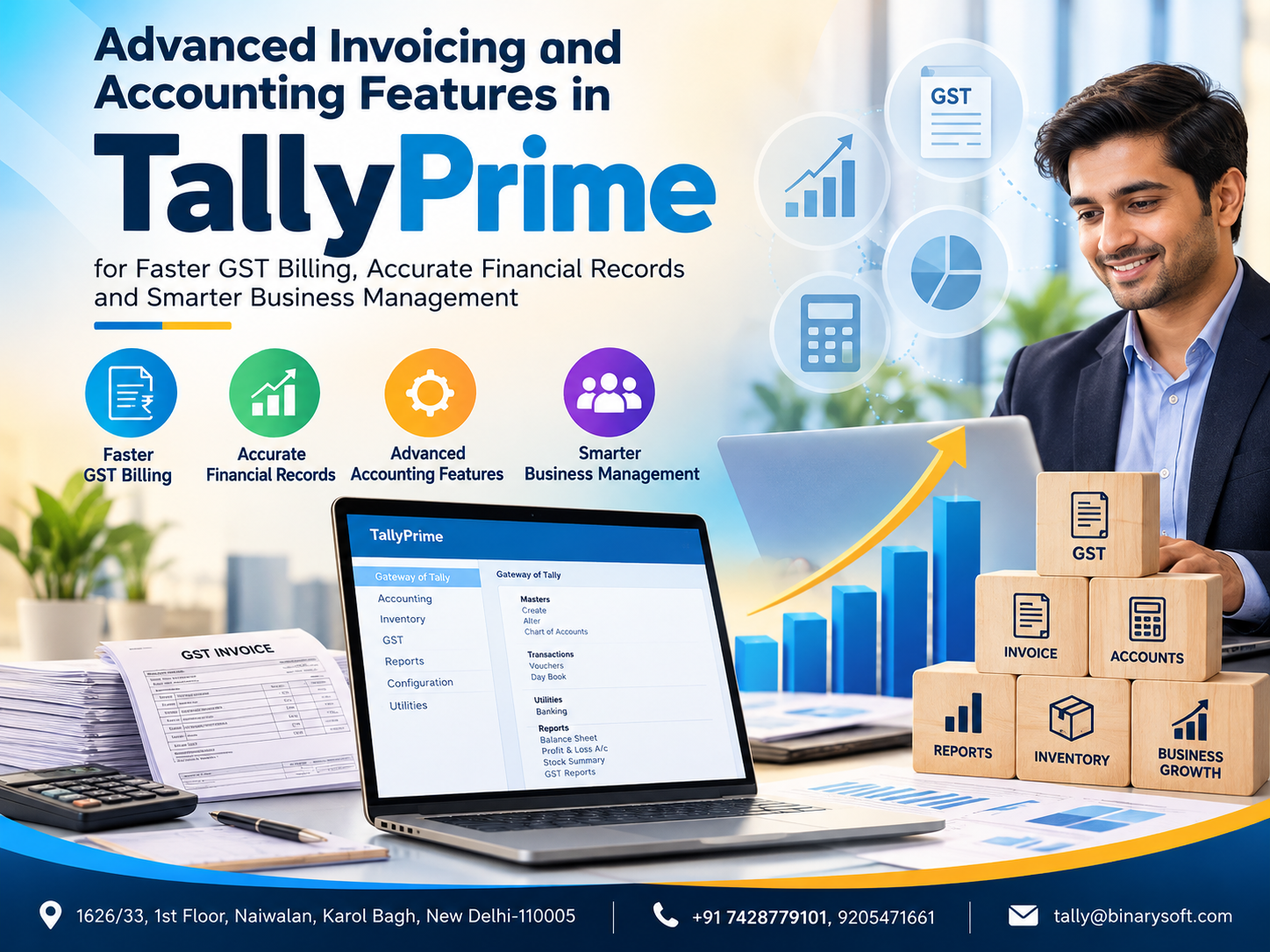
In 2026, Indian businesses are under increasing pressure to generate accurate GST invoices, maintain reliable accounting records, reconcile transactions, and respond quickly to customer and supplier requirements. As transaction volumes grow and digital compliance processes become more important, manual billing systems and disconnected spreadsheets can create costly mistakes. A small error in GST classification, invoice details, or ledger posting may lead to reconciliation difficulties, delayed payments, and additional accounting work. Retailers, wholesalers, manufacturers, distributors, and service providers need an integrated solution that simplifies daily operations without compromising financial accuracy. TallyPrime offers advanced invoicing and accounting capabilities, including customizable invoices, GST calculations, bill-wise tracking, ledger management, banking tools, and financial reporting. By using these features effectively, businesses can reduce repetitive work, improve invoice accuracy, maintain organized financial records, and make better-informed decisions while supporting efficient GST compliance and sustainable business growth.
Understanding Advanced Invoicing and Accounting in TallyPrime
Invoicing and accounting are two essential functions of every business.
Invoicing involves creating bills for goods or services supplied to customers. Accounting involves recording, classifying, and analyzing financial transactions to understand the financial position of the business.
Although these activities are closely connected, many businesses still manage them separately.
For example, a retailer may generate invoices using one application and maintain accounting records in another system. This can create duplicate work, increase the risk of mistakes, and delay financial reporting.
TallyPrime helps businesses manage invoicing and accounting within a connected environment.
When properly configured, sales invoices can update relevant accounting ledgers and inventory records, reducing the need for repeated manual entries.
Why Integrated Invoicing and Accounting Is Important
-
Improves consistency between sales invoices and accounting records.
-
Reduces repetitive transaction entry.
-
Supports accurate GST calculations.
-
Simplifies customer and supplier ledger management.
-
Helps monitor outstanding payments.
-
Improves access to financial reports.
-
Supports inventory-linked billing.
-
Reduces avoidable accounting errors.
-
Improves operational efficiency.
-
Helps business owners make informed financial decisions.
For growing businesses, integrated invoicing and accounting can provide greater control over daily transactions and financial performance.
A Business Story: How One Billing Error Nearly Damaged a Growing Wholesale Business
Consider the fictional story of Sandeep, who runs a wholesale electrical products business in Karol Bagh, New Delhi.
For several years, Sandeep managed his business using basic billing software, spreadsheets, and handwritten payment records.
His company supplied electrical switches, cables, lighting products, and accessories to retailers across Delhi NCR.
As the business expanded, the number of daily invoices increased significantly.
During busy periods, employees generated invoices quickly and updated accounting records later.
Initially, this process seemed manageable.
However, problems gradually began appearing.
Some invoices contained incorrect GST details. Customer payments were occasionally recorded against the wrong invoices. Certain sales returns were not reflected promptly in accounting records.
Sandeep often stayed late at the office trying to reconcile the differences.
The Day Everything Became Difficult
One afternoon, a major customer contacted Sandeep regarding a payment dispute.
The customer's records showed that an invoice had already been settled, but Sandeep's accounting spreadsheet still showed the amount as outstanding.
The customer was frustrated and questioned the reliability of the company's billing process.
At the same time, Sandeep's accountant was preparing GST-related records and discovered several invoices requiring correction.
What should have been a routine accounting review became a stressful investigation.
Sandeep worried that repeated billing mistakes could damage customer relationships and affect future business.
He had worked for years to build trust with his customers.
Now, administrative errors were putting that trust at risk.
The Turning Point: Organizing Invoicing and Accounting with TallyPrime
Sandeep decided to improve his business processes using TallyPrime.
He created structured customer and supplier ledgers, configured GST-related information, standardized invoice formats, and introduced bill-wise payment tracking.
His accounts team began recording transactions directly in the accounting system instead of maintaining disconnected spreadsheets.
They also started reviewing outstanding receivables, bank reconciliation reports, and GST-related information regularly.
Over time, the business experienced fewer avoidable billing discrepancies.
Customer payments became easier to trace against invoices, and financial records were more organized.
Sandeep could review sales, outstanding balances, and financial reports without waiting for multiple spreadsheets to be consolidated.
The biggest change was not simply faster invoice generation.
It was the confidence that his business records were becoming more reliable.
This illustrative example shows how integrated invoicing and accounting practices can help protect customer relationships and support business growth.
1. Advanced GST Invoicing in TallyPrime
GST invoicing is one of the most important accounting activities for registered businesses in India.
A GST invoice must contain the relevant details required under applicable GST rules.
Errors in GSTIN information, tax rates, place of supply, or invoice values can create reconciliation and compliance difficulties.
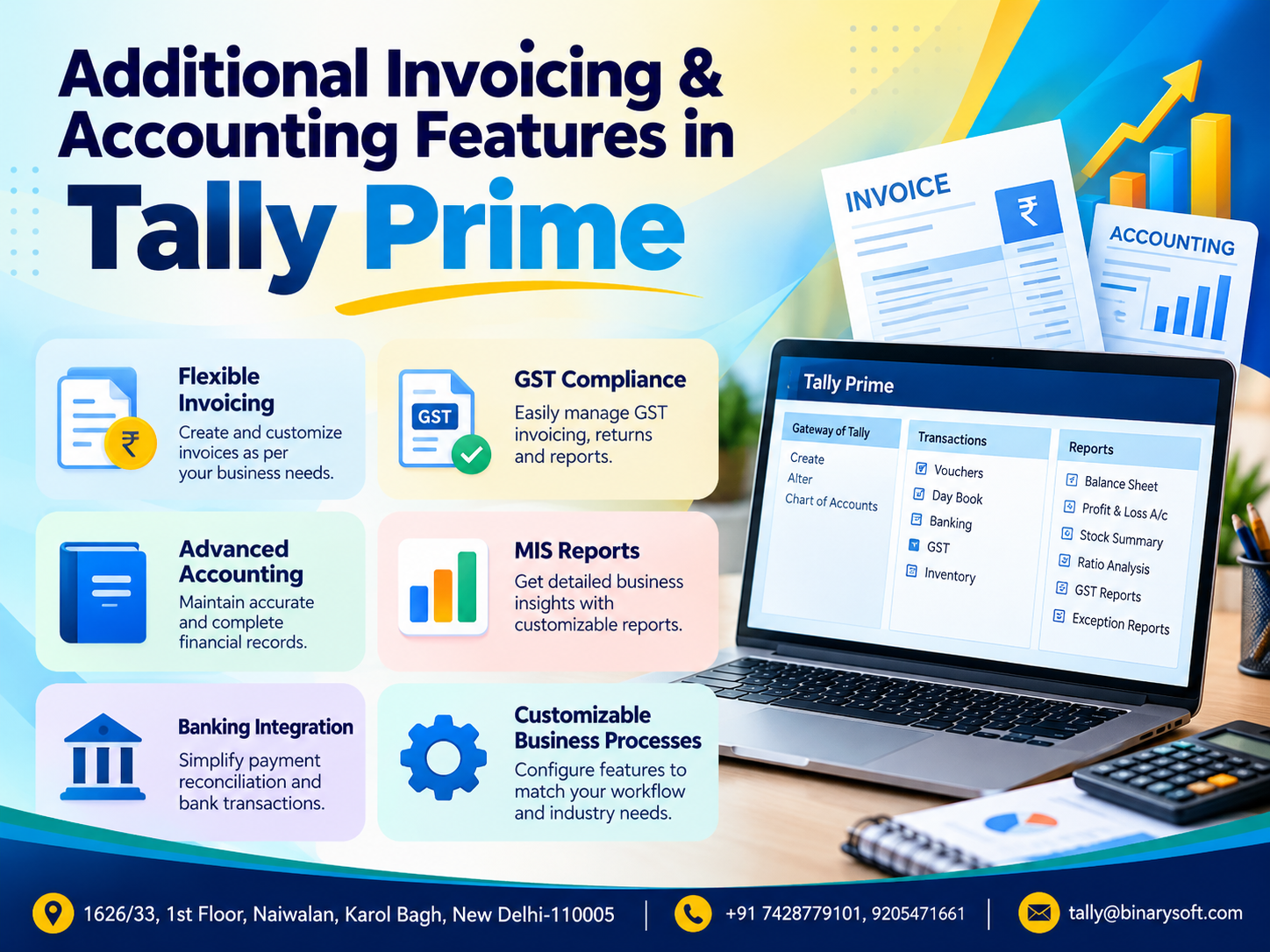
TallyPrime provides GST invoicing capabilities that help businesses maintain tax-related information and calculate applicable taxes.
Important GST Invoicing Features
GSTIN management: Maintain GST registration details for relevant parties and business registrations.
Tax calculation: Calculate CGST, SGST, or IGST based on transaction configuration and applicable tax treatment.
HSN and SAC information: Maintain relevant HSN or SAC details for goods and services.
Place of supply: Record information needed to determine the appropriate GST treatment.
Taxable value calculation: Calculate taxable values and related taxes according to configured transaction details.
GST invoice printing: Generate invoices containing relevant business and tax information.
GST reporting: Use recorded transactions to prepare and review GST-related reports.
Example of GST Invoice Calculation
A business sells goods worth ₹50,000 with an applicable GST rate of 18%.
|
Particulars
|
Amount
|
|---|
|
Taxable value
|
₹50,000
|
|
CGST at 9%
|
₹4,500
|
|
SGST at 9%
|
₹4,500
|
|
Invoice total
|
₹59,000
|
This example assumes an intra-state taxable supply for which CGST and SGST apply.
For an applicable inter-state transaction, IGST may be charged instead.
Correct GST treatment depends on the nature of the supply, place of supply, and current tax rules.
2. Customizable Invoice Formats for Professional Business Billing
Invoices represent more than payment requests.
They also communicate important information about the business.
A well-organized invoice helps customers understand product details, quantities, taxes, payment terms, and total amounts.
TallyPrime provides invoice printing and configuration options that businesses can use to prepare suitable invoice formats.
Common Invoice Customization Requirements
-
Business name and address.
-
GST registration details.
-
Customer billing information.
-
Invoice number and date.
-
Product or service descriptions.
-
Quantity and rate.
-
Discounts.
-
Taxable value.
-
Applicable GST.
-
Payment terms.
-
Bank details.
-
Relevant declarations or additional information.
Available formatting options depend on the software configuration. Highly specialized invoice designs may require additional customization.
Business Benefits
Professional invoices can reduce customer confusion, improve document consistency, and support faster payment processing.
They also help businesses maintain a recognizable and organized billing process.
3. Faster Sales Invoice Generation
Businesses handling large transaction volumes need an efficient invoicing process.
TallyPrime supports sales voucher entry, including accounting and item invoice modes for relevant business requirements.
How Faster Billing Improves Efficiency
A structured billing workflow allows employees to select customers, stock items, quantities, rates, and applicable tax information.
Where masters and configurations are maintained correctly, the software can use existing information to reduce repeated data entry.
This helps businesses:
-
Reduce time spent creating invoices.
-
Maintain consistent product descriptions.
-
Improve transaction recording.
-
Reduce repetitive calculations.
-
Support inventory-linked billing.
-
Improve customer service during busy periods.
For retail and wholesale businesses, faster billing can be especially valuable during seasonal sales and high-demand periods.
4. Multiple Invoice Numbering Methods
Invoice numbering is important for transaction identification, accounting records, and compliance.
TallyPrime supports configurable voucher numbering methods.
Businesses may use appropriate automatic or manual numbering approaches depending on their requirements.
Why Invoice Numbering Matters
A consistent numbering system helps businesses identify transactions, locate invoices, maintain organized records, and support accounting reviews.
Businesses should ensure that GST invoice numbering complies with applicable legal requirements, including relevant uniqueness and series rules.
5. Sales and Purchase Accounting Integration
One of the major advantages of TallyPrime is the connection between invoicing and accounting.
When a business records a sales invoice, relevant accounting entries can be reflected in the appropriate ledgers.
Similarly, purchase transactions can be recorded with supplier details, tax information, and inventory particulars where applicable.
Example of a Credit Sale
A business sells goods worth ₹1,00,000 plus 18% GST to a customer on credit.
The accounting entry, assuming intra-state GST, may be represented as:
|
Ledger
|
Debit
|
Credit
|
|---|
|
Customer Account
|
₹1,18,000
|
|
|
Sales Account
|
|
₹1,00,000
|
|
Output CGST
|
|
₹9,000
|
|
Output SGST
|
|
₹9,000
|
|
Total
|
₹1,18,000
|
₹1,18,000
|
The exact accounting treatment depends on the nature of the transaction and configuration.
This integrated approach helps reduce the need to enter the same sales transaction separately into accounting records.
6. Bill-Wise Outstanding Management
Customer payment tracking is essential for businesses that sell products or services on credit.
TallyPrime supports bill-wise accounting, allowing businesses to maintain invoice-level outstanding balances.
Key Capabilities
-
Track unpaid customer invoices.
-
Record partial payments.
-
Adjust receipts against outstanding bills.
-
Maintain advance payment references.
-
Review invoice-wise balances.
-
Monitor supplier outstanding invoices.
-
Support account reconciliation.
Practical Example
A distributor raises an invoice of ₹80,000.
The customer pays ₹50,000 after 15 days.
The remaining outstanding amount is ₹30,000.
With bill-wise accounting, the business can track the unpaid balance against the original invoice.
This helps accounts teams conduct more accurate payment follow-ups.
7. Customer and Supplier Ledger Management
Ledgers form the foundation of business accounting.
TallyPrime allows businesses to maintain separate ledgers for customers, suppliers, expenses, income, assets, and liabilities.
Customer Ledger Management
Customer ledgers help businesses review sales transactions, receipts, outstanding balances, and account activity.
Supplier Ledger Management
Supplier ledgers help businesses review purchases, payments, outstanding obligations, and relevant adjustments.
Benefits of Organized Ledgers
-
Better transaction classification.
-
Easier customer account review.
-
Improved supplier reconciliation.
-
More reliable outstanding reports.
-
Faster identification of accounting differences.
-
Better financial reporting.
Accurate ledger masters are particularly important for businesses handling many customers and suppliers.
8. Credit Note and Debit Note Management
Sales returns, purchase returns, and certain pricing adjustments can affect invoice values and outstanding balances.
TallyPrime provides credit note and debit note voucher capabilities for recording applicable transactions.
Credit Note Applications
Credit notes may be used for eligible sales returns, reductions in invoice values, and other applicable adjustments.
Debit Note Applications
Debit notes may be used for eligible purchase returns and other relevant accounting adjustments.
Business Advantages
Properly recorded credit and debit notes help businesses maintain accurate customer and supplier balances.
They also support clearer documentation of commercial adjustments.
GST treatment and reporting must follow applicable rules.
9. Discount Management in Sales Invoices
Discounts are commonly used in retail, wholesale, and distribution businesses.
Businesses may provide trade discounts, promotional discounts, or other price reductions.
TallyPrime supports discount-related invoice entry and calculations through appropriate configuration.
Example
Product value: ₹20,000
Trade discount: 10%
Discount amount: ₹2,000
Taxable value after eligible discount: ₹18,000
GST at 18%: ₹3,240
Final invoice value: ₹21,240
The example assumes the discount qualifies for reduction from taxable value under applicable GST rules.
Benefits
-
Consistent discount calculations.
-
Better invoice transparency.
-
Reduced manual calculation errors.
-
Easier promotional billing.
-
Improved pricing accuracy.
10. Inventory-Linked Invoicing
Businesses selling physical goods need accurate stock records alongside their billing operations.
TallyPrime supports inventory-linked invoicing that can update relevant stock quantities when applicable transactions are recorded.
Example
Opening stock: 500 units
Sales quantity: 120 units
Closing stock: 380 units
Assuming no other stock movements, the recorded sale reduces available inventory by 120 units.
Benefits of Inventory-Linked Billing
-
Improved coordination between billing and stock records.
-
Reduced duplicate entry.
-
Better stock quantity visibility.
-
Easier product-wise sales analysis.
-
More organized inventory accounting.
-
Improved purchasing decisions.
Accurate inventory balances still depend on proper transaction recording and physical stock verification.
11. Multi-GSTIN Accounting for Businesses with Multiple Registrations
Businesses operating across multiple states may have multiple GST registrations.
TallyPrime supports multi-GSTIN capabilities in supported releases and configurations.
These features can help businesses maintain relevant GST registration information and manage transactions associated with different registrations.
Potential Advantages
-
Better organization of GST registration details.
-
Support for registration-specific transaction recording.
-
Improved GST-related reporting.
-
Reduced dependence on separate manual records.
-
More consistent tax-related accounting processes.
Businesses should verify that their TallyPrime release and setup support the specific multi-GSTIN workflows they require.
12. E-Invoicing Integration in TallyPrime
E-invoicing is an important compliance requirement for businesses covered by the applicable GST rules.
Under the e-invoicing framework, eligible invoices are reported to the Invoice Registration Portal for generation of an Invoice Reference Number and related information.
TallyPrime provides e-invoicing-related capabilities for supported configurations.
Important E-Invoicing Functions
-
Preparation of eligible invoice information.
-
Support for e-invoice generation workflows.
-
Recording or retrieving relevant IRN information through supported services.
-
Inclusion of required e-invoice details in applicable invoice outputs.
-
Support for relevant cancellation and status workflows.
The availability of direct connected services depends on the software release, subscription, connectivity, and applicable setup.
Why E-Invoicing Matters
E-invoicing helps standardize eligible invoice reporting and supports GST-related compliance processes.
Businesses should verify current applicability thresholds and reporting requirements before relying on any specific compliance workflow.
13. E-Way Bill Management
Businesses transporting goods may need to generate e-way bills depending on the transaction and applicable legal requirements.
TallyPrime supports e-way bill-related information and workflows.
Benefits
-
Maintain relevant transport details.
-
Support e-way bill preparation.
-
Reduce repeated entry of invoice information.
-
Improve coordination between billing and dispatch.
-
Support applicable GST documentation requirements.
E-way bill applicability depends on factors such as consignment value, movement type, exemptions, and relevant rules.
14. Bank Reconciliation for Accurate Financial Records
Bank reconciliation helps businesses compare accounting records with bank statements.
Differences may arise because of bank charges, interest entries, uncleared payments, or missing transactions.
TallyPrime supports bank reconciliation capabilities, including additional banking features in supported releases.
Why Bank Reconciliation Is Important
-
Helps identify missing entries.
-
Supports accurate bank ledger balances.
-
Reduces accounting discrepancies.
-
Improves cash visibility.
-
Supports financial reporting.
-
Makes transaction verification easier.
Example
Bank ledger balance: ₹4,80,000
Bank statement balance: ₹4,65,000
Difference: ₹15,000
The difference may result from an uncleared payment or another timing-related transaction.
Bank reconciliation helps identify the cause rather than assuming either balance is incorrect.
15. Payment and Receipt Voucher Management
Businesses record many financial transactions beyond sales and purchases.
These include customer receipts, supplier payments, expenses, transfers, and adjustments.
TallyPrime provides different voucher types for relevant accounting activities.
|
Voucher type
|
Common purpose
|
|---|
|
Sales
|
Record sales transactions
|
|
Purchase
|
Record purchase transactions
|
|
Receipt
|
Record money received
|
|
Payment
|
Record money paid
|
|
Contra
|
Record applicable cash and bank transfers
|
|
Journal
|
Record appropriate accounting adjustments
|
|
Credit Note
|
Record applicable credit adjustments
|
|
Debit Note
|
Record applicable debit adjustments
|
Using appropriate voucher types helps maintain organized accounting records.
16. Financial Reporting in TallyPrime
Financial reports help business owners understand performance, profitability, and financial position.
TallyPrime provides accounting reports based on recorded transactions.
Balance Sheet
The Balance Sheet presents assets, liabilities, and capital at a particular date.
It helps management understand the financial position of the business.
Profit & Loss Account
The Profit & Loss Account provides information about income, expenses, and profitability over a selected period.
Cash Flow Report
Cash flow reporting helps businesses review cash inflows and outflows.
Trial Balance
The Trial Balance provides ledger balances and supports accounting review.
Outstanding Reports
Receivables and payables reports help businesses monitor amounts due from customers and owed to suppliers.
Ledger Reports
Ledger reports allow detailed examination of transactions recorded against individual accounts.
These reports provide useful information for financial planning and accounting verification.
17. Cost Centre Accounting for Department-Wise Financial Control
Businesses with multiple departments, branches, or projects often need to allocate income and expenses.
TallyPrime supports cost centre accounting.
Example
A company operates three departments:
-
Sales.
-
Administration.
-
Marketing.
By allocating relevant expenses to cost centres, management can review department-wise spending.
Benefits
-
Improved expense allocation.
-
Better departmental reporting.
-
More organized project-related accounting.
-
Easier cost analysis.
-
Better financial accountability.
Cost centre reporting can support business decisions when transactions are allocated consistently.
18. Budgeting and Expense Monitoring
Budgeting helps businesses plan spending and evaluate financial performance.
TallyPrime provides budgeting capabilities that allow businesses to compare defined budgets with actual accounting amounts.
Example
Monthly office expense budget: ₹75,000
Actual office expenses: ₹90,000
Budget variance: ₹15,000 unfavorable.
Management can investigate the difference and determine whether corrective action is required.
Benefits
-
Better expense control.
-
Improved financial planning.
-
Early identification of overspending.
-
More informed resource allocation.
-
Greater management accountability.
19. GST Return Preparation and Reconciliation
Accurate GST accounting requires businesses to review transaction classifications, tax amounts, and relevant return information.
TallyPrime provides GST reports and, in supported releases, connected GST-related functionality.
Common GST Accounting Activities
-
Reviewing sales transactions for GSTR-1.
-
Reviewing purchase-related GST information.
-
Checking tax classifications.
-
Identifying transaction exceptions.
-
Reviewing relevant GST return information.
-
Reconciling applicable purchase data.
-
Preparing information for return filing.
Connected GST services and direct filing or download features depend on the release, configuration, and supported service availability.
Businesses should always verify return data before filing and comply with current GST rules.
20. Data Security and User Access Control
Financial records contain sensitive business information.
Unauthorized changes or accidental deletion of accounting data can create serious problems.
TallyPrime provides security and user access features that help businesses manage access to company data.
Important Security Practices
-
Configure appropriate user access rights.
-
Use strong authentication credentials.
-
Restrict sensitive accounting activities.
-
Maintain regular backups.
-
Review changes and transactions.
-
Keep software updated.
-
Establish clear responsibilities for accounting staff.
Security features should be combined with suitable organizational controls and backup procedures.
21. Remote Access and Connected Business Operations
Businesses increasingly need access to accounting information from different locations.
TallyPrime offers remote-access and connected capabilities, subject to applicable product services, licensing, and configuration.
For example, an authorized business owner may need to review financial information while travelling.
Remote capabilities can support such requirements where the necessary setup is available.
Businesses should distinguish TallyPrime's supported remote-access services from full cloud hosting, which may involve additional infrastructure or third-party services.
22. How TallyPrime Helps Reduce Manual Accounting Errors
Manual accounting errors can arise from repeated data entry, incorrect calculations, missing vouchers, and inconsistent ledger information.
TallyPrime helps reduce some of these risks through structured transaction entry and integrated reporting.
Common Areas of Improvement
Tax calculations: Properly configured tax information can reduce repetitive manual calculations.
Ledger posting: Transactions can update relevant accounting records.
Invoice consistency: Standardized invoice formats reduce formatting variations.
Outstanding tracking: Bill-wise accounting improves payment allocation visibility.
Inventory accounting: Stock-linked transactions reduce disconnected records.
Financial reporting: Reports are generated from recorded accounting information.
However, software cannot automatically correct every incorrect entry.
Accurate master data, staff training, and regular review remain essential.
23. Industry-Wise Benefits of TallyPrime Invoicing and Accounting
Retail Businesses
Retailers can use TallyPrime for GST billing, product-wise sales recording, inventory accounting, and financial reporting.
Wholesale Traders
Wholesalers can manage credit invoices, customer outstanding balances, purchase accounting, and supplier payments.
Manufacturing Businesses
Manufacturers can connect relevant sales and purchase transactions with inventory and accounting records.
FMCG Distributors
Distributors can monitor customer invoices, product sales, outstanding receivables, and warehouse-related transactions.
Service Providers
Professional service businesses can maintain service invoices, customer ledgers, expenses, and financial reports.
Construction and Project-Based Businesses
Project-based organizations can use cost centres and accounting reports to review relevant income and expenses.
E-Commerce Businesses
Online sellers can use TallyPrime to maintain accounting records for sales, returns, expenses, taxes, and settlements, with suitable integrations or import processes where required.
24. Common Invoicing and Accounting Mistakes Businesses Should Avoid
Even businesses using accounting software can experience problems if financial processes are poorly managed.
Common mistakes include:
-
Entering incorrect GSTIN details.
-
Using unsuitable GST rates or classifications.
-
Creating duplicate customer ledgers.
-
Failing to adjust receipts against outstanding invoices.
-
Recording sales returns incorrectly.
-
Ignoring bank reconciliation.
-
Using inconsistent invoice numbering.
-
Delaying accounting entries.
-
Failing to verify opening balances.
-
Not reviewing outstanding receivables.
-
Ignoring supplier payment obligations.
-
Maintaining inaccurate stock records.
-
Failing to back up accounting data.
-
Granting unnecessary user permissions.
-
Reviewing financial reports only at year-end.
Avoiding these mistakes can improve the reliability of financial records.
25. Practical Steps to Improve Invoicing and Accounting with TallyPrime
Businesses can follow a structured approach to improve daily accounting operations.
Step 1: Configure company information. Maintain correct business details, accounting periods, and applicable registrations.
Step 2: Create accurate ledgers. Organize customers, suppliers, income, expenses, assets, and liabilities.
Step 3: Configure GST details. Maintain relevant tax classifications, rates, and transaction settings.
Step 4: Set up invoice formats. Configure suitable invoice printing and numbering options.
Step 5: Enable bill-wise accounting. Track invoices, advances, receipts, and outstanding balances.
Step 6: Integrate inventory where required. Maintain stock items and inventory-related sales transactions.
Step 7: Record transactions promptly. Avoid unnecessary delays in accounting entry.
Step 8: Reconcile bank transactions. Compare bank records with accounting entries regularly.
Step 9: Review GST-related reports. Investigate exceptions before preparing returns.
Step 10: Analyze financial reports. Review profitability, outstanding balances, cash flow, and expenses.
Step 11: Maintain backups and access controls. Protect financial information against accidental loss or unauthorized changes.
Step 12: Train accounting staff. Ensure employees understand the appropriate transaction workflows.
26. Why TallyPrime Is Valuable for Small and Medium Enterprises
Small and medium enterprises often operate with limited accounting resources.
They need software that supports daily transactions without creating unnecessary administrative complexity.
TallyPrime provides an integrated environment for many common accounting and invoicing activities.
Key Business Advantages
-
Faster invoice preparation.
-
More organized GST accounting.
-
Improved customer and supplier records.
-
Better outstanding payment visibility.
-
Reduced repetitive data entry.
-
Inventory-linked billing.
-
More accessible financial reports.
-
Better bank reconciliation processes.
-
Improved accounting consistency.
-
Greater financial transparency.
The benefits depend on appropriate configuration, accurate data, and regular financial review.
27. The Future of Digital Invoicing and Accounting in India
As businesses continue modernizing their operations in 2026, digital invoicing and accounting are becoming increasingly important.
Organizations need reliable records, efficient transaction processing, and timely financial information.
GST compliance, e-invoicing requirements, customer payment tracking, and connected banking workflows are encouraging businesses to adopt more structured accounting systems.
TallyPrime provides features that can support these requirements while maintaining a connection between daily business transactions and financial reporting.
For growing businesses, the objective should be to create an accounting process that is accurate, efficient, and scalable.
This requires more than software installation.
Businesses must establish consistent accounting policies, train employees, maintain reliable master data, and review financial information regularly.
When these practices are combined with appropriate TallyPrime features, organizations can improve financial control and support long-term growth.
Conclusion
Advanced invoicing and accounting capabilities are essential for businesses seeking faster billing, accurate financial records, and efficient daily operations.
In 2026, growing transaction volumes, GST-related requirements, customer expectations, and the need for timely financial information make integrated accounting systems increasingly valuable.
TallyPrime offers practical features for GST invoicing, invoice customization, bill-wise outstanding tracking, ledger management, banking, inventory-linked billing, e-invoicing workflows, and financial reporting.
By using these capabilities effectively, businesses can reduce repetitive work, improve transaction accuracy, maintain organized records, and make more informed financial decisions.
Retailers, wholesalers, manufacturers, distributors, and service providers can all benefit from structured invoicing and accounting practices.
TallyPrime helps businesses move beyond routine billing toward better financial visibility, stronger accounting control, and smarter business management.
Powered by Binarysoft Technologies
Authorized Tally Partner
Binarysoft Technologies provides TallyPrime-related assistance for businesses seeking improved invoicing, GST billing, accounting management, inventory control, and financial reporting.
Businesses looking to implement TallyPrime, organize accounting records, configure GST invoicing, or improve daily billing processes can contact Binarysoft Technologies for assistance.
Location: 1626/33, 1st Floor, Naiwalan, Karol Bagh, New Delhi – 110005, INDIA
Contact Us: +91 7428779101, 9205471661
Email Us: tally@binarysoft.com
Business Hours: 10:00 AM – 6:00 PM, Monday to Friday
Frequently Asked Questions
What are the advanced invoicing features available in TallyPrime?
TallyPrime provides GST invoicing, configurable invoice formats, voucher numbering options, discounts, inventory-linked billing, bill-wise tracking, and relevant e-invoicing capabilities in supported configurations.
How does TallyPrime simplify GST billing?
TallyPrime allows businesses to maintain GST-related information and calculate applicable taxes based on configured transaction details. It also provides GST reports that support accounting review and compliance preparation.
CA. Raghav Mundhra focuses on business accounting, GST reporting, and financial reconciliations. He works with organizations to strengthen accounting processes and maintain reliable financial information for compliance and decision-making.