Call CA Tally HelpDesk
+91 9205471661,
7428779101
Amazon Accounting Is Becoming More Data-Heavy in 2026
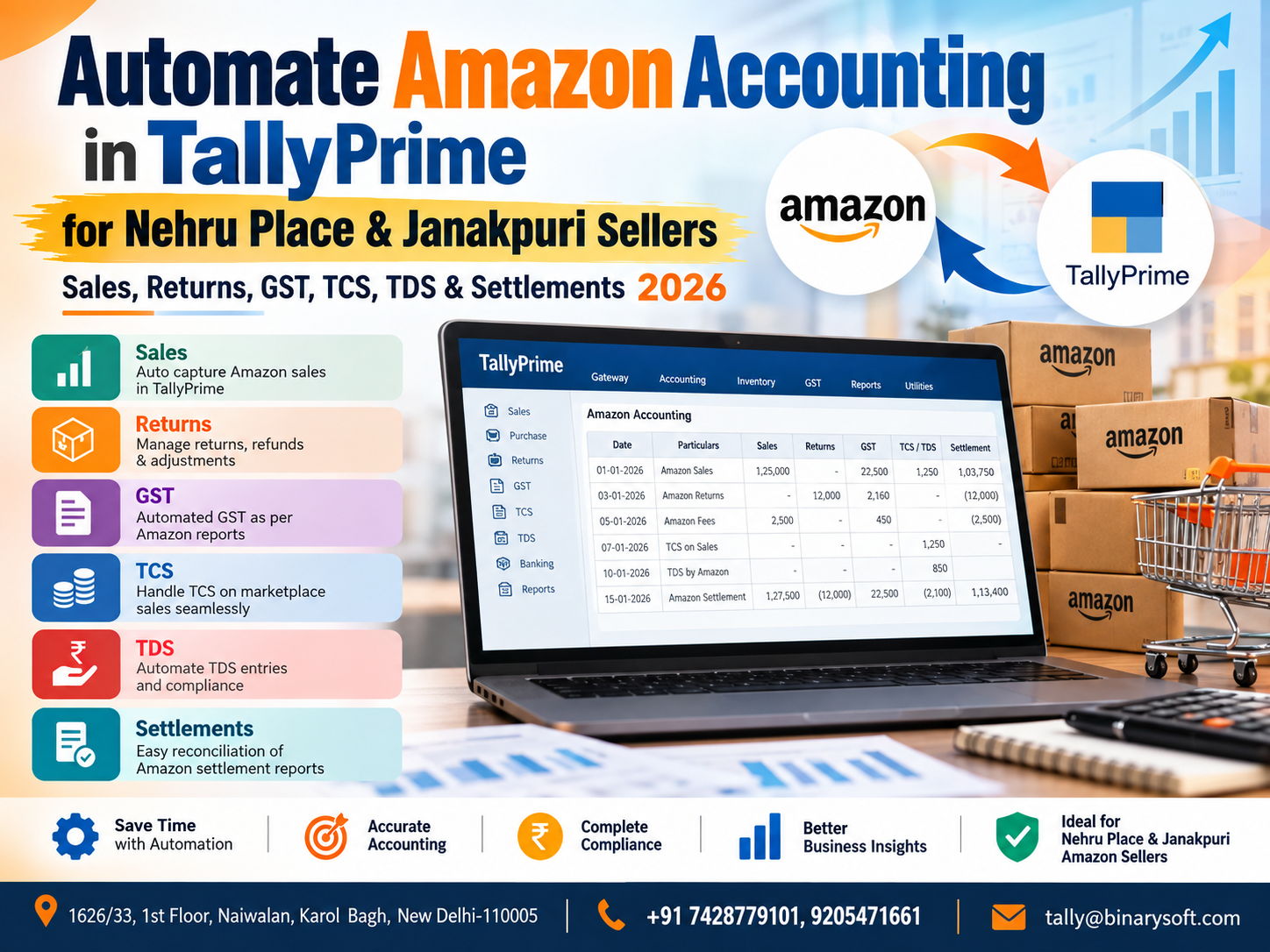
In 2026, Amazon sellers in Nehru Place and Janakpuri are dealing with an accounting challenge that grows with every order: sales, cancellations, returns, marketplace fees, GST, TCS, TDS, reimbursements and settlement deductions can all appear in different reports before the final amount reaches the bank. The pressure becomes serious when hundreds or thousands of transactions must be manually recreated in TallyPrime and reconciled before GST filing or month-end closure. A healthy Amazon sales figure does not necessarily mean the bank settlement will equal invoice value, making accurate reconciliation essential. A structured Amazon-to-TallyPrime accounting workflow can reduce repetitive voucher entry, organize sales and return data, account for marketplace deductions and connect settlement information with the books. For Nehru Place electronics sellers, Janakpuri retailers and growing Delhi e-commerce businesses, automation can mean faster accounting, clearer receivables, better GST visibility and significantly easier settlement reconciliation.
Why Amazon Accounting Is More Complicated Than Normal Sales Accounting
Traditional offline accounting can be comparatively straightforward.
A customer purchases a product.
The seller raises an invoice.
The customer pays.
The money reaches cash or bank.
Amazon transactions can involve several additional layers between the customer order and the final bank settlement.
An Amazon seller may need to account for:
Product sales
B2B invoices
B2C invoices
Inter-state sales
Intra-state sales
GST
Sales returns
Order cancellations
Refunds
Marketplace fees
Shipping-related charges
Other service charges
GST on marketplace services
TCS under applicable GST provisions
TDS under applicable income-tax provisions
Reimbursements
Adjustments
Settlement receivables
Bank receipts
This is why simply recording the amount received in the bank is not sufficient for accurate marketplace accounting.
The ₹12 Lakh Sales Month That Felt Like a Loss
Consider a fictional electronics seller operating from Nehru Place.
The business sold computer accessories, networking equipment, storage devices and electronic peripherals through Amazon.
One month, the seller's dashboard showed sales of approximately ₹12 lakh.
The owner was delighted.
He called his accounts manager and said, “This has been our best online month. We should have a very strong bank balance.”
The accountant remained quiet.
The actual settlements reaching the bank appeared much lower.
The owner immediately became worried.
“Where has the money gone?”
For several hours, the team compared bank entries with Amazon sales reports.
Then they discovered the problem was not one mysterious deduction.
It was the accounting process itself.
Sales were being looked at separately from returns.
Marketplace charges were sitting in another report.
Tax deductions were being reviewed separately.
Refunds belonged to different settlement cycles.
Some transactions from the last days of the month had not yet been settled.
The ₹12 lakh sales figure was real, but it was never supposed to equal the amount deposited directly into the bank.
The team spent days manually reconciling spreadsheets.
Eventually, the owner realized that the problem was not Amazon.
The problem was trying to manage a marketplace business with an accounting workflow designed for simple counter sales.
They reorganized the process around structured Amazon reports, TallyPrime accounting and settlement-wise reconciliation.
The emotional change was immediate.
Instead of asking, “Where did my money go?” every month, the owner could ask a much more useful question:
“What explains the difference between my gross sales and my net settlement?”
That is the question good Amazon accounting should answer.
What Is Amazon Accounting in TallyPrime?
Amazon accounting in TallyPrime involves systematically recording and reconciling the financial components generated by marketplace transactions.
Depending on the seller's business model, this may include:
Amazon sales invoices
GST liability
Customer returns
Credit notes
Amazon fees
GST on Amazon fees
TCS
TDS
Refunds
Other deductions
Reimbursements
Settlement receivables
Bank receipts
The objective is not merely to record sales.
The objective is to make the accounting books explain how a sale eventually becomes a bank settlement.
Why Nehru Place Amazon Sellers Need Automation
Nehru Place businesses often deal in:
Computers
Laptops
Computer accessories
Networking products
Storage devices
Printers
Electronic equipment
IT peripherals
Software-related products
Office technology
Many sellers have expanded from traditional wholesale or retail operations into marketplace selling.
This creates a hybrid accounting environment.
The same stock may be sold:
At the physical shop
To wholesale customers
Through a website
Through Amazon
Through other marketplaces
Without proper accounting classification, management may struggle to understand channel-wise sales, inventory and receivables.
Amazon accounting automation can reduce the manual workload associated with high transaction volumes.
Why Janakpuri Online Sellers Need Better Reconciliation
Janakpuri has a broad mix of retailers, distributors, service providers and home-grown businesses.
For sellers who have expanded online, the challenge often appears after order volume starts increasing.
Twenty marketplace transactions are manageable manually.
Two hundred become tedious.
Two thousand can become a serious accounting burden.
As volume increases, businesses need repeatable processes rather than relying on manual Excel calculations every month.
Amazon Order Value Is Not the Same as Settlement Value
This is one of the most important concepts for marketplace sellers.
Suppose a product is sold for an invoice value of ₹10,000.
It does not necessarily mean ₹10,000 will appear as the corresponding bank receipt.
The settlement may be affected by applicable components such as:
Marketplace fees
Shipping or fulfilment charges
GST on marketplace services
TCS
TDS
Refunds
Returns
Previous adjustments
Reimbursements
Other applicable charges
Therefore:
Gross Sales ≠ Net Bank Settlement
Accounting must explain the difference.
The Three-Way Reconciliation Approach
A strong marketplace accounting system should ideally allow the business to connect three important records:
Amazon transaction and settlement data
TallyPrime accounting records
Bank statement
If Amazon shows a settlement, the books should explain it.
If TallyPrime shows an Amazon receivable, marketplace records should support it.
If the bank shows a receipt, the settlement report should explain its composition.
This three-way reconciliation is one of the foundations of controlled Amazon accounting.
Step 1: Collect the Relevant Amazon Reports
Before automating anything, determine which source reports are required for your accounting workflow.
Depending on the seller account and reporting requirements, relevant information may include:
Order data
Tax invoice information
Returns
Refunds
Settlement information
Fee information
TCS information
TDS information
Reimbursements
Other adjustments
Do not build an automated workflow around a single report unless that report contains everything required for your accounting objective.
Step 2: Standardize the Source Data
Marketplace exports can contain many columns.
Accounting may require only a defined subset.
A structured data-preparation process can identify fields such as:
Order ID
Invoice number
Invoice date
SKU
Product description
Quantity
Taxable value
GST rate
CGST
SGST
IGST
Invoice total
Customer state
Place of supply
Return reference
Settlement ID
Fee type
Fee amount
Tax on fee
TCS
TDS
Net settlement amount
The exact structure should match the accounting design.
Step 3: Map Amazon SKUs with TallyPrime Stock Items
SKU mapping is particularly important for inventory-based sellers.
Amazon may identify a product using an SKU such as:
USBHUB-7P-BLK
TallyPrime may contain:
7 Port USB Hub Black
Both descriptions may represent the same item.
Without mapping, automated processes may fail or create inconsistent stock masters.
Create a controlled SKU-to-stock-item mapping.
For example:
Amazon SKU: SSD-1TB-NVME
TallyPrime Stock Item: 1TB NVMe SSD
This mapping should remain consistent across future imports.
Step 4: Configure Sales Ledgers Properly
Depending on the business and reporting structure, sellers may use suitable sales ledgers for different tax or transaction categories.
The configuration should reflect the seller's accounting and GST requirements.
Avoid creating unnecessary ledgers simply because the marketplace report contains many transaction descriptions.
The accounting structure should remain understandable.
Step 5: Handle B2B and B2C Sales Correctly
Amazon sellers can have both business and consumer transactions.
B2B transactions may require customer GSTIN and other tax information.
B2C transactions may follow a different reporting structure.
The source data should therefore allow the workflow to identify transaction categories correctly.
Incorrect classification can create GST reconciliation problems.
Step 6: Handle Intra-State and Inter-State GST
Place of supply and transaction location can affect whether the transaction involves:
CGST and SGST
or
IGST
The import workflow must not simply assign taxes based on a guess.
State information, place of supply and GST configuration should be properly validated.
Businesses should confirm transaction-specific GST treatment with their tax professional.
Step 7: Import Sales into TallyPrime
Once data has been cleaned and mapped, sales transactions can be prepared for import into TallyPrime through an appropriate supported or customized workflow.
Before processing the full dataset, use sample transactions.
Test different scenarios:
B2B sale
B2C sale
Intra-state sale
Inter-state sale
Multiple GST rates
Discount
Multiple-item invoice
Verify the resulting vouchers before increasing the import volume.
Step 8: Account for Amazon Returns
Returns are one of the biggest reasons marketplace accounting becomes confusing.
A sale may occur in one period while the return or refund occurs later.
For example:
Sale date: 28 September
Return initiated: 4 October
Refund processed: 7 October
Settlement adjustment: 10 October
If accounting is reviewed only by order date, the transaction may appear inconsistent.
A proper workflow should preserve the relationship between the original sale, return, refund and settlement adjustment wherever possible.
Sales Returns and Credit Notes
Where applicable, returned sales may need to be accounted for through the appropriate credit-note or sales-return process.
The transaction should correctly reflect relevant aspects such as:
Customer impact
Sales reversal
GST adjustment
Stock movement
Settlement impact
The exact treatment depends on the transaction and applicable accounting and tax requirements.
Step 9: Account for Marketplace Fees
Amazon may charge different types of fees depending on the seller's services and fulfilment arrangements.
These can include marketplace or service-related charges.
From an accounting perspective, these charges should not disappear inside a net settlement entry.
If the business records only the amount received in the bank, management loses visibility into the cost of selling through the marketplace.
Proper fee accounting helps answer:
How much did we sell?
How much did Amazon-related services cost?
What was the net contribution after marketplace expenses?
GST on Amazon Fees
Where Amazon service invoices contain GST and the seller is eligible to claim input tax credit subject to applicable rules, the underlying documentation and accounting treatment need to be properly maintained.
Do not simply treat the entire settlement deduction as one expense without reviewing its components.
Tax treatment should be confirmed with the business's GST professional.
Step 10: Account for GST TCS
Marketplace transactions can involve tax collected at source under applicable GST provisions.
This amount may affect the seller's receivable and reconciliation.
TCS should be accounted for separately rather than being treated as an unexplained shortage in the settlement.
Maintaining an appropriate TCS ledger can make reconciliation easier.
The applicable rate and compliance treatment should always be checked against current law and the seller's circumstances.
Step 11: Account for TDS
Certain e-commerce transactions may also involve TDS under applicable income-tax provisions.
Again, this should not simply be treated as a marketplace expense.
TDS represents a tax deduction that may need to be tracked appropriately for tax credit and reconciliation.
Maintain suitable records so that deductions can later be compared with applicable tax information and statements.
TCS and TDS Are Not Marketplace Fees
This distinction is critical.
Marketplace fees represent the cost of marketplace-related services.
TCS and TDS are tax-related deductions or collections governed by applicable law.
Mixing all three into one “Amazon Charges” ledger makes financial analysis and tax reconciliation unnecessarily difficult.
Use separate accounting classifications where appropriate.
Step 12: Create an Amazon Settlement Receivable Structure
One useful accounting concept is to treat Amazon as a settlement intermediary or receivable account according to the business's accounting design.
Conceptually, sales create an amount receivable through the marketplace.
Subsequent fees, refunds, TCS, TDS and adjustments change that receivable.
The final settlement clears part or all of the amount when money reaches the bank.
This approach can make the movement of money easier to understand.
The precise voucher structure should be designed by an accounting professional according to the seller's requirements.
Step 13: Match Settlement IDs
Settlement IDs can become valuable reconciliation references.
For every settlement, maintain relevant information such as:
Settlement ID
Settlement period
Opening balance if applicable
Sales included
Refunds
Fees
Taxes
Adjustments
Net settlement
Bank receipt date
This creates a traceable path between marketplace reports and bank entries.
Step 14: Match Amazon Settlement with Bank Receipt
When money reaches the bank, the accounts team should match the amount against the relevant marketplace settlement.
Check:
Settlement amount
Bank receipt
Settlement ID
Bank date
Unsettled balance
Previous adjustments
If the amount does not match, investigate before forcing the reconciliation.
Why You Should Not Book Amazon Sales from Bank Receipts
A common accounting mistake is:
Bank received ₹80,000.
Therefore, record sales of ₹80,000.
This can be incorrect.
The actual gross sales associated with that settlement could be much higher, with the difference consisting of returns, marketplace fees, taxes and other adjustments.
Sales should be recorded from appropriate transaction information.
Bank receipts should be reconciled against settlements.
These are different accounting events.
Amazon Returns and Inventory
Returns also affect inventory.
If a customer returns a product, several outcomes are possible depending on its condition and fulfilment process.
The product may:
Return to saleable inventory
Become damaged inventory
Be lost in transit
Be reimbursed
Remain under investigation
Therefore, sellers should not automatically assume that every financial refund means the stock is immediately available for resale.
Financial reconciliation and inventory reconciliation should work together.
Inventory Reconciliation for Nehru Place Electronics Sellers
Inventory accuracy is especially important for electronics sellers.
Products may have:
Different models
Storage capacities
Colours
Serial numbers
Configurations
Warranty differences
Variants
A mapping error between Amazon SKU and TallyPrime stock item can create serious stock discrepancies.
For example:
Amazon SKU: ROUTER-AX3000-V2
TallyPrime item: AX3000 Router
If another version also exists, incorrect mapping could combine two distinct products.
Master-data discipline is therefore essential.
Automating High-Volume Sales
Suppose a seller generates 3,000 Amazon invoices per month.
If manual accounting takes even 90 seconds per invoice, the basic entry work could require approximately 75 hours.
And that excludes:
Returns
Fee accounting
Settlement reconciliation
GST review
TCS reconciliation
TDS reconciliation
A structured import workflow can reduce much of this repetitive entry.
The accounts team can then focus on exceptions.
Exception-Based Accounting
A scalable automation model should aim for:
Routine transactions processed systematically.
Exceptions reviewed manually.
Exceptions may include:
Missing GSTIN
Unknown SKU
Unexpected GST rate
Duplicate invoice
Negative settlement
Unmapped fee
Unmatched return
Settlement difference
Missing bank receipt
This is more efficient than manually checking every routine transaction with equal effort.
Avoid Duplicate Amazon Imports
Duplicate imports can create major accounting errors.
Maintain an import control register.
It can include:
Report name
Period
File name
Import date
Number of records
Sales total
Imported by
Validation status
Also use unique transaction references wherever the selected workflow supports them.
Always Back Up Before Bulk Processing
Before importing large Amazon datasets into important company accounts, take a verified backup.
A safe workflow is:
Backup.
Test.
Import.
Validate.
Reconcile.
Finalize.
Never treat a successful import message as proof that the accounting result is correct.
Post-Import Validation
After processing Amazon transactions, compare important control totals.
Check:
Invoice count
Gross sales
Taxable value
CGST
SGST
IGST
Returns
Credit notes
Marketplace charges
GST on fees
TCS
TDS
Net settlement
Bank receipts
Closing marketplace receivable
Differences should be investigated.
Monthly Amazon Accounting Checklist
At month-end, an Amazon seller should consider reviewing:
Sales imported completely
Returns accounted for
Credit notes recorded
Marketplace charges booked
Service tax invoices reviewed
TCS reconciled
TDS reconciled
Settlement reports processed
Bank receipts matched
Unsettled balance identified
Inventory differences reviewed
GST information checked
This makes month-end closure more predictable.
Amazon Accounting and GST Reconciliation
GST reporting should not be treated as a separate exercise performed only at filing time.
Accurate transaction-level accounting throughout the month makes compliance review easier.
Businesses should periodically compare relevant accounting information with marketplace and GST-related records.
Any mismatch should be investigated early.
Waiting until the filing deadline increases pressure.
Amazon Accounting and Cash Flow
Marketplace sellers need to distinguish three concepts:
Sales
Profit
Cash
They are not the same.
A seller may generate high sales while experiencing weak cash flow because of:
Returns
Inventory purchases
Marketplace fees
Tax deductions
Settlement timing
Advertising expenses
Logistics costs
Other operating expenses
Accurate TallyPrime accounting helps management understand these differences.
Measuring Real Marketplace Profitability
Many Amazon sellers focus on the marketplace dashboard's sales figure.
A better question is:
What is the actual contribution after direct marketplace costs?
Management can consider:
Net sales after returns
Cost of goods sold
Marketplace charges
Logistics expenses
Advertising costs
Packaging
Employee costs
Other selling expenses
This provides a more realistic view of marketplace performance.
Multi-Channel Accounting
Many Nehru Place and Janakpuri businesses sell through several channels.
For example:
Physical store
Amazon
Own website
B2B wholesale
Other marketplaces
Accounting should make it possible to understand channel performance where practical.
Otherwise, strong offline margins may hide weak online margins or vice versa.
Excel to TallyPrime Automation for Amazon Data
Many Amazon workflows begin with downloaded reports that are processed in Excel.
Excel can be used as an intermediate data-preparation layer.
A typical workflow may look like:
Amazon report download
Data cleaning
SKU mapping
Ledger mapping
GST validation
Transaction classification
TallyPrime-compatible preparation
Import
Validation
Settlement reconciliation
This can be especially useful for businesses that do not require a direct API integration.
Direct Integration vs Excel-Based Import
Businesses generally need to decide how much automation they require.
An Excel-based process can be suitable when:
Transaction volumes are manageable.
Imports occur periodically.
Staff want control before processing.
Source reports are stable.
A more integrated solution may become attractive when:
Transaction volumes are very high.
Imports are required frequently.
Multiple marketplaces are involved.
Manual report preparation consumes too much time.
The best solution depends on volume, complexity and budget.
Common Amazon Accounting Mistakes
Marketplace sellers should watch for several recurring problems:
Recording only bank settlements as sales.
Ignoring returns.
Combining all Amazon deductions into one expense ledger.
Not separating TCS and TDS.
Ignoring GST on marketplace service invoices.
Failing to map SKUs properly.
Importing the same file twice.
Not reconciling settlement reports.
Assuming every return immediately restores saleable stock.
Failing to maintain backups.
Ignoring unsettled balances at month-end.
Why Automation Still Needs Human Review
Automation can process rules.
Accounting still requires judgment.
A system can identify that a report contains a deduction.
An accountant may need to determine what that deduction represents and how it should be treated.
Human review remains important for:
Unusual adjustments
Tax treatment
Reimbursements
Disputed returns
Settlement differences
Inventory differences
GST reconciliation
TDS/TCS reconciliation
The goal should be to automate predictable work, not eliminate financial oversight.
Building a Scalable Amazon Accounting System
A good system should continue working when the business grows.
Imagine today's seller processes 500 orders per month.
Next year, the business processes 5,000.
A workflow based entirely on manual voucher entry will struggle.
A structured system based on:
Standard masters
SKU mapping
Controlled imports
Separate deduction ledgers
Settlement reconciliation
Exception reports
Regular backups
can scale much more effectively.
Why Accurate Accounting Builds Confidence
There is an emotional side to financial control that business owners rarely discuss.
Unreconciled marketplace accounts create anxiety.
When the dashboard says one number, the bank says another and the books show a third, the owner begins questioning everything.
Was a payment missed?
Was a return deducted twice?
Are fees increasing?
Did the accountant make an error?
Is GST correct?
Once transactions and settlements are properly reconciled, those questions become measurable instead of emotional.
The owner may not always like the numbers.
But knowing exactly what the numbers mean is far better than guessing.
How Binarysoft Technologies Can Help
Businesses using TallyPrime can evaluate structured accounting workflows for marketplace data according to their transaction volume and existing systems.
A suitable implementation may involve:
Reviewing Amazon source reports
Understanding current TallyPrime configuration
Designing ledger structures
Mapping stock items and SKUs
Preparing Excel data
Planning sales import
Planning return accounting
Classifying marketplace charges
Handling TCS and TDS records
Designing settlement reconciliation
Testing sample transactions
Validating imported data
Training accounting users
The objective should be a repeatable accounting process rather than a one-time data transfer.
Conclusion
Amazon accounting becomes challenging when sellers try to treat marketplace settlements like ordinary sales receipts. For Nehru Place electronics businesses, Janakpuri retailers and other growing online sellers, the accounting process needs to explain the complete journey from customer order to final bank settlement.
Sales, GST, returns, marketplace charges, TCS, TDS, refunds, reimbursements and settlement adjustments should be classified and reconciled systematically.
TallyPrime can serve as the accounting foundation, while structured Amazon data and Excel-based or customized import workflows can reduce repetitive manual entry.
The most important objective is not simply automation.
It is reconciliation.
A good Amazon accounting system should allow a business owner to see gross sales, understand every significant deduction, identify unsettled amounts and match the final settlement with the bank.
When that happens, the monthly question changes from “Where has my Amazon money gone?” to “Here is exactly how my Amazon sales converted into cash.”
That clarity is what makes automation valuable.
Powered by Binarysoft Technologies
Authorized Tally Partner
Location : 1626/33, 1st Floor, Naiwalan, Karol Bagh, New Delhi – 110005, INDIA
Contact us : +91 7428779101, 9205471661
Email us : tally@binarysoft.com
Working Hours: 10:00 AM – 6:00 PM, Mon–Fri
Frequently Asked Questions
Can Amazon sales be imported into TallyPrime?
Amazon sales data can be prepared for TallyPrime using an appropriate import or integration workflow. The exact process depends on the source report, TallyPrime configuration and required transaction structure.
Can thousands of Amazon orders be processed in bulk?
A properly designed automation or import workflow can significantly reduce manual work for high transaction volumes. Large datasets should be processed with backups, testing and reconciliation controls.
CA. Harshit Gaurwaadi is a practicing Chartered Accountant with hands-on experience in accounting systems, GST compliance, and MSME advisory. He regularly works with small and mid-sized businesses to streamline inventory, billing, and statutory processes using modern accounting software. His articles focus on practical, ground-level challenges faced by Indian traders and professionals.