Call CA Tally HelpDesk
+91 9205471661,
7428779101

What Changed in 2026: Why SMEs Are Rethinking Their Accounting Software
In 2026, accounting for small and medium businesses is becoming increasingly connected with GST compliance, digital invoicing, banking, inventory control and faster financial reporting. Business owners can no longer afford to maintain sales in one system, stock in another and accounts in spreadsheets that are updated days later. GST reconciliation requirements, tighter cash-flow management and the need for accurate business information are putting additional pressure on SMEs to maintain reliable books throughout the year. This is where TallyPrime Silver can provide a practical advantage. Designed primarily for a single-user environment, it brings accounting, invoicing, GST-related processes, inventory management, receivables, payables and business reports together. Buying a genuine Tally Silver License through an Authorized Tally Partner also helps businesses receive proper licensing guidance, installation assistance and support instead of simply purchasing software and figuring everything out alone.
What Is a Tally Silver License?
Tally Silver generally refers to the single-user edition of TallyPrime. It is designed for businesses where TallyPrime needs to be used primarily from one computer at a time.
For a small company, shop, distributor, service provider, startup, professional office or growing SME, this can provide an economical way to establish a structured accounting environment without immediately investing in a multi-user setup.
The important distinction is between single-user and multi-user requirements.
If accounting work is primarily performed by one accountant or operator from one computer at a time, Silver can be suitable. When several employees need simultaneous access to TallyPrime across multiple computers on the same business environment, the organization should evaluate a multi-user option instead.
The right decision should therefore be based on actual usage rather than simply choosing the least expensive license.
Why Buy Tally Silver License from an Authorized Tally Partner?
Accounting software is closely connected with some of the most important information in a business: sales, purchases, taxes, outstanding payments, inventory, banking and financial statements.
That makes the buying process more important than it initially appears.
Purchasing through an Authorized Tally Partner can help a business understand the appropriate license, deployment requirements and implementation process before getting started.
An SME may need help determining whether it requires Silver or a multi-user configuration. An existing business may have accounting data that needs to be reviewed before moving to a new system. Another organization may need GST configuration, inventory setup, user guidance or assistance in understanding the software's capabilities.
An experienced partner can help address these practical implementation questions.
A Small Business Story: When Growth Made Spreadsheets Difficult to Manage
Consider the example of Rajiv, who runs a small electrical distribution business.
For years, his business operated with a familiar combination of spreadsheets, handwritten stock notes and accounting information updated periodically by his accountant.
When the company was small, the arrangement seemed manageable.
Then the business grew.
More customers started buying on credit. The number of products increased. Purchase invoices arrived almost every day, while sales staff regularly needed to know whether particular products were available.
Rajiv frequently asked a simple question:
"How much payment is actually due from customers this week?"
The answer was rarely immediate.
His spreadsheet showed one figure. His accountant had another. Some payments had arrived but had not yet been updated. A few sales invoices were still waiting to be entered.
The problem became especially stressful when a major customer disputed an outstanding balance.
Rajiv spent an evening checking invoices, bank entries and spreadsheet rows. The amount was eventually reconciled, but the experience changed the way he looked at accounting.
The issue was no longer simply bookkeeping.
It was visibility.
He wanted to know what was happening in his business without reconstructing the answer from several different records.
After moving toward a more structured TallyPrime-based accounting and inventory process, sales, purchases, outstanding amounts and stock records could be maintained within a more connected system.
For Rajiv, the biggest benefit wasn't a complicated financial feature.
It was confidence.
When a customer called about an invoice or his team asked about an outstanding amount, the information was easier to locate.
That is the practical value accounting technology can bring to an SME.
Complete Accounting for SMEs
Accounting remains at the heart of TallyPrime.
Businesses can record routine transactions such as sales, purchases, receipts, payments, contra entries and journal vouchers while maintaining ledgers for customers, suppliers, expenses, income, assets and liabilities.
A properly configured accounting system can help management understand:
Sales performance
Purchase expenditure
Cash and bank balances
Customer outstanding amounts
Supplier outstanding amounts
Expenses
Profitability
Assets and liabilities
Financial position
Instead of waiting until the end of a month, quarter or year to understand the books, businesses can maintain their accounts as transactions occur.
GST Compliance and Business Accounting
GST has made accurate transaction-level accounting increasingly important for Indian businesses.
Incorrect GSTIN information, tax classifications, invoice details or transaction treatment can create additional work during reconciliation and return preparation.
TallyPrime is widely used by GST-registered businesses because accounting and GST-related information can be maintained as part of the same workflow.
Depending on the business's configuration, applicable software features and statutory requirements, TallyPrime can assist businesses in maintaining GST-related sales and purchase information, tax invoices and compliance-oriented reports.
The real advantage is integration.
Rather than maintaining accounts first and attempting to reconstruct GST information later, businesses can capture relevant information when recording transactions.
This can reduce duplication and make review easier for the accountant or tax professional.
Businesses should still ensure that their GST treatment and filings are reviewed according to their individual circumstances and current legal requirements.
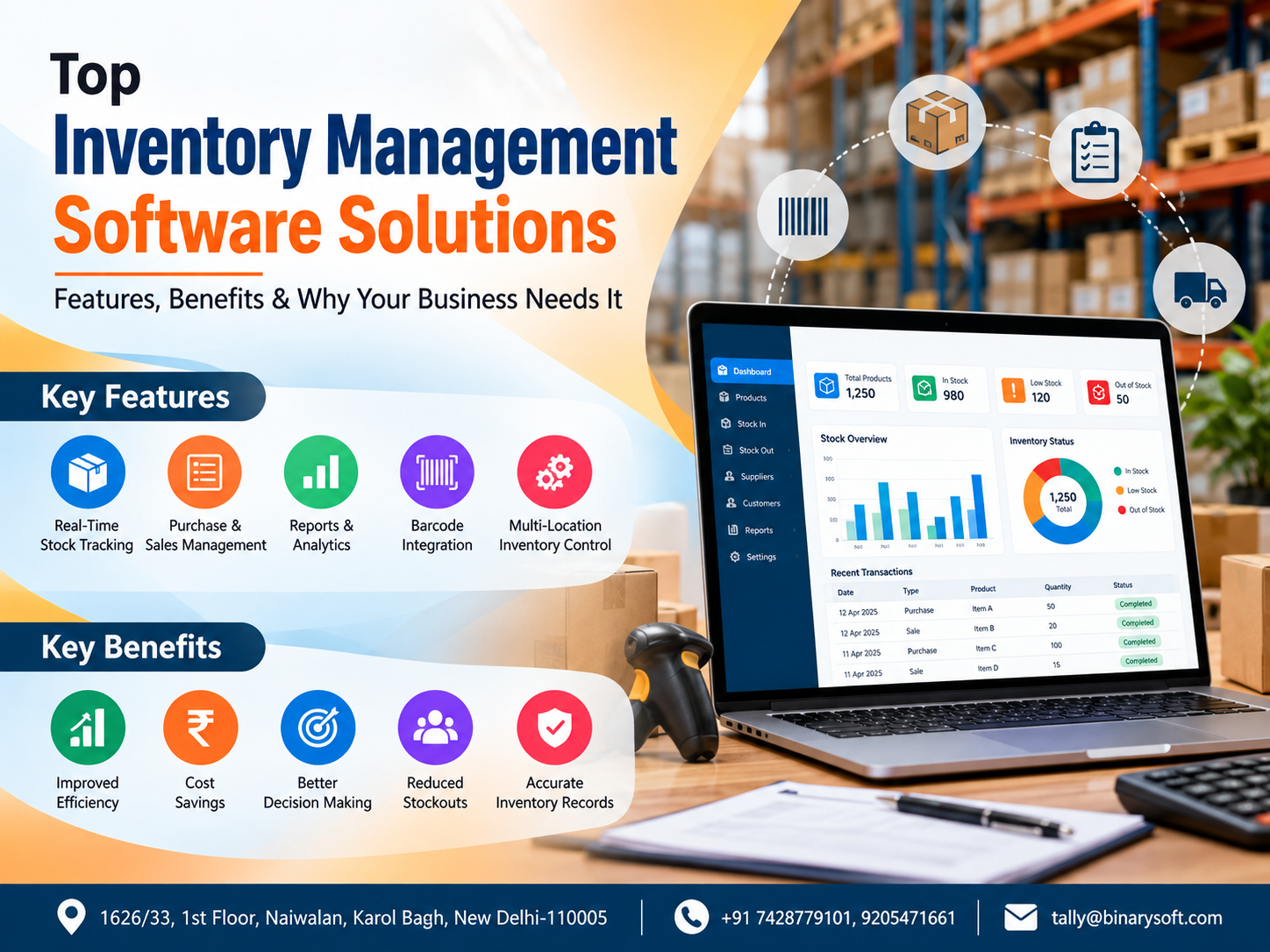
Inventory Management with TallyPrime
For traders, wholesalers, retailers, distributors and manufacturers, accounting tells only half the story.
The other half is inventory.
Imagine a distributor whose accounting records show healthy sales but whose warehouse repeatedly runs out of its highest-selling products.
Revenue may look good, but poor stock visibility can still result in lost orders.
TallyPrime can help businesses maintain stock information alongside their accounts.
Businesses can structure inventory around stock items, groups, units and locations as applicable to their operations.
This helps answer practical questions such as:
What stock is currently available?
Which products are moving quickly?
Which items have remained unsold?
What is the value of available inventory?
How are purchases and sales affecting stock?
Better inventory visibility can improve purchasing decisions and help prevent unnecessary overstocking or shortages.
Sales and Purchase Management
Sales and purchases generate the majority of accounting entries for many SMEs.
A structured TallyPrime implementation can help a company record transactions consistently while simultaneously affecting the relevant customer, supplier, tax, inventory and accounting records.
This is considerably more efficient than separately updating an invoice application, inventory spreadsheet and accounting software.
For example, when a properly configured sales transaction is recorded, the business can maintain the financial effect of the sale while also keeping the corresponding customer and inventory information connected.
This reduces fragmented recordkeeping.
Receivables: Know Who Owes You Money
Profit and cash flow are not the same thing.
A business may report strong sales but still struggle to pay suppliers because customers have not settled their invoices.
This is why receivables management matters.
TallyPrime can help businesses review outstanding customer balances and bill-related information, depending on how accounts have been configured and maintained.
Management can use this information to identify overdue payments and prioritize collection follow-ups.
For SMEs, even a modest improvement in collections can have a significant effect on working capital.
Payables: Plan Supplier Payments Better
The same principle applies to supplier obligations.
A business needs visibility into how much it owes and when payments are due.
Without organized payable records, companies may make late payments, overlook invoices or pay certain suppliers too early while cash is required elsewhere.
Maintaining accurate supplier ledgers and outstanding information helps management make more informed payment decisions.
Banking and Reconciliation
Bank reconciliation is an essential accounting control.
When the balance recorded in the books differs from the actual bank information, accountants need to identify the reason.
The difference could relate to an unrecorded transaction, timing issue, bank charge or another entry requiring attention.
TallyPrime provides banking and reconciliation capabilities that can help businesses maintain more accurate financial records.
Regular reconciliation is particularly important for growing SMEs because transaction volumes can increase rapidly.
Financial Reports for Better Decisions
Accounting software should do more than store vouchers.
It should turn transactions into useful business information.
TallyPrime provides access to reports that can help business owners and accountants review areas such as the Balance Sheet, Profit & Loss Account, Trial Balance, outstanding receivables and payables, cash and bank information, inventory and transaction-level details.
The value of these reports depends heavily on the quality and timeliness of the underlying entries.
Accurate data creates useful reports.
Incomplete data creates misleading reports.
This is another reason implementation and regular accounting discipline matter as much as the software itself.
Tally Silver for Traders and Distributors
Trading businesses frequently need accounting and inventory information together.
A wholesaler may have hundreds or thousands of stock movements while simultaneously managing customer credit and supplier payments.
A structured TallyPrime setup can provide a central environment for recording purchases, sales, inventory and accounts.
This can be useful for businesses operating in areas such as:
FMCG distribution
Electrical goods
Hardware
Garments
Automobile parts
Electronics
Pharmaceutical distribution
Industrial supplies
Consumer goods
General wholesale trading
The exact configuration should be designed around the company's workflow.
Tally Silver for Service Businesses
Inventory is not essential for every company.
Consultants, agencies, contractors and other service businesses may primarily require invoicing, accounting, expenses, receivables, GST-related records and financial reporting.
TallyPrime can also be configured around these requirements.
A service company, for example, may focus heavily on customer outstanding reports because cash flow depends on collecting invoices on time.
Tally Silver for Small Manufacturers
Manufacturing businesses have more complex requirements because materials, finished products and production processes need to be reflected correctly.
Depending on the nature of the business and configuration, TallyPrime can be used to maintain relevant inventory and accounting records for manufacturing-oriented operations.
Before implementation, a manufacturer should discuss its workflow with the Tally Partner, particularly when it has multiple warehouses, production stages or specialized inventory requirements.
Tally Silver vs Multi-User Requirements
One of the most important decisions before purchasing is whether the business needs single-user or multi-user operation.
Tally Silver is generally appropriate when the business primarily needs TallyPrime on one computer at a time.
For example, if a company has one accountant responsible for maintaining the books, Silver may be sufficient.
But imagine a business where the accountant records purchases while another employee prepares sales invoices and management simultaneously wants to access reports from another system.
That business should evaluate a multi-user arrangement.
Buying the correct license at the beginning can prevent unnecessary operational restrictions later.
Genuine Licensing Matters
Businesses should avoid treating accounting software licensing as an area where shortcuts are harmless.
Accounting data contains commercially sensitive information, including customer balances, supplier records, sales figures, profitability and tax-related details.
Using genuine, properly licensed software helps businesses maintain a legitimate software environment and obtain applicable product updates and services according to the licensing terms.
An Authorized Tally Partner can also help businesses understand genuine licensing options.
Implementation Is as Important as the Purchase
Buying TallyPrime is only the beginning.
A good implementation should consider how the business actually operates.
Important areas can include:
Company creation
Accounting period
Ledger structure
Customer and supplier masters
GST-related configuration
Stock groups and items
Units of measurement
Opening balances
Outstanding invoices
Bank accounts
Voucher configuration
Inventory locations where applicable
User processes
Reports required by management
A poorly planned structure can create unnecessary complexity later.
A carefully designed structure makes everyday accounting easier.
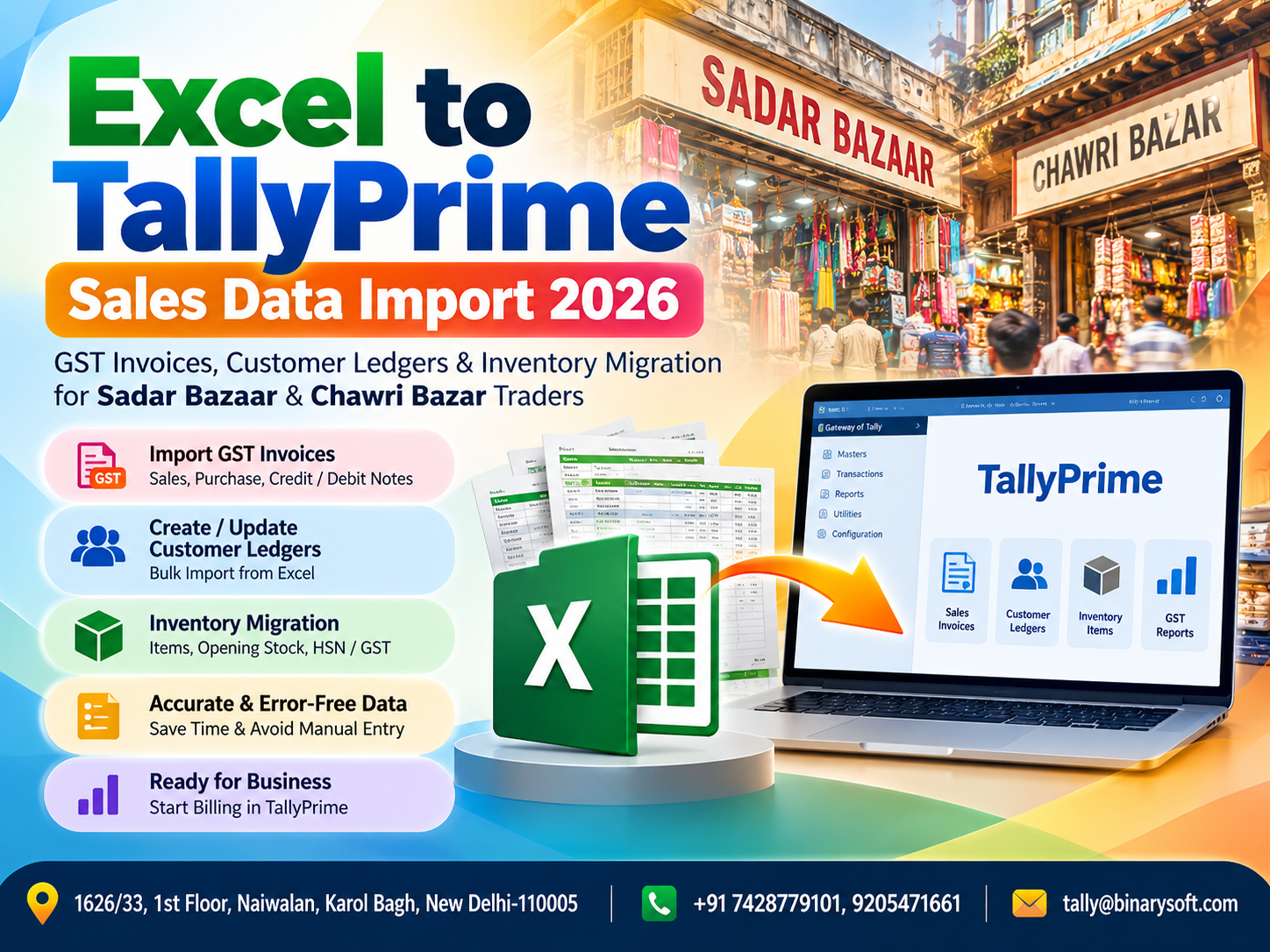
Moving from Excel or Manual Accounting to TallyPrime
Many SMEs start with Excel because it is familiar and flexible.
There is nothing unusual about that.
The problem appears when transaction volume grows beyond what spreadsheets can comfortably manage.
Different employees may maintain separate files. Formulas may be overwritten. Customer balances may not match invoice records. Inventory files may not be updated immediately.
Moving to TallyPrime can create a more structured accounting environment.
However, businesses should not simply copy everything from old records without reviewing it.
Opening balances, outstanding invoices, customer ledgers, supplier ledgers, inventory and statutory information should be checked carefully before migration.
Why Business Owners Need Real-Time Visibility
For many SME owners, the most valuable accounting report is not the one prepared after the financial year ends.
It is the information they need today.
How much cash is available?
How much do customers owe?
How much needs to be paid to suppliers?
What are current sales?
Which products are available?
Is the business profitable?
Are expenses increasing?
Structured accounting makes these questions easier to answer.
When financial information is available faster, management can respond faster.
Data Security and Backup Should Be Part of the Plan
Accounting information is one of a company's most important digital assets.
Businesses should establish a disciplined backup process from the beginning.
Backups should not depend entirely on someone remembering to copy a folder occasionally.
The company should define who is responsible for backups, how frequently they are taken and where secure copies are maintained.
Access to financial information should also be limited appropriately.
Software can support accounting operations, but good data-management practices remain essential.
Who Should Consider Buying Tally Silver?
Tally Silver can be particularly relevant for a small or medium business where accounting is handled primarily by one user at a time.
This can include proprietorships, startups, small private companies, wholesalers, distributors, retailers, service firms, professional offices and smaller manufacturing organizations.
However, the business should assess its present and near-future requirements.
If multiple employees are expected to use TallyPrime simultaneously, discuss the appropriate multi-user option before purchasing.
Questions to Ask Before Buying Tally Silver License
Before finalizing the purchase, discuss your requirements with the Authorized Tally Partner.
Explain how many people will use the software, how many computers are involved, whether GST is applicable, whether inventory is maintained, whether the business has multiple locations and whether existing data needs to be migrated.
Also discuss training and implementation requirements.
These questions can help determine whether the selected license and configuration will support the business effectively.
Why SMEs Should Think Beyond Basic Bookkeeping
Accounting is gradually moving away from being merely a record of what happened.
For modern SMEs, it is becoming an operational information system.
Sales influence receivables.
Purchases influence payables.
Inventory influences working capital.
GST information influences compliance.
Bank balances influence daily decisions.
When these elements are maintained in disconnected systems, management receives a fragmented picture.
A properly implemented accounting platform helps bring those pieces together.
Buy Tally Silver License from Binarysoft Technologies
Businesses planning to purchase TallyPrime Silver can contact Binarysoft Technologies for guidance on licensing, implementation and related Tally requirements.
The objective should not simply be to install accounting software.
It should be to establish an accounting environment that matches the way the business actually works.
Whether you are moving from spreadsheets, replacing an existing accounting process, starting a new company or looking for better control over GST, accounts and inventory, selecting the appropriate TallyPrime setup is an important first step.
Conclusion
For an SME, choosing accounting software is ultimately a decision about control.
You need control over transactions, customer outstanding amounts, supplier payments, inventory, GST-related records and financial information.
TallyPrime Silver can be a suitable choice for businesses that primarily require a single-user accounting environment while also needing integrated capabilities for invoicing, accounting, inventory and statutory workflows.
Buying through an Authorized Tally Partner adds another important layer: guidance.
Instead of selecting a license without understanding its suitability, businesses can discuss their user requirements, accounting workflow, inventory structure and implementation needs before deployment.
For an SME trying to grow without losing control of its finances, that combination of genuine software, structured implementation and ongoing support can make accounting much more manageable.
Frequently Asked Questions
What is a Tally Silver License?
Tally Silver generally refers to the single-user edition of TallyPrime. It is intended primarily for businesses that need to use TallyPrime from one computer at a time.
Is Tally Silver suitable for small businesses?
Yes. It can be suitable for SMEs, startups, traders, retailers, distributors, service providers and other businesses where accounting is primarily handled by one user at a time.
CA. Pranav Baheti focuses on financial reporting, GST reconciliations, and accounting controls. He works with growing businesses to structure their accounting information for easier compliance, reporting, and management review.